
NCERT Solutions Class 12 Physics Chapter 8: Electromagnetic Waves
Answers to all 10 end-of-chapter exercises and both worked examples of Chapter 8, Electromagnetic Waves, of Physics Part I, the Class 12 NCERT textbook. Page numbers follow the 2026-27 reprint (pages 201–214). The exercises come first, quoted from the book; the examples follow, restated in short. Every number was also checked by computer. Short notes: Chapter 8 notes.
We use c = 3 × 10⁸ m/s, ε₀ = 8.854 × 10⁻¹² C² N⁻¹ m⁻², μ₀ = 4π × 10⁻⁷ T m A⁻¹, h = 6.63 × 10⁻³⁴ J s and 1 eV = 1.6 × 10⁻¹⁹ J.
Safety: the 230 V supply, the X-rays and the gamma rays in these questions are numbers to calculate with. Never touch mains or high-voltage equipment, and never experiment with microwave ovens or X-ray sources.
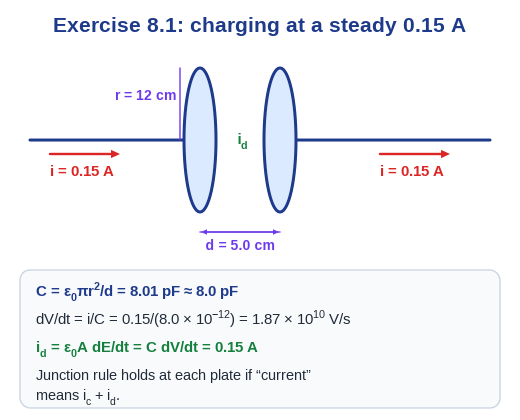
Exercises 8.1 and 8.2: displacement current in a capacitor
8.1 “Figure 8.5 shows a capacitor made of two circular plates each of radius 12 cm, and separated by 5.0 cm. The capacitor is being charged by an external source (not shown in the figure). The charging current is constant and equal to 0.15A. (a) Calculate the capacitance and the rate of change of potential difference between the plates. (b) Obtain the displacement current across the plates. (c) Is Kirchhoff’s first rule (junction rule) valid at each plate of the capacitor? Explain.”
(a) The plate area is A = πr² = π × (0.12 m)² = 0.0452 m². For a parallel plate capacitor,
C = ε₀A/d = 8.854 × 10⁻¹² × 0.0452/0.050 = 8.01 × 10⁻¹² F ≈ 8.0 pF
(The answer key, with ε₀ = 8.85 × 10⁻¹², prints 8.00 pF.) Since Q = CV, the current is i = dQ/dt = C dV/dt, so
dV/dt = i/C = 0.15/(8.01 × 10⁻¹²) = 1.87 × 10¹⁰ V s⁻¹
(b) The displacement current is i_d = ε₀ dΦ_E/dt. It is not a flow of charge: it is the current-like effect of a changing electric flux Φ_E, and it produces a magnetic field just as a current does. Between the plates (ignoring the fringing at the edges) Φ_E = EA, and E = Q/(ε₀A), so
i_d = ε₀A dE/dt = ε₀A × (1/(ε₀A)) dQ/dt = i = 0.15 A
The displacement current between the plates equals the conduction current in the wires.
(c) Yes, provided “current” means conduction plus displacement current. At each plate a conduction current of 0.15 A arrives along the wire, and a displacement current of 0.15 A leaves across the gap (or the other way round at the second plate), so what flows in equals what flows out. Counting conduction current alone, the rule would fail, since charge piles up on the plate.
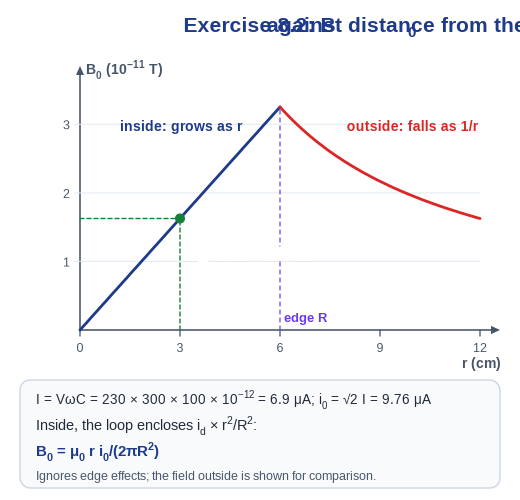
8.2 “A parallel plate capacitor (Fig. 8.6) made of circular plates each of radius R = 6.0 cm has a capacitance C = 100 pF. The capacitor is connected to a 230 V ac supply with a (angular) frequency of 300 rad s⁻¹. (a) What is the rms value of the conduction current? (b) Is the conduction current equal to the displacement current? (c) Determine the amplitude of B at a point 3.0 cm from the axis between the plates.”
(a) Take 230 V as the rms value. The capacitive reactance is X_C = 1/(ωC) = 1/(300 × 100 × 10⁻¹²) = 3.33 × 10⁷ Ω (Chapter 7), so
I_rms = V_rms/X_C = V_rms ωC = 230 × 300 × 100 × 10⁻¹² = 6.9 × 10⁻⁶ A = 6.9 µA
(b) Yes. The argument of Exercise 8.1(b) does not need the current to be steady: at every instant i_d = ε₀A dE/dt = dQ/dt = i, even when i oscillates.
(c) We use the Ampere–Maxwell law: B times the length of a closed loop equals μ₀ times the total current (conduction plus displacement) through that loop.
- Take a circle of radius r = 3.0 cm, centred on the axis, between the plates. No conduction current passes through it.
- The displacement current is spread evenly over the plate area πR². So the part through the circle is i_d × (πr²)/(πR²) = i_d r²/R².
- B has the same size all round the circle, so B(2πr) = μ₀ i_d r²/R². This gives B = μ₀ r i_d/(2πR²).
- B oscillates in step with i_d, so the amplitudes follow the same formula. The current amplitude is i₀ = √2 I_rms = 1.414 × 6.9 µA = 9.76 µA.
- B₀ = μ₀ r i₀/(2πR²) = (4π × 10⁻⁷ × 0.030 × 9.76 × 10⁻⁶)/(2π × 0.060²) = 1.63 × 10⁻¹¹ T.
Answer: B₀ = 1.63 × 10⁻¹¹ T
This tiny field grows in proportion to r up to the edge of the plates and then falls off as 1/r.
Exercises 8.3 to 8.7: speed, direction, wavelength and amplitude
8.3 “What physical quantity is the same for X-rays of wavelength 10⁻¹⁰ m, red light of wavelength 6800 Å and radiowaves of wavelength 500m?”
All three are electromagnetic waves, so their speed in vacuum is the same: c = 3 × 10⁸ m s⁻¹. Their frequencies, ν = c/λ, are very different: 3 × 10¹⁸ Hz for the X-rays, 4.4 × 10¹⁴ Hz for the red light (6800 Å = 6.8 × 10⁻⁷ m) and 6 × 10⁵ Hz for the radio waves.
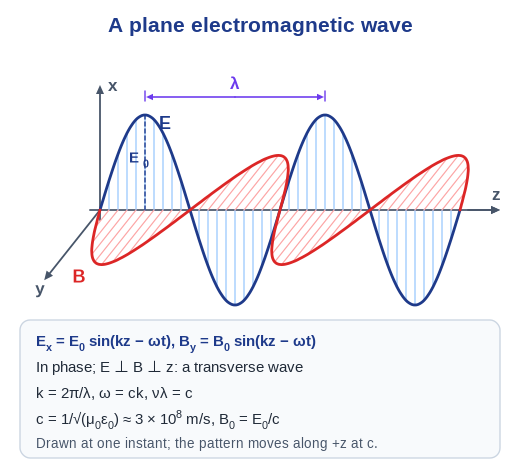
8.4 “A plane electromagnetic wave travels in vacuum along z-direction. What can you say about the directions of its electric and magnetic field vectors? If the frequency of the wave is 30 MHz, what is its wavelength?”
An em wave is transverse: E and B both lie in the x-y plane (perpendicular to z) and are perpendicular to each other, with E × B pointing along +z. The wavelength is
λ = c/ν = 3 × 10⁸/(30 × 10⁶) = 10 m
8.5 “A radio can tune in to any station in the 7.5 MHz to 12 MHz band. What is the corresponding wavelength band?”
λ = c/ν: at 7.5 MHz, λ = 3 × 10⁸/(7.5 × 10⁶) = 40 m; at 12 MHz, λ = 3 × 10⁸/(12 × 10⁶) = 25 m. The wavelength band is 40 m to 25 m; the higher frequency gives the shorter wavelength.
8.6 “A charged particle oscillates about its mean equilibrium position with a frequency of 10⁹ Hz. What is the frequency of the electromagnetic waves produced by the oscillator?”
An em wave has the same frequency as the charge whose oscillation produces it: 10⁹ Hz (1 GHz, in the microwave region; λ = c/ν = 0.3 m).
8.7 “The amplitude of the magnetic field part of a harmonic electromagnetic wave in vacuum is B₀ = 510 nT. What is the amplitude of the electric field part of the wave?”
E₀ = cB₀ = 3 × 10⁸ × 510 × 10⁻⁹ = 153 N/C (= 153 V/m)
Exercise 8.8: writing E and B
8.8 “Suppose that the electric field amplitude of an electromagnetic wave is E₀ = 120 N/C and that its frequency is ν = 50.0 MHz. (a) Determine, B₀,ω, k, and λ. (b) Find expressions for E and B.”
(a)
- B₀ = E₀/c = 120/(3 × 10⁸) = 4.00 × 10⁻⁷ T = 400 nT
- ω = 2πν = 2π × 50.0 × 10⁶ = 3.14 × 10⁸ rad/s
- k = ω/c = 3.14 × 10⁸/(3 × 10⁸) = 1.05 rad/m
- λ = 2π/k = c/ν = 3 × 10⁸/(50.0 × 10⁶) = 6.00 m
(b) The question does not fix the directions, so choose (as the answer key does) a wave travelling along +x with E along y; then B must be along z, so that E × B points along +x:
E = (120 N/C) sin[(1.05 rad/m)x − (3.14 × 10⁸ rad/s)t] ĵ
B = (400 nT) sin[(1.05 rad/m)x − (3.14 × 10⁸ rad/s)t] k̂
The two are in phase, and E₀/B₀ = 120/(4.00 × 10⁻⁷) = 3 × 10⁸ m/s = c.
Exercise 8.9: photon energies across the spectrum
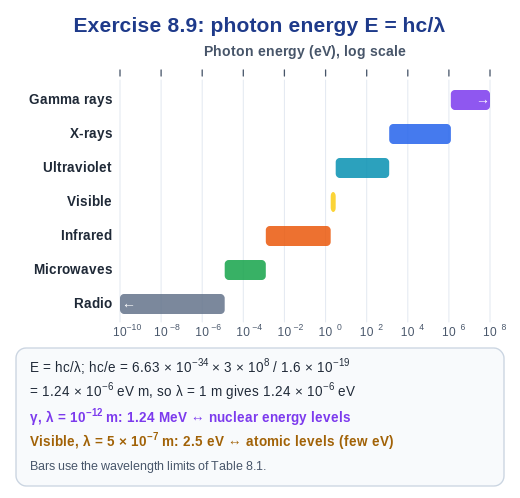
8.9 “The terminology of different parts of the electromagnetic spectrum is given in the text. Use the formula E = hν (for energy of a quantum of radiation: photon) and obtain the photon energy in units of eV for different parts of the electromagnetic spectrum. In what way are the different scales of photon energies that you obtain related to the sources of electromagnetic radiation?”
With ν = c/λ, E = hc/λ. In electronvolt,
hc/e = (6.63 × 10⁻³⁴ × 3 × 10⁸)/(1.6 × 10⁻¹⁹) = 1.24 × 10⁻⁶ eV m
so a photon of λ = 1 m has E = 1.24 × 10⁻⁶ eV, and for any other wavelength E = (1.24 × 10⁻⁶ eV m)/λ. Using the wavelength limits of Table 8.1:
| Band | Wavelength | Photon energy |
|---|---|---|
| Radio | > 0.1 m | < 1.24 × 10⁻⁵ eV |
| Microwave | 0.1 m to 1 mm | 1.24 × 10⁻⁵ eV to 1.24 × 10⁻³ eV |
| Infrared | 1 mm to 700 nm | 1.24 × 10⁻³ eV to 1.78 eV |
| Visible | 700 nm to 400 nm | 1.78 eV to 3.11 eV |
| Ultraviolet | 400 nm to 1 nm | 3.11 eV to 1.24 keV |
| X-rays | 1 nm to 10⁻³ nm | 1.24 keV to 1.24 MeV |
| Gamma rays | < 10⁻³ nm | > 1.24 MeV |
How this relates to the sources: a source gives out photons whose energy matches the gaps between its own energy levels. So the size of the photon energy tells us what kind of source made the radiation.
- Gamma rays (λ = 10⁻¹² m, E = 1.24 MeV) come from nuclei. So nuclear energy levels are typically about 1 MeV apart.
- X-rays (energies of keV) come from the inner electrons of heavy atoms.
- Visible light (λ = 5 × 10⁻⁷ m, E = 2.5 eV) comes from electrons in atoms. So the atomic levels that give light are a few eV apart.
- Radio waves have tiny photon energies. They come from charges accelerated in circuits and aerials.
(The idea of a photon, E = hν, is developed in Chapter 11 of Physics Part II.)
Exercise 8.10: wavelength, B₀ and energy density
8.10 “In a plane electromagnetic wave, the electric field oscillates sinusoidally at a frequency of 2.0 × 10¹⁰ Hz and amplitude 48 V m⁻¹. (a) What is the wavelength of the wave? (b) What is the amplitude of the oscillating magnetic field? (c) Show that the average energy density of the E field equals the average energy density of the B field. [c = 3 × 10⁸ m s⁻¹.]”
(a) λ = c/ν = 3 × 10⁸/(2.0 × 10¹⁰) = 1.5 × 10⁻² m (1.5 cm, a microwave)
(b) B₀ = E₀/c = 48/(3 × 10⁸) = 1.6 × 10⁻⁷ T
(c) The energy density of an electric field is u_E = ½ε₀E² (Chapter 2). For a magnetic field it is u_B = B²/(2μ₀) (Extra: this formula is not derived in the 2026-27 book, but the answer key uses it). In the wave, at every instant B = E/c, and c² = 1/(μ₀ε₀), so
u_B = B²/(2μ₀) = E²/(2μ₀c²) = E² μ₀ε₀/(2μ₀) = ½ε₀E² = u_E
The two energy densities are equal at every instant, so their averages over a cycle are equal too. (Extra: since the average of sin² over a cycle is ½, each average is ¼ε₀E₀² = ¼ × 8.854 × 10⁻¹² × 48² ≈ 5.1 × 10⁻⁹ J m⁻³.)
Worked examples 8.1 and 8.2 (page 208)
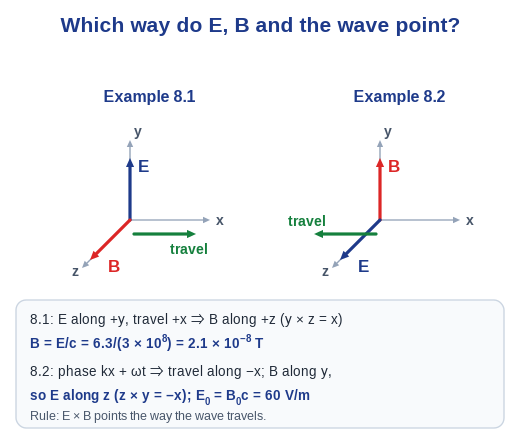
Example 8.1: A plane em wave of frequency 25 MHz travels in vacuum along x. At one point and instant E = 6.3 V/m along +y. Find B there.
Magnitude: B = E/c = 6.3/(3 × 10⁸) = 2.1 × 10⁻⁸ T. Direction: B must be perpendicular to both x and y, and E × B must point along the direction of travel, +x. Since ĵ × k̂ = î, B is along +z: B = 2.1 × 10⁻⁸ k̂ T.
Example 8.2: In a plane em wave, B_y = (2 × 10⁻⁷ T) sin(0.5 × 10³ x + 1.5 × 10¹¹ t). (a) Find the wavelength and frequency. (b) Give E as a function of x and t.
(a) Here k = 0.5 × 10³ rad/m and ω = 1.5 × 10¹¹ rad/s, so
λ = 2π/k = 2π/(0.5 × 10³) = 1.26 × 10⁻² m = 1.26 cm; ν = ω/2π = 1.5 × 10¹¹/(2π) = 23.9 GHz
Check: ω/k = 1.5 × 10¹¹/(0.5 × 10³) = 3 × 10⁸ m/s = c.
(b) E₀ = B₀c = 2 × 10⁻⁷ × 3 × 10⁸ = 60 V/m. E is perpendicular to the direction of travel (the x-axis) and to B (the y-axis), so it is along z:
E_z = 60 sin(0.5 × 10³ x + 1.5 × 10¹¹ t) V/m
(The phase is kx + ωt, so this wave travels along −x; with B along +y and E along +z, E × B points along −x, as it should.)
Notes for checking
- The answer key agrees with every exercise answer above. In 8.1(a) it prints 8.00 pF, from ε₀ = 8.85 × 10⁻¹²; with 8.854 × 10⁻¹² the value is 8.01 pF.
- Exercise 8.8(b) does not give the directions; the answer above, like the key, takes travel along x, E along y and B along z.
- Exercise 8.10(c) needs the magnetic energy density B²/(2μ₀), which the rationalised book does not derive; it is marked Extra above.
- The text gives Hertz’s experiment as 1885 on page 202 but 1887 on page 206 and in the Summary; these pages use 1887.
- Page 209 refers to “Chapter 15” for how radio waves are sent and received; the 2026-27 Physics books end at Chapter 14.
- Example 8.2 compares with B₀ sin[2π(x/λ + t/T)], where the print shows “2p” for 2π. Its wave travels along −x, which the book does not say.
- The wavelength limits in the text and in Table 8.1 differ (for example, UV down to 0.6 nm in the text but 1 nm in the table); the book notes that the bands overlap.
Practice
-
A capacitor of 50 pF is charged so that its voltage changes at 2.0 × 10⁸ V/s. The displacement current between its plates is:
Show answer
Answer: (b) 10 mA
-
The magnetic field amplitude of an em wave in vacuum is 2.0 × 10⁻⁸ T. The electric field amplitude is:
Show answer
Answer: (b) 6.0 V/m
-
A microwave has a wavelength of 3.0 cm. Its frequency is:
Show answer
Answer: (c) 10¹⁰ Hz
-
An em wave in vacuum is described by E_y = 30 sin(2.0 x − ωt) V/m, with x in metres. Find λ, ω and B₀.
Show answer
Answer: k = 2.0 rad/m, so λ = 2π/k = 3.14 m. ω = ck = 3 × 10⁸ × 2.0 = 6.0 × 10⁸ rad/s. B₀ = E₀/c = 30/(3 × 10⁸) = 1.0 × 10⁻⁷ T, along z.
-
Find the energy of a photon of wavelength 600 nm in electronvolt (hc/e = 1.24 × 10⁻⁶ eV m).
Show answer
Answer: E = hc/λ = 1.24 × 10⁻⁶/(600 × 10⁻⁹) = 2.07 eV, a typical size for visible light, which comes from atomic energy levels a few eV apart.
Stuck on a question?
Take a photo and Lagnever AI explains it step by step. Try it for 7 days for ₹2.
Get it on Google Play Open in browser
For parents: after the trial, the plan renews monthly by UPI or card autopay. You can cancel anytime in the app.