
Class 12 Physics Chapter 8: Electromagnetic Waves Notes
This chapter in five lines
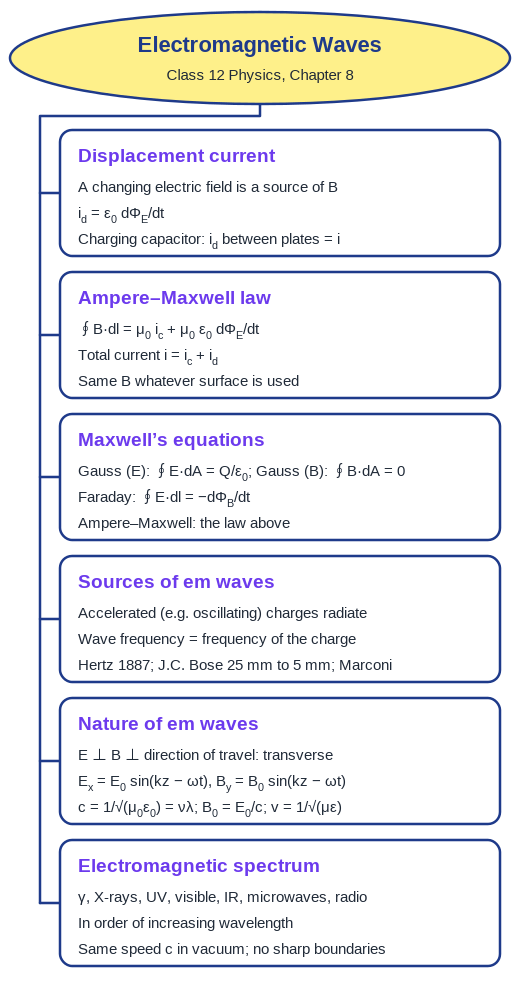
A changing electric field produces a magnetic field, just as a current does: Maxwell called its effect the displacement current, i_d = ε₀ dΦ_E/dt. With it, Ampere’s law becomes the Ampere–Maxwell law, and Maxwell’s equations predict electromagnetic waves: E and B oscillating at right angles to each other and to the direction of travel, moving at c = 1/√(μ₀ε₀) ≈ 3 × 10⁸ m/s. Gamma rays, X-rays, ultraviolet, visible light, infrared, microwaves and radio waves are all such waves.
What is this chapter about?
Chapter 4 showed that an electric current produces a magnetic field, and Chapter 6 showed that a magnetic field changing with time produces an electric field. James Clerk Maxwell asked whether the reverse of the second fact is also true: does an electric field that changes with time produce a magnetic field? He found that it must, or Ampere’s circuital law would contradict itself. He called the new source the displacement current.
With this addition, the laws of electricity and magnetism fit into four equations, now called Maxwell’s equations. Their most important prediction is the electromagnetic wave: electric and magnetic fields that change with time and travel through space. The predicted speed came out very close to the measured speed of light, 3 × 10⁸ m/s, so light itself must be an electromagnetic wave. The chapter is short (book pages 201 to 214): the displacement current, the sources and nature of em waves, and the spectrum from gamma rays (wavelengths near 10⁻¹² m) to long radio waves (near 10⁶ m).
Safety: this chapter mentions mains supplies, microwave ovens, X-ray machines and gamma sources only as information. Never open a microwave oven or run it empty, never touch mains or high-voltage equipment, and never look at the sun or at a welding arc. Any classroom work on em waves uses low-voltage kits, only with a teacher.
Why did Ampere’s law need a new term?
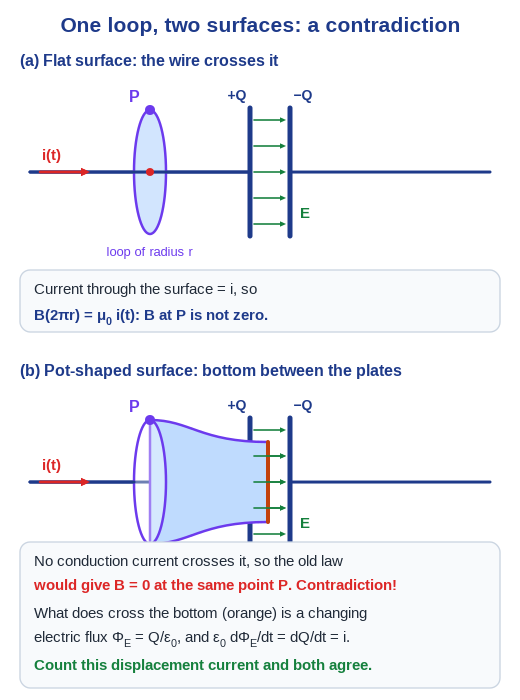
Take a capacitor being charged by a current i(t). To find the magnetic field at a point P near the wire, outside the capacitor, draw a circular loop of radius r through P, centred on the wire. By symmetry B is the same all round the loop, so Ampere’s law ∮B·dl = μ₀i gives
B(2πr) = μ₀i(t)
Here i is the current through a flat surface bounded by the loop, which the wire pierces. But Ampere’s law allows any surface with the same rim. Choose instead a pot-shaped (or tiffin-box-shaped) surface whose bottom lies in the gap between the plates. No wire passes through it, so the current through it is zero and the law would give B = 0 at the same point P. One point cannot have two different fields, so the law is missing something. Read displacement current.
What is the displacement current?
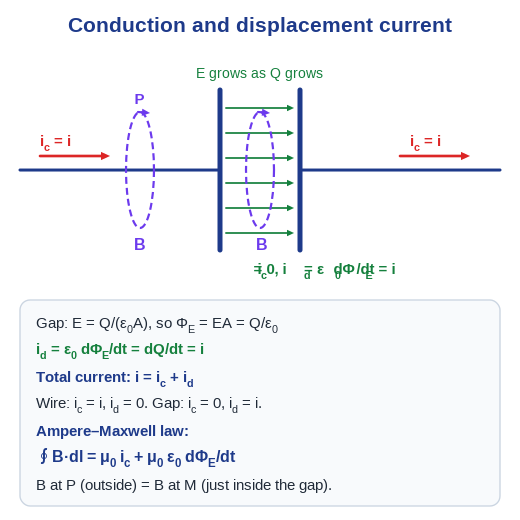
Something does pass through the bottom of the pot between the plates: the electric field. If the plates have area A and charge Q, the field between them is E = Q/(ε₀A) (Chapter 2), and it is perpendicular to the plates. Its flux through the flat bottom S is
Φ_E = EA = Q/ε₀
As the capacitor charges, Q changes and so does Φ_E. Since i = dQ/dt,
ε₀ dΦ_E/dt = dQ/dt = i
This quantity ε₀ dΦ_E/dt is the displacement current i_d. Maxwell’s idea is that the source of a magnetic field is the total current, the conduction current i_c (due to moving charges) plus the displacement current:
i = i_c + i_d = i_c + ε₀ dΦ_E/dt
Outside the plates, in the wires, i_c = i and i_d = 0. Between the plates, i_c = 0 and i_d = i. The total is the same for every surface, so the contradiction disappears, and B at a point M just inside the gap equals B at P just outside.
What is the Ampere–Maxwell law?
Ampere’s law, corrected by Maxwell, reads
∮B·dl = μ₀i_c + μ₀ε₀ dΦ_E/dt
In every respect the displacement current has the same magnetic effects as the conduction current. In a wire with a steady field, i_d is zero; in a charging capacitor the two currents sit in different regions; usually both are present together, since no material is a perfect conductor or a perfect insulator. Most interesting of all, there can be large regions of empty space with no conduction current, where a changing E field alone produces a magnetic field.
The laws are now nearly symmetric. Faraday’s law says a changing magnetic field produces an electric field; the Ampere–Maxwell law says a changing electric field produces a magnetic field. (They are still not perfectly symmetric: no magnetic monopoles, sources of B like charges for E, are known.)
What are Maxwell’s equations?
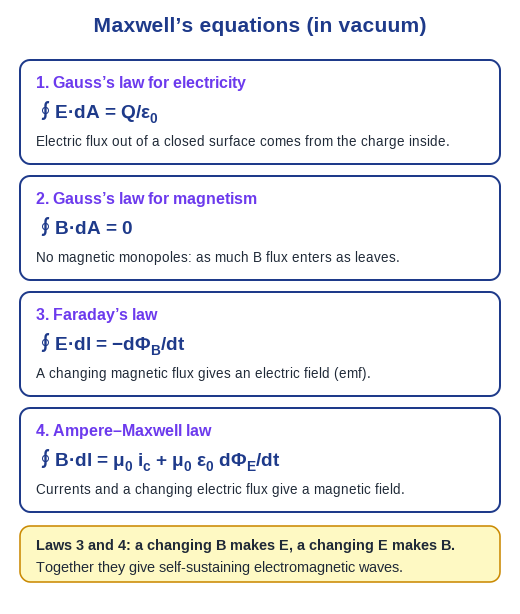
The book lists four equations in vacuum:
- Gauss’s law for electricity: ∮E·dA = Q/ε₀
- Gauss’s law for magnetism: ∮B·dA = 0
- Faraday’s law: ∮E·dl = −dΦ_B/dt
- Ampere–Maxwell law: ∮B·dl = μ₀i_c + μ₀ε₀ dΦ_E/dt
Together with the Lorentz force (Chapter 4), they express all the basic laws of electromagnetism. Equations 3 and 4 together mean that time-varying E and B fields keep producing each other, and this is what makes electromagnetic waves possible.
How are electromagnetic waves produced?
A charge at rest produces only an electrostatic field, and charges in uniform motion (a steady current) produce a magnetic field that does not change with time. Neither radiates. Maxwell’s theory shows that an accelerated charge gives out electromagnetic waves. The book does not prove this, but the idea is easy to picture: a charge oscillating to and fro (an accelerated charge) makes an oscillating electric field, which makes an oscillating magnetic field, which in turn makes an oscillating electric field, and so on. The fields regenerate each other as the wave spreads out. The frequency of the wave equals the frequency of the charge’s oscillation, and the energy the wave carries comes from the source.
Testing this with visible light was not possible: yellow light has a frequency of about 6 × 10¹⁴ Hz, while even modern electronic circuits reach only about 10¹¹ Hz. So the first test came at low frequencies, in the radio region. Heinrich Hertz produced and detected em waves in 1887, showing that they reflect and refract like light. Seven years later Jagdish Chandra Bose, working in Calcutta (now Kolkata), produced much shorter waves, 25 mm to 5 mm in wavelength. Around the same time Guglielmo Marconi sent em waves over many kilometres, the start of communication by em waves.
What is the nature of an electromagnetic wave?
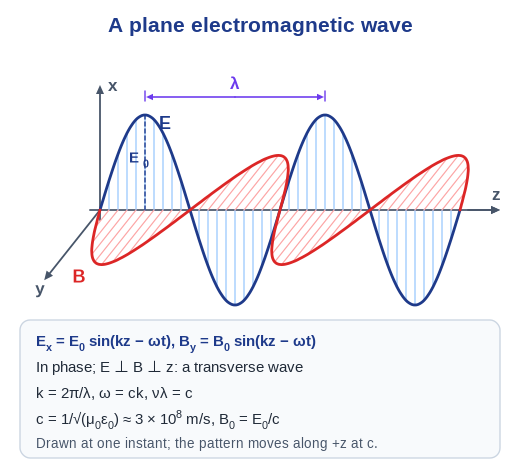
Maxwell’s equations show that in an em wave the electric and magnetic fields are at right angles to each other and to the direction of travel: the wave is transverse. The capacitor already hints at this: E between the plates is perpendicular to them, while the B it produces circles parallel to them.
For a plane wave moving along z, with E along x and B along y,
E_x = E₀ sin(kz − ωt) and B_y = B₀ sin(kz − ωt)
The two fields rise and fall together (in phase). Here k = 2π/λ is the wave number and ω the angular frequency; the wave moves at ω/k. Maxwell’s equations give
ω = ck, with c = 1/√(μ₀ε₀), so that νλ = c
and the amplitudes are related by B₀ = E₀/c. Putting in μ₀ = 4π × 10⁻⁷ T m A⁻¹ and ε₀ = 8.854 × 10⁻¹² C² N⁻¹ m⁻² gives c ≈ 3.00 × 10⁸ m/s, the speed of light. In a material of permittivity ε and permeability μ the speed becomes
v = 1/√(με)
so the speed of light depends on the electric and magnetic properties of the medium (Chapter 9 uses this for refractive index).
Em waves are self-sustaining oscillations of E and B in free space: unlike sound or waves on a string, no material medium vibrates. Experiments show their speed in vacuum is the same for all wavelengths, agreeing to a few metres per second in 3 × 10⁸ m/s, so precisely that this speed is used to define the standard of length. Em waves also carry energy: sunlight brings energy from the sun to the earth, and radio and TV signals carry energy from the transmitter.
Two worked examples in the book (page 208) use these results. In Example 8.1, E = 6.3 V/m gives B = E/c = 2.1 × 10⁻⁸ T. In Example 8.2, B_y = (2 × 10⁻⁷ T) sin(0.5 × 10³ x + 1.5 × 10¹¹ t) has λ = 2π/(0.5 × 10³) = 1.26 cm, ν = 1.5 × 10¹¹/2π = 23.9 GHz and E₀ = B₀c = 60 V/m. Both are solved in full in the NCERT solutions.
What is the electromagnetic spectrum?
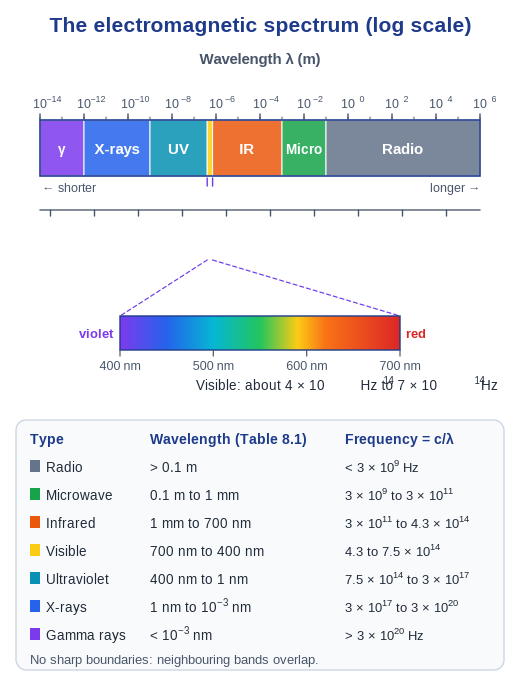
In Maxwell’s time the only familiar em waves were visible light, with ultraviolet and infrared barely known. By 1900 X-rays and gamma rays had been found too. Arranged by frequency (or wavelength), all of these form the electromagnetic spectrum. No sharp line separates one kind from the next; the names depend roughly on how the waves are produced or detected. In order of decreasing wavelength:
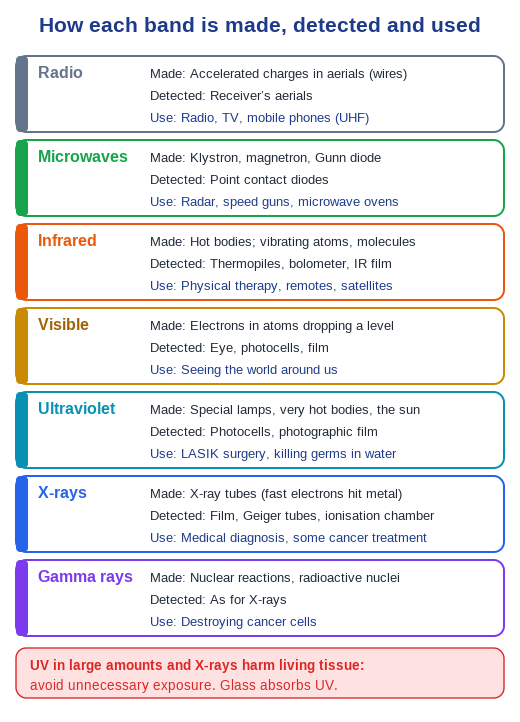
- Radio waves (wavelength above 0.1 m in Table 8.1): produced by accelerating charges in conducting wires (aerials); used for radio and TV. The book quotes 530 kHz to 1710 kHz for AM, up to 54 MHz for short-wave bands, 54 MHz to 890 MHz for TV and 88 MHz to 108 MHz for FM; cellular phones use the UHF band.
- Microwaves (0.1 m to 1 mm, GHz frequencies): made by klystrons, magnetrons and Gunn diodes; used in radar for aircraft navigation, in speed guns, and in microwave ovens, where the frequency is tuned to a natural (resonant) frequency of water molecules.
- Infrared (1 mm to 700 nm): given off by hot bodies and vibrating molecules; often called heat waves because water and other molecules absorb it and warm up. Used in infrared lamps for physical therapy, Earth satellites and the remote controls of TV sets; it also keeps the earth warm through the greenhouse effect.
- Visible light (700 nm to 400 nm, about 4 × 10¹⁴ Hz to 7 × 10¹⁴ Hz): the band our eyes detect. Snakes can detect infrared, and many insects see into the ultraviolet.
- Ultraviolet (400 nm down to about 1 nm in the table; the text gives 0.6 nm): from special lamps, very hot bodies and the sun. Most of the sun’s UV is absorbed by the ozone layer, about 40 to 50 km up. Large amounts are harmful; ordinary glass absorbs UV, which is why welders wear goggles or masks with glass windows. Used in LASIK eye surgery and to kill germs in water purifiers.
- X-rays (1 nm to 10⁻³ nm in the table): commonly made by bombarding a metal target with high-energy electrons; used to diagnose illness and to treat certain cancers. Because they damage living tissue, unnecessary exposure must be avoided.
- Gamma rays (below 10⁻³ nm): produced in nuclear reactions and by radioactive nuclei; used in medicine to destroy cancer cells.
Read the electromagnetic spectrum.
What do the different waves have in common?
All em waves travel through vacuum at the same speed c; they differ only in wavelength (or frequency), and so in how they interact with matter. They act on matter through their electric and magnetic fields, which set the charges in all matter oscillating; how strongly a wave is absorbed or scattered depends on its wavelength and on the atoms and molecules involved. The wavelength often matches the size of the system that radiates it: gamma rays (10⁻¹⁴ m to 10⁻¹⁵ m) come from nuclei, and a transmitting antenna radiates most efficiently at wavelengths about its own size, though light from atoms is much longer than an atom. Infrared, with lower frequencies than light, shakes whole atoms and molecules, which raises the temperature. The book also notes that our eyes are most sensitive near the centre of the sun’s wavelength distribution.
Which quantities and units belong to this chapter?
- Displacement current i_d = ε₀ dΦ_E/dt: ampere (A), like any current.
- Electric flux Φ_E: N m² C⁻¹ (or V m).
- ε₀ = 8.854 × 10⁻¹² C² N⁻¹ m⁻² and μ₀ = 4π × 10⁻⁷ T m A⁻¹; c = 1/√(μ₀ε₀) ≈ 3 × 10⁸ m s⁻¹.
- Wave number k = 2π/λ: rad m⁻¹; angular frequency ω = 2πν: rad s⁻¹.
- E₀ in V/m (= N/C), B₀ in tesla; B₀ = E₀/c.
Before we move on
A changing electric field is a source of magnetic field: that one idea, the displacement current, completes Maxwell’s equations and predicts waves of E and B that travel at c = 1/√(μ₀ε₀), the speed of light. Gamma rays, X-rays, ultraviolet, light, infrared, microwaves and radio waves are all such waves, differing only in wavelength. All 10 exercises and both worked examples are solved in the NCERT solutions for Chapter 8.
Key terms
| Term | Meaning |
|---|---|
| Conduction current (i_c) | The ordinary current due to moving charges in a conductor, such as the current in the wires leading to a capacitor. |
| Displacement current (i_d) | i_d = ε₀ dΦ_E/dt, where Φ_E is the electric flux through a surface. It is due to a changing electric field, and it produces a magnetic field exactly as a conduction current does. |
| Ampere–Maxwell law | ∮B·dl = μ₀i_c + μ₀ε₀ dΦ_E/dt. Ampere’s circuital law in which the current is the total current i_c + i_d through any surface bounded by the loop. |
| Maxwell’s equations | Four laws that, with the Lorentz force, sum up electromagnetism: Gauss’s law for E, Gauss’s law for B, Faraday’s law and the Ampere–Maxwell law. |
| Electromagnetic wave | Coupled electric and magnetic fields, changing with time, that travel through space and regenerate each other. In vacuum they need no material medium. |
| Transverse wave | A wave whose oscillations are at right angles to the direction of travel. In an em wave E, B and the direction of travel are mutually perpendicular. |
| Speed of light, c | c = 1/√(μ₀ε₀) ≈ 3 × 10⁸ m/s, the speed of every em wave in vacuum, whatever its wavelength. In a medium the speed is v = 1/√(με). |
| Wave number (k) | k = 2π/λ, the magnitude of the propagation vector. With angular frequency ω, the wave speed is ω/k = c. |
| Electromagnetic spectrum | The whole range of em waves arranged by frequency or wavelength: gamma rays, X-rays, ultraviolet, visible, infrared, microwaves and radio waves. The bands overlap; there are no sharp boundaries. |
| Greenhouse effect | The earth’s surface absorbs incoming visible light and re-radiates infrared, which carbon dioxide, water vapour and other greenhouse gases trap, keeping the earth warm. |
Topics in this chapter
Practice
-
The displacement current between the plates of a capacitor is given by:
Show answer
Answer: (b) ε₀ dΦ_E/dt
-
In an electromagnetic wave travelling along z, the electric field is along x. The magnetic field is along:
Show answer
Answer: (b) y
-
The amplitude of the electric field in an em wave in vacuum is 300 V/m. The amplitude of the magnetic field is:
Show answer
Answer: (a) 10⁻⁶ T
-
Which of these has the longest wavelength?
Show answer
Answer: (d) Microwaves
-
Which of these does NOT produce electromagnetic waves?
Show answer
Answer: (b) A steady current in a straight wire
-
A radio wave has a frequency of 100 MHz. Its wavelength in vacuum is:
Show answer
Answer: (b) 3 m
Questions students ask
What are the main topics of Class 12 Physics Chapter 8?
The displacement current and the Ampere–Maxwell law, Maxwell’s equations, how em waves are produced, the nature of em waves (E and B perpendicular, speed c = 1/√(μ₀ε₀), B₀ = E₀/c), and the electromagnetic spectrum from radio waves to gamma rays with Table 8.1 on production and detection.
Is the displacement current a real current?
It is not a flow of charge. It is the name for ε₀ dΦ_E/dt, the effect of a changing electric field. But its magnetic effect is just like that of a conduction current, and the magnetic field between the plates of a charging capacitor can be measured.
Do electromagnetic waves need a medium?
No. The electric and magnetic fields sustain each other, so em waves travel through vacuum, which is how sunlight reaches the earth. They can also travel through a medium such as glass, where their speed is v = 1/√(με), less than c.
Which formulas should I remember from this chapter?
i_d = ε₀ dΦ_E/dt; ∮B·dl = μ₀i_c + μ₀ε₀ dΦ_E/dt; c = 1/√(μ₀ε₀); v = 1/√(με); k = 2π/λ; ω = ck; νλ = c; and B₀ = E₀/c.
Why could early experimenters not test the theory with visible light?
Visible light has a frequency of about 6 × 10¹⁴ Hz for yellow, while even modern electronic circuits reach only about 10¹¹ Hz. So the first test, by Hertz, used much lower frequencies: radio waves.
Stuck on a question?
Take a photo and Lagnever AI explains it step by step. Try it for 7 days for ₹2.
Get it on Google Play Open in browser
For parents: after the trial, the plan renews monthly by UPI or card autopay. You can cancel anytime in the app.