
What is displacement current?
Answer in short
Displacement current is Maxwell’s name for ε₀ dΦ_E/dt, the effect of an electric flux that changes with time. Between the plates of a charging capacitor it equals the conduction current in the wires. Added to Ampere’s law, it gives the Ampere–Maxwell law, ∮B·dl = μ₀i_c + μ₀ε₀ dΦ_E/dt.
Stuck on a question? Take a photo and Lagnever AI explains it step by step. Try it for 7 days for ₹2. Get it on Google Play
What goes wrong with Ampere’s law?
Ampere’s circuital law from Chapter 4 says that the line integral of the magnetic field round a closed loop equals μ₀ times the current through a surface bounded by that loop:
∮B·dl = μ₀i
Apply it to a capacitor being charged by a current i(t) that changes with time. Choose a point P near the wire leading to one plate, and draw a circle of radius r through P, centred on the wire and perpendicular to it. By symmetry the field is along the circle and has the same size everywhere on it, so the left side is B(2πr). With a flat disc as the surface, the wire passes through it, and
B(2πr) = μ₀i(t)
The law, however, does not care which surface we take, as long as its rim is the loop. Stretch the surface into a pot, or a tiffin box without its lid, so that its bottom sits in the gap between the plates. The rim is the same circle, so the left side is still B(2πr). But no wire passes through this surface, so the right side is zero. One way of calculating gives a field at P; the other gives none. The law as it stands must be missing a term.
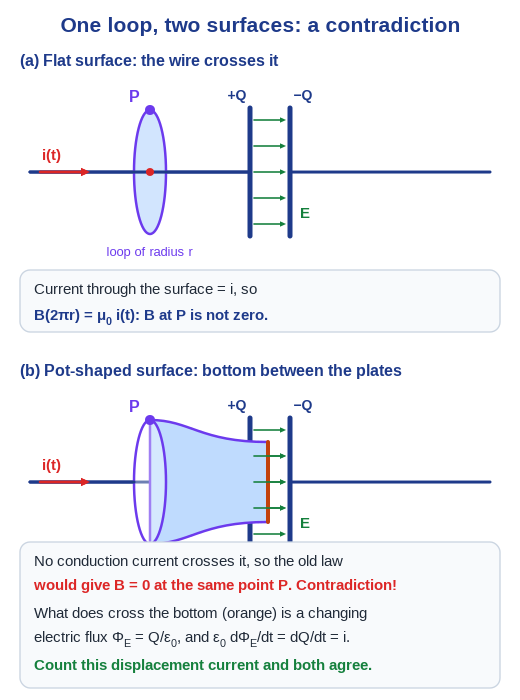
What crosses the gap?
No charge crosses the gap, but the electric field fills it. For plates of area A carrying charge Q, the field between them is E = (Q/A)/ε₀, perpendicular to the plates and uniform over the area A (and zero outside). The electric flux through the flat bottom S of the pot is therefore
Φ_E = EA = Q/ε₀
This is just Gauss’s law. While the capacitor charges, Q grows and the flux grows with it. Differentiating, and using i = dQ/dt,
dΦ_E/dt = (1/ε₀) dQ/dt, so ε₀ dΦ_E/dt = i
So the missing term is ε₀ multiplied by how fast the electric flux changes. Maxwell called it the displacement current:
i_d = ε₀ dΦ_E/dt
The Ampere–Maxwell law
The corrected rule is that the source of a magnetic field is the total current: the conduction current i_c, due to moving charges, plus the displacement current,
i = i_c + i_d = i_c + ε₀ dΦ_E/dt
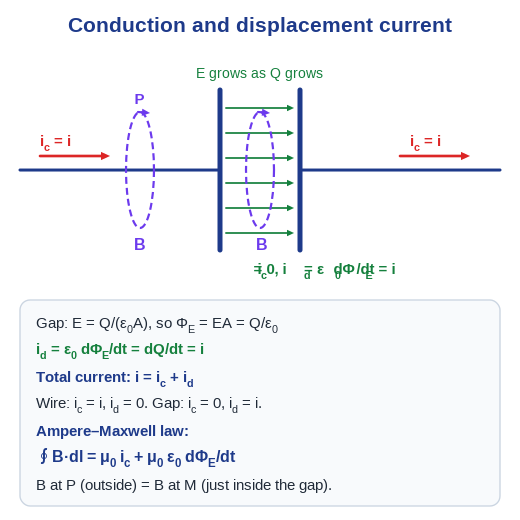
For the charging capacitor:
- In the wires: i_c = i and i_d = 0, because the field there is not changing.
- Between the plates: i_c = 0 and i_d = i, because no charge flows there but the flux changes.
Through the flat disc the total is i (all conduction); through the pot it is also i (all displacement). Every surface now gives the same answer. Ampere’s law becomes the Ampere–Maxwell law:
∮B·dl = μ₀i_c + μ₀ε₀ dΦ_E/dt
and the field at P is non-zero whichever surface is used. A point M just inside the gap has the same field as the point P just outside, and this field can indeed be measured.
When is each current present?
The displacement current has the same magnetic effects as a conduction current. The two can appear in different ways:
- Only conduction current: a wire carrying a steady current, where the electric field does not change, so i_d = 0.
- In different regions: the charging capacitor, with i_c in the wires and i_d in the gap.
- Together in the same region: the usual case, because no material is a perfect conductor or a perfect insulator.
- Only displacement current: large regions of empty space where the electric field changes with time. A magnetic field appears there although no charges are moving nearby.
The last case is the key to light and radio. Faraday’s law says a magnetic field changing with time produces an electric field. The Ampere–Maxwell law now says an electric field changing with time produces a magnetic field. So changing E and B fields can keep producing each other and travel through empty space as an electromagnetic wave. (The laws are still not perfectly symmetric: no magnetic monopoles are known.)
A worked example (Exercise 8.1)
Circular plates of radius 12 cm, 5.0 cm apart, are charged by a steady 0.15 A. The capacitance is C = ε₀πr²/d = 8.854 × 10⁻¹² × π × (0.12)²/0.05 = 8.0 pF, and the voltage rises at dV/dt = i/C = 1.87 × 10¹⁰ V/s. Between the plates, with E = V/d and A = πr², i_d = ε₀A dE/dt = C dV/dt = 0.15 A: exactly the conduction current in the wires. Kirchhoff’s junction rule still holds at each plate if “current” means the sum of conduction and displacement currents. All the exercises are worked in the NCERT solutions, and the rest of the chapter is in the Chapter 8 notes.
Practice
-
The SI unit of displacement current is:
Show answer
Answer: (b) ampere
-
Between the plates of a capacitor being charged by a current i, the displacement current is:
Show answer
Answer: (c) i
-
Which term did Maxwell add to Ampere’s circuital law?
Show answer
Answer: (b) μ₀ε₀ dΦ_E/dt
-
A capacitor of capacitance 2.0 µF is charged so that its voltage rises at 5.0 × 10³ V/s. Find the displacement current between the plates.
Show answer
Answer: i_d = ε₀ dΦ_E/dt = C dV/dt = 2.0 × 10⁻⁶ × 5.0 × 10³ = 1.0 × 10⁻² A = 10 mA, equal to the charging current in the wires.
-
Why does the magnetic field just inside the gap of a charging capacitor equal the field just outside it?
Show answer
Answer: The total current (conduction plus displacement) through any surface with the same rim is the same, i. Inside the gap the whole of it is displacement current, so the Ampere–Maxwell law gives the same B.
Questions students ask
Why is it called a displacement current?
The book explains that the name comes from “electric displacement”, an old term for the electric field in this context. The current is due to a changing electric field, not to moving charges.
Can there be a magnetic field with no conduction current nearby?
Yes. Wherever space holds no conduction current but has an electric field that changes with time, the displacement current by itself produces a magnetic field. This is what keeps an em wave going through empty space.
Has the displacement current been checked by experiment?
Yes. The magnetic field between the plates of a charging capacitor, where there is no conduction current, can be measured, and it matches the field just outside, as the Ampere–Maxwell law predicts.
Are the laws of electricity and magnetism now perfectly symmetric?
Nearly, but not perfectly. A changing B gives E and a changing E gives B, but no magnetic monopoles (sources of B like charges for E) are known.
Stuck on a question?
Take a photo and Lagnever AI explains it step by step. Try it for 7 days for ₹2.
Get it on Google Play Open in browser
For parents: after the trial, the plan renews monthly by UPI or card autopay. You can cancel anytime in the app.