
What is the electromagnetic spectrum?
Answer in short
The electromagnetic spectrum is the whole family of em waves arranged by wavelength or frequency. In order of increasing wavelength: gamma rays, X-rays, ultraviolet, visible light (400–700 nm), infrared, microwaves and radio waves. All travel at c in vacuum; they differ in how they are produced, detected and absorbed, and the bands overlap.
Stuck on a question? Take a photo and Lagnever AI explains it step by step. Try it for 7 days for ₹2. Get it on Google Play
How is the spectrum arranged?
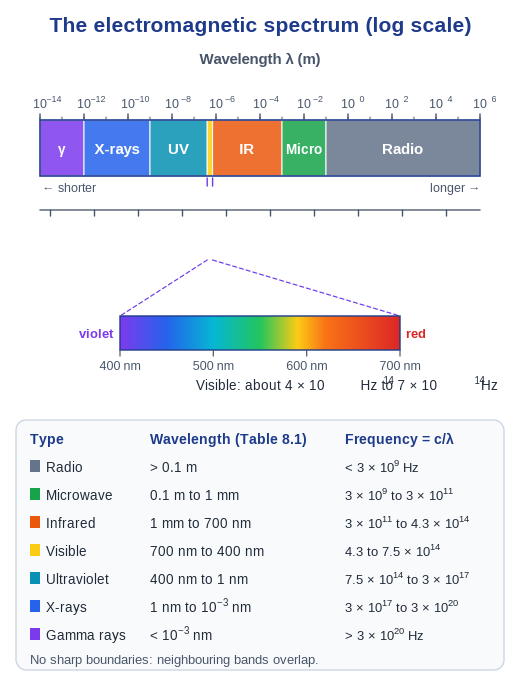
When Maxwell predicted em waves, visible light was the only kind people knew well; ultraviolet and infrared were only just known. X-rays and gamma rays were found before 1900. Today the whole family, arranged by frequency, is called the electromagnetic spectrum. Every member travels through vacuum at c = 3 × 10⁸ m/s, so frequency and wavelength are tied by νλ = c: the shorter the wavelength, the higher the frequency. The names are not sharp divisions. They reflect, roughly, the way each kind of wave is made or detected, and neighbouring bands overlap. The chart below is drawn on a logarithmic scale, because the wavelengths run from about 10⁻¹⁴ m to 10⁶ m.
Radio waves
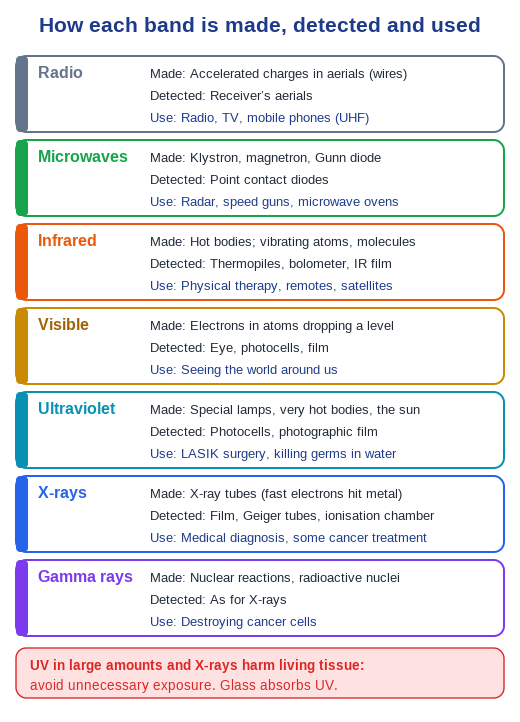
Radio waves come from charges accelerating in conducting wires, the aerials of transmitters, and are picked up by a receiver’s aerial. The text gives their range as roughly 500 kHz to 1000 MHz; Table 8.1 puts them at wavelengths above 0.1 m. The book lists the bands: AM radio from 530 kHz to 1710 kHz, short-wave bands up to 54 MHz, TV from 54 MHz to 890 MHz and FM radio in 88–108 MHz. Mobile phones carry voice in the ultrahigh frequency (UHF) band. An FM station at 100 MHz, for instance, has λ = c/ν = 3 m.
Microwaves
Microwaves are short-wavelength radio waves (0.1 m to 1 mm) with frequencies in the gigahertz range. Special vacuum tubes, klystrons and magnetrons, and Gunn diodes produce them; point-contact diodes detect them. Their short wavelength suits radar for aircraft navigation, and radar is also behind the speed guns that time fast balls, tennis serves and vehicles. In a microwave oven the frequency is tuned to a natural (resonant) frequency of water molecules, so the waves give their energy to the molecules and any food containing water gets hot.
Infrared waves
Infrared (1 mm to 700 nm) lies next to the red, long-wavelength end of visible light. Hot bodies and vibrating molecules emit it; thermopiles, bolometers and infrared photographic film detect it. It is often called heat waves, because water and molecules such as CO₂ and NH₃ absorb it readily and warm up. Uses in the book: infrared lamps in physical therapy, detectors on Earth satellites to watch crops grow, and light-emitting diodes in the remote controls of TV sets and other household electronics. Infrared also keeps the earth warm through the greenhouse effect: the ground absorbs incoming visible light and re-radiates infrared, which carbon dioxide and water vapour trap.
Visible light
Visible light is the narrow band our eyes detect: about 700 nm to 400 nm, or 4 × 10¹⁴ Hz to 7 × 10¹⁴ Hz. Atoms emit it when their electrons drop from one energy level to a lower one, and the eye, photocells and photographic film detect it. Light emitted or reflected by objects tells us about the world. Other animals see different ranges: snakes can detect infrared, and many insects see well into the ultraviolet.
Ultraviolet rays
Ultraviolet runs from about 400 nm down to 0.6 nm in the text (Table 8.1 stops at 1 nm). Special lamps and very hot bodies produce it, and the sun is an important source; most of the sun’s UV is absorbed by the ozone layer at about 40 to 50 km. UV in large amounts is harmful: exposure makes the skin produce more melanin (tanning). Ordinary glass absorbs UV, which is why welders protect their eyes with glass goggles or face masks. Its short wavelength lets it be focused into very narrow beams for LASIK eye surgery, and UV lamps kill germs in water purifiers. The book notes that depletion of the ozone layer by chlorofluorocarbons (CFCs) is a matter of international concern.
X-rays and gamma rays
X-rays (1 nm to 10⁻³ nm in the table; the text gives 10 nm down to 10⁻⁴ nm) are commonly made by bombarding a metal target with high-energy electrons. They are used to diagnose illness and to treat certain cancers; photographic film, Geiger tubes and ionisation chambers detect them. Because X-rays damage or destroy living tissue, unnecessary or excessive exposure must be avoided. Gamma rays (below 10⁻³ nm) have the highest frequencies. They are produced in nuclear reactions and by radioactive nuclei, are detected in the same ways as X-rays, and medicine uses them to destroy cancer cells.
Safety: these uses are for reading about only. Never open or tamper with a microwave oven, never look at a welding arc or the sun, and stay out of X-ray and radiation areas unless a doctor or technician asks you in.
Why do they behave so differently?
Since every band has the same speed, the only difference is wavelength, and that changes how a wave interacts with matter. Em waves act through their fields, which set the charges in matter oscillating. The wavelength is often linked to the size of the source: gamma rays come from nuclei, X-rays from heavy atoms, and a transmitting antenna radiates most efficiently at wavelengths about its own size. Infrared shakes whole molecules, so it heats; visible light and UV act on electrons in atoms. For a numerical comparison of photon energies across the bands, see Exercise 8.9 in the NCERT solutions, and for how em waves arise, the Chapter 8 notes.
Practice
-
Which radiation is produced by klystron and magnetron valves?
Show answer
Answer: (b) Microwaves
-
Which band lies just beyond the red end of the visible spectrum?
Show answer
Answer: (b) Infrared
-
The wavelength of an FM signal at 100 MHz is:
Show answer
Answer: (b) 3 m
-
Why can you not get a suntan through a glass window?
Show answer
Answer: Ordinary glass absorbs ultraviolet radiation, and it is the UV that makes the skin produce more melanin.
-
Find the frequency range of visible light from its wavelength range, 400 nm to 700 nm.
Show answer
Answer: ν = c/λ: 3 × 10⁸/(700 × 10⁻⁹) = 4.3 × 10¹⁴ Hz and 3 × 10⁸/(400 × 10⁻⁹) = 7.5 × 10¹⁴ Hz, about 4 × 10¹⁴ Hz to 7 × 10¹⁴ Hz as the book says.
Questions students ask
What is the basic difference between the types of em waves?
Only their wavelength, or frequency. All of them travel through vacuum at the same speed c, but because their wavelengths differ, they interact with matter very differently.
Why is infrared called heat waves?
Water molecules, and many others such as CO₂ and NH₃, absorb infrared readily. Infrared makes whole atoms and molecules vibrate, so their thermal motion increases and the material warms up.
How does a microwave oven heat food?
The microwave frequency is tuned to a natural (resonant) frequency of water molecules, so energy passes efficiently from the waves to the kinetic energy of the molecules. Food containing water heats up.
Why does the ozone layer matter?
It absorbs most of the ultraviolet from the sun at a height of about 40 to 50 km. UV in large amounts is harmful, so the depletion of ozone by chlorofluorocarbons (CFCs) is a matter of international concern.
Stuck on a question?
Take a photo and Lagnever AI explains it step by step. Try it for 7 days for ₹2.
Get it on Google Play Open in browser
For parents: after the trial, the plan renews monthly by UPI or card autopay. You can cancel anytime in the app.