
NCERT Solutions Class 12 Physics Chapter 9: Ray Optics and Optical Instruments
Answers to all 31 end-of-chapter exercises and the 8 worked examples of Chapter 9, Ray Optics and Optical Instruments, of Physics Part II, the Class 12 NCERT textbook. Page numbers follow the 2026-27 reprint (pages 221–254). The exercises come first, quoted from the book; the examples follow, restated in short. Every number was also checked by computer. Short notes: Chapter 9 notes.
We use the Cartesian sign convention throughout: light travels from left to right, distances along the light are positive, and 1/v + 1/u = 1/f (mirror), 1/v − 1/u = 1/f (lens). The near point is D = 25 cm.
Safety: never look at the Sun through a lens, prism, mirror or telescope, and never point a laser at anyone’s eyes. Any activity with sunlight or a laser is done only with a teacher.
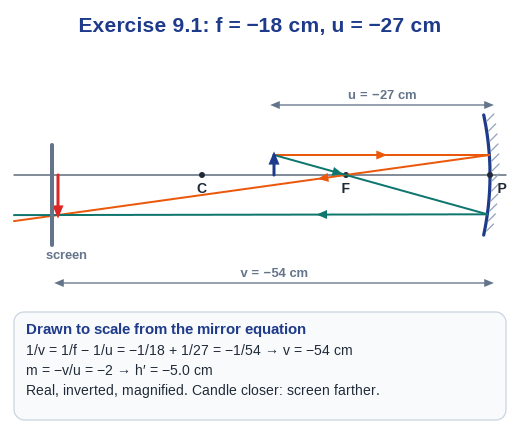
Exercises 9.1 and 9.2: spherical mirrors
9.1 “A small candle, 2.5 cm in size is placed at 27 cm in front of a concave mirror of radius of curvature 36 cm. At what distance from the mirror should a screen be placed in order to obtain a sharp image? Describe the nature and size of the image. If the candle is moved closer to the mirror, how would the screen have to be moved?”
u = −27 cm, R = −36 cm, so f = R/2 = −18 cm, h = 2.5 cm.
1/v = 1/f − 1/u = −1/18 + 1/27 = (−3 + 2)/54 = −1/54, so v = −54 cm
The screen goes 54 cm in front of the mirror. m = −v/u = −(−54)/(−27) = −2, so h′ = −2 × 2.5 = −5.0 cm: the image is real, inverted and magnified (5.0 cm tall).
As the candle moves closer (towards F), v grows: the screen must be moved farther away. At u = f the image goes to infinity, and for the candle inside F the image is virtual and cannot be caught on a screen.
9.2 “A 4.5 cm needle is placed 12 cm away from a convex mirror of focal length 15 cm. Give the location of the image and the magnification. Describe what happens as the needle is moved farther from the mirror.”
u = −12 cm, f = +15 cm (convex).
1/v = 1/15 − 1/(−12) = 1/15 + 1/12 = (4 + 5)/60 = 9/60, so v = +6.7 cm (behind the mirror, virtual)
m = −v/u = −(6.67)/(−12) = 5/9 ≈ 0.56, so h′ = 0.56 × 4.5 = 2.5 cm: virtual, erect, smaller.
As the needle moves away, the image moves towards the focus (v → f = 15 cm, never beyond it) and becomes smaller and smaller (m → 0).
Exercises 9.3 to 9.6: refraction and total internal reflection
9.3 “A tank is filled with water to a height of 12.5 cm. The apparent depth of a needle lying at the bottom of the tank is measured by a microscope to be 9.4 cm. What is the refractive index of water? If water is replaced by a liquid of refractive index 1.63 up to the same height, by what distance would the microscope have to be moved to focus on the needle again?”
n = real depth/apparent depth = 12.5/9.4 = 1.33.
With the new liquid, apparent depth = 12.5/1.63 = 7.67 cm. The needle now looks higher, so the microscope must be moved up by 9.4 − 7.67 = 1.7 cm.
9.4 “Figures 9.27(a) and (b) show refraction of a ray in air incident at 60° with the normal to a glass-air and water-air interface, respectively. Predict the angle of refraction in glass when the angle of incidence in water is 45° with the normal to a water-glass interface [Fig. 9.27(c)].”
The idea: find the refractive index of glass and of water (each with respect to air) from figures (a) and (b). Their ratio is the refractive index of glass with respect to water, n_gw. Then use Snell’s law at the water-glass surface.
- From (a): n_glass = sin 60°/sin 35° = 0.866/0.574 = 1.51.
- From (b): figure (b) as printed shows 47° in water, so n_water = sin 60°/sin 47° = 0.866/0.731 = 1.18.
- n_gw = n_glass/n_water = 1.51/1.18 = 1.276.
- Snell’s law at the water-glass surface: sin r = sin 45°/n_gw = 0.707/1.276 = 0.554, so r ≈ 34°.
Answer (with the figure as printed): r ≈ 34°.
The answer key uses n_water = 1.32 instead (close to the real value 1.33; it would need an angle of about 41° in figure (b), since 0.866/0.656 = 1.32). Then n_gw = 1.51/1.32 = 1.144, sin r = 0.707/1.144 = 0.618 and r ≈ 38°, the key’s answer. Either way, the ray bends towards the normal on going from water into glass, because glass is optically denser.
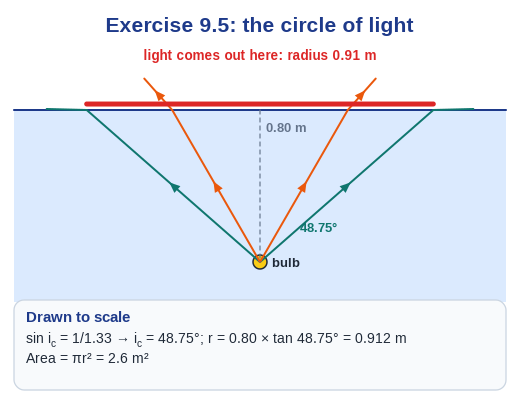
9.5 “A small bulb is placed at the bottom of a tank containing water to a depth of 80 cm. What is the area of the surface of water through which light from the bulb can emerge out? Refractive index of water is 1.33. (Consider the bulb to be a point source.)”
Light escapes only where it meets the surface at less than the critical angle: sin i_c = 1/1.33 = 0.752, i_c = 48.75°. The rays at exactly i_c mark the edge of a circle of radius
r = 0.80 m × tan 48.75° = 0.80 × 1.140 = 0.912 m
Area = πr² = 3.142 × 0.912² = 2.6 m². Outside this circle the light is totally reflected back into the water.
9.6 “A prism is made of glass of unknown refractive index. A parallel beam of light is incident on a face of the prism. The angle of minimum deviation is measured to be 40°. What is the refractive index of the material of the prism? The refracting angle of the prism is 60°. If the prism is placed in water (refractive index 1.33), predict the new angle of minimum deviation of a parallel beam of light.”
n = sin[(A + D_m)/2]/sin(A/2) = sin 50°/sin 30° = 0.766/0.5 = 1.53.
In water the prism’s refractive index relative to its surroundings is 1.532/1.33 = 1.152. Then
sin[(60° + D_m′)/2] = 1.152 × sin 30° = 0.576, so (60° + D_m′)/2 = 35.2° and D_m′ ≈ 10°
The deviation is much smaller in water because glass and water differ less in refractive index.
Exercises 9.7 to 9.10: lenses
9.7 “Double-convex lenses are to be manufactured from a glass of refractive index 1.55, with both faces of the same radius of curvature. What is the radius of curvature required if the focal length is to be 20 cm?”
With R₁ = R and R₂ = −R, the lens maker’s formula gives 1/f = (n − 1)(2/R), so
R = 2(n − 1)f = 2 × 0.55 × 20 = 22 cm
9.8 “A beam of light converges at a point P. Now a lens is placed in the path of the convergent beam 12 cm from P. At what point does the beam converge if the lens is (a) a convex lens of focal length 20 cm, and (b) a concave lens of focal length 16 cm?”
The point P, 12 cm beyond the lens, is a virtual object: u = +12 cm.
(a) f = +20 cm: 1/v = 1/20 + 1/12 = (3 + 5)/60 = 8/60, so v = +7.5 cm. The beam converges 7.5 cm beyond the lens (a real image).
(b) f = −16 cm: 1/v = −1/16 + 1/12 = (−3 + 4)/48 = 1/48, so v = +48 cm. The beam now converges 48 cm beyond the lens (real image).
9.9 “An object of size 3.0 cm is placed 14 cm in front of a concave lens of focal length 21 cm. Describe the image produced by the lens. What happens if the object is moved further away from the lens?”
u = −14 cm, f = −21 cm: 1/v = −1/21 − 1/14 = (−2 − 3)/42 = −5/42, so v = −8.4 cm.
m = v/u = (−8.4)/(−14) = 0.6, h′ = 0.6 × 3.0 = 1.8 cm. The image is virtual, erect and diminished, 8.4 cm from the lens on the same side as the object. As the object moves farther away, the image moves towards the focus (v → −21 cm, never beyond) and shrinks (m → 0). Even with the object at the focus (u = −21 cm), the image is at 10.5 cm, not at infinity.
9.10 “What is the focal length of a convex lens of focal length 30 cm in contact with a concave lens of focal length 20 cm? Is the system a converging or a diverging lens? Ignore thickness of the lenses.”
1/f = 1/30 + 1/(−20) = (2 − 3)/60 = −1/60, so f = −60 cm: a diverging lens of focal length 60 cm (power −1.67 D).
Exercises 9.11 to 9.14: microscopes and telescopes
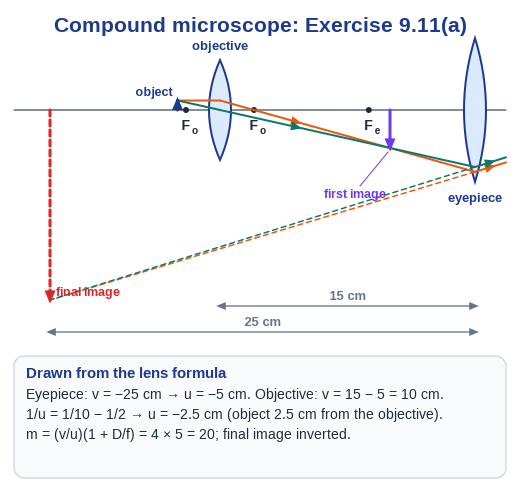
9.11 “A compound microscope consists of an objective lens of focal length 2.0 cm and an eyepiece of focal length 6.25 cm separated by a distance of 15 cm. How far from the objective should an object be placed in order to obtain the final image at (a) the least distance of distinct vision (25 cm), and (b) at infinity? What is the magnifying power of the microscope in each case?”
(a) Eyepiece: v_e = −25 cm, f_e = 6.25 cm. 1/u_e = 1/v_e − 1/f_e = −1/25 − 1/6.25 = −0.04 − 0.16 = −0.20, so u_e = −5 cm. The objective’s image is 15 − 5 = 10 cm from the objective: v_o = +10 cm. Then 1/u_o = 1/10 − 1/2 = −0.4, so u_o = −2.5 cm: the object is 2.5 cm from the objective.
m = |v_o/u_o| × (1 + D/f_e) = (10/2.5) × (1 + 25/6.25) = 4 × 5 = 20
(b) Final image at infinity: the first image is at the eyepiece’s focus, u_e = −6.25 cm, so v_o = 15 − 6.25 = 8.75 cm. 1/u_o = 1/8.75 − 1/2 = −0.3857, so u_o = −2.59 cm.
m = (8.75/2.59) × (25/6.25) = 3.375 × 4 = 13.5
9.12 “A person with a normal near point (25 cm) using a compound microscope with objective of focal length 8.0 mm and an eyepiece of focal length 2.5 cm can bring an object placed at 9.0 mm from the objective in sharp focus. What is the separation between the two lenses? Calculate the magnifying power of the microscope,”
Objective (in cm): u_o = −0.90 cm, f_o = 0.80 cm. 1/v_o = 1/0.8 − 1/0.9 = 1.25 − 1.111 = 0.1389, so v_o = 7.2 cm.
Eyepiece, final image at 25 cm: 1/u_e = −1/25 − 1/2.5 = −0.44, so u_e = −2.27 cm.
Separation = 7.2 + 2.27 = 9.47 cm. Magnifying power m = (7.2/0.9) × (1 + 25/2.5) = 8 × 11 = 88.
9.13 “A small telescope has an objective lens of focal length 144 cm and an eyepiece of focal length 6.0 cm. What is the magnifying power of the telescope? What is the separation between the objective and the eyepiece?”
m = f_o/f_e = 144/6.0 = 24; separation (normal adjustment) = f_o + f_e = 144 + 6 = 150 cm.
9.14 “(a) A giant refracting telescope at an observatory has an objective lens of focal length 15 m. If an eyepiece of focal length 1.0 cm is used, what is the angular magnification of the telescope? (b) If this telescope is used to view the moon, what is the diameter of the image of the moon formed by the objective lens? The diameter of the moon is 3.48 × 10⁶ m, and the radius of lunar orbit is 3.8 × 10⁸ m.”
(a) m = f_o/f_e = 1500 cm/1.0 cm = 1500.
(b) The moon subtends α = 3.48 × 10⁶/3.8 × 10⁸ = 9.16 × 10⁻³ rad at the objective. Its image at the focal plane has diameter d = α f_o = 9.16 × 10⁻³ × 15 m = 0.137 m = 13.7 cm.
Exercises 9.15 to 9.21: deductions, slabs, fibres and lenses
9.15 “Use the mirror equation to deduce that: (a) an object placed between f and 2f of a concave mirror produces a real image beyond 2f. (b) a convex mirror always produces a virtual image independent of the location of the object. (c) the virtual image produced by a convex mirror is always diminished in size and is located between the focus and the pole. (d) an object placed between the pole and focus of a concave mirror produces a virtual and enlarged image. [Note: This exercise helps you deduce algebraically properties of images that one obtains from explicit ray diagrams.]”
Write the mirror equation as 1/v = 1/f − 1/u. For a real object, u < 0.
(a) Concave: f < 0, and 2f < u < f (u between f and 2f, both negative). Then 1/u lies between 1/f and 1/(2f), so 1/v = 1/f − 1/u lies between 0 and 1/(2f), all negative: v < 0 (real) and |v| > 2|f|. The image is real and beyond 2f.
(b) Convex: f > 0 and u < 0, so 1/v = 1/f − 1/u = 1/f + 1/|u| > 0. Hence v > 0 always: the image is behind the mirror, virtual, wherever the object is.
(c) From (b), 1/v = 1/f + 1/|u| > 1/f, so 0 < v < f: the image lies between the pole and the focus. Also 1/v > 1/|u| gives v < |u|, so m = −v/u = v/|u| lies between 0 and 1: erect and diminished.
(d) Concave with f < u < 0 (object inside F): |u| < |f|, so 1/u is more negative than 1/f, and 1/v = 1/f − 1/u > 0. Then v > 0: virtual. And m = −v/u = v/|u|; since 1/v = 1/|u| − 1/|f| < 1/|u|, v > |u| and m > 1: enlarged.
9.16 “A small pin fixed on a table top is viewed from above from a distance of 50 cm. By what distance would the pin appear to be raised if it is viewed from the same point through a 15 cm thick glass slab held parallel to the table? Refractive index of glass = 1.5. Does the answer depend on the location of the slab?”
A slab of thickness t makes an object seen nearly along the normal appear nearer by t(1 − 1/n):
shift = 15 × (1 − 1/1.5) = 15 × 1/3 = 5.0 cm
The pin appears raised by 5.0 cm. No, the answer does not depend on where the slab is held between the pin and the eye (for small angles of incidence): the shift comes only from the path through the glass.
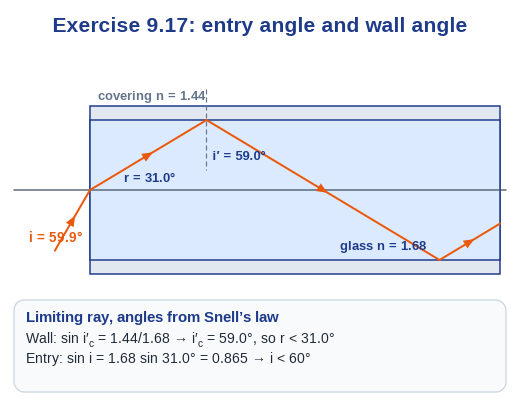
9.17 “(a) Figure 9.28 shows a cross-section of a ‘light pipe’ made of a glass fibre of refractive index 1.68. The outer covering of the pipe is made of a material of refractive index 1.44. What is the range of the angles of the incident rays with the axis of the pipe for which total reflections inside the pipe take place, as shown in the figure. (b) What is the answer if there is no outer covering of the pipe?”
Names used: i is the angle the incoming ray makes with the axis at the entrance face, r is the angle after it enters the glass, and i′ is the angle at which the ray then hits the side wall (measured from the normal to the wall). Since the wall is parallel to the axis, i′ = 90° − r.
(a)
- Critical angle at the wall (core to covering): sin i′_c = 1.44/1.68 = 0.857, so i′_c = 59°.
- Total reflection needs i′ > 59°, that is 90° − r > 59°, so r < 31°.
- At the entrance (air to glass), sin i = 1.68 sin r. The largest r (31°) gives the largest i: sin i_max = 1.68 × sin 31° = 0.865, so i_max ≈ 60°.
Answer: all rays with 0 < i < 60° are totally reflected inside the pipe. (A real pipe of finite length also sets a lower limit on i, which depends on its diameter and length.)
(b)
- With air outside, the critical angle at the wall is i′_c = sin⁻¹(1/1.68) = 36.5°.
- Even the most slanted ray (i = 90°) enters at r = sin⁻¹(1/1.68) = 36.5° and meets the wall at i′ = 90° − 36.5° = 53.5°.
- 53.5° is more than 36.5°, so even this ray is totally reflected. Every less slanted ray meets the wall at a still larger angle.
Answer: every incident ray (0 < i < 90°) is totally reflected. (The answer key writes the range as 53.5° < i < 90°; that range is for the angle i′ at the wall, not for the incident angle i.)
9.18 “The image of a small electric bulb fixed on the wall of a room is to be obtained on the opposite wall 3 m away by means of a large convex lens. What is the maximum possible focal length of the lens required for the purpose?”
- Let the walls be s = 3 m apart and the lens x from the bulb. Then u = −x and v = s − x.
- The lens formula 1/v − 1/u = 1/f becomes 1/(s − x) + 1/x = 1/f. Clearing fractions: x² − sx + sf = 0.
- This quadratic has a real answer for x only if its discriminant is not negative: s² − 4sf ≥ 0, that is f ≤ s/4.
- So f can be at most 3 m/4 = 0.75 m. Then x = s/2: the lens sits midway, 1.5 m from each wall.
Answer: the maximum focal length is 0.75 m.
9.19 “A screen is placed 90 cm from an object. The image of the object on the screen is formed by a convex lens at two different locations separated by 20 cm. Determine the focal length of the lens.”
The two positions are symmetric: the object distance in one is the image distance in the other. With |u| + v = 90 and v − |u| = 20 (or the reverse), v = 55 cm and |u| = 35 cm. Then
1/f = 1/55 + 1/35 = (7 + 11)/385 = 18/385, so f = 21.4 cm
This agrees with the general result f = (D² − d²)/4D = (8100 − 400)/360 = 21.4 cm.
9.20 “(a) Determine the ‘effective focal length’ of the combination of the two lenses in Exercise 9.10, if they are placed 8.0 cm apart with their principal axes coincident. Does the answer depend on which side of the combination a beam of parallel light is incident? Is the notion of effective focal length of this system useful at all? (b) An object 1.5 cm in size is placed on the side of the convex lens in the arrangement (a) above. The distance between the object and the convex lens is 40 cm. Determine the magnification produced by the two-lens system, and the size of the image.”
(a) (i) Parallel light on the convex lens first: f₁ = +30 cm, u₁ = −∞, so v₁ = +30 cm. This is a virtual object for the concave lens 8 cm away: u₂ = +22 cm, f₂ = −20 cm, 1/v₂ = −1/20 + 1/22 = −2/440, so v₂ = −220 cm. The beam appears to diverge from a point 220 cm before the concave lens, that is 216 cm from the midpoint of the system.
(ii) Parallel light on the concave lens first: v₁ = −20 cm, so for the convex lens u₂ = −28 cm: 1/v₂ = 1/30 − 1/28 = −2/840, v₂ = −420 cm. The beam appears to diverge from a point 416 cm from the midpoint.
The result depends on the side from which the light comes, and no single constant f makes 1/v − 1/u = 1/f work for all objects. So the idea of an effective focal length is not useful for this separated pair.
(b) Convex lens: u₁ = −40 cm, f₁ = +30 cm: 1/v₁ = 1/30 − 1/40 = 1/120, v₁ = +120 cm, m₁ = 120/(−40) = −3. Concave lens: u₂ = 120 − 8 = +112 cm (virtual object), f₂ = −20 cm: 1/v₂ = −1/20 + 1/112 = −92/2240, v₂ = −24.3 cm, m₂ = v₂/u₂ = −24.3/112 = −0.217.
m = m₁m₂ = (−3)(−0.217) = 0.652; image size = 0.652 × 1.5 = 0.98 cm (erect relative to the object, and virtual, 24.3 cm before the concave lens).
9.21 “At what angle should a ray of light be incident on the face of a prism of refracting angle 60° so that it just suffers total internal reflection at the other face? The refractive index of the material of the prism is 1.524.”
Critical angle: i_c = sin⁻¹(1/1.524) = 41.0°. For the ray to meet the second face at exactly i_c, r₂ = 41.0°, so at the first face r₁ = A − r₂ = 60° − 41.0° = 19.0°. Then
sin i = 1.524 × sin 19.0° = 0.496, so i ≈ 30°
At any smaller angle of incidence the ray is totally reflected at the second face.
Exercises 9.22 to 9.25: the magnifying glass
9.22 “A card sheet divided into squares each of size 1 mm² is being viewed at a distance of 9 cm through a magnifying glass (a converging lens of focal length 9 cm) held close to the eye. (a) What is the magnification produced by the lens? How much is the area of each square in the virtual image? (b) What is the angular magnification (magnifying power) of the lens? (c) Is the magnification in (a) equal to the magnifying power in (b)? Explain.”
As printed, u = −9 cm equals the focal length, so the card is at the focus: the image goes to infinity and the linear magnification is not a finite number.
The answer key works this exercise with a focal length of 10 cm: then 1/v = 1/10 + 1/(−9) = −1/90, so v = −90 cm, m = v/u = 10, and each square appears 10 mm × 10 mm, an area of 100 mm² (1 cm²).
(b) Magnifying power compares the angle the card subtends at the eye (h/9 for h at 9 cm) with the angle it would subtend at the near point (h/25): 25/9 ≈ 2.8.
(c) No. Magnification compares sizes, |v/u|; magnifying power compares angles, 25/|u|. The image is larger, but it is also farther, so it subtends the same angle as the object. The two are equal only when the image is at the near point, |v| = 25 cm.
9.23 “(a) At what distance should the lens be held from the card sheet in Exercise 9.22 in order to view the squares distinctly with the maximum possible magnifying power? (b) What is the magnification in this case? (c) Is the magnification equal to the magnifying power in this case? Explain.”
(a) The magnifying power is largest when the image is at the near point, v = −25 cm. With the printed f = 9 cm: 1/u = 1/v − 1/f = −1/25 − 1/9, so u = −6.6 cm. (The key, with f = 10 cm, gets u = −7.14 cm.)
(b) m = v/u = 25/6.6 = 3.8 (key, f = 10 cm: 25/7.14 = 3.5).
(c) Yes. With the image at 25 cm, the magnifying power 25/|u| equals the magnification |v/u|.
9.24 “What should be the distance between the object in Exercise 9.23 and the magnifying glass if the virtual image of each square in the figure is to have an area of 6.25 mm². Would you be able to see the squares distinctly with your eyes very close to the magnifier? [Note: Exercises 9.22 to 9.24 will help you clearly understand the difference between magnification in absolute size and the angular magnification (or magnifying power) of an instrument.]”
An area of 6.25 mm² means each side is 2.5 mm, so m = 2.5 and v = 2.5u. Then 1/(2.5u) − 1/u = 1/f gives u = −0.6f.
With the printed f = 9 cm: u = −5.4 cm and v = −13.5 cm. (The key, with f = 10 cm: u = −6 cm, v = −15 cm.)
No, the squares cannot be seen distinctly: the image is closer than the near point of 25 cm.
9.25 “Answer the following questions: (a) The angle subtended at the eye by an object is equal to the angle subtended at the eye by the virtual image produced by a magnifying glass. In what sense then does a magnifying glass provide angular magnification? (b) In viewing through a magnifying glass, one usually positions one’s eyes very close to the lens. Does angular magnification change if the eye is moved back? (c) Magnifying power of a simple microscope is inversely proportional to the focal length of the lens. What then stops us from using a convex lens of smaller and smaller focal length and achieving greater and greater magnifying power? (d) Why must both the objective and the eyepiece of a compound microscope have short focal lengths?”
Part (e) asks why, for clear viewing through a compound microscope, the eye should sit a short distance behind the eyepiece rather than touching it, and how large that distance should be. (The book’s wording of (e) is restated here in our own words.)
(a) Without the lens, a small object cannot be brought closer than about 25 cm and still be seen clearly, so its angle is small. With the lens, the object can sit much closer to the eye, where it subtends a larger angle, and the lens throws its image far enough away to be seen. The gain in angle, compared with the object at 25 cm, is the angular magnification.
(b) Yes, slightly. Moved back, the eye sees the image under a slightly smaller angle than the angle at the lens. If the image is very far away, the change is negligible.
(c) Very short focal lengths are hard to grind, and the aberrations (spherical and chromatic) grow as f shrinks. In practice a single lens gives a magnifying power of about 3; corrected lens systems raise this limit by about ten times.
(d) The eyepiece’s magnification, 1 + D/f_e, is larger for small f_e. The objective’s magnification, v_o/|u_o| = 1/(|u_o|/f_o − 1), is large when |u_o| is just more than f_o; since the object is placed very close, |u_o| and therefore f_o must be small.
(e) The ideal place for the eye is the eye-ring, the image of the objective formed by the eyepiece. All the light from the objective passes through it, so an eye placed there collects all of it and sees the widest field. Too close to the eyepiece, the eye gathers less light and sees a smaller field. The exact distance depends on the lens separation, and microscopes are built so that the eye rests at the right spot.
Exercises 9.26 to 9.28: setting up instruments
9.26 “An angular magnification (magnifying power) of 30X is desired using an objective of focal length 1.25 cm and an eyepiece of focal length 5 cm. How will you set up the compound microscope?”
Take the final image at the near point. Eyepiece: m_e = 1 + 25/5 = 6, so the objective must give m_o = 30/6 = 5, that is v_o = 5|u_o|. From 1/v_o + 1/|u_o| = 1/f_o: 1/(5|u_o|) + 1/|u_o| = 1/1.25, so |u_o| = 1.5 cm and v_o = 7.5 cm.
For the eyepiece: 1/u_e = −1/25 − 1/5 = −0.24, so u_e = −4.17 cm.
Set-up: place the object 1.5 cm in front of the objective and keep the lenses 7.5 + 4.17 = 11.67 cm apart.
9.27 “A small telescope has an objective lens of focal length 140 cm and an eyepiece of focal length 5.0 cm. What is the magnifying power of the telescope for viewing distant objects when (a) the telescope is in normal adjustment (i.e., when the final image is at infinity)? (b) the final image is formed at the least distance of distinct vision (25 cm)?”
(a) m = f_o/f_e = 140/5 = 28.
(b) m = (f_o/f_e)(1 + f_e/D) = 28 × (1 + 5/25) = 28 × 1.2 = 33.6.
9.28 “(a) For the telescope described in Exercise 9.27 (a), what is the separation between the objective lens and the eyepiece? (b) If this telescope is used to view a 100 m tall tower 3 km away, what is the height of the image of the tower formed by the objective lens? (c) What is the height of the final image of the tower if it is formed at 25 cm?”
(a) f_o + f_e = 140 + 5 = 145 cm.
(b) The tower subtends 100/3000 = 1/30 rad. The objective’s image, at its focus, has height h = f_o × (1/30) = 140/30 = 4.7 cm.
(c) For the eyepiece with the image at 25 cm, 1/u_e = −1/25 − 1/5, so u_e = −4.17 cm and its magnification is 25/4.17 = 6. Final image height = 6 × 4.67 = 28 cm.
Exercises 9.29 to 9.31: mirrors at work
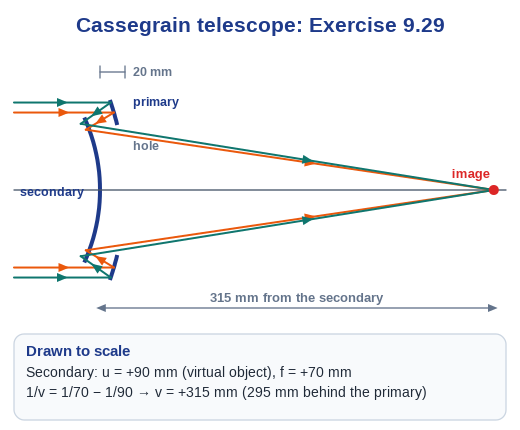
9.29 “A Cassegrain telescope uses two mirrors as shown in Fig. 9.26. Such a telescope is built with the mirrors 20 mm apart. If the radius of curvature of the large mirror is 220 mm and the small mirror is 140 mm, where will the final image of an object at infinity be?”
The large (concave) mirror alone would focus parallel light at f = 220/2 = 110 mm in front of it. The small (convex) mirror, 20 mm in front, intercepts the light first, so the point 110 − 20 = 90 mm behind it is a virtual object: u = +90 mm, f = +70 mm (convex, R = 140 mm). Then
1/v = 1/70 − 1/90 = (9 − 7)/630 = 2/630, so v = +315 mm
The final image is 315 mm from the small mirror, on the side of the large mirror: 295 mm behind the large mirror, which the light reaches through the hole in its centre.
9.30 “Light incident normally on a plane mirror attached to a galvanometer coil retraces backwards as shown in Fig. 9.29. A current in the coil produces a deflection of 3.5° of the mirror. What is the displacement of the reflected spot of light on a screen placed 1.5 m away?”
When a mirror turns by θ, the reflected ray turns by 2θ = 7°. So the spot moves by
d = 1.5 m × tan 7° = 1.5 × 0.1228 = 0.184 m = 18.4 cm
9.31 “Figure 9.30 shows an equiconvex lens (of refractive index 1.50) in contact with a liquid layer on top of a plane mirror. A small needle with its tip on the principal axis is moved along the axis until its inverted image is found at the position of the needle. The distance of the needle from the lens is measured to be 45.0 cm. The liquid is removed and the experiment is repeated. The new distance is measured to be 30.0 cm. What is the refractive index of the liquid?”
Key idea: the inverted image falls exactly on the needle when the rays leave the lens parallel, hit the plane mirror at 90° and retrace their path. That happens when the needle is at the focus of the lens system. So each measured distance is a focal length.
- Without the liquid: the glass lens alone has f₁ = 30 cm. For an equiconvex lens (both faces of radius R), 1/f₁ = (n − 1)(2/R): 1/30 = 0.5 × 2/R, so R = 30 cm.
- With the liquid: the liquid fills the gap between the lens and the mirror, so it forms a plano-concave lens: one face curved with radius 30 cm (touching the glass), the other face flat (on the mirror). The glass lens and this liquid lens are in contact, and together f = 45 cm.
- For lenses in contact, 1/f = 1/f₁ + 1/f₂: 1/f₂ = 1/45 − 1/30 = −1/90, so f₂ = −90 cm.
- Lens maker’s formula for the liquid lens, 1/f₂ = (n − 1)(1/R₁ − 1/R₂), with R₁ = −30 cm (the curved face) and R₂ = ∞ (the flat face): 1/f₂ = −(n − 1)/30. So −1/90 = −(n − 1)/30, and n − 1 = 1/3.
Answer: the refractive index of the liquid is n = 1.33 (close to that of water).
Worked examples in the chapter
Example 9.1 (page 226): the lower half of a concave mirror is covered. What happens to the image?
The whole image still forms, because every point of the uncovered half obeys the laws of reflection and sends light from every part of the object to the image. Only half the light is collected, so the image is fainter (half as bright).
Example 9.2 (pages 226–227): a mobile phone lies along the axis of a concave mirror. Why is its image distorted?
Each part of the phone is at a different distance, and the magnification −v/u changes with distance, so different parts are enlarged by different amounts. The end lying in the plane through C is imaged in that same plane at the same size. The distortion does depend on where the phone is placed relative to the mirror.
Example 9.3 (page 227): object at (i) 10 cm and (ii) 5 cm from a concave mirror with R = 15 cm.
f = −7.5 cm. (i) 1/v = −1/7.5 + 1/10, v = −30 cm, m = −3: real, inverted, magnified. (ii) 1/v = −1/7.5 + 1/5, v = +15 cm, m = +3: virtual, erect, magnified.
Example 9.4 (pages 227–228): a jogger runs at 5 m/s towards a convex side mirror with R = 2 m (f = +1 m).
v = fu/(u − f). At u = −39 m, v = 39/40 m; one second later, u = −34 m and v = 34/35 m. The image moves 39/40 − 34/35 = 1/280 m in 1 s. In the same way the image speed is 1/280, 1/150, 1/60 and 1/10 m/s at 39 m, 29 m, 19 m and 9 m: it rises sharply as the jogger comes close.
Example 9.5 (page 233): point source 100 cm from a glass surface with n = 1.5 and R = 20 cm.
n₂/v − n₁/u = (n₂ − n₁)/R: 1.5/v + 1/100 = 0.5/20, so v = +100 cm, inside the glass.
Example 9.6 (page 236): a lens with n = 1.47 vanishes in a liquid.
The lens disappears only if 1/f = 0, so the liquid’s refractive index must be 1.47. It is not water (1.33); it could be glycerine.
Example 9.7 (pages 236–237): (i) f = 0.5 m gives P = +2 D. (ii) f = 12 cm, R₁ = 10 cm, R₂ = −15 cm: 1/12 = (n − 1)(1/10 + 1/15), so n = 1.5. (iii) A glass lens (n = 1.5) of f = 20 cm in air: dividing the lens maker’s equations for air and for water (n = 1.33) gives f = 20 × 0.5 × 1.33/0.17 = 78.2 cm in water.
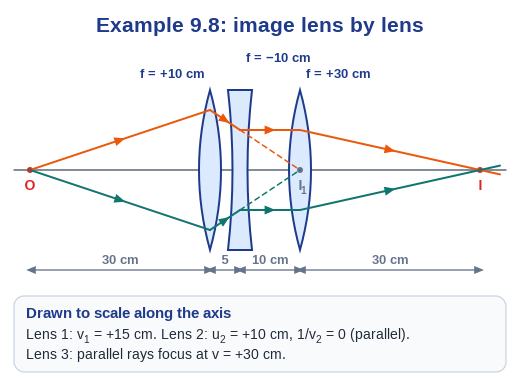
Example 9.8 (pages 238–239): three lenses of focal length +10 cm, −10 cm and +30 cm, with the object 30 cm before the first and gaps of 5 cm and 10 cm.
First lens: v₁ = +15 cm. Second lens: u₂ = +10 cm, 1/v₂ = −1/10 + 1/10 = 0, so the rays leave parallel (image at infinity). Third lens: parallel rays meet at its focus: v₃ = 30 cm to the right of the third lens.
Notes for checking
- The answer key agrees with every answer above except where noted here.
- Exercise 9.4: Fig. 9.27(b) prints 47° in water, which gives n_water ≈ 1.18 and r ≈ 34°; the key gives n_water = 1.32 (an angle of about 41°) and r ≈ 38°.
- Exercises 9.22 to 9.24: the exercise prints a focal length of 9 cm, which puts the card at the focus in 9.22; the key works all three with 10 cm. Both sets of answers are given above.
- Exercise 9.17(b): the key’s range 53.5° < i < 90° is the angle at the wall; every incident angle up to 90° gives total reflection.
- Exercise 9.27(b): the key writes the formula as (f_o/f_e)[1 + f_o/25]; the second term should be f_e/25. Its value, 33.6, is right.
- Exercise 9.9: the key prints v = 8.4 cm; with the sign convention it is v = −8.4 cm (virtual image on the object’s side).
- Exercise 9.25(e) is restated rather than quoted because its wording contains a word the site does not print.
- Table 9.1 gives the critical angle of dense flint glass (n = 1.62) as 37.31°; sin⁻¹(1/1.62) = 38.12°.
Practice
-
An object is placed 20 cm in front of a convex mirror of focal length 20 cm. The image is at:
Show answer
Answer: (a) 10 cm behind the mirror
-
A coin at the bottom of a tank of water (n = 4/3) 24 cm deep appears, when seen from above, to be at a depth of:
Show answer
Answer: (b) 18 cm
-
A prism of angle 60° gives a minimum deviation of 60°. Its refractive index is:
Show answer
Answer: (c) 1.73
-
An object 2 cm tall stands 30 cm from a convex lens of focal length 20 cm. Find the position and size of the image.
Show answer
Answer: 1/v = 1/f + 1/u = 1/20 − 1/30 = 1/60, so v = +60 cm (real, on the other side). m = v/u = 60/(−30) = −2, so h′ = −4 cm: inverted, 4 cm tall.
-
A telescope in normal adjustment is 105 cm long and has a magnifying power of 20. Find the focal lengths of its lenses.
Show answer
Answer: f_o + f_e = 105 cm and f_o/f_e = 20, so 21 f_e = 105: f_e = 5 cm and f_o = 100 cm.
Stuck on a question?
Take a photo and Lagnever AI explains it step by step. Try it for 7 days for ₹2.
Get it on Google Play Open in browser
For parents: after the trial, the plan renews monthly by UPI or card autopay. You can cancel anytime in the app.