
Class 12 Physics Chapter 9: Ray Optics and Optical Instruments Notes
This chapter in five lines
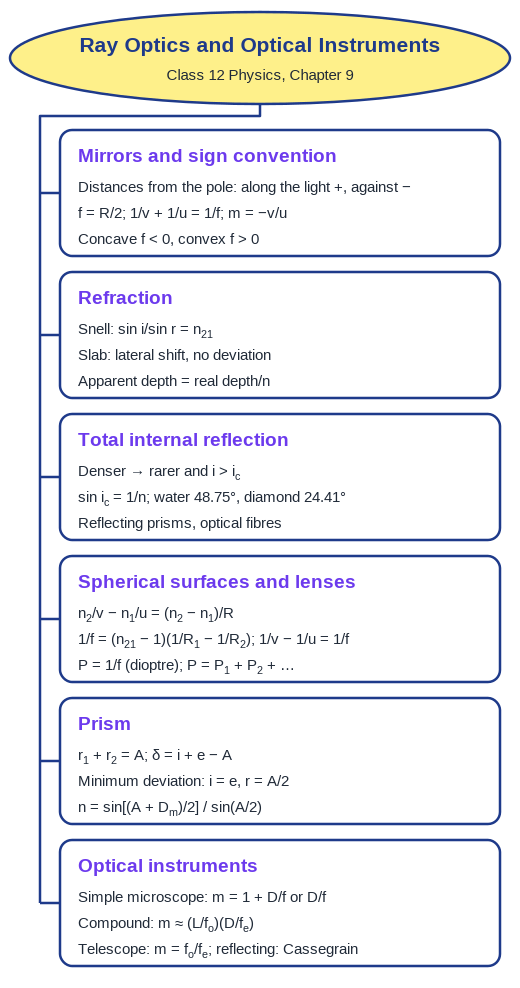
Ray optics treats light as rays that travel in straight lines and obey the laws of reflection and refraction. With the Cartesian sign convention, one mirror equation, 1/v + 1/u = 1/f, and one thin lens formula, 1/v − 1/u = 1/f, cover every case. The chapter then explains total internal reflection, the lens maker’s formula, refraction through a prism, and how microscopes and telescopes magnify.
What is this chapter about?
Our eyes respond to a narrow band of the electromagnetic spectrum, wavelengths of roughly 400 nm to 750 nm, and we call this band light (Chapter 8 placed it in the full spectrum). Light travels very fast, c ≈ 3 × 10⁸ m/s in vacuum, the highest speed possible in nature, and in everyday life it seems to go in straight lines. Both facts fit the wave picture because the wavelength of light is tiny compared with ordinary objects, so we can follow light along straight paths called rays; a bundle of rays is a beam.
This chapter (book pages 221 to 254) uses rays to study reflection by spherical mirrors, refraction at plane and curved surfaces, total internal reflection, lenses, the prism, and finally the microscope and the telescope. It builds on the Class 10 chapter on reflection and refraction, so the ray rules will look familiar; what is new is the full sign convention, the derivations and many more numericals.
Safety: never look at the Sun through a lens, a prism, a telescope, binoculars or a mirror, not even for a moment: it can blind you. Never focus sunlight with a lens on skin or paper; any activity with sunlight is done only with a teacher. A laser pointer is never shone into anyone’s eyes or face, and laser activities are done only with a teacher.
What sign convention does the book use?
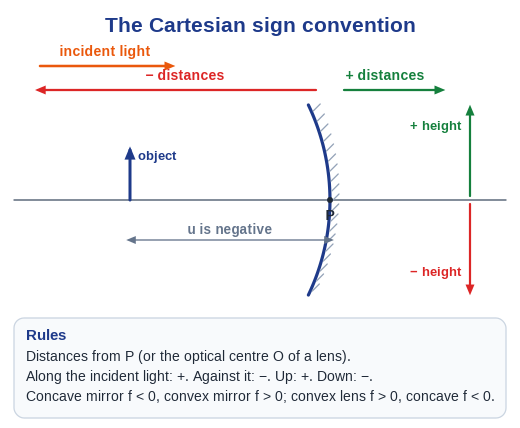
All distances are measured from the pole P of a mirror or the optical centre of a lens, along the principal axis (the x-axis):
- Distances measured along the direction of the incident light count as positive; distances against it are negative. With light coming from the left, everything to the left of the mirror or lens is negative.
- Heights measured upwards from the axis are positive; heights downwards are negative.
So an object in front of a mirror always has u < 0. A concave mirror has its focus in front, so f < 0; a convex mirror has f > 0. A convex lens has f > 0 and a concave lens f < 0.
How do spherical mirrors form images?
The laws of reflection hold at every point of a curved mirror, with the normal at a point along the radius through it. Take paraxial rays: rays close to the axis and making small angles with it. A ray parallel to the axis meets the mirror at M; if the angle of incidence there is θ, the reflected ray crosses the axis at F with ∠MFP = 2θ while ∠MCP = θ. For small angles tan θ ≈ θ, which gives FD = CD/2 and so
f = R/2
Any two of these rays locate an image: a ray parallel to the axis reflects through F (or seems to come from F for a convex mirror); a ray through C (or aimed at C) comes straight back; a ray through F (or aimed at F) leaves parallel; a ray hitting the pole reflects symmetrically about the axis. Similar triangles in the ray diagram, with the signs put in, give the mirror equation and the magnification:
1/v + 1/u = 1/f and m = h′/h = −v/u
Derived for a real image of a concave mirror, they hold for every case: concave or convex, real or virtual. A negative m means an inverted image, a positive m an erect one.
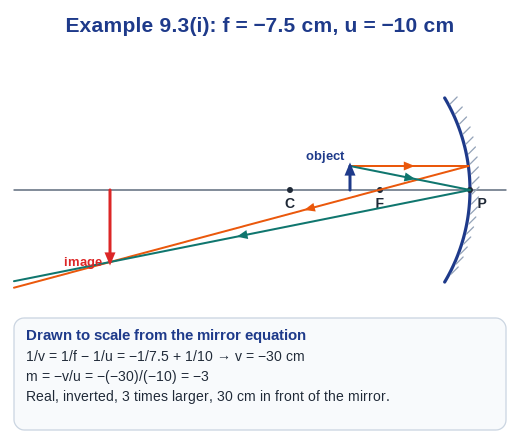
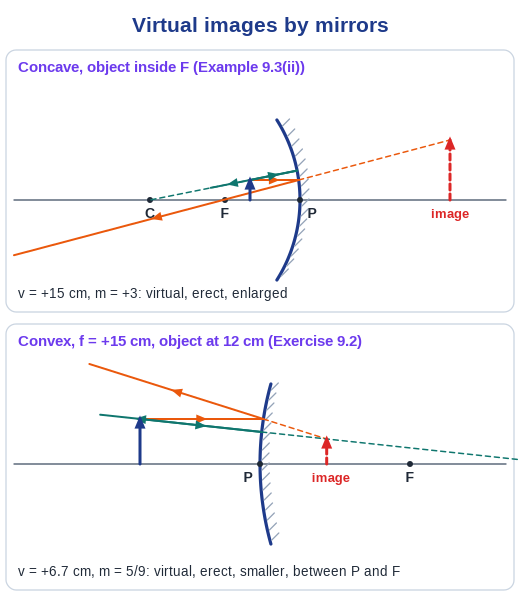
Example 9.3 shows both kinds of image with R = 15 cm (f = −7.5 cm). With the object at 10 cm, v = −30 cm and m = −3: real, inverted, three times larger. With the object at 5 cm, inside F, v = +15 cm and m = +3: virtual, erect, behind the mirror. A convex mirror always gives a virtual, erect, smaller image between P and F, which is why it is used as a side-view mirror (Example 9.4: the image of a jogger running at a steady 5 m/s seems to speed up from 1/280 m/s to 1/10 m/s as the jogger comes closer).
What are the laws of refraction?
When light meets another transparent medium, part is reflected and the rest enters the new medium; an oblique ray changes direction there. Snell’s laws say that the incident ray, refracted ray and normal lie in one plane, and
sin i/sin r = n₂₁
where n₂₁, the index of medium 2 relative to medium 1, depends on the two media and on the wavelength but not on i. If n₂₁ > 1 the ray bends towards the normal and medium 2 is optically denser. Optical density is not mass density: turpentine is lighter than water but optically denser. Also n₁₂ = 1/n₂₁, and n₃₂ = n₃₁ × n₁₂.
A rectangular glass slab shifts a ray sideways (lateral shift) without changing its direction. Seen nearly along the normal, a tank of water looks shallower than it is: apparent depth = real depth/n.
What is total internal reflection?
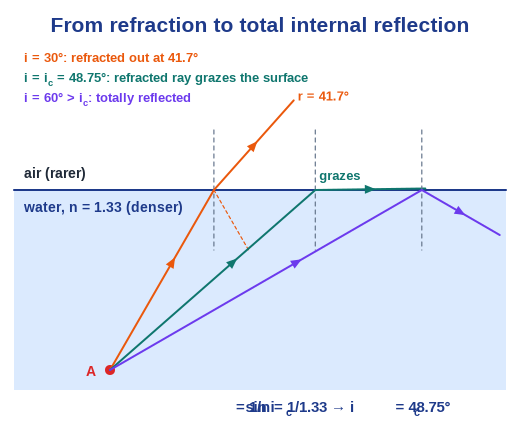
Light going from a denser to a rarer medium bends away from the normal, and some of it is reflected inside. As i grows, r reaches 90° at the critical angle i_c, where sin i_c = n₂₁ (that is, 1/n for a medium with respect to air). For i > i_c there is no refracted ray at all: every bit of the light is reflected. This is total internal reflection, and unlike reflection at a mirror it loses no light to transmission. Table 9.1 lists critical angles: water (n = 1.33) 48.75°, crown glass (1.52) 41.14°, diamond (2.42) 24.41°.
Uses in the book: right-angled prisms that turn light through 90° or 180°, or invert an image without changing its size (they need i_c < 45°, true for crown and dense flint glass), and optical fibres, whose core has a higher refractive index than the cladding, so light zigzags along by repeated total internal reflection even when the fibre bends. Fibres carry telephone and video signals and act as light pipes for viewing inside the stomach and intestines. The summary also lists multiple internal reflections in diamond and the mirage as examples. Read total internal reflection.
How does a spherical surface refract light?
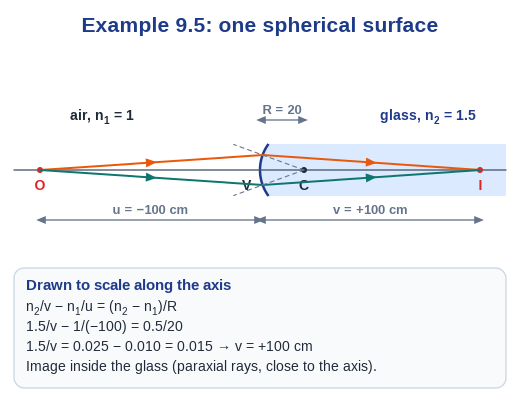
At a curved boundary between media of refractive index n₁ and n₂, the normal at each point passes through the centre of curvature. For a point object O on the axis, small angles and Snell’s law in the form n₁i = n₂r give, with the sign convention,
n₂/v − n₁/u = (n₂ − n₁)/R
Example 9.5: a point source 100 cm in front of a glass surface (n = 1.5, R = +20 cm) gives 1.5/v = 0.5/20 − 1/100, so v = +100 cm, inside the glass.
What are the lens maker’s formula and the lens formula?
A thin lens is two refracting surfaces close together. The first surface forms an image I₁, which acts as the object for the second. Adding the two surface equations (with the lens thickness neglected) and putting the object at infinity gives the lens maker’s formula:
1/f = (n₂₁ − 1)(1/R₁ − 1/R₂)
For a double convex lens R₁ > 0 and R₂ < 0, so f > 0; for a double concave lens R₁ < 0, R₂ > 0 and f < 0. The same steps give the thin lens formula and the magnification:
1/v − 1/u = 1/f and m = h′/h = v/u
The two foci are equally far from the optical centre. Ray rules: a ray parallel to the axis passes through the second focus F′ of a convex lens (or appears to come from the first focus of a concave lens); a ray through the optical centre goes straight on; a ray through the first focus of a convex lens (or heading for the second focus of a concave lens) leaves parallel. A lens of refractive index equal to the liquid around it has 1/f = 0 and vanishes (Example 9.6: n = 1.47, so the liquid could be glycerine, not water).
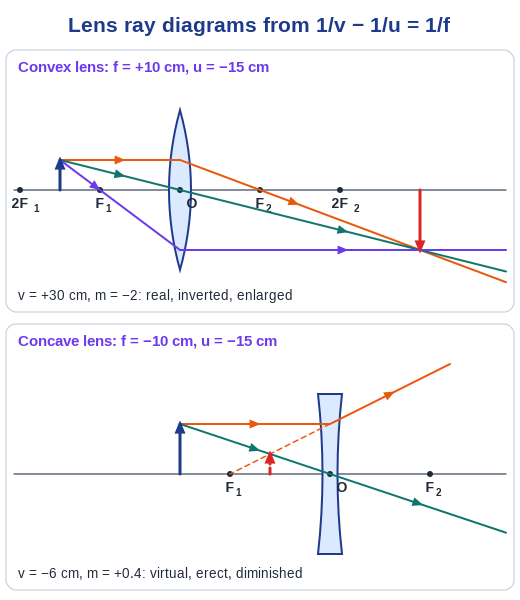
Power measures how strongly a lens bends light: P = 1/f, with f in metres, in dioptres (D). +2.5 D is a converging lens with f = 40 cm; −4.0 D is a diverging lens with f = −25 cm. For thin lenses in contact,
1/f = 1/f₁ + 1/f₂ + …, P = P₁ + P₂ + … and m = m₁m₂m₃…
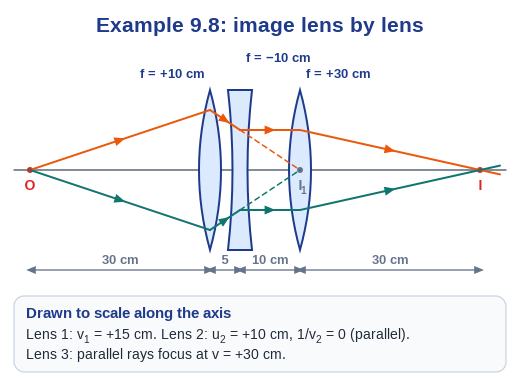
where the sums are algebraic. Example 9.7 finds n = 1.5 from R₁ = 10 cm, R₂ = −15 cm and f = 12 cm, and shows that a glass lens of f = 20 cm in air has f = 78.2 cm in water. Example 9.8 traces an object through three lenses in turn. Read the lens maker’s formula and power.
How does a prism deviate light?
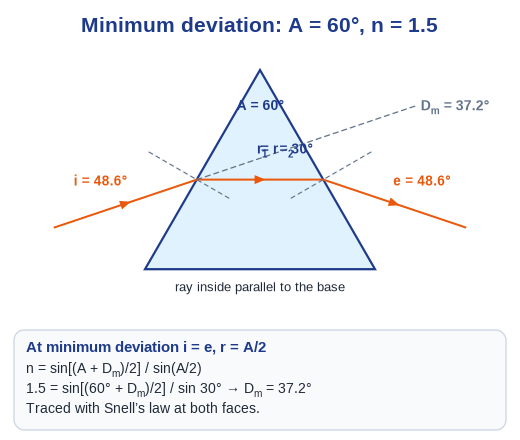
A ray entering a triangular prism of angle A is refracted at both faces. Geometry of the quadrilateral and triangle inside gives
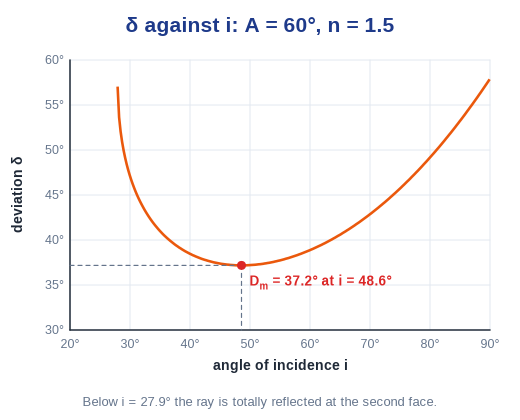
r₁ + r₂ = A and δ = i + e − A
where δ is the angle of deviation and e the angle of emergence. As i increases, δ first falls and then rises: it has a minimum D_m, reached when i = e and r₁ = r₂ = A/2, with the ray inside parallel to the base. Then
n₂₁ = sin[(A + D_m)/2] / sin(A/2)
so measuring A and D_m gives the refractive index. For a thin prism, D_m = (n₂₁ − 1)A. The summary adds that dispersion is the splitting of white light into its colours, because n depends on wavelength; the Class 10 chapter on the human eye and the colourful world covers it.
How do microscopes and telescopes work?
The chapter names the human eye as the most important optical device and refers back to Class 10 for it (see the Class 10 human eye notes). It then explains two instruments.
Simple microscope: a convex lens of short focal length held close to the eye, with the object at or inside F. With the image at the near point D ≈ 25 cm, m = 1 + D/f; with the image at infinity (relaxed eye), m = D/f. A 5 cm lens gives m = 6. Realistic lenses limit this to about 9.
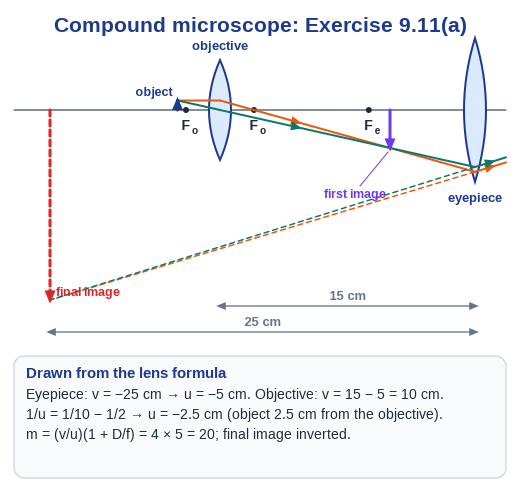
Compound microscope: the objective forms a real, inverted, enlarged image near the focus of the eyepiece, which acts as a simple microscope. With the final image at infinity, m = m_o m_e ≈ (L/f_o)(D/f_e), where L, the tube length, is the distance between the second focus of the objective and the first focus of the eyepiece. With f_o = 1.0 cm, f_e = 2.0 cm and L = 20 cm, m = 250. The final image is inverted.
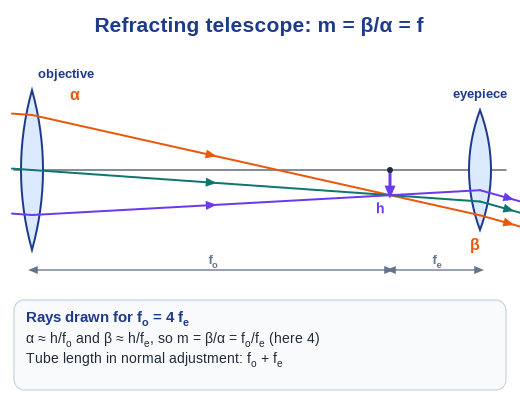
Refracting telescope: an objective of long focal length and large aperture forms a real image of a distant object at its focus; the eyepiece magnifies it. m = β/α = f_o/f_e in normal adjustment, with tube length f_o + f_e. With f_o = 100 cm and f_e = 1 cm, m = 100, so two stars 1′ apart appear 1.67° apart. A larger objective gathers more light and resolves finer detail.
Reflecting telescope: big lenses are heavy, hard to support and suffer chromatic aberration, so large telescopes use a concave mirror as objective. In the Cassegrain design a convex secondary mirror sends the light back through a hole in the primary. Examples in the book: the 2.34 m telescope at Kavalur, Tamil Nadu, and the 10 m Keck telescopes in Hawaii. Read microscopes and telescopes.
Which formulas and units belong to this chapter?
- Mirror: 1/v + 1/u = 1/f, f = R/2, m = −v/u.
- Snell’s law: sin i/sin r = n₂₁; critical angle sin i_c = 1/n.
- One surface: n₂/v − n₁/u = (n₂ − n₁)/R.
- Lens: 1/v − 1/u = 1/f, m = v/u; lens maker: 1/f = (n₂₁ − 1)(1/R₁ − 1/R₂).
- Power P = 1/f in dioptre (1 D = 1 m⁻¹); P = P₁ + P₂ + … for lenses in contact.
- Prism: r₁ + r₂ = A, δ = i + e − A, n₂₁ = sin[(A + D_m)/2]/sin(A/2).
- Simple microscope m = 1 + D/f or D/f; compound m ≈ (L/f_o)(D/f_e); telescope m = f_o/f_e.
Before we move on
Two equations with one sign convention, the mirror equation and the thin lens formula, describe every image in this chapter; Snell’s law explains refraction, the critical angle and the prism; and the instruments simply chain lenses or mirrors so that one image becomes the next object. All 31 exercises and the 8 worked examples are solved step by step in the NCERT solutions for Chapter 9.
Key terms
| Term | Meaning |
|---|---|
| Cartesian sign convention | Distances are measured from the pole of a mirror or the optical centre of a lens: positive along the direction of the incident light, negative against it. Heights above the principal axis are positive, below it negative. |
| Focal length (f) | The distance from the pole (or optical centre) to the principal focus. For a spherical mirror f = R/2. With the sign convention, f is negative for a concave mirror and a concave lens, positive for a convex mirror and a convex lens. |
| Mirror equation | 1/v + 1/u = 1/f, linking object distance u, image distance v and focal length f for a spherical mirror. Magnification m = h′/h = −v/u. |
| Refractive index (n₂₁) | n₂₁ = sin i/sin r (Snell’s law), the index of medium 2 relative to medium 1. It depends on the pair of media and on the wavelength, not on the angle of incidence. |
| Critical angle (i_c) | The angle of incidence in the denser medium at which the refracted ray leaves at 90° to the normal. sin i_c = 1/n for a medium of refractive index n with respect to air. |
| Total internal reflection | When light in a denser medium meets a rarer medium at more than the critical angle, none of it is refracted: all of it is reflected back. Optical fibres and totally reflecting prisms use it. |
| Lens maker’s formula | 1/f = (n₂₁ − 1)(1/R₁ − 1/R₂): the focal length of a thin lens from the refractive index of its material (relative to the surrounding medium) and the radii of curvature of its two faces. |
| Thin lens formula | 1/v − 1/u = 1/f, valid for convex and concave lenses and for real and virtual images. Magnification m = h′/h = v/u. |
| Power of a lens (P) | P = 1/f, with f in metres; unit dioptre (D), 1 D = 1 m⁻¹. Positive for a converging (convex) lens, negative for a diverging (concave) lens. Powers of thin lenses in contact add. |
| Angle of minimum deviation (D_m) | The smallest deviation a prism of angle A can produce. Then i = e, r₁ = r₂ = A/2 and the ray inside runs parallel to the base; n₂₁ = sin[(A + D_m)/2]/sin(A/2). |
| Magnifying power | For an optical instrument, the angle the final image makes at the eye divided by the angle the object makes without the instrument (at the near point for a microscope, at the eye for a telescope). |
| Near point (D) | The least distance of distinct vision, about 25 cm for a normal eye. A simple microscope gives m = 1 + D/f with the image at D, and m = D/f with the image at infinity. |
Topics in this chapter
Practice
-
A concave mirror has a focal length of 10 cm, and an object stands 30 cm in front of it. The image is formed at:
Show answer
Answer: (a) 15 cm in front of the mirror
-
The critical angle for a glass–air interface is 42°. Total internal reflection happens for a ray in the glass when the angle of incidence is:
Show answer
Answer: (c) more than 42°
-
A convex lens of power +4 D is placed in contact with a concave lens of power −2 D. The focal length of the combination is:
Show answer
Answer: (b) +50 cm
-
At the angle of minimum deviation through an equilateral prism, the angle of refraction at the first face is:
Show answer
Answer: (c) 30°
-
A telescope has an objective of focal length 120 cm and an eyepiece of focal length 4 cm. In normal adjustment its magnifying power and length are:
Show answer
Answer: (a) 30 and 124 cm
-
A simple microscope uses a lens of focal length 5 cm. With the image at the near point (25 cm), the magnification is:
Show answer
Answer: (b) 6
Questions students ask
What are the main topics of Class 12 Physics Chapter 9?
Reflection by spherical mirrors with the sign convention and mirror equation, refraction and Snell’s law, total internal reflection and optical fibres, refraction at a spherical surface, the lens maker’s formula, power and lens combinations, refraction through a prism, and the simple microscope, compound microscope and telescopes.
Why do we need a sign convention?
With signs for distances and heights, a single mirror equation and a single lens formula work for every case: concave or convex, object near or far, real or virtual image. Without signs, each case would need its own formula.
What is the difference between magnification and magnifying power?
Magnification m = h′/h compares sizes of image and object. Magnifying power compares angles: the angle the final image subtends at the eye against the angle the object would subtend without the instrument. For a magnifying glass they are equal only when the image is at the near point.
Why do big telescopes use mirrors instead of lenses?
A mirror has no chromatic aberration, weighs much less than an equally good lens, and can rest on its whole back instead of only its rim. Very large lenses are heavy and hard to make without distortion.
Is the human eye part of this chapter?
The rationalised chapter only names the eye as an important optical device and refers back to Class 10, where its parts, accommodation and defects of vision are covered. The new material here is the microscope and the telescope.
Stuck on a question?
Take a photo and Lagnever AI explains it step by step. Try it for 7 days for ₹2.
Get it on Google Play Open in browser
For parents: after the trial, the plan renews monthly by UPI or card autopay. You can cancel anytime in the app.