
What is the lens maker’s formula?
Answer in short
The lens maker’s formula, 1/f = (n₂₁ − 1)(1/R₁ − 1/R₂), gives the focal length of a thin lens from the refractive index of its material relative to the surroundings and the radii of its two faces. It follows from applying n₂/v − n₁/u = (n₂ − n₁)/R at each surface.
Stuck on a question? Take a photo and Lagnever AI explains it step by step. Try it for 7 days for ₹2. Get it on Google Play
How is light refracted at one spherical surface?
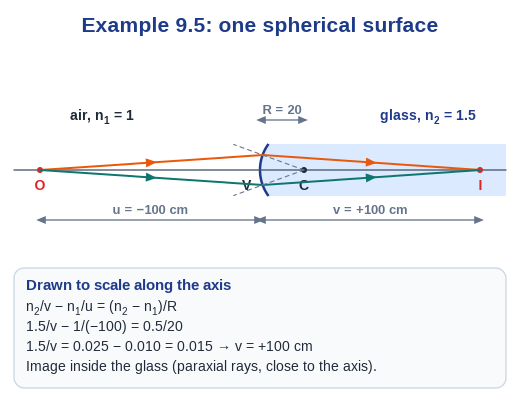
Let a spherical surface of radius R separate a medium of refractive index n₁ (where the light comes from) from a medium of refractive index n₂. The normal at any point N on the surface is the radius through N, so it passes through the centre of curvature C. Take a point object O on the axis and a ray from O to N that refracts and crosses the axis at the image I. If the surface is small compared with the distances (paraxial rays), every angle is small and can be replaced by its tangent:
- angle of incidence: i = ∠NOM + ∠NCM = MN/OM + MN/MC
- angle of refraction: r = ∠NCM − ∠NIM = MN/MC − MN/MI
Snell’s law for small angles, n₁i = n₂r, then gives n₁/OM + n₂/MI = (n₂ − n₁)/MC. With the sign convention (OM = −u, MI = +v, MC = +R) this becomes
n₂/v − n₁/u = (n₂ − n₁)/R
It holds for any spherical refracting surface. In Example 9.5, a source 100 cm from a glass surface (n₁ = 1, n₂ = 1.5, R = +20 cm) gives 1.5/v = 0.5/20 − 1/100 = 0.015, so v = +100 cm: the image forms 100 cm inside the glass.
How do two surfaces make a lens?
A thin lens of refractive index n₂ in a medium n₁ has two faces with centres C₁ and C₂. The first face would form an image I₁ of the object O inside the glass. That image acts as the object for the second face, where the light passes from n₂ back to n₁ and forms the final image I. Writing the surface equation for each face, taking the thickness as negligible so that the two distances to I₁ cancel, and adding:
n₁/OB + n₁/DI = (n₂ − n₁)(1/BC₁ + 1/DC₂)
For an object at infinity the image is at the focus, DI = f. With BC₁ = +R₁ and DC₂ = −R₂, this gives the lens maker’s formula:
1/f = (n₂₁ − 1)(1/R₁ − 1/R₂), where n₂₁ = n₂/n₁
Signs decide the type: a double convex lens has R₁ positive and R₂ negative, so 1/R₁ − 1/R₂ > 0 and f > 0 (converging). A double concave lens has R₁ negative and R₂ positive, so f < 0 (diverging).
How do we get the thin lens formula?
Comparing the two-surface result with the lens maker’s formula gives n₁/OB + n₁/DI = n₁/f. With OB = −u and DI = +v,
1/v − 1/u = 1/f
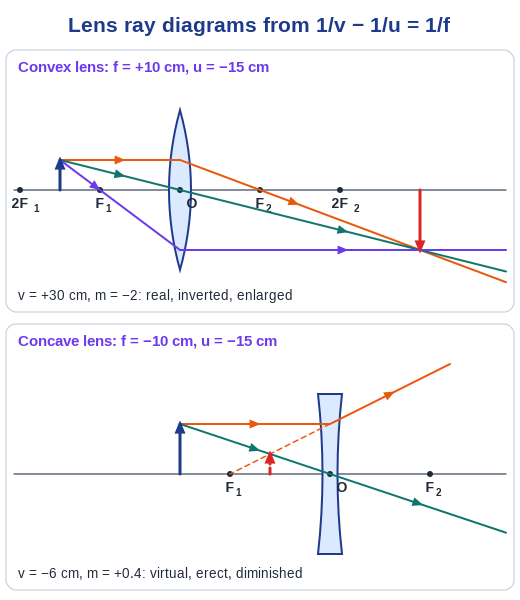
It holds for convex and concave lenses and for real and virtual images. The two foci lie at equal distances on either side of the lens; the one on the side of the incoming light is the first focal point. The magnification is
m = h′/h = v/u
m is negative for a real, inverted image and positive for a virtual, erect one.
Example 9.6: a glass lens (n = 1.47) vanishes in a liquid. That needs n₂₁ = 1, so 1/f = 0: the lens acts as a flat sheet. The liquid has n = 1.47, so it is not water (1.33); it could be glycerine.
What is the power of a lens?
The power P measures how sharply a lens converges or diverges light. The book defines it through the angle δ by which the lens bends a ray parallel to the axis at unit height: tan δ = 1/f, and for small δ,
P = 1/f
The SI unit is the dioptre (D): 1 D = 1 m⁻¹, the power of a lens of focal length 1 m. Converging lenses have positive power, diverging lenses negative. A prescription of +2.5 D means a convex lens of f = +40 cm; −4.0 D means a concave lens of f = −25 cm. In Example 9.7(i), f = 0.5 m gives P = +2 D.
Example 9.7(ii): R₁ = +10 cm, R₂ = −15 cm, f = +12 cm. Then 1/12 = (n − 1)(1/10 + 1/15) = (n − 1)/6, so n = 1.5.
Example 9.7(iii): in air, 1/20 = 0.5 K, where K = 1/R₁ − 1/R₂. In water, n₂₁ = 1.5/1.33, so 1/f = (0.17/1.33) K. Dividing, f = 20 × 0.5 × 1.33/0.17 = 78.2 cm.
What happens when thin lenses are in contact?
For lenses A and B (focal lengths f₁ and f₂) touching each other, the image I₁ by lens A is the object for lens B. Writing 1/v₁ − 1/u = 1/f₁ and 1/v − 1/v₁ = 1/f₂ and adding, v₁ drops out:
1/f = 1/f₁ + 1/f₂, and for many lenses 1/f = 1/f₁ + 1/f₂ + 1/f₃ + …
In powers, P = P₁ + P₂ + P₃ + …, an algebraic sum in which concave lenses count as negative. The total magnification is the product, m = m₁m₂m₃…. Camera and microscope lenses use such combinations.
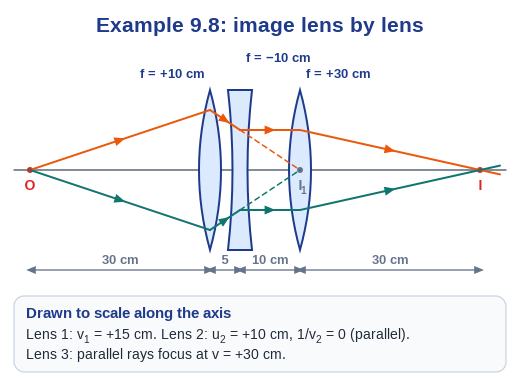
When lenses are not in contact, trace the image lens by lens. In Example 9.8, an object 30 cm before a +10 cm lens gives v₁ = 15 cm. The second lens (−10 cm) is 5 cm further on, so the first image is a virtual object 10 cm beyond it: 1/v₂ = −1/10 + 1/10 = 0, and the rays leave parallel. The third lens (+30 cm) brings parallel rays to its focus, so the final image is 30 cm beyond it.
Exercises 9.7, 9.8, 9.10, 9.20 and 9.31 use these formulas; see the NCERT solutions. Chapter overview: Chapter 9 notes.
Practice
-
A double convex lens of glass (n = 1.5) has both radii of curvature 20 cm. Its focal length in air is:
Show answer
Answer: (b) 20 cm
-
The power of a concave lens of focal length 50 cm is:
Show answer
Answer: (b) −2 D
-
A glass lens disappears when dipped in a liquid. This means the liquid has:
Show answer
Answer: (b) the same refractive index as the glass
-
Lenses of power +5 D and −3 D are placed in contact. Find the focal length of the combination and say whether it converges or diverges.
Show answer
Answer: P = +5 − 3 = +2 D, so f = 1/P = 0.5 m = +50 cm. The combination is converging.
-
A plano-convex lens (n = 1.5) must have a focal length of 30 cm. What radius should its curved face have?
Show answer
Answer: With the plane face R₂ = ∞: 1/f = (1.5 − 1)(1/R₁) gives R₁ = 0.5 × 30 = 15 cm.
Questions students ask
Why is it called the lens maker’s formula?
A lens maker who wants a given focal length chooses a glass (n) and grinds the two faces to suitable radii. The formula tells which radii will give that focal length.
Does a lens have the same focal length in water?
No. In water n₂₁ = n_glass/n_water is smaller, so (n₂₁ − 1) is smaller and f is longer. Example 9.7 shows a glass lens of f = 20 cm in air has f ≈ 78 cm in water.
Why do opticians use power instead of focal length?
Powers of thin lenses in contact simply add, which makes it easy to combine lenses and to describe a correction: +2.5 D is a converging lens with f = 40 cm, −4.0 D a diverging lens with f = −25 cm.
Stuck on a question?
Take a photo and Lagnever AI explains it step by step. Try it for 7 days for ₹2.
Get it on Google Play Open in browser
For parents: after the trial, the plan renews monthly by UPI or card autopay. You can cancel anytime in the app.