
How do microscopes and telescopes work?
Answer in short
A simple microscope is one convex lens: m = 1 + D/f, or D/f with the image at infinity. A compound microscope adds an eyepiece to a short-focus objective: m ≈ (L/f_o)(D/f_e). A telescope pairs a long-focus objective with a short-focus eyepiece: m = f_o/f_e.
Stuck on a question? Take a photo and Lagnever AI explains it step by step. Try it for 7 days for ₹2. Get it on Google Play
How does a simple microscope magnify?
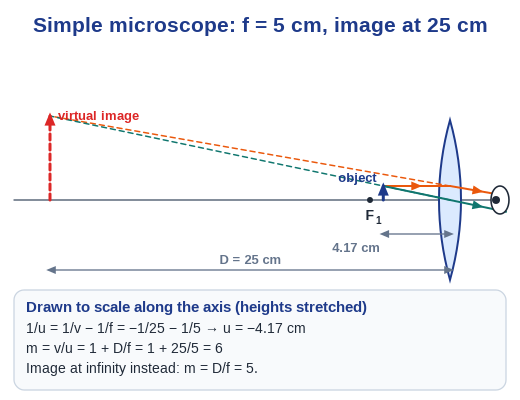
A simple microscope (magnifying glass) is a converging lens of short focal length. The object is placed at its focus or a little inside it, and the eye is held near the lens, on its far side, so it sees an erect, enlarged, virtual image.
The key idea: without a lens, the largest angle a small object can make at the eye comes when it sits at the near point, D ≈ 25 cm; any closer and it blurs. The lens lets us bring the object much closer and still see it clearly.
- Image at the near point: v = −D. The lens formula gives m = v/u = 1 − v/f, so m = 1 + D/f. A lens of f = 5 cm gives m = 6.
- Image at infinity: the object sits at F. Without the lens, at D, the object subtends θ_o ≈ h/D. With the lens, the image subtends θ_i ≈ h/f. So m = θ_i/θ_o = D/f, one less than before, but the relaxed eye is more comfortable, and the difference is small.
The book notes that the image and object subtend the same angle at the lens: the gain comes entirely from bringing the object closer than 25 cm. Realistic focal lengths limit a simple microscope to about m = 9.
How does a compound microscope work?
For higher magnification, two lenses share the work:
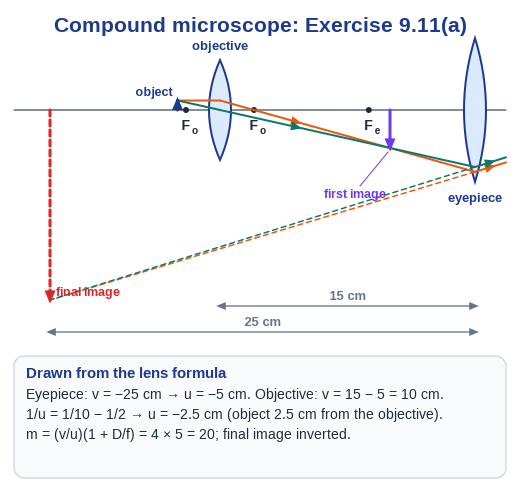
- The objective, of short focal length f_o, faces the object and forms a real, inverted, enlarged image.
- The eyepiece, focal length f_e, acts as a simple microscope on that first image, which lies at or just inside its focus. The final image is virtual, enlarged and inverted relative to the object.
The tube length L is the distance between the second focus of the objective and the first focus of the eyepiece. Similar triangles in the ray diagram give the objective’s magnification m_o = h′/h = L/f_o. The eyepiece adds m_e = 1 + D/f_e (final image at D) or m_e = D/f_e (final image at infinity). The total is the product:
m = m_o m_e ≈ (L/f_o)(D/f_e) (image at infinity)
With f_o = 1.0 cm, f_e = 2.0 cm and L = 20 cm, m = 20 × 12.5 = 250. Short focal lengths for both lenses and a long tube give large m, but focal lengths below about 1 cm are hard to make. Real microscopes use multi-element lenses to reduce aberrations, and good illumination of the object matters too.
How does a refracting telescope work?
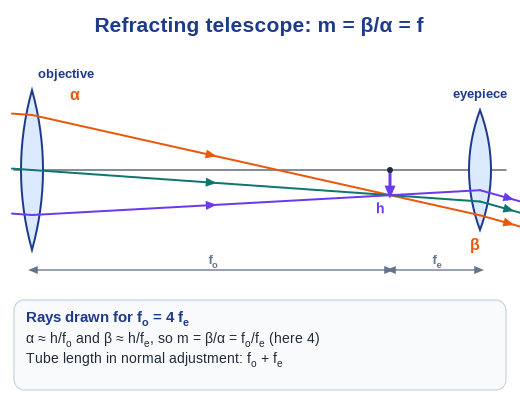
A telescope gives angular magnification of distant objects. Its objective has a long focal length and a large aperture; light from a far object forms a real, inverted image at the objective’s second focus. The eyepiece magnifies this image. In normal adjustment the final image is at infinity, so the first image sits at the eyepiece’s focus too, and the tube length is f_o + f_e.
If the object subtends α at the objective and the final image subtends β at the eye, the first image of height h gives α ≈ h/f_o and β ≈ h/f_e, so
m = β/α = f_o/f_e
With f_o = 100 cm and f_e = 1 cm, m = 100: two stars 1′ apart look 100′ = 1.67° apart. For astronomy the objective’s diameter matters most: a wider objective collects more light (fainter objects) and has better resolving power (separates objects in nearly the same direction). Terrestrial telescopes add inverting lenses so the image is erect.
Why do big telescopes use mirrors?
The largest lens objective in use is about 1.02 m across (Yerkes Observatory, USA). Bigger lenses are very heavy, can be held only at their rims, and are hard to make without chromatic aberration and distortion. So large modern telescopes are reflecting telescopes, with a concave mirror as objective:
- a mirror has no chromatic aberration;
- it weighs much less than a lens of equal quality and can be supported over its whole back.
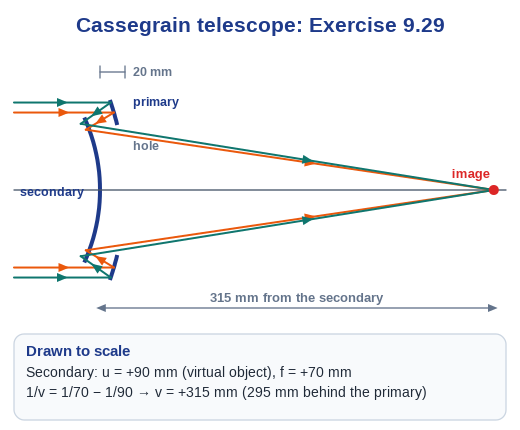
The catch is that the mirror focuses light inside the tube, where an observer (as in the 5.08 m Mt. Palomar telescope) blocks some light. The Cassegrain design avoids this: a small convex secondary mirror sends the converging light back through a hole in the primary to the eyepiece, giving a long focal length in a short tube. India’s largest, the 2.34 m telescope at Kavalur, Tamil Nadu, is a Cassegrain; the Keck telescopes in Hawaii have 10 m mirrors.
Safety: never point a telescope, binoculars or a magnifying glass at the Sun, and never look at the Sun through any of them: it can blind you in an instant. Any activity with sunlight is done only with a teacher.
Exercises 9.11 to 9.14 and 9.22 to 9.29 are worked out in the NCERT solutions. Chapter overview: Chapter 9 notes.
Practice
-
A simple microscope with a lens of focal length 2.5 cm, image at infinity, has a magnifying power of:
Show answer
Answer: (a) 10
-
In a compound microscope, the image formed by the objective is:
Show answer
Answer: (b) real, inverted and enlarged
-
A telescope has f_o = 90 cm and f_e = 3 cm. Its magnifying power in normal adjustment is:
Show answer
Answer: (c) 30
-
A compound microscope has f_o = 0.5 cm, f_e = 2.5 cm and tube length L = 15 cm. Find its magnifying power with the final image at infinity.
Show answer
Answer: m ≈ (L/f_o)(D/f_e) = (15/0.5) × (25/2.5) = 30 × 10 = 300.
-
Give two reasons why large modern telescopes use mirrors rather than lenses.
Show answer
Answer: A mirror has no chromatic aberration, and it is much lighter than a lens of equal quality, and its whole back can be held up, not just the rim. Very large lenses are heavy, sag and are hard to make without distortion.
Questions students ask
Why is the image at infinity preferred?
The eye views an image at infinity while relaxed. An image at the near point gives slightly more magnification (by 1 for a simple microscope) but strains the eye, and the gain is small.
Why is the final image of an astronomical telescope inverted, and does it matter?
The objective forms an inverted real image and the eyepiece magnifies it without turning it back. For stars this does not matter. Terrestrial telescopes add two extra lenses that turn the image upright.
What limits a simple microscope?
Lenses of very short focal length are hard to grind, and their aberrations grow. The book puts the realistic maximum at about 9; larger magnification needs a compound microscope.
Stuck on a question?
Take a photo and Lagnever AI explains it step by step. Try it for 7 days for ₹2.
Get it on Google Play Open in browser
For parents: after the trial, the plan renews monthly by UPI or card autopay. You can cancel anytime in the app.