
Microscope aur telescope kaise kaam karte hain?
Short mein jawab
Simple microscope ek convex lens hai: m = 1 + D/f, ya image infinity par ho to D/f. Compound microscope short-focus objective ke saath eyepiece jodta hai: m ≈ (L/f_o)(D/f_e). Telescope long-focus objective aur short-focus eyepiece use karta hai: m = f_o/f_e.
Koi sawal atak gaya? Photo lo, Lagnever AI step-by-step samjhayega. 7 din ka trial sirf ₹2. Google Play se app lo
Simple microscope kaise magnify karta hai?
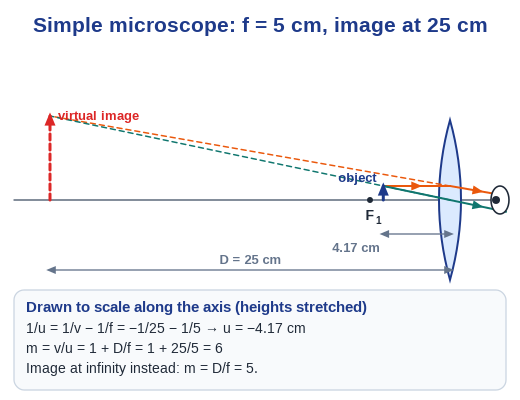
Simple microscope (magnifying glass) chhoti focal length ka converging lens hai. Object uske focus par ya thoda andar rakha jaata hai, aur aankh doosri taraf lens ke paas rakhi jaati hai, to wo seedhi, badi, virtual image dekhti hai.
Main idea: lens ke bina chhota object aankh par sabse bada angle tab banata hai jab wo near point, D ≈ 25 cm, par ho; usse paas wo dhundhla ho jaata hai. Lens object ko kaafi paas laane deta hai aur phir bhi saaf dikhata hai.
- Image near point par: v = −D. Lens formula m = v/u = 1 − v/f deta hai, isliye m = 1 + D/f. f = 5 cm ka lens m = 6 deta hai.
- Image infinity par: object F par hai. Lens ke bina, D par, object θ_o ≈ h/D banata hai. Lens ke saath image θ_i ≈ h/f banati hai. To m = θ_i/θ_o = D/f, pehle se ek kam, par relaxed aankh ke liye aaramdeh, aur fark chhota hai.
Book batati hai ki image aur object lens par ek jaisa angle banate hain: saara fayda object ko 25 cm se paas laane se aata hai. Realistic focal lengths simple microscope ko lagbhag m = 9 tak seemit rakhti hain.
Compound microscope kaise kaam karta hai?
Zyada magnification ke liye do lenses kaam baant-te hain:
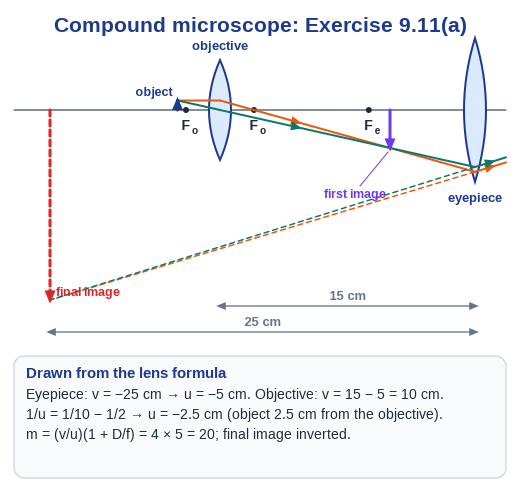
- Objective, chhoti focal length f_o, object ki taraf hota hai aur real, ulti, badi image banata hai.
- Eyepiece, focal length f_e, us pehli image par simple microscope ki tarah kaam karta hai, jo uske focus par ya thoda andar hoti hai. Final image virtual, badi aur object ke muqable ulti hoti hai.
Tube length L objective ke second focus aur eyepiece ke first focus ki doori hai. Ray diagram ke similar triangles objective ka magnification m_o = h′/h = L/f_o dete hain. Eyepiece m_e = 1 + D/f_e (final image D par) ya m_e = D/f_e (final image infinity par) jodta hai. Kul product hai:
m = m_o m_e ≈ (L/f_o)(D/f_e) (image infinity par)
f_o = 1.0 cm, f_e = 2.0 cm aur L = 20 cm se m = 20 × 12.5 = 250. Dono lenses ki chhoti focal lengths aur lambi tube bada m deti hain, par lagbhag 1 cm se chhoti focal length banana mushkil hai. Asli microscopes aberrations kam karne ke liye kai elements wale lenses use karte hain, aur object par achhi roshni bhi zaroori hai.
Refracting telescope kaise kaam karta hai?
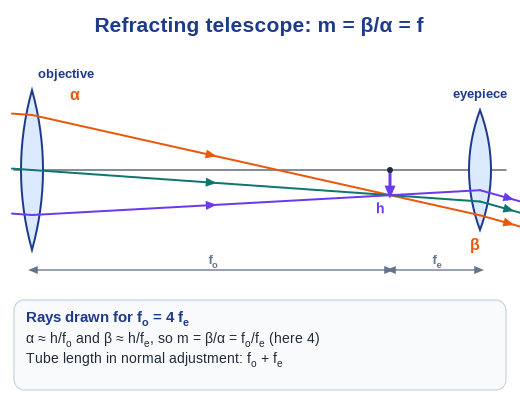
Telescope door ki cheezon ka angular magnification deta hai. Uska objective lambi focal length aur bade aperture ka hota hai; door ki cheez ki light objective ke second focus par real, ulti image banati hai. Eyepiece is image ko magnify karta hai. Normal adjustment mein final image infinity par hoti hai, to pehli image eyepiece ke focus par bhi hoti hai, aur tube length f_o + f_e hai.
Agar object objective par α banata hai aur final image aankh par β, to h height ki pehli image se α ≈ h/f_o aur β ≈ h/f_e, isliye
m = β/α = f_o/f_e
f_o = 100 cm aur f_e = 1 cm se m = 100: 1′ door do taare 100′ = 1.67° door dikhte hain. Astronomy ke liye objective ka diameter sabse zaroori hai: chauda objective zyada light ikattha karta hai (dhundhli cheezein bhi dikhti hain) aur behtar resolving power deta hai (lagbhag ek hi direction ki cheezein alag dikhti hain). Terrestrial telescopes inverting lenses jodte hain taaki image seedhi ho.
Bade telescopes mirror kyun use karte hain?
Istemaal mein sabse bada lens objective lagbhag 1.02 m ka hai (Yerkes Observatory, USA). Usse bade lens bahut bhaari hote hain, sirf kinaron se pakde ja sakte hain, aur chromatic aberration aur distortion ke bina banana mushkil hai. Isliye bade modern telescopes reflecting telescopes hain, jinme objective concave mirror hota hai:
- mirror mein chromatic aberration nahi hota;
- wo utni hi quality ke lens se kaafi halka hai aur poori peeth se support ho sakta hai.
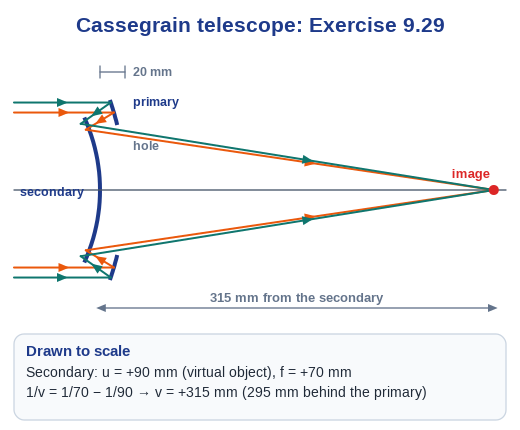
Dikkat ye hai ki mirror light ko tube ke andar focus karta hai, jahan baitha observer (jaise 5.08 m ke Mt. Palomar telescope mein) kuch light rok leta hai. Cassegrain design isse bachta hai: chhota convex secondary mirror converge hoti light ko primary ke beech ke chhed se eyepiece tak wapas bhejta hai, jisse chhoti tube mein lambi focal length milti hai. India ka sabse bada, Kavalur, Tamil Nadu ka 2.34 m telescope, Cassegrain hai; Hawaii ke Keck telescopes ke mirror 10 m ke hain.
Safety: telescope, binoculars ya magnifying glass ko kabhi Sun ki taraf mat karo, aur inme se Sun ko kabhi mat dekho: aankh pal bhar mein kharab ho sakti hai. Sunlight wali koi bhi activity sirf teacher ke saath karo.
Exercises 9.11 se 9.14 aur 9.22 se 9.29 NCERT solutions mein hal ki gayi hain. Chapter ka overview: Chapter 9 ke notes.
Practice karo
-
2.5 cm focal length ke lens wala simple microscope, image infinity par, magnifying power deta hai:
Jawab dekho
Jawab: (a) 10
-
Compound microscope mein objective ki banayi image hoti hai:
Jawab dekho
Jawab: (b) real, ulti aur badi
-
Telescope ke f_o = 90 cm aur f_e = 3 cm hain. Normal adjustment mein magnifying power hai:
Jawab dekho
Jawab: (c) 30
-
Compound microscope ke f_o = 0.5 cm, f_e = 2.5 cm aur tube length L = 15 cm hain. Final image infinity par ho to magnifying power nikalo.
Jawab dekho
Jawab: m ≈ (L/f_o)(D/f_e) = (15/0.5) × (25/2.5) = 30 × 10 = 300.
-
Bade modern telescopes lens ki jagah mirror kyun use karte hain, do wajah batao.
Jawab dekho
Jawab: Mirror mein chromatic aberration nahi hota, aur wo utni hi quality ke lens se kaafi halka hai aur poori peeth se support ho sakta hai. Bahut bade lens bhaari hote hain, jhukte hain aur bina distortion ke banana mushkil hai.
Students ke sawal
Image infinity par kyun pasand ki jaati hai?
Infinity par image ko aankh relaxed rehkar dekhti hai. Near point par image thoda zyada magnification deti hai (simple microscope mein 1 zyada) par aankh par zor daalti hai, aur fayda chhota hai.
Astronomical telescope ki final image ulti kyun hoti hai, aur kya isse fark padta hai?
Objective ulti real image banata hai aur eyepiece use bina palte magnify karta hai. Taaron ke liye isse fark nahi padta. Terrestrial telescopes image seedhi karne ke liye inverting lenses ka ek jodha jodte hain.
Simple microscope ko kya seemit karta hai?
Bahut chhoti focal length ke lens ghisna mushkil hai, aur unke aberrations badh jaate hain. Book realistic maximum lagbhag 9 batati hai; zyada magnification ke liye compound microscope chahiye.
Koi sawal atak gaya?
Photo lo, Lagnever AI step-by-step samjhayega. 7 din ka trial sirf ₹2.
Google Play se app lo Browser mein kholo
Parents ke liye: trial ke baad plan har mahine UPI ya card autopay se renew hota hai. App mein kabhi bhi cancel kar sakte hain.