
Class 12 Physics Chapter 9: Ray Optics and Optical Instruments Notes Hinglish mein
Ye chapter 5 lines mein
Ray optics light ko rays maanta hai jo seedhi line mein chalti hain aur reflection aur refraction ke laws follow karti hain. Cartesian sign convention ke saath ek mirror equation, 1/v + 1/u = 1/f, aur ek thin lens formula, 1/v − 1/u = 1/f, har case sambhaal lete hain. Phir chapter total internal reflection, lens maker’s formula, prism se refraction, aur microscope aur telescope ka magnification samjhaata hai.
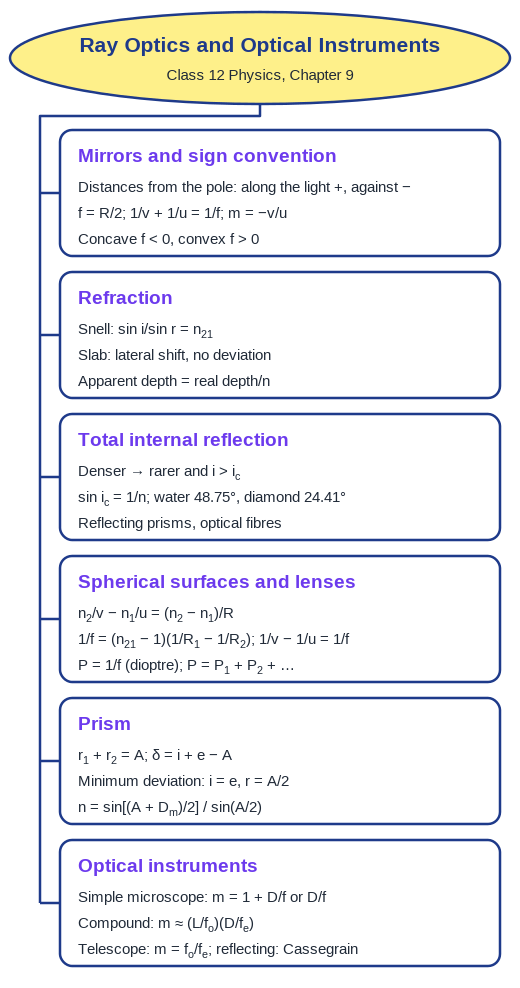
Ye chapter kis baare mein hai?
Hamari aankhein electromagnetic spectrum ki ek patli band par react karti hain, lagbhag 400 nm se 750 nm ki wavelengths, aur is band ko ham light kehte hain (Chapter 8 ne ise poore spectrum mein dikhaya tha). Light bahut tez chalti hai, vacuum mein c ≈ 3 × 10⁸ m/s, jo nature ki sabse oonchi possible speed hai, aur roz ki zindagi mein seedhi line mein chalti lagti hai. Dono baatein wave picture se mel khaati hain kyunki light ki wavelength aam cheezon ke muqable bahut chhoti hai, isliye ham light ko seedhe raston par follow kar sakte hain jinhe rays kehte hain; rays ka bundle beam hai.
Ye chapter (book pages 221 se 254) rays se spherical mirrors ka reflection, plane aur curved surfaces par refraction, total internal reflection, lenses, prism, aur aakhir mein microscope aur telescope padhta hai. Ye Class 10 ke reflection aur refraction wale chapter par bana hai, isliye ray rules jaane-pehchaane lagenge; naya hai poora sign convention, derivations aur kaafi zyada numericals.
Safety: Sun ko lens, prism, telescope, binoculars ya mirror se kabhi mat dekho, ek pal ke liye bhi nahi: isse aankh hamesha ke liye kharab ho sakti hai. Lens se sunlight ko skin ya kaagaz par focus mat karo; sunlight wali koi bhi activity sirf teacher ke saath karo. Laser pointer kabhi kisi ki aankh ya chehre par mat chamkao, aur laser activities sirf teacher ke saath karo.
Book kaun sa sign convention use karti hai?
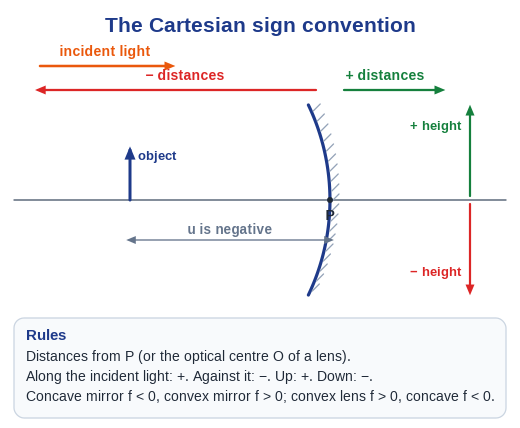
Saari distances mirror ke pole P ya lens ke optical centre se, principal axis (x-axis) ke along naapi jaati hain:
- Incident light ki direction mein distances positive; ulti direction mein negative. Light left se aaye to mirror ya lens ke left ki har cheez negative hai.
- Axis se upar naapi heights positive; neeche naapi heights negative.
Isliye mirror ke saamne object ke liye hamesha u < 0. Concave mirror ka focus saamne hota hai, to f < 0; convex mirror ka f > 0. Convex lens ka f > 0 aur concave lens ka f < 0.
Spherical mirrors image kaise banate hain?
Reflection ke laws curved mirror ke har point par lagte hain, aur kisi point par normal us point se guzarne wala radius hai. Paraxial rays lo: axis ke paas aur usse chhota angle banane wali rays. Axis ke parallel ek ray mirror ko M par milti hai; wahan angle of incidence θ ho to reflected ray axis ko F par kaat-ti hai, ∠MFP = 2θ jabki ∠MCP = θ. Chhote angles ke liye tan θ ≈ θ, jisse FD = CD/2 aur isliye
f = R/2
In mein se koi do rays image dhoondh leti hain: axis ke parallel ray reflect hokar F se guzarti hai (convex mirror mein F se aati lagti hai); C se (ya C ki taraf) jaane wali ray seedhi wapas aati hai; F se (ya F ki taraf) jaane wali ray parallel nikalti hai; pole par girne wali ray axis ke barabar angle par reflect hoti hai. Ray diagram ke similar triangles, signs lagaakar, mirror equation aur magnification dete hain:
1/v + 1/u = 1/f aur m = h′/h = −v/u
Concave mirror ki real image ke liye derive kiye gaye, ye har case mein sahi hain: concave ya convex, real ya virtual. Negative m ulti image, positive m seedhi image batata hai.
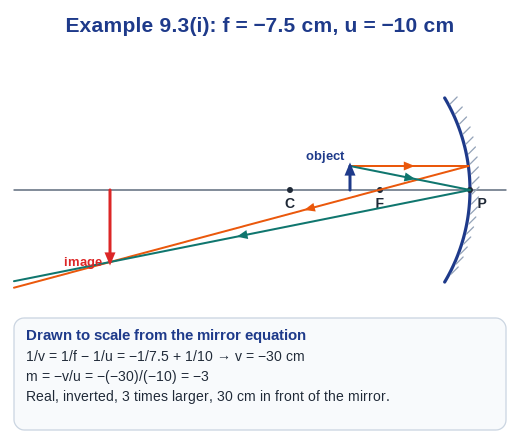
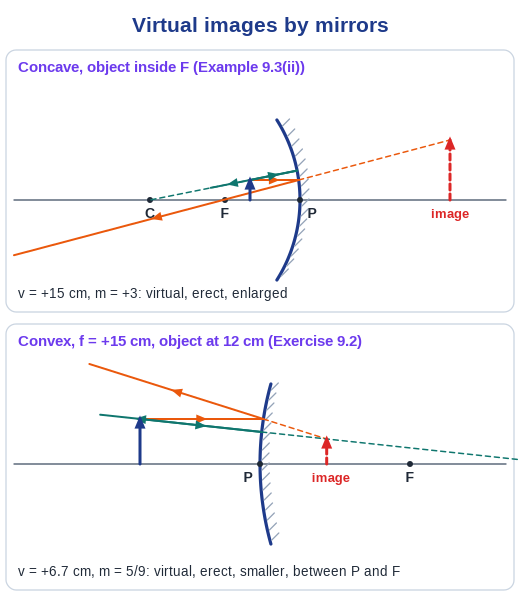
Example 9.3 R = 15 cm (f = −7.5 cm) ke saath dono tarah ki images dikhata hai. Object 10 cm par ho to v = −30 cm aur m = −3: real, ulti, teen guna badi. Object 5 cm par, F ke andar, ho to v = +15 cm aur m = +3: virtual, seedhi, mirror ke peeche. Convex mirror hamesha P aur F ke beech virtual, seedhi, chhoti image deta hai, isliye wo side-view mirror banta hai (Example 9.4: 5 m/s ki steady speed se daudte jogger ki image, jogger ke paas aane par, 1/280 m/s se 1/10 m/s tak tez hoti lagti hai).
Refraction ke laws kya hain?
Jab light doosre transparent medium se milti hai, to kuch hissa reflect hota hai aur baaki naye medium mein jaata hai; tirchhi ray wahan direction badalti hai. Snell ke laws kehte hain ki incident ray, refracted ray aur normal ek plane mein hote hain, aur
sin i/sin r = n₂₁
jahan n₂₁, medium 1 ke respect mein medium 2 ka refractive index, dono media aur wavelength par depend karta hai par i par nahi. n₂₁ > 1 ho to ray normal ki taraf mudti hai aur medium 2 optically denser hai. Optical density mass density nahi hai: turpentine paani se halka hai par optically denser hai. Saath hi n₁₂ = 1/n₂₁, aur n₃₂ = n₃₁ × n₁₂.
Rectangular glass slab ray ko bina direction badle side mein khiska deta hai (lateral shift). Normal ke kareeb se dekhne par paani ka tank asal se kam gehra lagta hai: apparent depth = real depth/n.
Total internal reflection kya hai?
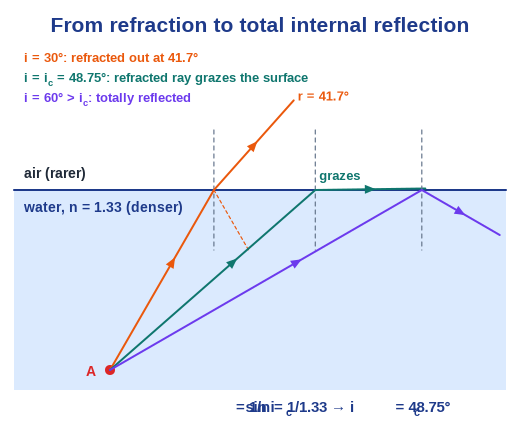
Denser se rarer medium mein jaati light normal se door mudti hai, aur kuch andar hi reflect hoti hai. Jaise-jaise i badhta hai, critical angle i_c par r 90° ho jaata hai, jahan sin i_c = n₂₁ (yaani air ke respect mein medium ke liye 1/n). i > i_c ke liye koi refracted ray nahi hoti: saari light reflect ho jaati hai. Ye total internal reflection hai, aur mirror ke reflection ke ulat isme transmission mein koi light nahi khoti. Table 9.1 critical angles deti hai: paani (n = 1.33) 48.75°, crown glass (1.52) 41.14°, diamond (2.42) 24.41°.
Book ke uses: right-angled prisms jo light ko 90° ya 180° modte hain, ya image ka size badle bina use ulat dete hain (inhe i_c < 45° chahiye, jo crown aur dense flint glass mein hai), aur optical fibres, jinke core ka refractive index cladding se zyada hota hai, isliye light baar-baar total internal reflection se zigzag chalti hai, fibre mude tab bhi. Fibres telephone aur video signals le jaate hain aur pet aur aanton ke andar dekhne ke liye light pipe ka kaam karte hain. Summary diamond ke andar multiple internal reflections aur mirage ko bhi examples mein ginaati hai. Padho total internal reflection kya hai.
Spherical surface light ko kaise refract karti hai?
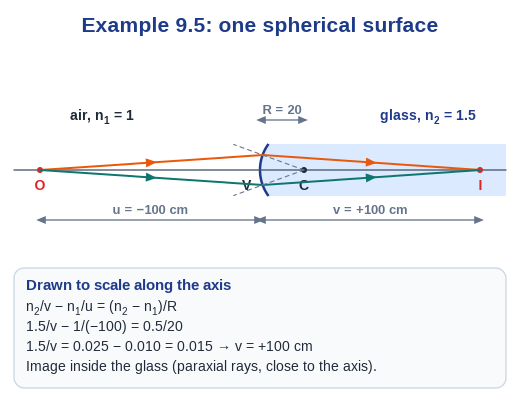
Refractive index n₁ aur n₂ wale media ki curved boundary par har point ka normal centre of curvature se guzarta hai. Axis par point object O ke liye chhote angles aur n₁i = n₂r wala Snell ka law, sign convention ke saath, dete hain
n₂/v − n₁/u = (n₂ − n₁)/R
Example 9.5: glass surface (n = 1.5, R = +20 cm) ke 100 cm saamne point source se 1.5/v = 0.5/20 − 1/100, to v = +100 cm, glass ke andar.
Lens maker’s formula aur lens formula kya hain?
Thin lens do paas-paas refracting surfaces hai. Pehli surface image I₁ banati hai, jo doosri ke liye object ka kaam karti hai. Dono surface equations jodkar (lens ki motai chhodkar) aur object ko infinity par rakhkar lens maker’s formula milta hai:
1/f = (n₂₁ − 1)(1/R₁ − 1/R₂)
Double convex lens ke liye R₁ > 0 aur R₂ < 0, to f > 0; double concave ke liye R₁ < 0, R₂ > 0 aur f < 0. Yahi steps thin lens formula aur magnification dete hain:
1/v − 1/u = 1/f aur m = h′/h = v/u
Dono foci optical centre se barabar door hote hain. Ray rules: axis ke parallel ray convex lens ke second focus F′ se guzarti hai (concave lens ke first focus se aati lagti hai); optical centre se guzarne wali ray seedhi jaati hai; convex lens ke first focus se (ya concave lens ke second focus ki taraf) jaane wali ray parallel nikalti hai. Aas-paas ke liquid jitne refractive index wala lens 1/f = 0 rakhta hai aur gayab ho jaata hai (Example 9.6: n = 1.47, to liquid glycerine ho sakta hai, paani nahi).
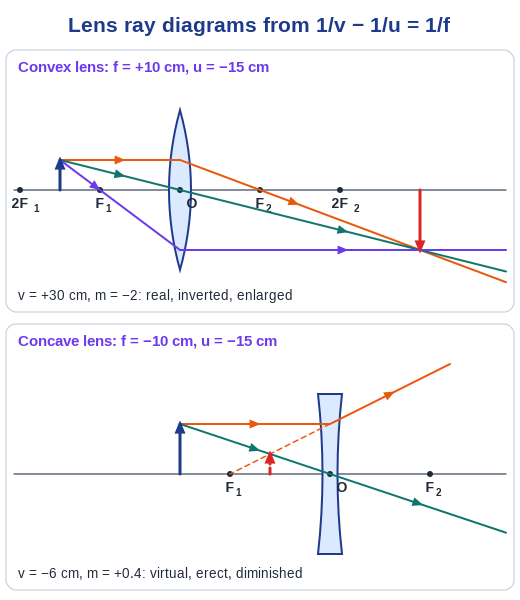
Power batati hai ki lens light ko kitna modta hai: P = 1/f, f metre mein, dioptre (D) mein. +2.5 D matlab 40 cm focal length ka convex lens; −4.0 D matlab 25 cm focal length ka concave lens. Contact mein thin lenses ke liye
1/f = 1/f₁ + 1/f₂ + …, P = P₁ + P₂ + … aur m = m₁m₂m₃…
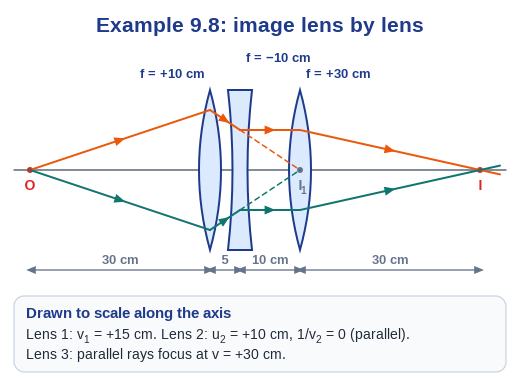
jahan sums algebraic hain. Example 9.7 R₁ = 10 cm, R₂ = −15 cm aur f = 12 cm se n = 1.5 nikaalta hai, aur dikhata hai ki air mein f = 20 cm ka glass lens paani mein f = 78.2 cm ka ho jaata hai. Example 9.8 ek object ko teen lenses se baari-baari trace karta hai. Padho lens maker’s formula aur power.
Prism light ko kaise deviate karta hai?
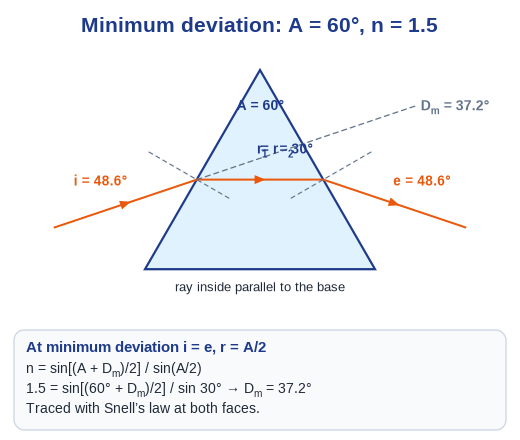
Angle A ke triangular prism mein ghusne wali ray dono faces par refract hoti hai. Andar ke quadrilateral aur triangle ki geometry deti hai
r₁ + r₂ = A aur δ = i + e − A
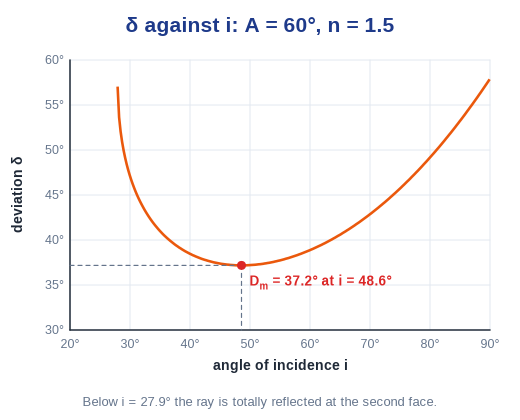
jahan δ angle of deviation aur e angle of emergence hai. i badhne par δ pehle ghat-ta hai phir badhta hai: iska ek minimum D_m hai, jo i = e aur r₁ = r₂ = A/2 par aata hai, aur tab andar ki ray base ke parallel hoti hai. Tab
n₂₁ = sin[(A + D_m)/2] / sin(A/2)
to A aur D_m naapkar refractive index mil jaata hai. Thin prism ke liye D_m = (n₂₁ − 1)A. Summary jodti hai ki dispersion white light ka rangon mein bantna hai, kyunki n wavelength par depend karta hai; Class 10 ka human eye aur colourful world chapter ise padhaata hai.
Microscope aur telescope kaise kaam karte hain?
Chapter human eye ko sabse important optical device kehta hai aur uske liye Class 10 ki taraf bhejta hai (dekho Class 10 human eye notes). Phir do instruments samjhaata hai.
Simple microscope: chhoti focal length ka convex lens aankh ke paas, object F par ya uske andar. Image near point D ≈ 25 cm par ho to m = 1 + D/f; image infinity par ho (relaxed aankh) to m = D/f. 5 cm ka lens m = 6 deta hai. Realistic lenses isse lagbhag 9 tak seemit rakhte hain.
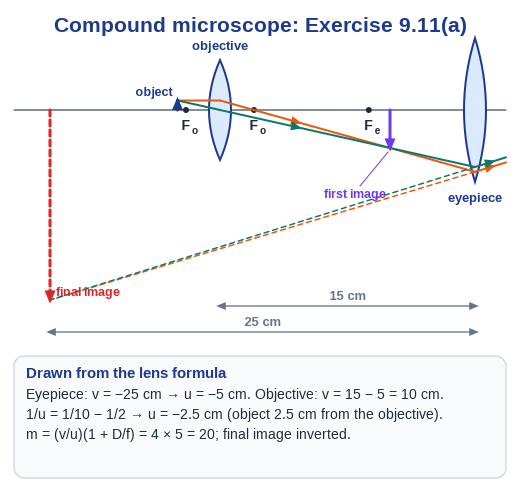
Compound microscope: objective eyepiece ke focus ke paas real, ulti, badi image banata hai, aur eyepiece simple microscope ki tarah kaam karta hai. Final image infinity par ho to m = m_o m_e ≈ (L/f_o)(D/f_e), jahan L, tube length, objective ke second focus aur eyepiece ke first focus ki doori hai. f_o = 1.0 cm, f_e = 2.0 cm aur L = 20 cm se m = 250. Final image ulti hoti hai.
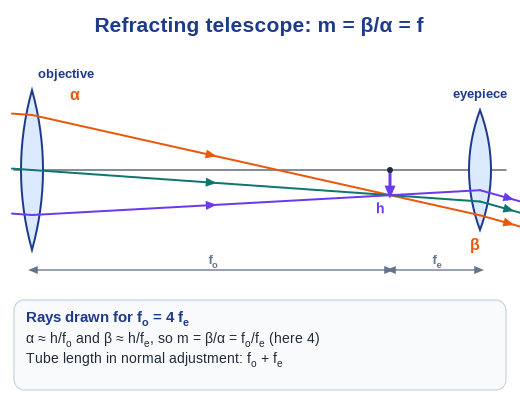
Refracting telescope: lambi focal length aur bade aperture ka objective door ki cheez ki real image apne focus par banata hai; eyepiece use magnify karta hai. Normal adjustment mein m = β/α = f_o/f_e, tube length f_o + f_e. f_o = 100 cm aur f_e = 1 cm se m = 100, to 1′ door do taare 1.67° door dikhte hain. Bada objective zyada light ikattha karta hai aur baareek detail alag dikhata hai.
Reflecting telescope: bade lens bhaari, sambhaalne mein mushkil aur chromatic aberration wale hote hain, isliye bade telescopes objective ke roop mein concave mirror use karte hain. Cassegrain design mein ek convex secondary mirror light ko primary ke ek chhed se wapas bhejta hai. Book ke examples: Kavalur, Tamil Nadu ka 2.34 m telescope, aur Hawaii ke 10 m Keck telescopes. Padho microscope aur telescope.
Is chapter ke formulas aur units
- Mirror: 1/v + 1/u = 1/f, f = R/2, m = −v/u.
- Snell ka law: sin i/sin r = n₂₁; critical angle sin i_c = 1/n.
- Ek surface: n₂/v − n₁/u = (n₂ − n₁)/R.
- Lens: 1/v − 1/u = 1/f, m = v/u; lens maker: 1/f = (n₂₁ − 1)(1/R₁ − 1/R₂).
- Power P = 1/f dioptre mein (1 D = 1 m⁻¹); contact mein lenses ke liye P = P₁ + P₂ + ….
- Prism: r₁ + r₂ = A, δ = i + e − A, n₂₁ = sin[(A + D_m)/2]/sin(A/2).
- Simple microscope m = 1 + D/f ya D/f; compound m ≈ (L/f_o)(D/f_e); telescope m = f_o/f_e.
Aage badhne se pehle
Ek sign convention ke saath do equations, mirror equation aur thin lens formula, is chapter ki har image samjha dete hain; Snell ka law refraction, critical angle aur prism samjhaata hai; aur instruments bas lenses ya mirrors ko aise jodte hain ki ek ki image agle ka object ban jaaye. Saari 31 exercises aur 8 worked examples step by step Chapter 9 ke NCERT solutions mein hain.
Key terms (zaroori shabd)
| Term | Matlab |
|---|---|
| Cartesian sign convention | Saari distances mirror ke pole ya lens ke optical centre se naapi jaati hain: incident light ki direction mein positive, uske ulta negative. Principal axis ke upar ki heights positive, neeche ki negative. |
| Focal length (f) | Pole (ya optical centre) se principal focus tak ki doori. Spherical mirror ke liye f = R/2. Sign convention se concave mirror aur concave lens ka f negative, convex mirror aur convex lens ka f positive. |
| Mirror equation | 1/v + 1/u = 1/f, jo spherical mirror ke liye object distance u, image distance v aur focal length f ko jodta hai. Magnification m = h′/h = −v/u. |
| Refractive index (n₂₁) | n₂₁ = sin i/sin r (Snell ka law), medium 1 ke respect mein medium 2 ka refractive index. Ye media ke jode aur wavelength par depend karta hai, angle of incidence par nahi. |
| Critical angle (i_c) | Denser medium mein wo angle of incidence jiske liye angle of refraction 90° ho. Air ke respect mein refractive index n wale medium ke liye sin i_c = 1/n. |
| Total internal reflection | Jab denser medium ki light rarer medium se critical angle se bade angle par milti hai, to koi refraction nahi hota: saari light wapas reflect ho jaati hai. Optical fibres aur totally reflecting prisms isi par chalte hain. |
| Lens maker’s formula | 1/f = (n₂₁ − 1)(1/R₁ − 1/R₂): material ke refractive index (aas-paas ke medium ke respect mein) aur dono faces ke radii of curvature se thin lens ki focal length. |
| Thin lens formula | 1/v − 1/u = 1/f, convex aur concave dono lenses aur real aur virtual dono images ke liye. Magnification m = h′/h = v/u. |
| Lens ki power (P) | P = 1/f, f metre mein; unit dioptre (D), 1 D = 1 m⁻¹. Converging (convex) lens ke liye positive, diverging (concave) ke liye negative. Contact mein thin lenses ki powers jud jaati hain. |
| Angle of minimum deviation (D_m) | Angle A ka prism jo sabse kam deviation de sakta hai. Tab i = e, r₁ = r₂ = A/2 aur andar ki ray base ke parallel; n₂₁ = sin[(A + D_m)/2]/sin(A/2). |
| Magnifying power | Optical instrument ke liye, final image dwara aankh par banaye angle aur instrument ke bina object ke angle ka ratio (microscope ke liye near point par, telescope ke liye aankh par). |
| Near point (D) | Saaf dekhne ki sabse kam doori, normal aankh ke liye lagbhag 25 cm. Simple microscope image D par hone par m = 1 + D/f, aur infinity par hone par m = D/f deta hai. |
Is chapter ke topics
Practice karo
-
10 cm focal length ke concave mirror ke saamne 30 cm par object rakha hai. Image banti hai:
Jawab dekho
Jawab: (a) mirror ke saamne 15 cm par
-
Glass–air interface ka critical angle 42° hai. Glass ke andar ki ray ka total internal reflection tab hota hai jab angle of incidence ho:
Jawab dekho
Jawab: (c) 42° se zyada
-
+4 D power ka convex lens −2 D power ke concave lens ke contact mein rakha hai. Combination ki focal length hai:
Jawab dekho
Jawab: (b) +50 cm
-
Equilateral prism mein minimum deviation par pehle face par angle of refraction hai:
Jawab dekho
Jawab: (c) 30°
-
Telescope ke objective ki focal length 120 cm aur eyepiece ki 4 cm hai. Normal adjustment mein magnifying power aur length hain:
Jawab dekho
Jawab: (a) 30 aur 124 cm
-
Simple microscope 5 cm focal length ka lens use karta hai. Image near point (25 cm) par ho to magnification hai:
Jawab dekho
Jawab: (b) 6
Students ke sawal
Class 12 Physics Chapter 9 ke main topics kya hain?
Sign convention aur mirror equation ke saath spherical mirrors se reflection, refraction aur Snell ka law, total internal reflection aur optical fibres, spherical surface par refraction, lens maker’s formula, power aur lens combinations, prism se refraction, aur simple microscope, compound microscope aur telescopes.
Sign convention ki zaroorat kyun hai?
Distances aur heights ko sign dene se ek hi mirror equation aur ek hi lens formula har case mein kaam karte hain: concave ya convex, object paas ya door, image real ya virtual. Signs ke bina har case ka alag formula chahiye hota.
Magnification aur magnifying power mein kya fark hai?
Magnification m = h′/h image aur object ke size compare karta hai. Magnifying power angles compare karta hai: final image ka aankh par angle, instrument ke bina object ke angle ke muqable. Magnifying glass ke liye dono tabhi barabar hote hain jab image near point par ho.
Bade telescopes lens ki jagah mirror kyun use karte hain?
Mirror mein chromatic aberration nahi hota, wo utni hi optical quality ke lens se kaafi halka hota hai, aur use sirf kinare ki jagah poori peeth se support kiya ja sakta hai. Bahut bade lens bhaari hote hain aur bina distortion ke banana mushkil hai.
Kya human eye is chapter mein hai?
Rationalised chapter aankh ko sirf ek important optical device kehkar Class 10 ki taraf bhejta hai, jahan uske parts, accommodation aur vision ke defects padhaaye gaye hain. Yahan naya material microscope aur telescope hai.
Koi sawal atak gaya?
Photo lo, Lagnever AI step-by-step samjhayega. 7 din ka trial sirf ₹2.
Google Play se app lo Browser mein kholo
Parents ke liye: trial ke baad plan har mahine UPI ya card autopay se renew hota hai. App mein kabhi bhi cancel kar sakte hain.