
What is total internal reflection?
Answer in short
Total internal reflection happens when light travelling in a denser medium meets a rarer medium at an angle of incidence greater than the critical angle i_c, where sin i_c = 1/n. No light is refracted out; all of it is reflected back. Totally reflecting prisms and optical fibres work this way.
Stuck on a question? Take a photo and Lagnever AI explains it step by step. Try it for 7 days for ₹2. Get it on Google Play
How does light behave going from a denser to a rarer medium?
Snell’s law, sin i/sin r = n₂₁, says that a ray entering an optically rarer medium (n₂₁ < 1) bends away from the normal, so the angle of refraction r is larger than the angle of incidence i. At the boundary part of the light is also reflected back into the denser medium; this is called internal reflection.
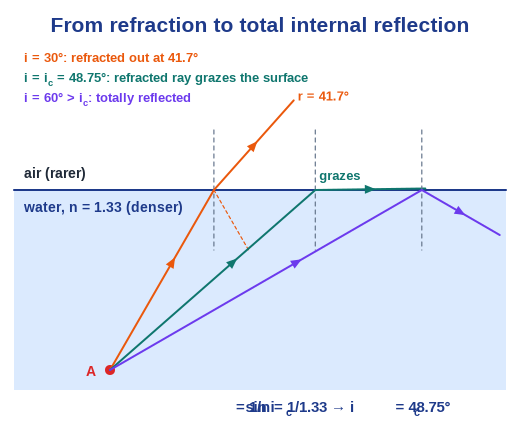
Picture a small lamp at the bottom of a tank of water, sending rays up to the surface at different angles:
- A ray at a small angle of incidence leaves the water, bent away from the normal, while a weak part of it reflects back down.
- As i grows, r grows faster, and the refracted ray leans more and more towards the surface.
- At one particular angle, r becomes 90°: the refracted ray skims along the surface.
- For any larger angle, Snell’s law would need sin r > 1, which is impossible. No ray leaves; all the light reflects back into the water.
What is the critical angle?
The critical angle i_c is the angle of incidence in the denser medium for which the angle of refraction is exactly 90°. Putting r = 90° in Snell’s law gives
sin i_c = n₂₁
where n₂₁ (less than 1) is the index of the rarer medium relative to the denser one. When the rarer medium is air and the denser medium has refractive index n, n₂₁ = 1/n, so
sin i_c = 1/n, or n = 1/sin i_c
Table 9.1 of the book lists:
| Medium | Refractive index | Critical angle |
|---|---|---|
| Water | 1.33 | 48.75° |
| Crown glass | 1.52 | 41.14° |
| Dense flint glass | 1.62 | 37.31° (see the note below) |
| Diamond | 2.42 | 24.41° |
The higher the refractive index, the smaller the critical angle. Diamond’s very small critical angle means light that enters it is reflected many times inside before it can escape. (Note: sin⁻¹(1/1.62) works out to 38.12°; the printed 37.31° would fit n ≈ 1.65. The other three rows check out exactly.)
When does total internal reflection happen?
Two conditions must both hold:
- the light travels from an optically denser medium towards a rarer one, and
- the angle of incidence is greater than the critical angle.
Then no refraction is possible, and the incident light is totally reflected. This is a better reflector than any mirror: a polished surface always lets some light through or absorbs it, but in total internal reflection nothing is transmitted.
Demonstration in the book: a laser beam passed through slightly milky water in a beaker shows its path. Aimed at the water surface from below, it partly reflects and partly refracts; tilted more, the refracted beam disappears and all the light reflects back. In a long test tube of the same water, the beam reflects from wall to wall like light in an optical fibre. Do this only with a teacher, and never look into a laser beam or point it at anyone’s face.
How do prisms use total internal reflection?
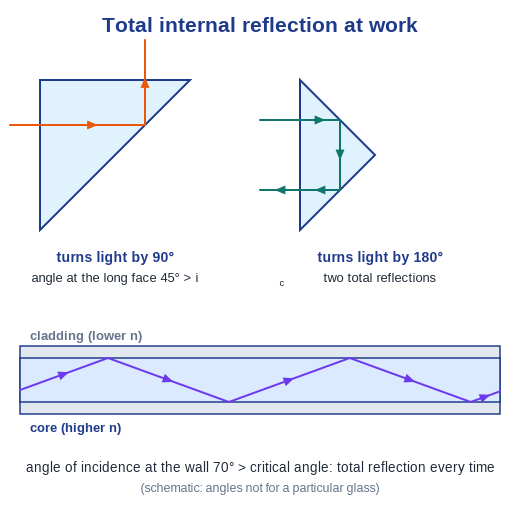
A glass prism with angles of 45°, 45° and 90° can act as a perfect mirror:
- Turning light by 90°: light enters one short face normally, meets the long face at 45° and is totally reflected out through the other short face.
- Turning light by 180°: light enters the long face normally, is totally reflected twice at the short faces and comes back parallel to its original direction.
- Inverting an image: the same prism can turn an image upside down without changing its size.
All three need the light to meet a face at 45° and still be totally reflected, so i_c must be less than 45°, that is n > √2 ≈ 1.414. Crown glass and dense flint glass both satisfy this.
How does an optical fibre carry light?
An optical fibre is a thin strand of very pure glass or quartz with a core surrounded by a cladding of slightly lower refractive index. Light sent into one end at a suitable angle strikes the core–cladding boundary at more than the critical angle, is totally reflected, crosses to the other side, is totally reflected again, and so on to the far end. Since each reflection is total, the signal loses little strength, and the light follows the fibre even round gentle bends.
Uses named in the book:
- carrying audio and video signals over long distances, after converting electrical signals to light;
- light pipes for looking inside the oesophagus, stomach and intestines;
- decorative lamps, where light from a bulb comes out at the tips of many fine plastic fibres.
The glass must absorb very little light: in silica fibres more than 95% of the light survives 1 km of fibre, which window glass could never manage.
What examples does nature give?
The chapter summary lists multiple internal reflections in diamond, totally reflecting prisms and the mirage as examples. Exercise 9.5 shows another everyday case: light from a bulb under water escapes only through a circle on the surface, because rays meeting the surface beyond the critical angle are trapped. Exercise 9.17 works out the angles a light pipe can accept, and Exercise 9.21 finds the angle at which a ray just suffers total internal reflection inside a prism; all are solved in the NCERT solutions.
Short notes on the whole chapter: Chapter 9 notes.
Practice
-
The refractive index of a glass is 1.5. Its critical angle with air is about:
Show answer
Answer: (b) 41.8°
-
Total internal reflection can take place when light travels from:
Show answer
Answer: (c) glass to water
-
In an optical fibre, the refractive index of the core is:
Show answer
Answer: (c) greater than that of the cladding
-
The critical angle of a medium with respect to air is 30°. Find its refractive index.
Show answer
Answer: sin i_c = 1/n, so n = 1/sin 30° = 1/0.5 = 2.0.
-
A point source sits 40 cm below the surface of water (n = 1.33). Find the radius of the circle on the surface through which light comes out.
Show answer
Answer: Light escapes only where i < i_c = sin⁻¹(1/1.33) = 48.75°. Radius = 40 × tan 48.75° = 40 × 1.140 = 45.6 cm.
Questions students ask
Why is it called total reflection?
At an ordinary mirror or glass surface, some light is always transmitted or absorbed, so the reflected beam is weaker than the incident one. Beyond the critical angle no light leaves the denser medium, so the whole beam is reflected.
Why must a totally reflecting prism have a critical angle below 45°?
In a right-angled isosceles prism the light meets the long face (or the short faces) at 45°. Total internal reflection needs 45° > i_c, so sin i_c < 0.707, which means n > 1.414. Crown glass (1.52) and dense flint glass (1.62) both qualify.
Is the critical angle the same for all colours?
No. The refractive index depends on wavelength, so the critical angle does too. Table 9.1 gives single values, which refer to a standard colour.
Stuck on a question?
Take a photo and Lagnever AI explains it step by step. Try it for 7 days for ₹2.
Get it on Google Play Open in browser
For parents: after the trial, the plan renews monthly by UPI or card autopay. You can cancel anytime in the app.