
Class 10 Science Chapter 10: The Human Eye and the Colourful World Notes
This chapter in five lines
The eye lens forms a real, inverted image on the retina, and the ciliary muscles change its focal length so we can see from about 25 cm to infinity. Myopia is corrected with a concave lens and hypermetropia with a convex lens. A prism splits white light into colours; atmospheric refraction makes stars twinkle, and scattering makes the sky blue.
What is this chapter about?
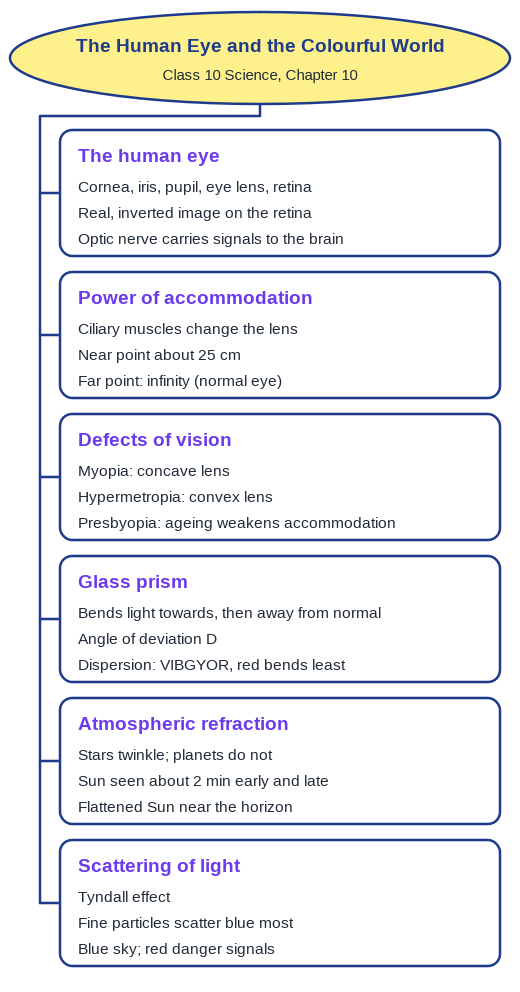
The previous chapter was about how lenses refract light and form images. This chapter uses the same ideas twice. First, for the human eye: it has a lens, so how does it focus, and how do spectacles correct an eye that cannot? Second, for light in nature: why a prism splits white light into colours, how a rainbow forms, why stars twinkle and why the sky is blue. The chapter runs from page 161 to page 170.
How does the human eye form an image?
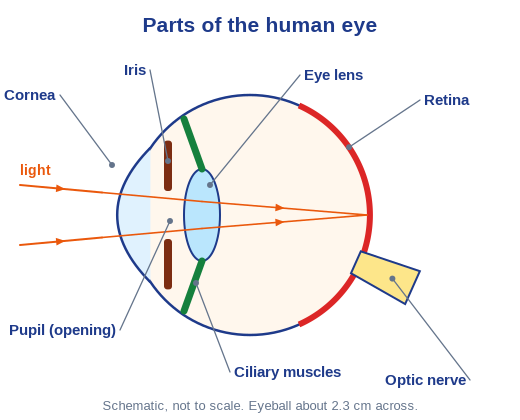
The eye works like a camera. Its lens system forms an image on a light-sensitive screen at the back, the retina. The eyeball is roughly a sphere about 2.3 cm across.
- Cornea: the thin, transparent bulge at the front. Light enters here, and most of the bending of light happens at its outer surface.
- Iris: a dark muscular diaphragm behind the cornea. It controls the size of the pupil, and the pupil controls how much light enters.
- Eye lens: a crystalline lens that makes the fine adjustment of focal length. It forms a real, inverted image on the retina.
- Retina: a delicate membrane with a very large number of light-sensitive cells. They produce electrical signals when light falls on them.
- Optic nerve: carries the signals to the brain, which interprets them so that we see objects as they are.
With our eyes closed we can still recognise things by smell, taste, sound or touch, but we cannot tell colours. Read more in the human eye and power of accommodation.
What is the power of accommodation?
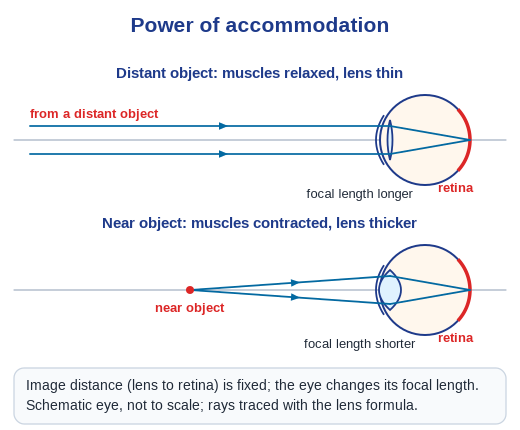
The eye lens is made of a fibrous, jelly-like material, and the ciliary muscles can change its curvature.
- For a distant object, the muscles relax, the lens becomes thinner and its focal length increases.
- For a near object, the muscles contract, the lens becomes thicker and its focal length decreases.
The distance from the lens to the retina does not change; the eye changes its focal length instead. This ability is called accommodation. The focal length cannot go below a certain minimum, so a page held very close to the eyes looks blurred or strains the eyes. The closest distance at which we can see clearly without strain is the near point, or least distance of distinct vision: about 25 cm for a young adult with normal vision. The far point of a normal eye is at infinity. So a normal eye sees clearly anything between 25 cm and infinity.
In old age the eye lens sometimes becomes milky and cloudy. This is cataract, which causes partial or complete loss of vision; cataract surgery can restore vision.
What are the defects of vision, and how are they corrected?
When the eye gradually loses its power of accommodation, vision becomes blurred. The chapter describes three common refractive defects, all corrected with suitable spherical lenses.
| Defect | What the person cannot see clearly | Where the image forms | Causes | Correction |
|---|---|---|---|---|
| Myopia (near-sightedness) | distant objects | in front of the retina | eye lens too curved, or eyeball too long | concave lens |
| Hypermetropia (far-sightedness) | nearby objects | behind the retina | focal length of the lens too long, or eyeball too small | convex lens |
| Presbyopia | nearby objects (with age) | the near point moves farther away | ciliary muscles weaken, lens less flexible | corrective glasses (convex for reading, Extra); bifocals for people with both defects |
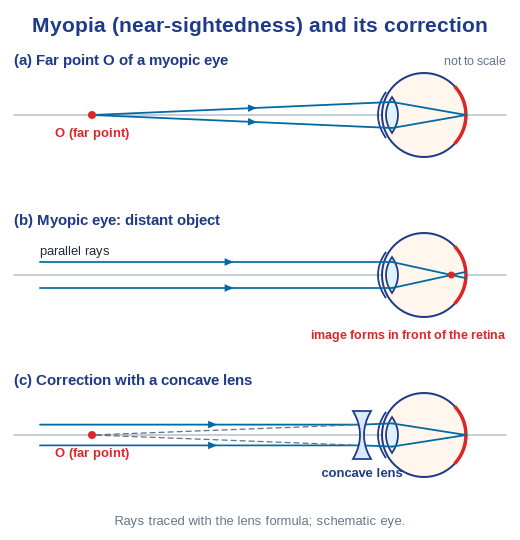
A person with both myopia and hypermetropia often needs bifocal lenses: the upper part is concave for distant vision and the lower part is convex for near vision. Today, refractive defects can also be corrected with contact lenses or surgery. Ray diagrams and lens power are worked out in defects of vision and their correction. If you find it hard to see the board or to read, tell a parent or teacher and get your eyes checked by an eye doctor.
What happens when light passes through a glass prism?
A triangular glass prism has two triangular bases and three rectangular faces, inclined to one another. The angle between the two faces the light passes through is the angle of the prism, A. In Activity 10.1, done with pins on paper, a ray PE enters face AB, travels inside along EF and leaves face AC along FS.
- At the first face, light goes from air into glass and bends towards the normal.
- At the second face, it goes from glass into air and bends away from the normal.
Unlike a glass slab, whose faces are parallel, the prism turns the light. The angle between the incident ray and the emergent ray is the angle of deviation, D.
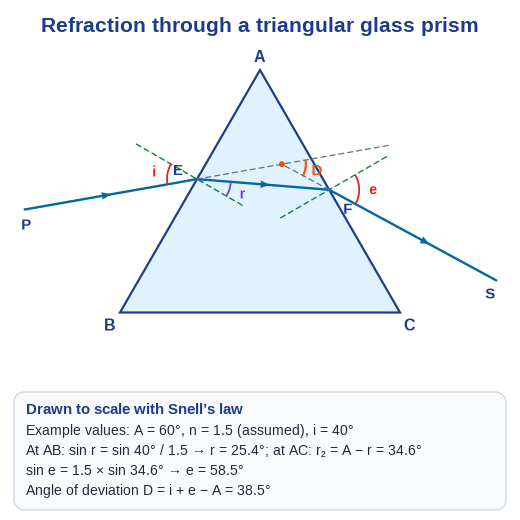
The numbers in this figure are an example of our own (Extra): with A = 60°, a refractive index of 1.5 and i = 40°, Snell’s law gives r ≈ 25.4°, e ≈ 58.5° and D = i + e − A ≈ 38.5°.
What is dispersion of white light?
When a narrow beam of white light falls on a prism (Activity 10.2), a band of colours appears on a screen: Violet, Indigo, Blue, Green, Yellow, Orange, Red, remembered as VIBGYOR. This band is a spectrum, and the splitting of light into its colours is dispersion. It happens because each colour bends through a different angle: red the least, violet the most.
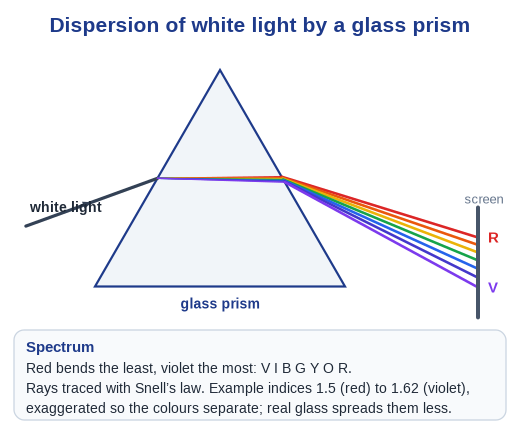
Isaac Newton was the first to use a glass prism to get the spectrum of sunlight. A second, similar prism could not split the colours any further. When he placed a second, identical prism upside down after the first, the colours joined again into white light. So sunlight is made up of these colours, and any light that gives a similar spectrum is called white light.
A rainbow is a natural spectrum seen after a shower, always in the direction opposite to the Sun. Tiny water droplets act like small prisms: they refract and disperse sunlight, reflect it inside, and refract it again as it comes out. Read more in dispersion and scattering of light.
What is atmospheric refraction?
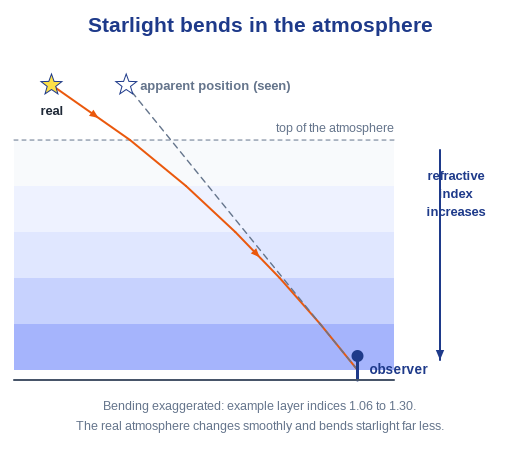
Air above a fire is hotter and less dense than the air above it, so its refractive index is slightly lower. Because this hot air keeps moving, objects seen through it seem to waver. The Earth’s atmosphere does the same on a large scale.
- Twinkling of stars: starlight bends as it passes through air of gradually changing refractive index, so a star appears slightly higher than it really is when seen near the horizon. The air keeps changing, so the star’s apparent position and the amount of its light entering the eye flicker: it looks brighter, then fainter.
- Planets do not twinkle: they are much closer and appear as extended sources, like many point sources together, so the changes average out.
- Advance sunrise and delayed sunset: the Sun is seen about 2 minutes before it actually crosses the horizon and about 2 minutes after actual sunset. The apparent flattening of the Sun’s disc at sunrise and sunset has the same cause.
What is scattering of light?
The atmosphere contains smoke, tiny water droplets, dust and air molecules. When a beam of light meets such fine particles, they send light off in many directions, and the path of the beam becomes visible. This is the Tyndall effect: a sunbeam entering a smoky room through a small hole, or sunlight through the canopy of a dense, misty forest.
The colour of the scattered light depends on the particle size. Very fine particles scatter mainly blue light; larger particles scatter longer wavelengths; large enough particles make the scattered light look white.
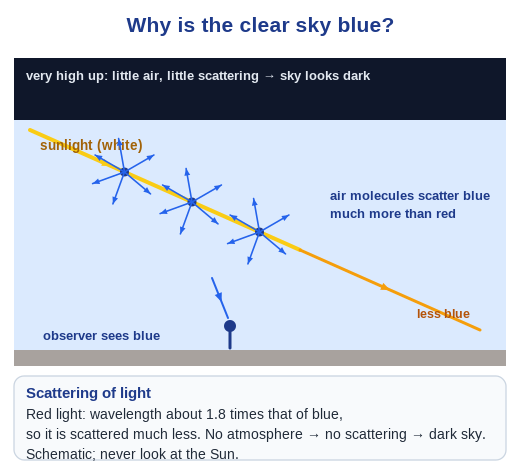
- Blue sky: air molecules and fine particles are smaller than the wavelength of visible light, so they scatter blue much more than red (red light has a wavelength about 1.8 times that of blue). The scattered blue light reaches our eyes from all over the sky.
- Dark sky high up: with no atmosphere there would be no scattering and the sky would look dark, as it does to passengers flying very high.
- Red danger signals: red is scattered least by fog or smoke, so it can be seen in the same colour from far away.
Before we move on
Practise the labelled eye, the myopia and hypermetropia diagrams, and the prism with i, r, e and D marked. The prism activities use sunlight or a bright beam: do them only with a teacher, never look at the Sun, even at sunrise or sunset, and never look at the Sun through a prism or lens. Answers to the Questions box and all twelve exercises are in the NCERT solutions for Chapter 10.
Key terms
| Term | Meaning |
|---|---|
| Retina | The light-sensitive screen at the back of the eye, with a very large number of light-sensitive cells. The eye lens forms the image here. |
| Power of accommodation | The ability of the eye lens to change its focal length so that both near and distant objects are focused on the retina. |
| Near point | The least distance of distinct vision: the closest point that can be seen clearly without strain. About 25 cm for a young adult with normal vision. |
| Far point | The farthest point up to which the eye can see clearly. It is infinity for a normal eye. |
| Myopia | Near-sightedness: distant objects look blurred because their image forms in front of the retina. Corrected with a concave lens. |
| Hypermetropia | Far-sightedness: nearby objects look blurred because their image would form behind the retina. Corrected with a convex lens. |
| Presbyopia | Loss of the power of accommodation with age, as the ciliary muscles weaken and the eye lens becomes less flexible. |
| Angle of deviation | The angle between the direction of the incident ray and the emergent ray when light passes through a prism. |
| Dispersion | The splitting of white light into its component colours, VIBGYOR, for example by a glass prism. |
| Spectrum | The band of coloured components of a beam of light. |
| Atmospheric refraction | Refraction of light by the Earth’s atmosphere, whose refractive index changes from place to place and keeps changing. |
| Scattering of light | Light being sent off in many directions by small particles. It makes a beam visible (Tyndall effect) and the sky blue. |
Topics in this chapter
Practice
-
The eye forms the image of an object on the:
Show answer
Answer: (c) retina
-
To see a nearby object clearly, the ciliary muscles:
Show answer
Answer: (b) contract, and the lens becomes thicker
-
A person cannot see distant objects clearly. The defect and the corrective lens are:
Show answer
Answer: (c) myopia, concave lens
-
When white light passes through a prism, the colour that bends the least is:
Show answer
Answer: (d) red
-
Planets do not twinkle because they:
Show answer
Answer: (b) are extended sources, so the changes average out
-
The clear sky looks blue because fine particles in air scatter:
Show answer
Answer: (b) blue light more than red
Questions students ask
What are the main topics of Class 10 Science Chapter 10?
The human eye and its parts, the power of accommodation with the near and far points, three defects of vision (myopia, hypermetropia and presbyopia) and their correction, refraction through a glass prism, dispersion of white light and the rainbow, atmospheric refraction (twinkling of stars, advance sunrise and delayed sunset) and scattering of light (Tyndall effect, blue sky).
Is The Human Eye and the Colourful World in the 2026-27 NCERT book?
Yes. It is Chapter 10 of Science, the Class 10 NCERT textbook marked Reprint 2026-27, on pages 161 to 170. It has one Questions box, two activities and twelve exercises.
Which diagrams should I practise for the board exam?
Practise the labelled human eye, the three-part diagrams of myopia and hypermetropia with their correction, refraction through a prism with i, r, e and D marked, and dispersion of white light into VIBGYOR. Also practise lens-power numericals such as Exercises 5 to 7.
Why is the colour of the Sun reddish at sunrise and sunset?
The chapter lists the reddening of the Sun at sunrise and sunset among the effects of scattering, without explaining it. Extra: near the horizon, sunlight travels through a much longer stretch of air, so most of the blue is scattered away on the way and mainly the longer, redder wavelengths reach us. Never look at the Sun directly, even when it is low.
Stuck on a question?
Take a photo and Lagnever AI explains it step by step. Try it for 7 days for ₹2.
Get it on Google Play Open in browser
For parents: after the trial, the plan renews monthly by UPI or card autopay. You can cancel anytime in the app.