
NCERT Solutions Class 10 Science Chapter 10: The Human Eye and the Colourful World
Answers to the Questions box inside Chapter 10, The Human Eye and the Colourful World, Activities 10.1 and 10.2, and all twelve end-of-chapter exercises, from Science, the Class 10 NCERT textbook. Page numbers follow the 2026-27 reprint (pages 161–170). The exercises are quoted from the book; the in-chapter questions are restated in short. Every numerical is worked with the sign convention of Chapter 9 and checked by computation; all agree with the book’s answer key. Points that go beyond the chapter are marked “Extra”. Short notes: Chapter 10 notes.
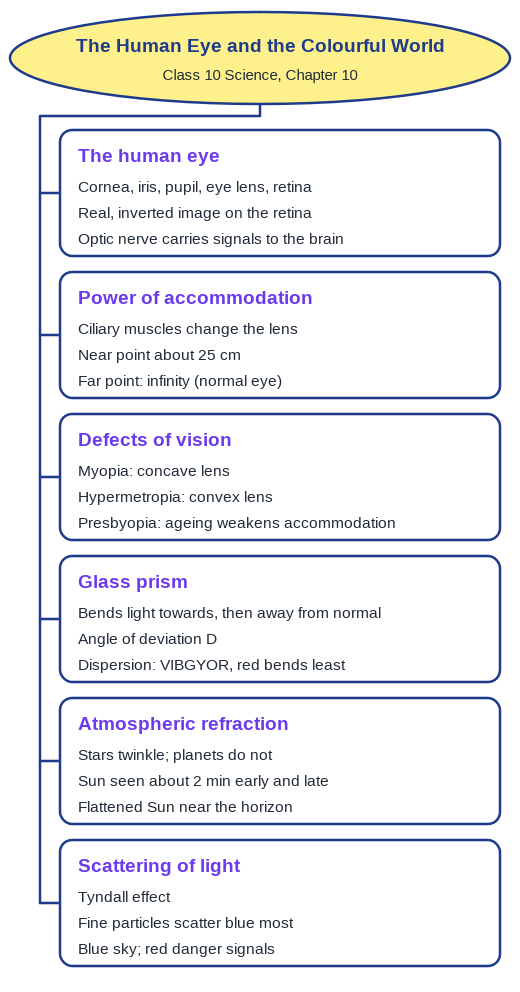
Questions, page 164
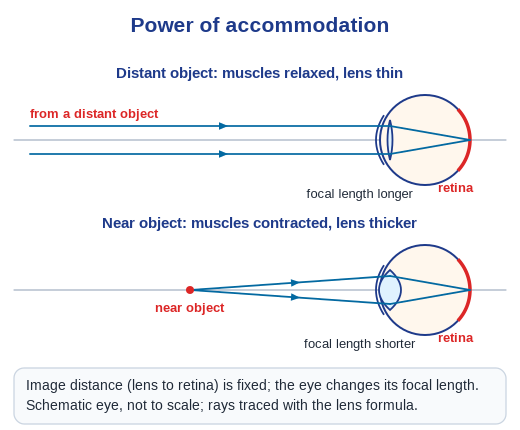
Question 1 (page 164): what is the power of accommodation of the eye? It is the ability of the eye lens to adjust its focal length. The ciliary muscles change the curvature of the lens: relaxed for distant objects (lens thinner, focal length longer) and contracted for near objects (lens thicker, focal length shorter). So both near and distant objects can be focused on the retina.
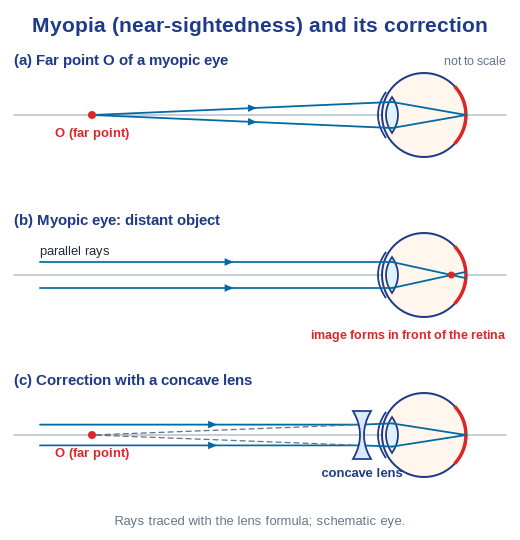
Question 2 (page 164): a myopic person cannot see objects beyond 1.2 m clearly; which corrective lens is needed? A concave (diverging) lens of suitable power. Its far point is 1.2 m, so the lens must make rays from distant objects seem to come from 1.2 m. (Extra: taking the lens close to the eye, f = −1.2 m and P = 1/f = −0.83 D.)
Question 3 (page 164): the far point and near point of a normal eye. The far point is at infinity, and the near point (least distance of distinct vision) is about 25 cm for a young adult. A normal eye sees clearly everything between these.
Question 4 (page 164): a student in the last row cannot read the blackboard; what is the defect, and how is it corrected? The student cannot see distant objects clearly, so the defect is most likely myopia (near-sightedness): the image of the distant board forms in front of the retina. It is corrected with concave lenses of suitable power. The student should get the eyes tested by an eye doctor, who decides the exact lens.
What the activities show (Activities 10.1 and 10.2)
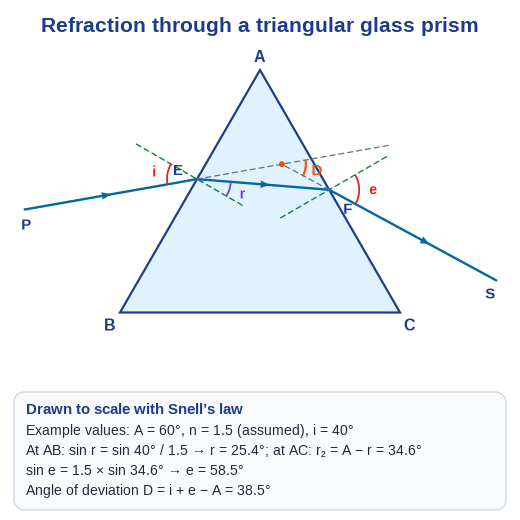
- 10.1, refraction through a prism (pages 165–166): the outline of a prism is traced on paper and a ray is found with pins at P, Q, R and S. The ray bends towards the normal at the first face (air to glass) and away from the normal at the second face (glass to air), as in a glass slab. But because the faces are inclined, the emergent ray is not parallel to the incident ray: it is turned through the angle of deviation D. Your measured angles will depend on your prism and on the angle of incidence you choose. (Extra: for the example in the figure, A = 60°, n = 1.5 and i = 40° give D ≈ 38.5°.) Use the pins carefully.
- 10.2, dispersion (pages 166–167): a narrow beam of sunlight from a slit in cardboard passes through a prism, and the prism is turned until a band of colours, VIBGYOR, appears on a nearby screen. White light is made of these colours, and each bends by a different angle (red least, violet most). This activity uses sunlight: do it only with a teacher, look only at the screen, and never look at the Sun, directly or through the prism.
Exercises 1 to 4: multiple choice
1. “The human eye can focus on objects at different distances by adjusting the focal length of the eye lens. This is due to (a) presbyopia. (b) accommodation. (c) near-sightedness. (d) far-sightedness.”
(b) accommodation. The ability of the eye lens to change its focal length is called accommodation; the other three are defects of vision.
2. “The human eye forms the image of an object at its (a) cornea. (b) iris. (c) pupil. (d) retina.”
(d) retina. The eye lens forms a real, inverted image on the retina, the light-sensitive screen at the back of the eye.
3. “The least distance of distinct vision for a young adult with normal vision is about (a) 25 m. (b) 2.5 cm. (c) 25 cm. (d) 2.5 m.”
(c) 25 cm.
4. “The change in focal length of an eye lens is caused by the action of the (a) pupil. (b) retina. (c) ciliary muscles. (d) iris.”
(c) ciliary muscles. They change the curvature of the eye lens, and so its focal length.
Exercises 5 to 7: lens power
5. “A person needs a lens of power –5.5 dioptres for correcting his distant vision. For correcting his near vision he needs a lens of power +1.5 dioptre. What is the focal length of the lens required for correcting (i) distant vision, and (ii) near vision?”
f = 1/P, with f in metres.
- (i) Distant vision: f = 1/(−5.5 D) = −0.18 m (−18.2 cm), a concave lens.
- (ii) Near vision: f = 1/(+1.5 D) = +0.67 m (+66.7 cm), a convex lens.
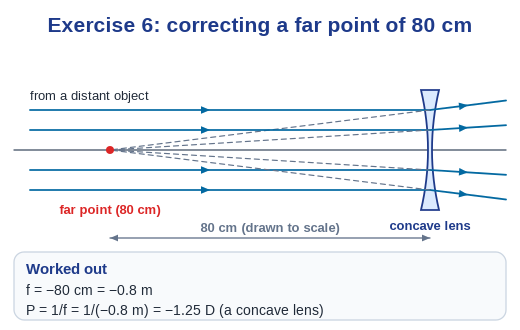
6. “The far point of a myopic person is 80 cm in front of the eye. What is the nature and power of the lens required to correct the problem?”
A myopic eye cannot see clearly beyond its far point (80 cm). The corrective lens must make rays from a very distant object look as if they come from 80 cm.
- The object is very far away: u = −∞, so 1/u = 0. The image must be at the far point: v = −80 cm.
- Lens formula: 1/f = 1/v − 1/u = −1/80 − 0. So f = −80 cm = −0.8 m.
- Power: P = 1/f = 1/(−0.8 m) = −1.25 D.
Answer: a concave lens of power −1.25 D.
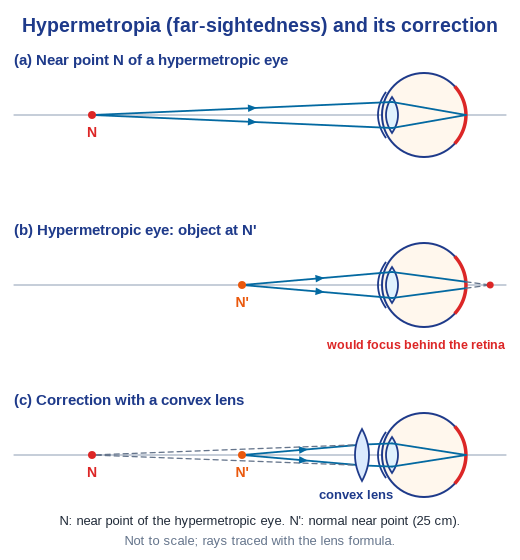
7. “Make a diagram to show how hypermetropia is corrected. The near point of a hypermetropic eye is 1 m. What is the power of the lens required to correct this defect? Assume that the near point of the normal eye is 25 cm.”
The diagram: (a) rays from the near point N of the hypermetropic eye focus on the retina; (b) rays from N′, the normal near point at 25 cm, would focus behind the retina; (c) a convex lens makes rays from N′ seem to come from N, so the eye focuses them on the retina.
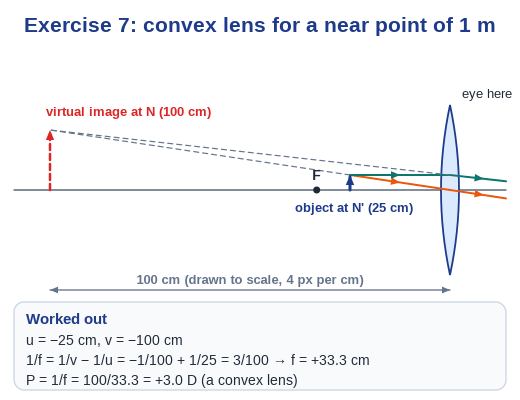
The power: the lens takes an object at the normal near point (25 cm) and forms its virtual image at the eye’s own near point (1 m = 100 cm), where this eye can see it clearly.
- u = −25 cm and v = −100 cm.
- Lens formula: 1/f = 1/v − 1/u = −1/100 + 1/25 = (−1 + 4)/100 = 3/100. So f = +33.3 cm = +0.333 m.
- Power: P = 1/f = 1/0.333 = +3.0 D.
Answer: a convex lens of power +3.0 D.
Exercises 8 and 9: the eye
8. “Why is a normal eye not able to see clearly the objects placed closer than 25 cm?”
The ciliary muscles can make the eye lens thicker only up to a limit, so its focal length cannot be decreased below a certain minimum. For an object closer than about 25 cm, the lens would need an even shorter focal length to bring the image onto the retina, which it cannot have. So the image is not formed on the retina, and the object looks blurred or the eye feels strained.
9. “What happens to the image distance in the eye when we increase the distance of an object from the eye?”
The image distance does not change. The image always has to form on the retina, and the distance from the eye lens to the retina is fixed. Instead, the eye adjusts the focal length of the lens: as the object moves away, the ciliary muscles relax, the lens becomes thinner and its focal length increases, keeping the image on the retina.
Exercises 10 to 12: light in the atmosphere
10. “Why do stars twinkle?”
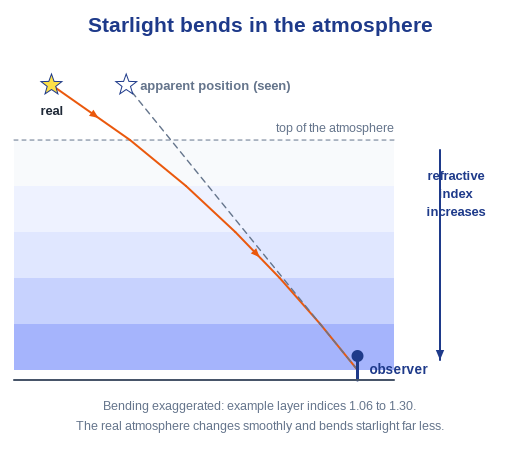
Starlight is refracted continuously by the atmosphere, whose refractive index changes gradually with height. The atmosphere bends starlight towards the normal, so the star’s apparent position differs slightly from its real one. The air is never still, so the path of the light keeps changing a little. Stars are very far away and act as point sources, so these changes make the apparent position fluctuate and the amount of light entering the eye flicker: the star looks brighter at one moment and fainter at the next. This is twinkling.
11. “Explain why the planets do not twinkle.”
Planets are much closer to the Earth, so they appear as extended sources, not points. A planet can be thought of as a collection of a large number of point sources. The flickering of the light from each of them is different, and over the whole disc the total variation averages out to nearly zero. So the light from a planet stays steady and it does not twinkle.
12. “Why does the sky appear dark instead of blue to an astronaut?”
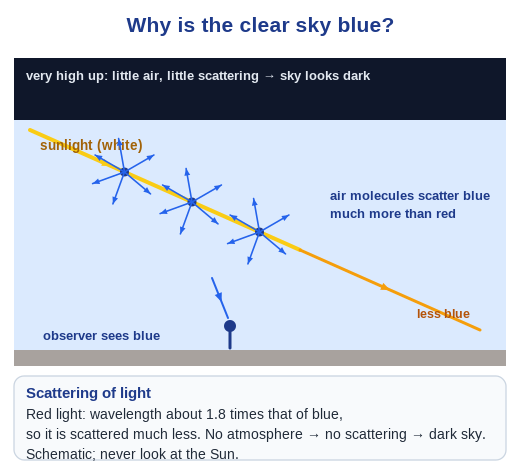
The sky looks blue because air molecules and fine particles scatter the blue part of sunlight towards our eyes. An astronaut in space is above the atmosphere, where there is practically no air to scatter sunlight. With no scattered light coming from the surroundings, the sky looks dark. (The chapter notes that the sky also looks dark to passengers flying at very great heights, where scattering is not prominent.)
Go back to the Chapter 10 notes, or read the human eye and accommodation, defects of vision and dispersion and scattering of light.
Practice
-
A lens has a power of −2.5 D. Its focal length and type are:
Show answer
Answer: (b) −40 cm, concave
-
The near point of a hypermetropic eye is 75 cm. The lens needed to read at 25 cm has a power of:
Show answer
Answer: (a) +2.67 D
-
Which colour of white light is deviated most by a prism?
Show answer
Answer: (d) violet
-
A myopic person can see clearly only up to 50 cm. Find the power of the corrective lens.
Show answer
Answer: The concave lens must make rays from far away seem to come from 50 cm, so f = −50 cm = −0.5 m. P = 1/f = 1/(−0.5 m) = −2 D.
-
Why does the Sun appear about 2 minutes before it actually rises?
Show answer
Answer: Sunlight is bent by atmospheric refraction as it passes through air of changing refractive index. So when the Sun is still slightly below the horizon, its light already reaches us and the Sun appears above the horizon.
Stuck on a question?
Take a photo and Lagnever AI explains it step by step. Try it for 7 days for ₹2.
Get it on Google Play Open in browser
For parents: after the trial, the plan renews monthly by UPI or card autopay. You can cancel anytime in the app.