
How does the human eye see, and what is the power of accommodation?
Answer in short
Light enters through the cornea, passes the pupil and the eye lens, and forms a real, inverted image on the retina; the optic nerve takes signals to the brain. The ciliary muscles change the lens’s focal length, so a normal eye sees clearly from its near point, about 25 cm, to its far point at infinity.
Stuck on a question? Take a photo and Lagnever AI explains it step by step. Try it for 7 days for ₹2. Get it on Google Play
What are the parts of the human eye?
The eyeball is roughly spherical, about 2.3 cm across. Light passes through these parts in order:
- Cornea: a thin, transparent membrane that bulges out at the front of the eyeball. Light enters the eye here, and most of the refraction of the light happens at the outer surface of the cornea.
- Iris: a dark, muscular diaphragm just behind the cornea. It controls the size of the pupil.
- Pupil: the opening in the iris. It regulates how much light enters the eye.
- Eye lens: a crystalline lens that only provides the finer adjustment of focal length needed to focus objects at different distances.
- Retina: a delicate membrane at the back with a very large number of light-sensitive cells. The lens forms a real, inverted image here.
- Optic nerve: the light-sensitive cells produce electrical signals when light falls on them, and the optic nerve carries these signals to the brain.
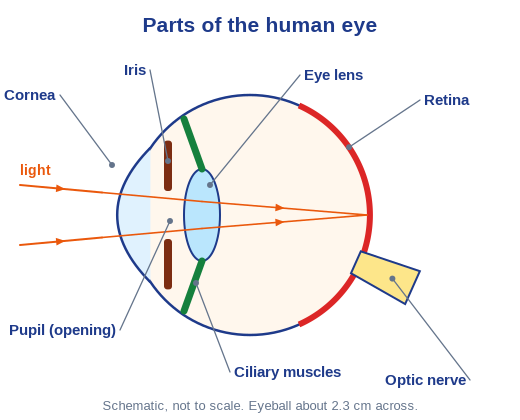
The brain interprets the signals and processes the information so that we see objects as they are. The eye is often compared to a camera: its lens system forms an image on a light-sensitive screen.
How does the eye focus near and far objects?
Many cameras focus by moving the lens (Extra). The eye does not move its lens closer to or farther from the retina; it changes the focal length of the lens instead. The eye lens is made of a fibrous, jelly-like material, and the ciliary muscles around it can change its curvature.
| Looking at | Ciliary muscles | Eye lens | Focal length |
|---|---|---|---|
| a distant object | relaxed | becomes thin | increases |
| a nearby object | contract | becomes thicker (more curved) | decreases |
The ability of the eye lens to adjust its focal length in this way is called accommodation.
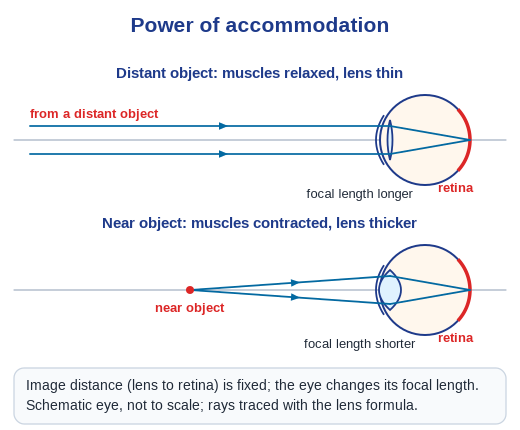
In both cases the image distance, from the lens to the retina, stays the same. You can check this with the lens formula from Chapter 9 (Extra): with v fixed, a larger u (distant object) needs a larger f, and a smaller u (near object) needs a smaller f.
What are the near point and the far point?
The focal length of the eye lens cannot be made shorter than a certain minimum. Try reading a printed page held very close to your eyes: the print looks blurred, or your eyes feel strained.
- Near point, or least distance of distinct vision: the minimum distance at which objects can be seen most distinctly without strain. For a young adult with normal vision it is about 25 cm.
- Far point: the farthest point up to which the eye can see objects clearly. For a normal eye it is at infinity.
So a normal eye sees objects clearly anywhere between 25 cm and infinity. An eye that has a far point closer than infinity, or a near point farther than 25 cm, has a defect of vision; see defects of vision and their correction.
What is cataract?
In old age the crystalline lens sometimes becomes milky and cloudy. This condition is called cataract, and it causes partial or complete loss of vision. Vision can be restored through cataract surgery. Only an eye doctor can tell whether someone has cataract and what treatment suits them.
What does the chapter say about eye donation?
A box in the chapter explains that eyes can be donated after death, so that a person with corneal blindness can see again through a corneal transplant. Donors can be of any age or sex, and people who wear spectacles or have had a cataract operation can still donate. The chapter also lists infections that rule a person out. An eye bank collects and checks donated eyes and keeps the identities of donors and receivers confidential. Families who want to pledge eyes can contact their nearest eye bank.
Quick check
- Light path: cornea → pupil (in the iris) → eye lens → retina → optic nerve → brain.
- Focusing: ciliary muscles change the lens; the retina stays where it is.
- Limits: near point about 25 cm, far point at infinity.
More questions are solved in the NCERT solutions for Chapter 10. Go back to the Chapter 10 notes, or read about dispersion and scattering of light.
Practice
-
Which part of the eye controls the amount of light entering it?
Show answer
Answer: (b) pupil (controlled by the iris)
-
When we look at a distant object, the eye lens:
Show answer
Answer: (b) becomes thinner, with a longer focal length
-
The far point of a normal eye is at:
Show answer
Answer: (d) infinity
-
Why does a printed page held very close to your eyes look blurred?
Show answer
Answer: The eye lens cannot make its focal length shorter than a certain minimum. For objects closer than the near point, about 25 cm, the image cannot be brought onto the retina, so the page looks blurred or the eyes feel strained.
-
What is cataract?
Show answer
Answer: In old age the crystalline lens sometimes becomes milky and cloudy. This causes partial or complete loss of vision. Vision can be restored by cataract surgery.
Questions students ask
Why is the human eye compared to a camera?
Both use a lens system to form an image on a light-sensitive surface: the retina in the eye, a sensor or film in a camera. The eye also controls the light entering it with the pupil, much as a camera does with its aperture (Extra comparison).
If the image on the retina is inverted, why do we see things upright?
The retina only turns light into electrical signals. The brain interprets these signals and processes the information so that we perceive objects as they are.
Does the near point stay at 25 cm all our life?
No. The chapter gives about 25 cm for a young adult with normal vision. With age, the power of accommodation usually decreases and the near point moves farther away. This is presbyopia.
Can I identify colours with my eyes closed?
No. With closed eyes we can recognise objects to some extent by smell, taste, sound or touch, but not colours. That is why the chapter calls the eye the most significant sense organ.
Stuck on a question?
Take a photo and Lagnever AI explains it step by step. Try it for 7 days for ₹2.
Get it on Google Play Open in browser
For parents: after the trial, the plan renews monthly by UPI or card autopay. You can cancel anytime in the app.