
Why does a prism make colours, why do stars twinkle and why is the sky blue?
Answer in short
A prism bends each colour of white light by a different angle, red least and violet most, so white light disperses into VIBGYOR. Changing refraction in the atmosphere makes stars twinkle and shows the Sun about 2 minutes early and late. Fine particles scatter blue light more than red, so the clear sky looks blue.
Stuck on a question? Take a photo and Lagnever AI explains it step by step. Try it for 7 days for ₹2. Get it on Google Play
How does light pass through a glass prism?
A triangular glass prism has two triangular bases and three rectangular side faces, inclined to one another. The angle between the two faces the light uses is the angle of the prism, A. In Activity 10.1 a ray is traced with pins: the incident ray PE meets face AB at E, the refracted ray EF crosses the glass, and the emergent ray FS leaves face AC.
- At AB, light passes from air into glass and bends towards the normal: i is larger than r.
- At AC, it passes from glass into air and bends away from the normal.
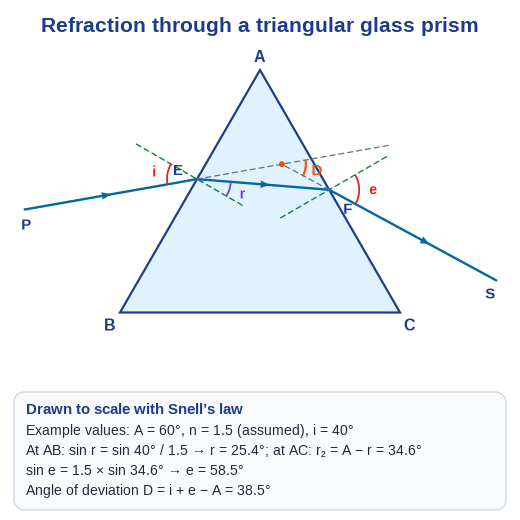
Because the faces are not parallel, the emergent ray is turned away from the original direction. This angle is the angle of deviation, D. The figure is drawn to scale with Snell’s law for an example glass of refractive index 1.5 (Extra): A = 60°, i = 40°, r ≈ 25.4°, e ≈ 58.5°, and D = i + e − A ≈ 38.5°.
What is dispersion?
In Activity 10.2 a narrow beam of white light passes through a prism and falls on a screen as a band of colours: Violet, Indigo, Blue, Green, Yellow, Orange, Red, or VIBGYOR. The band is a spectrum, and the splitting of light into its colours is dispersion. Each colour bends through a different angle: red the least, violet the most, so each emerges along its own path.
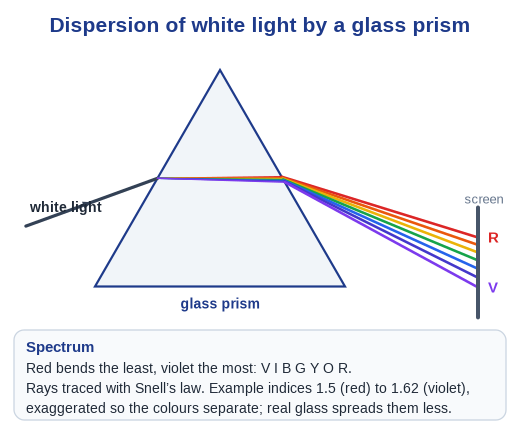
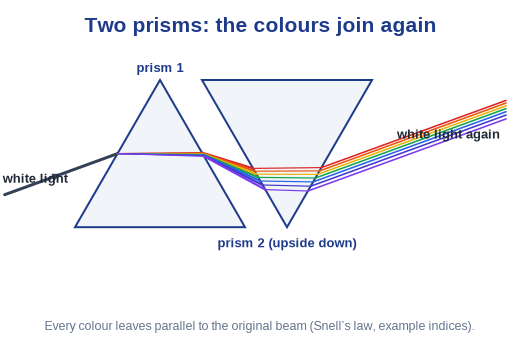
Isaac Newton first got the spectrum of sunlight with a prism. A second prism could not split any colour further. A second, identical prism placed upside down joined all the colours back into a beam of white light. So sunlight is made of these colours. Any light that gives a spectrum like sunlight is called white light.
How does a rainbow form?
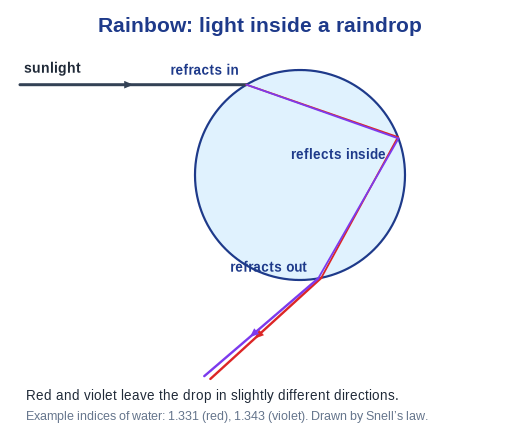
A rainbow is a natural spectrum seen after a rain shower, always in the direction opposite to the Sun. Tiny water droplets act like small prisms. Each drop refracts and disperses the sunlight entering it, reflects it from the inside, and refracts it again as it comes out, so different colours reach the eye from different drops. You can also see one on a sunny day through the spray of a waterfall or fountain, with the Sun behind you.
What is atmospheric refraction?
Air above a fire is hotter and less dense, with a slightly lower refractive index, and it keeps moving. So objects seen through it seem to waver. The atmosphere does this on a larger scale.
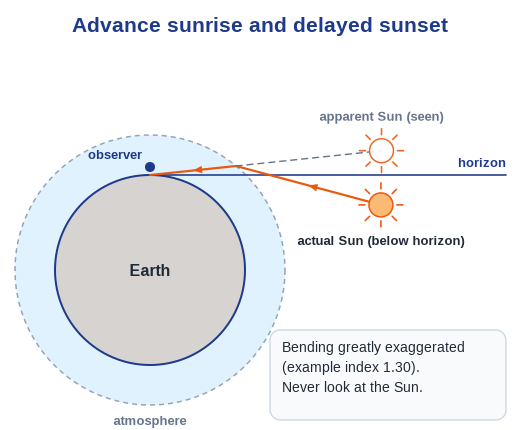
- Twinkling of stars: starlight bends gradually as it passes through air of changing refractive index. A star near the horizon appears slightly higher than it really is. The air keeps changing, so the apparent position and the light reaching the eye flicker. Stars are so far away that they act as point sources.
- Planets do not twinkle: they are closer and appear as extended sources, like many point sources; their variations average out.
- Advance sunrise and delayed sunset: the Sun is visible about 2 minutes before it actually crosses the horizon and about 2 minutes after actual sunset.
What is scattering of light?
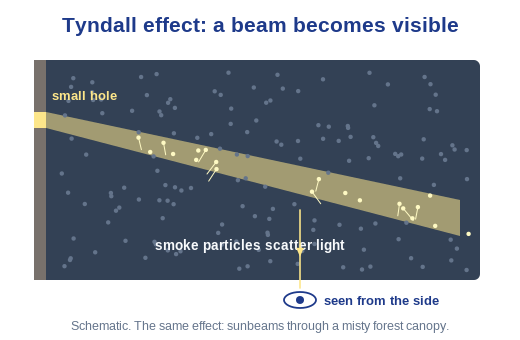
Tyndall effect: the atmosphere holds smoke, water droplets, dust and air molecules. When a beam of light hits such fine particles, they scatter light towards us and the beam’s path becomes visible: in a smoky room lit through a small hole, or in a misty forest. Very fine particles scatter mainly blue light, larger ones scatter longer wavelengths, and large enough ones make the scattered light look white.
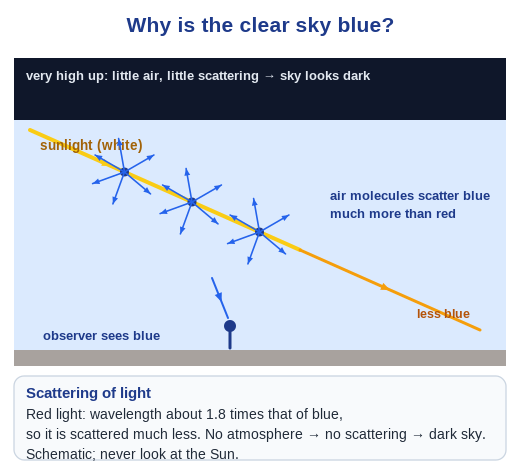
Blue sky: air molecules and fine particles are smaller than the wavelength of visible light, so they scatter blue much more strongly than red; red light has a wavelength about 1.8 times that of blue. The scattered blue light reaches our eyes. Without an atmosphere the sky would look dark, as it does at very great heights.
Red danger signals: red is scattered least by fog or smoke, so it is seen in the same colour from far away. The reddish Sun at sunrise and sunset is explained in the FAQ of the Chapter 10 notes (Extra).
Do prism activities only with a teacher, let the light fall on a screen, and never look at the Sun, directly or through a prism. More questions are solved in the NCERT solutions for Chapter 10, and the eye is covered in defects of vision.
Practice
-
The angle between the incident ray and the emergent ray in a prism is the:
Show answer
Answer: (c) angle of deviation
-
A rainbow is always seen:
Show answer
Answer: (b) opposite to the Sun
-
The sky looks dark to people flying very high because:
Show answer
Answer: (b) scattering is not prominent at such heights
-
Why is a beam of sunlight visible in a smoky room but not in clean air?
Show answer
Answer: Smoke particles are large enough to scatter the light sideways towards our eyes, so the path of the beam becomes visible. This is the Tyndall effect.
-
Why do the colours separate in a prism?
Show answer
Answer: Different colours of light bend through different angles as they pass through glass: red the least and violet the most. So each colour comes out along a different path, and the colours spread into a band.
Questions students ask
What is the difference between a prism and a glass slab?
In a glass slab the two faces are parallel, so the emergent ray is parallel to the incident ray, only shifted sideways. In a prism the faces are inclined, so the emergent ray comes out turned through the angle of deviation.
Why are danger signals red?
Red light is scattered least by fog or smoke, so it travels far and is still seen in the same colour from a distance.
Why does the Sun look flattened at sunrise and sunset?
The chapter says the apparent flattening has the same cause as advance sunrise and delayed sunset: atmospheric refraction. Extra: light from the lower edge passes through more air near the horizon and is lifted a little more than light from the upper edge.
Can I look at the Sun through a prism to see the colours?
No. Never look at the Sun, directly or through a prism, lens or glass, even at sunrise or sunset: it can harm your eyes. Prism activities with sunlight are done only with a teacher, by letting the light fall on a screen.
Stuck on a question?
Take a photo and Lagnever AI explains it step by step. Try it for 7 days for ₹2.
Get it on Google Play Open in browser
For parents: after the trial, the plan renews monthly by UPI or card autopay. You can cancel anytime in the app.