
What are myopia, hypermetropia and presbyopia, and how are they corrected?
Answer in short
In myopia the far point is closer than infinity and distant images form in front of the retina; a concave lens corrects it. In hypermetropia the near point is beyond 25 cm and near images would form behind the retina; a convex lens corrects it. Presbyopia is the loss of accommodation with age; bifocals help people with both defects.
Stuck on a question? Take a photo and Lagnever AI explains it step by step. Try it for 7 days for ₹2. Get it on Google Play
Why do defects of vision happen?
A normal eye sees clearly from its near point, about 25 cm, to its far point at infinity. Sometimes the eye gradually loses its power of accommodation, and vision becomes blurred because of a refractive defect. The chapter describes three common ones: myopia, hypermetropia and presbyopia. All three can be corrected with suitable spherical lenses, the concave and convex lenses of Chapter 9.
What is myopia?
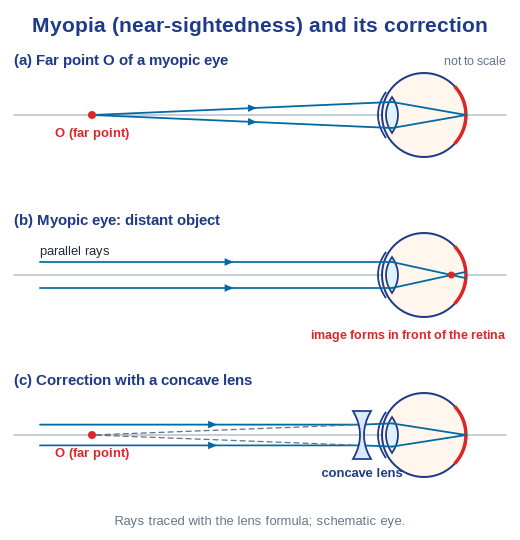
Myopia, or near-sightedness: the person sees nearby objects clearly but not distant ones. The far point is nearer than infinity; the person may see clearly only up to a few metres. Rays from a distant object are focused in front of the retina, not on it.
Causes: (i) excessive curvature of the eye lens, or (ii) elongation of the eyeball.
Correction: a concave lens of suitable power. It spreads the parallel rays from a distant object so that they seem to come from the far point O. The eye can focus rays from O, so the image comes back onto the retina.
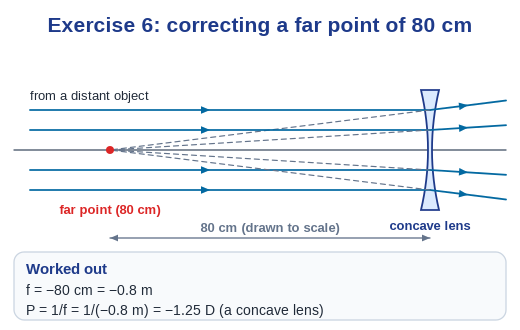
The power needed: the concave lens must form the image of a very distant object at the far point. Taking the lens to be very close to the eye, as the exercises do, its focal length equals the far point distance, with a minus sign. For a far point of 80 cm, f = −0.8 m and P = 1/f = −1.25 D (Exercise 6).
What is hypermetropia?
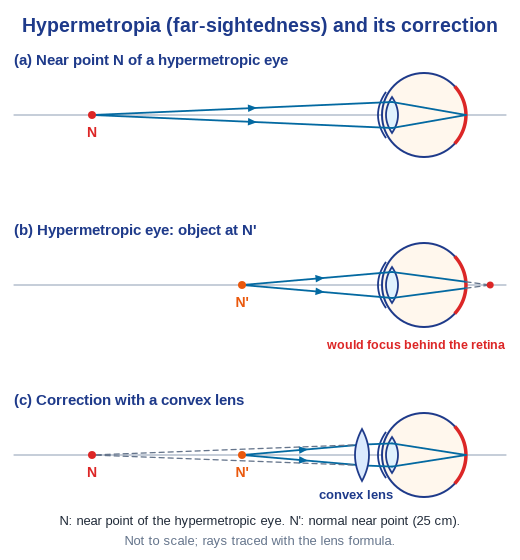
Hypermetropia, or far-sightedness: the person sees distant objects clearly but not nearby ones. The near point is farther away than the normal 25 cm, so reading material has to be held well beyond 25 cm. Rays from a close object would be focused at a point behind the retina.
Causes: (i) the focal length of the eye lens is too long, or (ii) the eyeball has become too small.
Correction: a convex lens of appropriate power. Spectacles with converging lenses give the extra focusing power needed to form the image on the retina. In the diagram, N is the near point of the hypermetropic eye and N′ is the normal near point. The convex lens makes rays from an object at N′ seem to come from N.
The power needed: the lens must take an object at 25 cm (u = −25 cm) and form a virtual image at the person’s near point. For a near point of 1 m (v = −100 cm), 1/f = 1/v − 1/u = −1/100 + 1/25 = 3/100, so f = +33.3 cm and P = +3.0 D (Exercise 7).
What is presbyopia?
The power of accommodation usually decreases with age. For most people the near point gradually moves farther away, and nearby objects become hard to see comfortably without corrective glasses. This is presbyopia. It is caused by the gradual weakening of the ciliary muscles and the reduced flexibility of the eye lens.
Some people have both myopia and hypermetropia. They often need bifocal lenses. A common bifocal has a concave upper part, for distant vision, and a convex lower part, for near vision.
How else can defects be corrected?
Besides spectacles, refractive defects can now be corrected with contact lenses or through surgery. Which method suits a person, and the exact lens power, is decided by an eye doctor after testing the eyes.
Summary table
| Myopia | Hypermetropia | |
|---|---|---|
| Sees clearly | near objects | distant objects |
| Changed point | far point closer than infinity | near point beyond 25 cm |
| Image (uncorrected) | in front of the retina | behind the retina |
| Lens | concave, P negative | convex, P positive |
| Focal length of the lens | −(far point distance) | from 1/f = 1/v − 1/u with u = −25 cm |
Every exercise on these defects is worked out in the NCERT solutions for Chapter 10. Go back to the Chapter 10 notes, or read about the human eye and accommodation.
Practice
-
In a myopic eye, the image of a distant object is formed:
Show answer
Answer: (b) in front of the retina
-
Hypermetropia can be caused by:
Show answer
Answer: (c) an eyeball that is too small
-
The lower part of a common bifocal lens is:
Show answer
Answer: (b) convex, for near vision
-
The far point of a myopic eye is 2 m. Find the focal length and power of the lens needed.
Show answer
Answer: The concave lens must make parallel rays seem to come from the far point, so f = −2 m. P = 1/f = 1/(−2 m) = −0.5 D.
-
The near point of a hypermetropic eye is 50 cm. What lens lets this person read at 25 cm?
Show answer
Answer: The lens must form a virtual image at 50 cm of a page at 25 cm: u = −25 cm, v = −50 cm. 1/f = 1/v − 1/u = −1/50 + 1/25 = 1/50, so f = +50 cm = +0.5 m and P = +2 D, a convex lens.
Questions students ask
Why does a concave lens correct myopia?
A myopic eye can focus only up to its far point. A concave lens of the right power takes parallel rays from a distant object and makes them diverge as if they came from that far point. The eye can focus such rays, so the image lands on the retina.
Why does a convex lens correct hypermetropia?
A hypermetropic eye cannot focus objects closer than its own near point. A convex lens takes rays from an object at 25 cm and makes them seem to come from that farther near point, giving the extra focusing power the eye lacks.
Is presbyopia the same as hypermetropia?
No. Both make near objects hard to see, but presbyopia comes from age: the ciliary muscles weaken and the lens becomes less flexible. Hypermetropia comes from the focal length or the size of the eyeball.
What should I do if I cannot read the board clearly?
Tell a parent or teacher and get your eyes tested by an eye doctor. Only an eye doctor can find out what the problem is and prescribe the right lenses. Do not use someone else’s spectacles.
Stuck on a question?
Take a photo and Lagnever AI explains it step by step. Try it for 7 days for ₹2.
Get it on Google Play Open in browser
For parents: after the trial, the plan renews monthly by UPI or card autopay. You can cancel anytime in the app.