
NCERT Solutions Class 6 Maths Chapter 10: The Other Side of Zero
Answers to every “Figure it Out” question in Chapter 10, The Other Side of Zero, of Ganita Prakash (Reprint 2026-27), with the in-text questions, the integer grids and the history questions. The page numbers match the book. Short notes: Chapter 10 notes.
Less than zero? (pages 242–243)
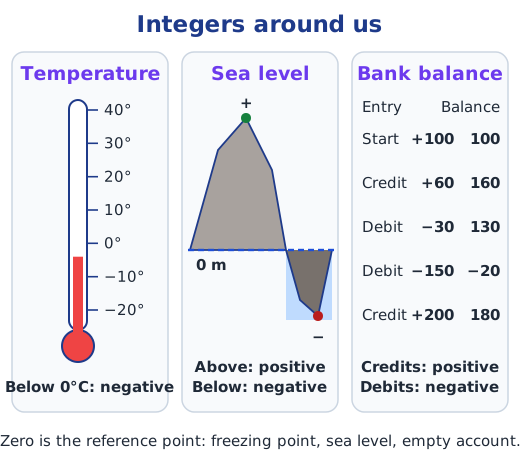
Can you think of ways to have less than 0 of something? Owing money (having less than nothing), floors below the ground, temperatures below freezing, and depths below sea level.
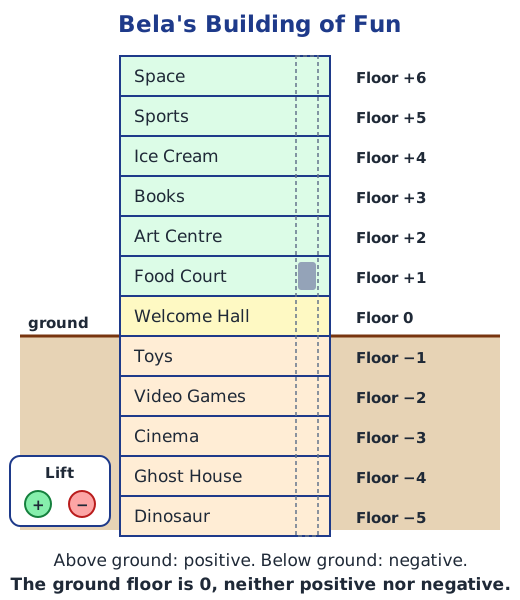
Bela’s Building of Fun: the shops below the ground are the Toy Store, Video Games, Cinema, Ghost House and Dinosaur; the ground floor is the Welcome Hall. To go four floors up, press + + + +, that is +4; to go three floors down, press − − −, that is −3.
Numbering the floors (page 244)
The ground floor is Floor 0 because you need zero button presses to reach it from the ground floor; it is the starting point for numbering. All the floors: Space +6, Sports +5, Ice Cream +4, Books +3, Art Centre +2, Food Court +1, Welcome Hall 0, Toys −1, Video Games −2, Cinema −3, Ghost House −4, Dinosaur −5.
Figure it Out: adding movements (page 245)
From the Food Court, pressing +2 takes you to the Book Store (+3).
- You reach Floor −1 (the Toy Store): (+2) + (−3) = −1.
- a. (+1) + (+4) = +5 b. (+4) + (+1) = +5 c. (+4) + (−3) = +1 d. (−1) + (+2) = +1 e. (−1) + (+1) = 0 f. 0 + (+2) = +2 g. 0 + (−2) = −2
- To reach Floor −5: (+6) + (−11) = −5, (+4) + (−9) = −5, (+1) + (−6) = −5, 0 + (−5) = −5, (−1) + (−4) = −5, (−3) + (−2) = −5, and (−4) + (−1) = −5.
Gurmit ends up one floor below the Toy Store, on Floor −2 (Video Games): (+2) + (−3) = −1.
Figure it Out: combining button presses (page 246)
a. (+1) + (+4) = +5 b. (+4) + (+1) = +5 c. (+4) + (−3) + (−2) = −1 d. (−1) + (+2) + (−3) = −2
Back to zero: inverses (page 246)
If Basant presses +4 and then −4, he is back on the ground floor.
Inverses: +4 → −4; −4 → +4; −3 → +3; 0 → 0; +2 → −2; −1 → +1.
Connecting inverses: +5 with −5, −7 with +7, −8 with +8, and +9 with −9.
Who is on the lowest floor? Jay is on +2, Asin (Sports Centre) on +5, Binnu (Cinema) on −3 and Aman (Toy Store) on −1, so Binnu is on the lowest floor.
Figure it Out: comparing numbers (page 247)
We should write −4 < −3, because Floor −4 is below Floor −3.
- a. −2 < +5 b. −5 < +4 c. −5 < −3 d. +6 > −6 e. 0 > −4 f. 0 < +4
- a. −10 > −12 b. +17 > −10 c. 0 > −20 d. +9 > −9 e. −25 < −7 f. +15 > −17
- Counting the marks from E (+1) and D (−1): B = −9, C = −6, F = +2, G = +6, H = +11.
- −7 is the first mark below C; −4 is the second mark above C (the third below D); +3 is the first mark above F; −10 is the first mark below B.
Subtraction to find the button (pages 247–249)
15 − 5, 100 − 10 and 74 − 34 as ‘making equal’: 5 + 10 = 15, so 15 − 5 = 10; 10 + 90 = 100, so 100 − 10 = 90; 34 + 40 = 74, so 74 − 34 = 40.
From the Art Centre to the Sports Centre you press +3: (+5) − (+2) = +3.
Figure it Out (page 249):
| a. (+1) − (+4) = −3 | b. 0 − (+2) = −2 | c. (+4) − (+1) = +3 | d. 0 − (−2) = +2 |
| e. (+4) − (−3) = +7 | f. (−4) − (−3) = −1 | g. (−1) − (+2) = −3 | h. (−2) − (−2) = 0 |
| i. (−1) − (+1) = −2 | j. (+3) − (−3) = +6 |
Figure it Out: the mine (page 251)
a. (+40) + (+160) = +200 b. (+40) + (−240) = −200 c. (−50) + (+250) = +200 d. (−50) + (−150) = −200 e. (−200) − (−40) = −160 f. (+200) − (+40) = +160 g. (−200) − (+40) = −240
With an ‘infinite lift’: a. −125 + (−30) = −155 b. +105 − (−55) = +160 c. +105 + (+55) = +160 d. +80 − (−150) = +230 e. +80 + (+150) = +230 f. −99 − (−200) = +101 g. −99 + (+200) = +101 h. +1500 − (−1500) = +3000
Yes: in each pair, subtracting a negative number gave the same answer as adding the positive number.
Math Talk: the infinite lift and the number line. Both have 0 in the middle, positive numbers on one side and negative numbers on the other, equal steps between neighbouring numbers, and go on forever both ways. Moving up the lift is like moving right on the number line.
Figure it Out: the number line (pages 253–254)
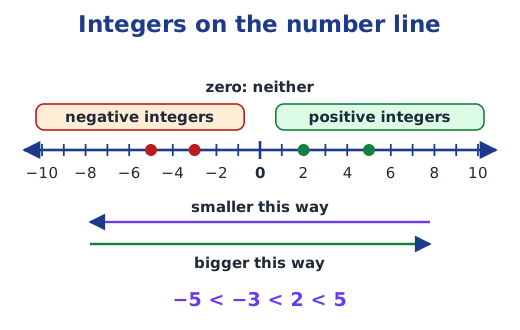
- For example, mark 2, 5, 8 and −1, −4, −7.
- −7, −4, −1, the three negative numbers marked above, in increasing order: −7 < −4 < −1.
- Yes, 2 > −3: 2 is to the right of −3 (a positive number is greater than a negative number). Yes, −2 < 3: −2 is to the left of 3.
- a. −5 + 0 = −5 b. 7 + (−7) = 0 c. −10 + 20 = 10 d. 10 − 20 = −10 e. 7 − (−7) = 14 f. −8 − (−10) = 2
Using unmarked number lines (page 255): a. −125 + (−30) = −155 b. +105 − (−55) = +160 c. +80 − (−150) = +230 d. −99 − (−200) = +101
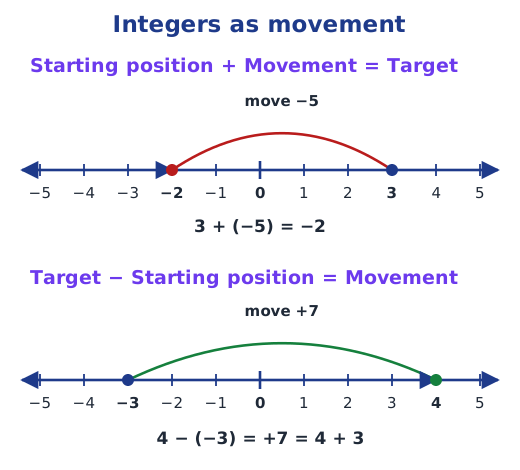
Figure it Out: tokens for addition (page 257)
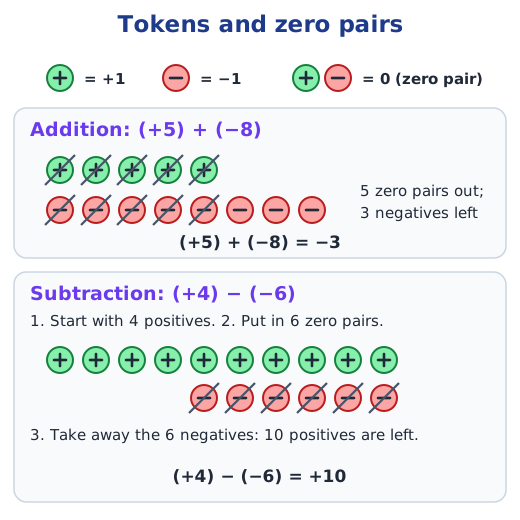
- a. (+6) + (+4) = +10 (no zero pairs) b. (−3) + (−2) = −5 c. (+5) + (−7) = −2 (5 zero pairs removed) d. (−2) + (+6) = +4 (2 zero pairs removed)
- a. 3 positives and 5 negatives: remove 3 zero pairs, 2 negatives are left. The attendant is on Floor −2: (+3) + (−5) = −2. b. 6 positives and 3 negatives: remove 3 zero pairs, 3 positives are left. He is on Floor +3: (+6) + (−3) = +3.
Is (−7) − (−5) the same as (−7) + (+5)? Yes, both are −2.
Figure it Out: tokens for subtraction (page 258)
- a. (+10) − (+7) = +3 b. (−8) − (−4) = −4 c. (−9) − (−4) = −5 d. (+9) − (+12) = −3 (put in 3 zero pairs) e. (−5) − (−7) = +2 (put in 2 zero pairs) f. (−2) − (−6) = +4 (put in 4 zero pairs)
- a. (−5) − (−7) = +2 b. (+10) − (+13) = −3 c. (−7) − (−9) = +2 d. (+3) − (+8) = −5 e. (−2) − (−7) = +5 f. (+3) − (+15) = −12
Figure it Out: more zero pairs (page 259)
- Start with 3 negatives. To take away 5 positives, put in 5 zero pairs, then take the 5 positives away: 8 negatives are left. So (−3) − (+5) = −8.
- a. (−3) − (+10) = −13 b. (+8) − (−7) = +15 c. (−5) − (+9) = −14 d. (−9) − (+10) = −19 e. (+6) − (−4) = +10 f. (−2) − (+7) = −9
Credits and debits (pages 259–260)
₹100 + ₹60 = ₹160; then ₹160 − ₹30 = ₹130; then ₹130 − ₹150 = −₹20. Yes, this is possible: some banks allow a negative balance for a while, usually charging interest or a fee. After the ₹200 credit, the balance is −₹20 + ₹200 = ₹180.
- 30 + 40 + 50 = 120 in credits and 40 + 50 + 60 = 150 in debits, so the balance is 120 − 150 = −₹30.
- The debits add up to 1 + 2 + 4 + 8 + 16 + 32 + 64 + 128 = 255, so the balance is 256 − 255 = +₹1.
- A positive balance means you do not owe the bank, you pay no extra interest or fees, and you have money ready for emergencies. A short negative balance may be worthwhile when an important payment cannot wait, such as a medical bill, or when a purchase now, like the business purchase in the story, will soon bring in more money, as long as it can be paid back quickly.
Figure it Out: geographical cross section (page 261)
- Read against the lines, which are 100 m apart (the values are approximate): a. A ≈ +1500 m b. B ≈ −500 m c. C ≈ +300 m d. D ≈ −1200 m e. E ≈ +1200 m f. F ≈ −200 m g. G ≈ +100 m
- The highest point is A; the lowest is D.
- Decreasing order: A, E, C, G, F, B, D. Increasing order: D, B, F, G, C, E, A.
- Mount Everest (Sagarmatha) on the Nepal–China border: 8,848.86 m above sea level, measured in 2020 (older books give 8,848 m).
- The lowest known point is the Challenger Deep in the Mariana Trench in the Pacific Ocean, about −10,994 m, nearly 11 km below sea level. (Extra: the lowest place on land is the shore of the Dead Sea, about −430 m.)
Figure it Out: temperature (page 262)
On a very hot summer day with a heat wave, temperatures can be above 40°C. Your area’s highest and lowest temperatures last year can be found in newspapers or weather reports.
- Places in India that sometimes go below 0°C include Leh, Kargil and Drass in Ladakh, Srinagar and Gulmarg in Jammu and Kashmir, Keylong and Manali in Himachal Pradesh, Auli in Uttarakhand, Tawang in Arunachal Pradesh and Lachung in Sikkim. What is common: they are high up in the mountains, mostly in the Himalayas. (Extra: the air gets colder as we go higher, and these places are in the north, where winters are colder.)
- The warmest time is the afternoon and the coldest is late at night, so: 14°C at 02:00 p.m., 8°C at 11:00 a.m., −2°C at 11:00 p.m. and −4°C at 02:00 a.m.
Explorations with integers: hollow grids (pages 263–264)
- Second grid: 5 + (−3) + (−5) = −3; (−8) + (−2) + 7 = −3; 5 + 0 + (−8) = −3; (−5) + (−5) + 7 = −3. The border sum is −3.
- Rows are written top to bottom, and the centre stays empty.
- Border sum +4: the middle-left number must be 5 (since −10 + 5 + 9 = 4). One answer: top row −10, 7, 7; middle row 5, −5; bottom row 9, −7, 2.
- Border sum −2: top row 6, 8, −16; middle row 11, −5; bottom row −19, −2, 19. This is the only answer.
- Border sum −4: one answer: top row 7, −11, 0; middle row −11, −5; bottom row 0, −5, 1.
- Another way for the last grid: top row 7, −5, −6; middle row −1, −5; bottom row −10, −1, 7. (Choose any value for the top-right corner and the bottom-left corner, then fill the rest to make each sum −4.)
- The first grid can also be filled in many ways: only three numbers are given, so one corner can be chosen freely. The second grid has a single answer, because once its four numbers are placed, each row and column has just one unknown left to work out.
- A puzzle for your classmates: border sum −1, with 5 and −8 in the top row, 3 in the middle of the right column and −6 in the middle of the bottom row. Solution: top row 5, −8, 2; middle row −17, 3; bottom row 11, −6, −6.
An amazing grid of numbers (pages 264–265)
- Whatever numbers you circle, the sum is always −1.
- Second grid (−11 to 4): the sum is always −14. First grid (7, 10, 13, 16 at the top): the sum is −8, the answer in NCERT’s key. One cell needs care: the −7 in the bottom row breaks the pattern of the grid (going down each column, the numbers fall by 9 each time, so that cell should be −17). If you circle that −7, you get +2 instead; with −17 there, the sum is always −8.
- In these grids, each row is the row above with the same number added to every cell, so every cell is a ‘row number’ plus a ‘column number’. Circling one number in each row and each column uses every row number and every column number exactly once, so the total never changes. The magic is in both the numbers and their arrangement. To make your own, choose four row numbers and four column numbers and fill each cell with their sum.
Figure it Out: integer practice (pages 265–266)
- a. −6, −5, −4, −3, −2, −1 b. −3, −2, −1, 0, 1, 2, 3 c. −14, −13, −12, −11, −10, −9 d. −29, −28, −27, −26, −25, −24
- For example, (−2) + (−3) + (−3) = −8, or 5 + (−10) + (−3) = −8.
- The sums that cannot be made are −9, −7, −5, 0, 2, 7, 9 and 11. (All other numbers from −10 to 12 can: for example −8 = (−5) + (−3), 4 = 2 + 2 and 5 = (−1) + 6.)
- 8 − 13 = −5; (−8) − 13 = −21; (−13) − (−8) = −5; (−13) + (−8) = −21; 8 + (−13) = −5; (−8) − (−13) = 5; 13 − 8 = 5; 13 − (−8) = 21.
- Taking the present year as 2026: a. 150 years ago was 1876. b. 2026 − 2200 = −174, but there was no year 0 (1 BCE was followed by 1 CE), so it was 175 BCE. c. 320 years after 680 BCE is 360 BCE.
- a. −40, −34, −28, −22, −16, −10, −4 (add 6 each time) b. 3, 4, 2, 5, 1, 6, 0, 7, −1, 8, −2 (two sequences take turns: 3, 2, 1, 0, … and 4, 5, 6, 7, …) c. 27, 19, 12, 6, 1, −3, −6, −8, −9, −9 (the differences are −8, −7, −6, −5, −4, −3, −2, −1, 0)
- Exactly −30 can be made: (−5) − (+18) − (+7) = −30. Another: (−9) − (+18) + (−2) − (+1) = −30.
- a. (positive) − (negative): always positive b. (positive) + (negative): positive, negative or zero c. (negative) + (negative): always negative d. (negative) − (negative): positive, negative or zero e. (negative) − (positive): always negative f. (negative) + (positive): positive, negative or zero
- The pattern repeats every 5 tokens: three positives and two negatives, worth +1. 100 tokens make 20 such groups, so the string is worth +20.
Brahmagupta’s rules (pages 266–268)
- In the Building of Fun, adding is Start + Movement = Target and subtracting is Target − Start = Movement:
- Addition. Two positives: going up from above the ground keeps you above it. Two negatives: going down from below the ground takes you further down. A positive and a negative: the up and down movements cancel as far as they can, and you end up on the side of the bigger one, by the difference (from −5, going up 3 leaves you at −2). A number and its inverse: going up and down the same number of floors brings you back to 0. Adding zero: pressing nothing keeps you where you are.
- Subtraction. 3 − 2: from Floor 2 to Floor 3 you go up, so the answer is positive. 2 − 3: from Floor 3 to Floor 2 you go down, so it is negative. 2 − (−3): from Floor −3 you go up 3 to reach 0 and 2 more, which is the same as 2 + 3. 2 − 2: start and target are the same, so there is no movement, 0. −2 − 0: from the ground to Floor −2 you go down 2. 0 − (−2): from Floor −2 to the ground you go up 2, the inverse of −2.
- Own examples: 4 + 6 = 10; (−4) + (−6) = −10; −9 + 4 = −5 and 9 + (−4) = 5; 7 + (−7) = 0; −8 + 0 = −8. 9 − 4 = 5; 4 − 9 = −5; 4 − (−9) = 4 + 9 = 13; (−6) − (−6) = 0; −7 − 0 = −7 and 0 − 7 = −7.
Snakes and ladders with integers (page 271): a useful idea is to choose, after each roll, whether to add or subtract the two dice so that you move towards whichever end, +50 or −50, you are closer to.
Practice
-
(−15) + (+9) equals:
Show answer
Answer: (b) −6 Subtract 9 from 15 and keep the sign of the bigger number: −6.
-
Which is the inverse of −543?
Show answer
Answer: (c) +543
-
A diver is at −12 m and comes up 5 m. The new level is:
Show answer
Answer: (b) −7 m (−12) + (+5) = −7.
-
Find (−20) − (−35).
Show answer
Answer: Subtracting −35 is adding +35: −20 + 35 = +15.
-
The temperature was 3°C in the evening and −5°C at night. By how much did it fall?
Show answer
Answer: The change is Target − Start = (−5) − (+3) = −8, so it fell by 8 degrees.
Stuck on a question?
Take a photo and Lagnever AI explains it step by step. Try it for 7 days for ₹2.
Get it on Google Play Open in browser
For parents: after the trial, the plan renews monthly by UPI or card autopay. You can cancel anytime in the app.