
Class 6 Maths Chapter 10: The Other Side of Zero Notes
This chapter in five lines
There are numbers less than zero, called negative numbers, such as −1, −2 and −3. Together with zero and the positive numbers they make the integers: …, −3, −2, −1, 0, 1, 2, 3, … On the number line, negative numbers lie to the left of zero, and smaller numbers are always to the left. Adding means Starting position + Movement = Target, and subtracting means Target − Starting position = Movement; subtracting a number is the same as adding its inverse.
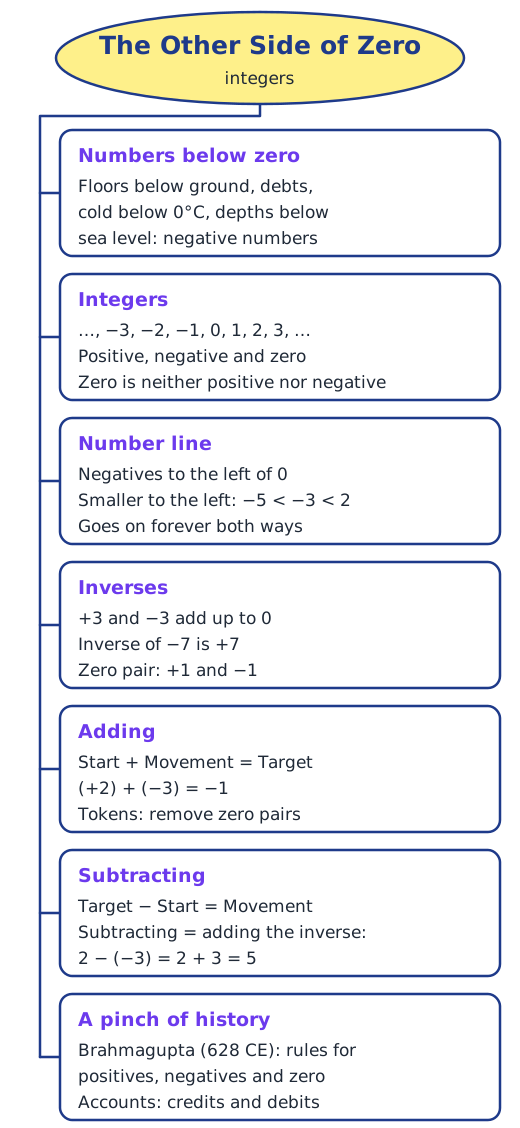
Is there anything less than zero?
We started with the counting numbers 1, 2, 3, …, then met 0, and then fractions between them. The number line we have used so far starts at 0 and goes only to the right, so it is really a number ray. Are there numbers to the left of 0, less than 0? Yes: think of floors below the ground, money you owe, temperatures below freezing, or depths below sea level.
Bela’s Building of Fun
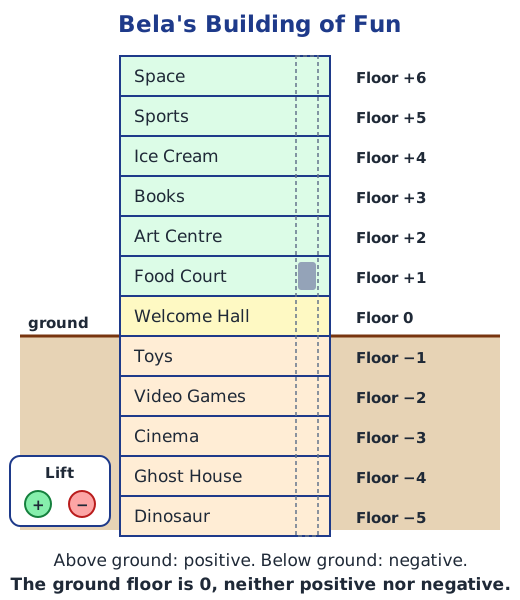
Bela’s Building of Fun has floors above and below the ground and a lift with two buttons: ‘+’ to go up and ‘−’ to go down. Pressing ‘+’ twice is +2; pressing ‘−’ three times is −3. The ground floor, the Welcome Hall, is Floor 0. Floors above it are numbered with positive numbers (+1, +2, …) and floors below with negative numbers (−1, −2, …). Zero is neither positive nor negative. Learn more in what are negative numbers.
Adding and subtracting as movement
- Adding: Starting floor + Movement = Target floor. From Floor +2, pressing −3 takes you to Floor −1: (+2) + (−3) = −1.
- Combining presses is also adding: pressing +2 and then −3 is a total movement of −1.
- Inverse: pressing +3 and then −3 brings you back: (+3) + (−3) = 0. So −3 is the inverse of +3.
- Subtracting: Target − Starting floor = Movement needed. To go from Floor −2 to Floor +2, press +4: (+2) − (−2) = +4.
In a mine, levels measured in metres above and below the ground work the same way: (−90) + (−55) = −145 and (+40) − (−50) = +90.
Integers and the number line
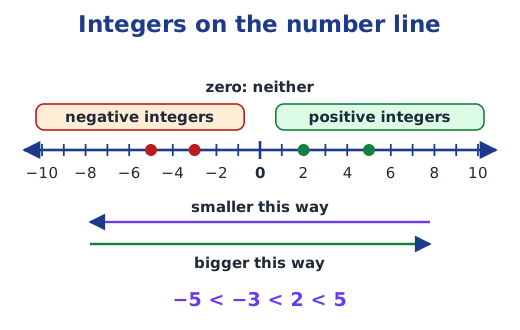
Positive numbers go on forever, and so do negative numbers. Together with zero they are the integers: …, −3, −2, −1, 0, 1, 2, 3, … Imagine an ‘infinite lift’ and turn it on its side: it becomes the number line, with the negative numbers to the left of 0. Smaller numbers are always to the left, so −5 < −3 < 2. More in integers on the number line.
Rules for adding and subtracting
Subtracting a negative number is the same as adding the positive number: (+2000) − (−200) = (+2000) + (+200) = +2200. In general, subtracting a number is the same as adding its inverse, so any subtraction can be turned into an addition. The token model shows this: a positive and a negative token make a zero pair worth 0, and putting in or taking out zero pairs does not change a value. More in adding and subtracting integers.
Integers around us
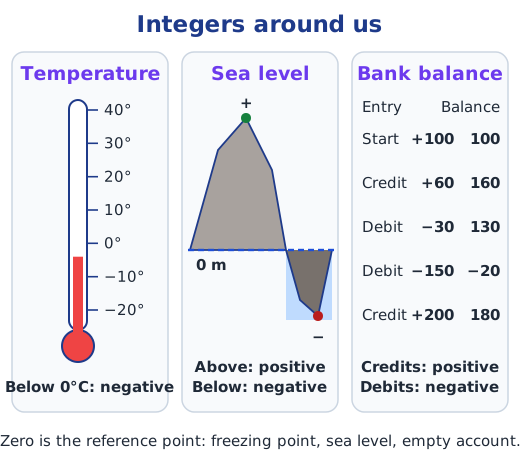
- Banking: credits (money in) are positive and debits (money out) are negative. Some banks allow a balance to become negative for a while, often with an extra charge.
- Geography: heights are measured from sea level, 0 m; places below sea level have negative heights.
- Temperature: in degrees Celsius, temperatures below the freezing point of water, 0°C, are negative, as in Leh on a winter night.
A pinch of history
Negative numbers were first used for accounts. In China, The Nine Chapters on Mathematical Art (first or second century CE) used red and black rods for positive and negative numbers. In India, Kautilya’s Arthaśhāstra (c. 300 BCE) wrote about credits and debits, and the Bakhshali manuscript (around 300 CE) wrote negative numbers with a special sign after the number. In 628 CE, Brahmagupta treated positive numbers, negative numbers and zero as equally valid numbers and gave clear rules for working with them. These ideas reached the Arab world by the 9th century and Europe by the 13th century. Answers to every question in the chapter are in the NCERT solutions for Chapter 10.
Key terms
| Term | Meaning |
|---|---|
| Negative number | A number less than zero, written with a ‘−’ sign in front, like −4. It lies to the left of 0 on the number line. |
| Positive number | A number greater than zero, sometimes written with a ‘+’ sign, like +4 or simply 4. |
| Integers | The numbers …, −3, −2, −1, 0, 1, 2, 3, …: the positive numbers, the negative numbers and zero. |
| Zero | The reference point. Zero is neither positive nor negative. |
| Inverse (additive inverse) | The number that gives zero when added to a given number. The inverse of +3 is −3, and the inverse of −3 is +3. |
| Zero pair | A positive token and a negative token together. Their total value is zero, so they cancel. |
| Number line | A line with 0 in the middle, positive numbers to the right and negative numbers to the left, going on forever both ways. |
| Unmarked number line | A number line that shows only 0; you imagine the other numbers to add or subtract large integers. |
| Credit and debit | Money put into a bank account (credit, positive) and money taken out (debit, negative). |
| Sea level | The reference level, 0 m, for heights: above it is positive, below it negative. |
| Brahmagupta's rules | Rules for adding and subtracting positive numbers, negative numbers and zero, given by Brahmagupta in 628 CE. |
Topics in this chapter
Practice
-
Which of these is a negative number?
Show answer
Answer: (c) −4
-
The inverse of −7 is:
Show answer
Answer: (c) +7
-
Which is the correct comparison?
Show answer
Answer: (b) −4 < −3 −4 is to the left of −3 on the number line (and Floor −4 is below Floor −3), so −4 is smaller.
-
(+5) + (−8) equals:
Show answer
Answer: (c) −3 Five zero pairs cancel, and three negative tokens are left.
-
2 − (−3) equals:
Show answer
Answer: (d) 5 Subtracting −3 is the same as adding +3: 2 + 3 = 5.
Questions students ask
What are the main topics of Class 6 Maths Chapter 10?
Negative numbers through Bela's Building of Fun, adding and subtracting integers as movements, inverses, comparing integers, the number line, the token model, integers in banking, geography and temperature, explorations with integer grids, and a short history of negative numbers.
Is The Other Side of Zero in the new Ganita Prakash book?
Yes. The Other Side of Zero (Integers) is Chapter 10, the last chapter of Ganita Prakash, the Class 6 Maths textbook used in the 2026-27 session.
Who gave the rules for negative numbers?
Brahmagupta gave clear rules for adding, subtracting, multiplying and dividing positive numbers, negative numbers and zero in his Brāhma-sphuṭa-siddhānta in 628 CE.
Stuck on a question?
Take a photo and Lagnever AI explains it step by step. Try it for 7 days for ₹2.
Get it on Google Play Open in browser
For parents: after the trial, the plan renews monthly by UPI or card autopay. You can cancel anytime in the app.