
How do we add and subtract integers?
Answer in short
Adding is Starting position + Movement = Target: from 3, moving −5 takes you to −2, so 3 + (−5) = −2. Subtracting finds the movement needed: Target − Start = Movement, so 4 − (−3) = +7. Subtracting a number equals adding its inverse. With tokens, a positive and a negative token cancel as a zero pair.
Stuck on a question? Take a photo and Lagnever AI explains it step by step. Try it for 7 days for ₹2. Get it on Google Play
Adding to keep track of movement
In Bela’s Building of Fun, start in the Food Court (Floor +1) and press +2: you reach the Book Store on Floor +3. We write this as:
Starting floor + Movement = Target floor, so (+1) + (+2) = +3.
From Floor +2, pressing −3 takes you down three floors to Floor −1: (+2) + (−3) = −1. Combining button presses is also addition: Gurmit, in the Toy Store, pressed + twice by mistake and then − three times, a total movement of (+2) + (−3) = −1, one floor down.
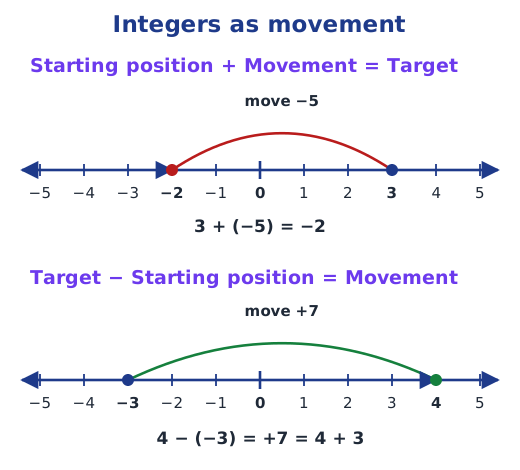
Subtracting to find the movement
Subtraction can mean ‘making equal’, or finding the missing number to be added: 6 + ? = 10 is the same as 10 − 6 = ?. For floors:
Target floor − Starting floor = Movement needed.
- From Floor −2 to Floor −1 you go up 1: (−1) − (−2) = +1.
- From Floor +3 to Floor −1 you go down 4: (−1) − (+3) = −4.
- From Floor −2 to Floor +2 you go up 4: (+2) − (−2) = +4.
Subtracting is adding the inverse
To go from −200 to +2000, you go up 200 to reach 0 and then 2000 more: +2200. So (+2000) − (−200) = (+2000) + (+200) = +2200. Subtracting a negative number is the same as adding the positive number. In general, the number being subtracted can be replaced by its inverse and added instead:
| Subtraction | As an addition | Answer |
|---|---|---|
| (+7) − (+5) | (+7) + (−5) | +2 |
| (−3) − (+8) | (−3) + (−8) | −11 |
| (+8) − (−2) | (+8) + (+2) | +10 |
| (+6) − (−9) | (+6) + (+9) | +15 |
The token model
A lift attendant takes a positive (green) token each time he presses ‘+’ and a negative (red) token each time he presses ‘−’. A positive and a negative token cancel, because together they are worth 0: they make a zero pair. To add, put the tokens together and remove the zero pairs.
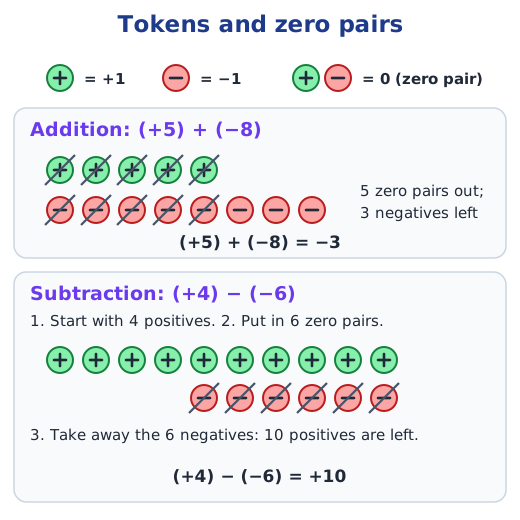
To subtract, take tokens away. If there are not enough of the right kind, first put in zero pairs, which do not change the value. For (+5) − (+6), put in one zero pair, take away six positives, and one negative is left: −1. For (+4) − (−6), put in six zero pairs, take away six negatives, and ten positives are left: +10.
Brahmagupta’s rules
In 628 CE, Brahmagupta wrote down rules that still work for any integers:
- two positives add up to a positive, and two negatives to a negative: (−2) + (−3) = −5;
- for a positive and a negative, subtract the smaller number from the bigger and keep the sign of the bigger: −5 + 3 = −2;
- a number plus its inverse is zero, and a number plus zero is the same number;
- subtracting a negative number is the same as adding the positive number: 2 − (−3) = 2 + 3.
Practise with the Building of Fun or the number line until these rules feel natural. For the meaning of each integer, see what are negative numbers.
Practice
-
(−6) + (+4) equals:
Show answer
Answer: (c) −2
-
(−8) − (−4) equals:
Show answer
Answer: (b) −4 Subtracting −4 is adding +4: −8 + 4 = −4.
-
To evaluate (+5) − (+6) with tokens, you first need to:
Show answer
Answer: (a) add one zero pair Five positives are not enough to take away six, so put in one zero pair; taking six positives then leaves one negative: −1.
-
Find (−3) − (+5) using tokens.
Show answer
Answer: Start with 3 negatives. To take away 5 positives, put in 5 zero pairs. Take away the 5 positives: 8 negatives are left, so (−3) − (+5) = −8.
-
Rewrite (+6) − (−9) as an addition and find the answer.
Show answer
Answer: Replace −9 by its inverse +9 and add: (+6) + (+9) = +15.
Questions students ask
How do you add a positive and a negative integer?
Subtract the smaller number (without its sign) from the bigger one and give the answer the sign of the bigger one. For example, −5 + 3 = −2 and 2 + (−3) = −1. This is one of Brahmagupta's rules.
What does subtraction mean for integers?
It tells you the movement needed to go from the starting number to the target number: Target − Start = Movement. For example, to go from 3 to −1 you move −4, so (−1) − 3 = −4.
Why is subtracting a negative number the same as adding?
To go from −200 to +2000 you must go up 200 to reach 0 and then 2000 more, a total of +2200. So 2000 − (−200) = 2000 + 200. Subtracting a number always equals adding its inverse.
What is a zero pair?
One positive token and one negative token. Together they are worth 0, so you can add or remove zero pairs without changing a value.
Stuck on a question?
Take a photo and Lagnever AI explains it step by step. Try it for 7 days for ₹2.
Get it on Google Play Open in browser
For parents: after the trial, the plan renews monthly by UPI or card autopay. You can cancel anytime in the app.