
How do we show integers on the number line?
Answer in short
Integers are the numbers …, −3, −2, −1, 0, 1, 2, 3, … On the number line, zero is in the middle, positive integers are to its right and negative integers to its left, and the line goes on forever both ways. A number to the left is always smaller, so −5 < −3 < 0 < 2. Moving right means adding a positive number.
Stuck on a question? Take a photo and Lagnever AI explains it step by step. Try it for 7 days for ₹2. Get it on Google Play
From a number ray to a number line
The number line we drew in earlier classes started at 0 and went on forever to the right. In the language of geometry, that is a number ray. Negative numbers complete it into a true number line, going on forever in both directions.
How many negative numbers are there?
Bela’s Building of Fun had floors from −5 to +6. A mine in the chapter has levels from −200 m to +180 m. But we can imagine bigger buildings and deeper mines. Just as positive numbers +1, +2, +3, … go up without end, negative numbers −1, −2, −3, … go down without end. Positive and negative numbers, together with zero, are called integers:
…, −4, −3, −2, −1, 0, 1, 2, 3, 4, …
The infinite lift becomes a number line
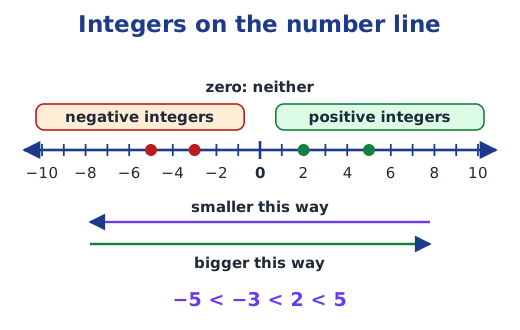
Imagine a lift that goes forever upwards and forever downwards from Level 0. Turn this ‘infinite lift’ through 90° and it becomes the number line: zero in the middle, positive numbers to the right and negative numbers to the left. We usually drop the ‘+’ sign and write positive numbers simply as 1, 2, 3, …
Comparing and ordering integers
On the number line, smaller numbers are to the left of bigger numbers. So 2 < 5, −3 < 2 and −5 < −3. In the building, a lower floor has a smaller number. Two quick facts follow:
- every negative number is less than 0, and 0 is less than every positive number;
- between two negative numbers, the one with the bigger number after the sign is smaller: −10 < −2.
| Comparison | Why |
|---|---|
| −2 < +5 | A negative number is less than a positive number |
| −5 < −3 | −5 is to the left of −3 |
| 0 > −4 | −4 is to the left of 0 |
| −25 < −7 | −25 is much farther to the left |
Walking along the number line
To the right is the positive (forward) direction, and to the left is the negative (backward) direction. From 5 to 9 you move 4 steps forward, so 5 + 4 = 9 and 9 − 5 = 4. From 9 to 3 you move 6 steps back, a movement of −6, so 9 + (−6) = 3 and 3 − 9 = −6. From 3 to −2 you move 5 steps back: 3 + (−5) = −2 and −2 − 3 = −5.
The unmarked number line
For large numbers, draw a line that shows only 0 and imagine where the other numbers are. For 85 + (−60), start at 85 and move 60 to the left: you land at 25. For (−100) − (+250), ask what must be added to 250 to reach −100: you must go 250 down to 0 and then 100 more, a movement of −350.
Writing integers in order
To list the integers between two numbers, count along the line. Between −4 and 4, in increasing order, are −3, −2, −1, 0, 1, 2, 3. Between −8 and −15 are −14, −13, −12, −11, −10, −9. To see how adding and subtracting work as movement, read adding and subtracting integers.
Practice
-
Which is the smallest number?
Show answer
Answer: (c) −9
-
Which integers lie between −4 and 1?
Show answer
Answer: (b) −3, −2, −1, 0
-
From 9, how far must you move to reach 3?
Show answer
Answer: (b) −6 You move 6 steps backward (left), so the movement is −6: 9 + (−6) = 3.
-
Arrange in increasing order: 4, −6, 0, −1, 2.
Show answer
Answer: −6, −1, 0, 2, 4.
-
Is −2 < 3? Why?
Show answer
Answer: Yes. On the number line −2 lies to the left of 3, and every negative number is less than every positive number.
Questions students ask
What are integers?
The positive numbers 1, 2, 3, …, the negative numbers −1, −2, −3, …, and zero, taken together: …, −3, −2, −1, 0, 1, 2, 3, …
How do you compare two integers?
Place them on the number line. The one to the left is smaller. So any negative number is less than zero, and zero is less than any positive number.
How many integers are there?
Endlessly many. Positive integers go on forever, and so do negative integers, in the other direction.
What is an unmarked number line?
A number line on which only 0 is shown. You imagine the positions of other numbers on it, which makes it handy for adding and subtracting large integers.
Stuck on a question?
Take a photo and Lagnever AI explains it step by step. Try it for 7 days for ₹2.
Get it on Google Play Open in browser
For parents: after the trial, the plan renews monthly by UPI or card autopay. You can cancel anytime in the app.