
NCERT Solutions Class 6 Maths Chapter 6: Perimeter and Area
Answers to every “Figure it Out” question and puzzle in Chapter 6, Perimeter and Area, of Ganita Prakash (Reprint 2026-27). The page numbers match the book, so you can find each question quickly. Short notes: Chapter 6 notes.
Figure it Out: perimeter (page 132)
Question 1: find the missing terms
- (a) Perimeter of a rectangle = 14 cm, breadth = 2 cm. Length + breadth = 14 ÷ 2 = 7 cm, so length = 7 − 2 = 5 cm.
- (b) Perimeter of a square = 20 cm. Side = 20 ÷ 4 = 5 cm.
- (c) Perimeter of a rectangle = 12 m, length = 3 m. Length + breadth = 12 ÷ 2 = 6 m, so breadth = 6 − 3 = 3 m.
Question 2: wire rectangle bent into a square
The wire’s length is the rectangle’s perimeter: 2 × (5 + 3) = 16 cm. The same wire makes the square, so its side = 16 ÷ 4 = 4 cm.
Question 3: third side of a triangle
Third side = 55 − (20 + 14) = 55 − 34 = 21 cm.
Question 4: cost of fencing the park
Perimeter = 2 × (150 + 120) = 2 × 270 = 540 m. Cost = 540 × ₹40 = ₹21,600.
Question 5: a 36 cm string
- (a) Square: 36 ÷ 4 = 9 cm each side.
- (b) Triangle with equal sides: 36 ÷ 3 = 12 cm each side.
- (c) Hexagon with equal sides: 36 ÷ 6 = 6 cm each side.
Question 6: three rounds of rope
Perimeter of the field = 2 × (230 + 160) = 2 × 390 = 780 m. Three rounds need 3 × 780 = 2,340 m of rope.
Matha Pachchi: two running tracks (page 133)
Akshi’s outer track is 70 m × 40 m, so one round = 2 × (70 + 40) = 220 m. Toshi’s inner track is 60 m × 30 m, so one round = 2 × (60 + 30) = 180 m.
Question 1
Akshi’s 5 rounds = 5 × 220 = 1,100 m.
Question 2
Toshi’s 7 rounds = 7 × 180 = 1,260 m. Toshi ran the longer distance, by 160 m.
Question 3: marking positions
Both girls start at the bottom-right corner of their own track and run along the bottom side first, as the arrows show. The dots on each track are 10 m apart, so you can count dots to mark the points.
- (a) A, Akshi after 250 m: 250 = 220 + 30. One full round, then 30 m more: A is on the bottom side, 30 m from her starting point.
- (b) B, Akshi after 500 m: 500 = 2 × 220 + 60. B is on the bottom side, 60 m from the start (10 m before the bottom-left corner).
- (c) C, Akshi after 1,000 m: 1,000 = 4 × 220 + 120. She has finished 4 full rounds. The extra 120 m = 70 m (bottom) + 40 m (left side) + 10 m, so C is on the top side, 10 m from the top-left corner.
- (d) X, Toshi after 250 m: 250 = 180 + 70. The extra 70 m = 60 m (bottom) + 10 m, so X is on the left side, 10 m above the bottom-left corner.
- (e) Y, Toshi after 500 m: 500 = 2 × 180 + 140. The extra 140 m = 60 + 30 + 50, so Y is on the top side, 50 m from the top-left corner.
- (f) Z, Toshi after 1,000 m: 1,000 = 5 × 180 + 100. She has finished 5 full rounds. The extra 100 m = 60 + 30 + 10, so Z is on the top side, 10 m from the top-left corner.
Deep Dive: a common finishing line (page 134)
The flags are in the middle of the bottom side of both square tracks, and the runners move along the bottom towards the flags, as the arrows show. Each runner must run exactly 350 m.
- A (inner track, sides of 100 m): start at the bottom-right corner of the inner track. Run up the right side (100 m), along the top (100 m), down the left side (100 m) and half of the bottom (50 m): 100 + 100 + 100 + 50 = 350 m.
- B (outer track, sides of 150 m): start on the top side, 25 m from the top-right corner. Run 125 m to the top-left corner, 150 m down the left side and 75 m (half of the bottom) to the flag: 125 + 150 + 75 = 350 m.
Is the triangle’s perimeter 9 units? (page 134)
Toshi is right: it is more than 9 units. Two sides are straight, 3 units each, but the slanting side crosses 3 squares diagonally. The diagonal of a unit square is longer than its side, so the slanting side is more than 3 units. In the book’s short form, the perimeter is 6s + 3d.
Straight and diagonal units (page 135)
Counting straight units (s) and diagonal units (d) around each figure, in the order shown:
- 8s + 2d
- 4s + 6d
- 12s + 6d
- 18s + 6d
Perimeter of a regular polygon (pages 135–136)
Similarity between a square and an equilateral triangle: both are regular polygons, with all sides equal and all angles equal. So each perimeter is the number of sides × the length of one side: 4 × side for the square and 3 × side for the triangle.
General rule: perimeter of a regular polygon = number of sides × length of one side. A regular pentagon with sides of 4 cm has a perimeter of 5 × 4 = 20 cm.
Split and rejoin (page 136)
Each piece is 6 cm × 2 cm, with a perimeter of 2 × (6 + 2) = 16 cm. When two pieces touch along some length, that length disappears from the outside of both pieces. So:
Perimeter of the arrangement = 16 + 16 − 2 × (length where the pieces touch)
- (a) Touch along 2 cm: 32 − 4 = 28 cm (as given in the book).
- (b) L-shape, touching along 2 cm: 32 − 4 = 28 cm.
- (c) T-shape, touching along 2 cm: 32 − 4 = 28 cm.
- (d) Side by side, touching along 3 cm: 32 − 6 = 26 cm.
A figure with a perimeter of 22 cm: we need 32 − 2 × (touching length) = 22, so the pieces must touch along 5 cm. Place them side by side along their long 6 cm sides and slide one piece 1 cm along the other.
Figure it Out: area (page 138)
Question 1
Width = area ÷ length = 300 ÷ 25 = 12 m.
Question 2
Area = 500 × 200 = 1,00,000 sq m = 1,000 lots of 100 sq m. Cost = 1,000 × ₹8 = ₹8,000.
Question 3
Area of the grove = 100 × 50 = 5,000 sq m. Number of trees = 5,000 ÷ 25 = 200 trees.
Question 4: splitting into rectangles
- (a) Split the shape into four rectangles: 3 m × 4 m (12 sq m), 4 m × 1 m (4 sq m), 3 m × 2 m (6 sq m) and 2 m × 3 m (6 sq m). Area = 12 + 4 + 6 + 6 = 28 sq m.
- (b) Take the full 5 m × 3 m rectangle (15 sq m) and subtract the 3 m × 2 m gap in the middle (6 sq m). Area = 15 − 6 = 9 sq m.
Tangram (page 139)
Placing the pieces on each other shows: A and B (the big triangles) are equal; C and E (the small triangles) are equal; and D, F and G are each made of two small triangles. Taking the area of C as 1 part: C = E = 1, D = F = G = 2, A = B = 4.
- Pieces with the same area: A and B; C and E; D, F and G.
- D is 2 times C. C and E together exactly cover D, so D = C + E.
- D and F have the same area, 2 parts each.
- F and G have the same area, 2 parts each, even though their shapes differ.
- A is twice as big as G: 4 parts compared with 2 parts.
- The big square = 16 times the area of C (4 + 4 + 1 + 1 + 2 + 2 + 2 = 16).
- The rectangle also has an area of 16 times C, because it is made of the same seven pieces with no gaps or overlaps.
- The perimeters are different. The rectangle is longer and thinner than the square, so its boundary is longer, even though both have the same area.
Estimating area on squared paper (page 140)
Count full squares as 1 and half squares (cut by a diagonal) as ½. The four figures, in order, have areas of 4, 9, 10 and 11 sq units.
Let’s Explore: rectangles with an area of 24 sq units (pages 141–142)
The rectangles with whole-number sides are 1 × 24, 2 × 12, 3 × 8 and 4 × 6 (and the same ones turned around).
- (a) Greatest perimeter: 1 × 24, with 2 × (1 + 24) = 50 units.
- (b) Least perimeter: 4 × 6, with 2 × (4 + 6) = 20 units.
- (c) Area of 32 sq cm: the rectangles are 1 × 32, 2 × 16 and 4 × 8. The greatest perimeter is 1 cm × 32 cm (66 cm) and the least is 4 cm × 8 cm (24 cm).
Prediction: for any area, the longest and thinnest rectangle (1 × area) has the greatest perimeter, and the rectangle closest to a square has the least.
Area of a triangle on grid paper (page 143)
Rectangle ABCD is 5 squares long and 4 squares high, so its area = 20 sq units.
- Triangle BAD is half of the rectangle: 10 sq units.
- Triangle ABE: half of rectangle AFED (3 × 4 = 12, half = 6) + half of rectangle BFEC (2 × 4 = 8, half = 4) = 10 sq units.
Conclusion: a triangle that has one side of a rectangle as its base and its third corner on the opposite side has half the area of the rectangle.
Figure it Out: areas on grid paper (page 144)
Split each figure into rectangles and triangles (each triangle being half of a rectangle) and add:
- (a) 4 × 5 rectangle (20) + two triangles, each half of 4 × 1 (2 + 2) = 24 sq units.
- (b) 4 × 5 rectangle (20) + triangle half of 4 × 3 (6) + triangle half of 4 × 2 (4) = 30 sq units.
- (c) Top triangle half of 6 × 2 (6) + 3 × 8 rectangle (24) + small triangle half of 3 × 2 (3) + large triangle half of 3 × 10 (15) = 48 sq units.
- (d) 4 × 3 rectangle (12) + triangle half of 1 × 2 (1) + triangle half of 3 × 2 (3) = 16 sq units.
- (e) Split along the horizontal line through the side corners: triangle half of 4 × 2 (4) + triangle half of 4 × 4 (8) = 12 sq units.
Making it ‘More’ or ‘Less’ (pages 145–146)
Each unit square has 4 sides. Every side shared by two squares is hidden from the boundary twice, so perimeter = 36 − 2 × (number of shared sides) for 9 squares.
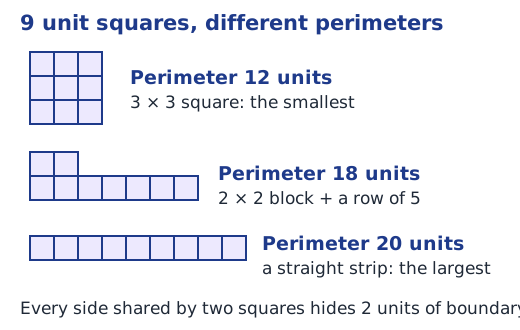
- Smallest perimeter: 12 units, from the 3 × 3 square.
- Largest perimeter: 20 units, for example a straight strip of 9 squares.
- Perimeter of 18 units: a 2 × 2 block of 4 squares with the other 5 squares in a row attached to it.
- Other shapes: for 18 and 20 units there are many different shapes. For 12 units the 3 × 3 square is the only one, because no other arrangement of 9 squares shares as many sides.
Adding a new square to the 24-unit figure: if it touches the figure along 1 side, the perimeter increases by 2; along 2 sides, it stays the same; along 3 sides, it decreases by 2.
House plans (pages 146–147)
Charan’s house (30 ft deep)
The width is 15 ft (master bedroom) + 5 ft (toilet) + 15 ft (kitchen) = 35 ft.
- Small bedroom: 180 ÷ 15 = 12, so 15 ft × 12 ft.
- Utility: above the kitchen; 15 ft − 12 ft = 3 ft high, so 15 ft × 3 ft = 45 sq ft.
- Garden: 30 − 15 − 12 = 3 ft high and 15 + 5 = 20 ft wide, so 20 ft × 3 ft = 60 sq ft.
- Parking: 15 ft × 3 ft = 45 sq ft.
- Hall: the part below the kitchen is 20 ft × 12 ft = 240 sq ft. The plan also shows a 5 ft × 5 ft passage between the toilet and the hall, which adds 25 sq ft if you count it with the hall.
- Area of the house = 35 ft × 30 ft = 1,050 sq ft.
Sharan’s house (42 ft wide)
The depth is 15 ft (master bedroom) + 10 ft (small bedroom) = 25 ft. The hall is 23 ft wide and the kitchen 18 ft, so the toilet is 23 − 18 = 5 ft wide, and the utility column is 42 − 12 − 23 = 7 ft wide.
- Toilet: 5 ft × 10 ft = 50 sq ft.
- Utility: 70 ÷ 7 = 10, so 7 ft × 10 ft.
- Hall: 25 − 10 = 15 ft deep, so 23 ft × 15 ft = 345 sq ft.
- Entrance: 7 ft × 15 ft = 105 sq ft.
- Small bedroom: 12 ft × 10 ft = 120 sq ft.
- Area of the house = 42 ft × 25 ft = 1,050 sq ft.
Comparing the two: both houses have the same area, 1,050 sq ft. Charan’s house has a perimeter of 2 × (35 + 30) = 130 ft and Sharan’s has 2 × (42 + 25) = 134 ft, so Sharan’s house has the longer perimeter.
Area Maze Puzzles (page 148)
- (a) 30 sq cm. The two top rectangles have the same height, and 26 is twice 13, so the right column is twice as wide as the left one. The bottom rectangles share a height too, so the missing area is 2 × 15 = 30 sq cm.
- (b) 9 sq cm. The bottom rectangle is 2 cm high with an area of 10 sq cm, so it is 5 cm wide. The tall rectangle is 5 − 3 = 2 cm wide, and with an area of 10 sq cm it is 5 cm tall. The shaded rectangle is 3 cm wide and 5 − 2 = 3 cm tall: 3 × 3 = 9 sq cm.
- (c) 16 sq cm. The middle rectangle: 42 ÷ 6 = 7 cm wide. The bottom one is 7 + 5 = 12 cm wide, so it is 60 ÷ 12 = 5 cm tall. The shaded part is 15 − 6 − 5 = 4 cm tall and 7 − 3 = 4 cm wide: 4 × 4 = 16 sq cm.
- (d) 5 cm. The small rectangle is 18 ÷ 5 = 3.6 cm tall, so the big one is 4 + 3.6 = 7.6 cm tall and 38 ÷ 7.6 = 5 cm wide.
Figure it Out: mixed problems (page 149)
Question 1
Total area = 5 × 10 + 2 × 7 = 50 + 14 = 64 sq m. One answer is 8 m × 8 m. Others are 16 m × 4 m and 32 m × 2 m.
Question 2
Width = 1,000 ÷ 50 = 20 m.
Question 3
Floor = 5 × 4 = 20 sq m, carpet = 3 × 3 = 9 sq m. Area without carpet = 20 − 9 = 11 sq m.
Question 4
Garden = 15 × 12 = 180 sq m. Flower beds = 4 × (2 × 1) = 8 sq m. Lawn = 180 − 8 = 172 sq m.
Question 5
For example, Shape A can be a 1 × 18 strip (area 18 sq units, perimeter 38 units) and Shape B a 4 × 5 rectangle (area 20 sq units, perimeter 18 units). A has the smaller area but the longer perimeter.
Question 6
The answer depends on the size of your page. If the page is W cm wide and H cm tall, the border is (W − 3) cm wide and (H − 2) cm tall, so its perimeter = 2 × ((W − 3) + (H − 2)). For example, on a 20 cm × 27 cm page, the border is 17 cm × 25 cm and its perimeter is 2 × 42 = 84 cm.
Question 7
The outer rectangle has an area of 12 × 8 = 96 sq units, so the inner one needs 48 sq units. Draw an 8 × 6 rectangle in the middle: it leaves a gap of 2 units on the left and right and 1 unit at the top and bottom, so it does not touch the outer rectangle.
Question 8
(c) is always true. Take a square of side 10 cm: its perimeter is 40 cm. Cut in half, it gives two 10 cm × 5 cm rectangles, each with a perimeter of 30 cm. Together they make 60 cm, which is 1½ times 40 cm. The other statements are false: each rectangle is half the square’s area (not larger), the two perimeters together are more than the square’s, and the square’s area equals both rectangles together (not three times).
Practice
-
A rectangle is 11 cm long and 4 cm wide. Its perimeter is:
Show answer
Answer: (b) 30 cm
-
A square field has a perimeter of 100 m. Its area is:
Show answer
Answer: (c) 625 sq m Side = 100 ÷ 4 = 25 m, so area = 25 × 25 = 625 sq m.
-
Which rectangle with an area of 36 sq cm has the greatest perimeter?
Show answer
Answer: (d) 1 cm × 36 cm
-
A garden is 20 m long and 15 m wide. A path 1 m wide runs along the inside of its boundary. Find the area of the garden left inside the path.
Show answer
Answer: Inside the path the garden is (20 − 2) m × (15 − 2) m = 18 m × 13 m = 234 sq m.
-
A triangle is drawn on the 12 cm side of a 12 cm × 7 cm rectangle with its top corner on the opposite side. Find its area.
Show answer
Answer: Rectangle = 12 × 7 = 84 sq cm, so the triangle = half of 84 = 42 sq cm.
Stuck on a question?
Take a photo and Lagnever AI explains it step by step. Try it for 7 days for ₹2.
Get it on Google Play Open in browser
For parents: after the trial, the plan renews monthly by UPI or card autopay. You can cancel anytime in the app.