
Class 6 Maths Chapter 6: Perimeter and Area Notes
This chapter in five lines
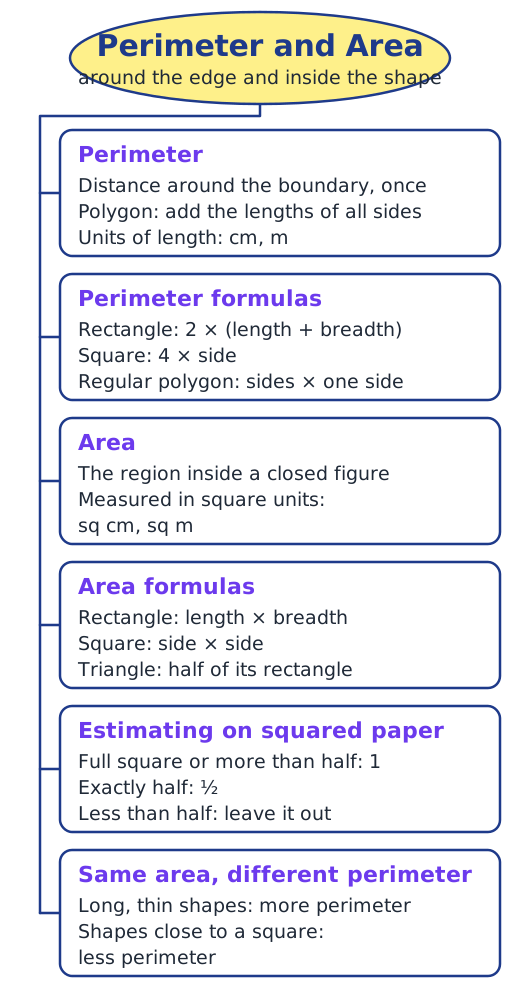
Perimeter is the distance around the boundary of a closed figure; for a polygon, add the lengths of all its sides. A rectangle's perimeter is 2 × (length + breadth) and a square's is 4 × side. Area is the region a closed figure covers, measured in square units. A rectangle's area is length × breadth, a square's is side × side, and a triangle drawn on the base of a rectangle with its top corner on the opposite side covers half of that rectangle.
What is perimeter?
The perimeter of a closed figure is the distance covered along its boundary when you go around it once. For a polygon (a closed figure made of line segments), it is the sum of the lengths of all its sides. Perimeter is a length, so we write it in cm, m and so on.
Which perimeter formulas should you know?
- Rectangle: opposite sides are equal, so perimeter = length + breadth + length + breadth = 2 × (length + breadth).
- Square: all four sides are equal, so perimeter = 4 × side.
- Triangle: add the three sides. For an equilateral triangle, perimeter = 3 × side.
- Regular polygon (all sides and all angles equal): perimeter = number of sides × length of one side.
What is area?
Area is the amount of region enclosed by a closed figure. We measure it in square units: a square of side 1 cm has an area of 1 sq cm. Squares are used because they fit together with no gaps and no overlaps.
- Rectangle: area = length × breadth.
- Square: area = side × side.
- Triangle: a diagonal cuts a rectangle into two equal triangles, and any triangle drawn on the rectangle’s base with its top corner on the opposite side covers half of the rectangle.
How do you estimate the area of an odd shape?
Trace it on squared paper. Count every full square as 1 sq unit, count a square that is more than half covered as 1, count exactly half as ½, and leave out squares that are less than half covered.
Can two shapes have the same area but different perimeters?
Yes. Rectangles of area 24 sq units can be 1 × 24 (perimeter 50 units), 2 × 12 (28 units), 3 × 8 (22 units) or 4 × 6 (20 units). The longer and thinner the rectangle, the bigger its perimeter; the closer it is to a square, the smaller its perimeter.
Key terms
| Term | Meaning |
|---|---|
| Perimeter | The distance covered along the boundary of a closed figure when you go around it once. |
| Polygon | A closed plane figure made up of line segments. Its perimeter is the sum of the lengths of its sides. |
| Regular polygon | A closed figure with all sides equal and all angles equal, such as a square or an equilateral triangle. |
| Equilateral triangle | A triangle with all three sides (and angles) equal. Perimeter = 3 × side. |
| Area | The amount of region enclosed by a closed figure. |
| Square unit | The area of a square of side 1 unit, for example 1 sq cm or 1 sq m. |
| Length and breadth | The two sides of a rectangle. Breadth is also called width. |
| Diagonal | A line joining two opposite corners. It splits a rectangle into two equal triangles. |
| Tangram | A square cut into 7 pieces (triangles, a square and a parallelogram) used to compare areas. |
| Estimate | A close guess. Area on squared paper is estimated by counting squares. |
Topics in this chapter
Practice
-
What is the perimeter of a rectangle 8 cm long and 3 cm wide?
Show answer
Answer: (b) 22 cm 2 × (8 + 3) = 22 cm
-
The perimeter of a square is 36 m. Its side is:
Show answer
Answer: (b) 9 m 36 ÷ 4 = 9 m
-
What is the area of a square of side 7 cm?
Show answer
Answer: (c) 49 sq cm
-
A rectangle has an area of 40 sq m and a length of 8 m. Its breadth is:
Show answer
Answer: (b) 5 m 40 ÷ 8 = 5 m
-
A triangle is drawn on the base of a 10 cm × 6 cm rectangle with its top corner on the opposite side. Its area is:
Show answer
Answer: (b) 30 sq cm Half of 10 × 6 = 60 sq cm, which is 30 sq cm.
Questions students ask
What is Chapter 6 of Class 6 Maths Ganita Prakash about?
Perimeter and area: the perimeter of rectangles, squares, triangles and regular polygons, the area of rectangles, squares and triangles, estimating area on squared paper, and shapes with the same area but different perimeters.
What is the difference between perimeter and area?
Perimeter is the length around the edge of a shape, measured in cm or m. Area is the space inside the shape, measured in square units such as sq cm or sq m.
Where are the answers to the “Figure it Out” questions of Chapter 6?
All of them, including the puzzles, are answered step by step on our NCERT solutions page for this chapter.
Stuck on a question?
Take a photo and Lagnever AI explains it step by step. Try it for 7 days for ₹2.
Get it on Google Play Open in browser
For parents: after the trial, the plan renews monthly by UPI or card autopay. You can cancel anytime in the app.