
Perimeter of a rectangle and a square
Answer in short
Perimeter is the distance around the boundary of a closed figure. For a polygon, add the lengths of all its sides. The perimeter of a rectangle is 2 × (length + breadth), and the perimeter of a square is 4 × side. Write the answer in a unit of length, such as cm or m.
Stuck on a question? Take a photo and Lagnever AI explains it step by step. Try it for 7 days for ₹2. Get it on Google Play
What is perimeter?
Imagine an ant walking along the edge of a notebook cover, starting from one corner and going all the way round back to the same corner. The total distance it walks is the perimeter of the cover.
So the perimeter of a closed figure is the distance covered along its boundary when you go around it once. For a polygon, a closed figure made of straight sides, it is simply the sum of the lengths of all its sides.
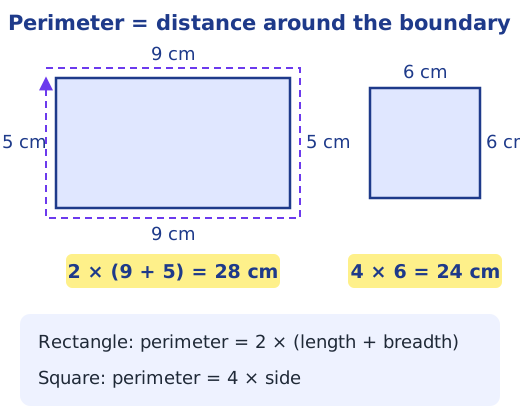
Why is the perimeter of a rectangle 2 × (length + breadth)?
A rectangle has two lengths and two breadths, because its opposite sides are equal. So:
Perimeter = length + breadth + length + breadth = 2 × (length + breadth)
Example: a rectangle is 9 cm long and 5 cm wide.
Perimeter = 2 × (9 cm + 5 cm) = 2 × 14 cm = 28 cm
Why is the perimeter of a square 4 × side?
All four sides of a square are equal. Instead of adding the same side four times, multiply it by 4:
Perimeter = 4 × side
Example: a square tile has sides of 6 cm. Perimeter = 4 × 6 cm = 24 cm.
What about triangles and other polygons?
- Any triangle: add the three sides. A triangle with sides 4 cm, 6 cm and 7 cm has a perimeter of 17 cm.
- Equilateral triangle (all sides equal): perimeter = 3 × side.
- Regular polygon (all sides and all angles equal): perimeter = number of sides × length of one side. A square is a regular polygon with 4 sides, which is why its perimeter is 4 × side.
How do you find a missing side?
Work backwards from the formula.
- A square has a perimeter of 20 cm. Side = 20 ÷ 4 = 5 cm.
- A rectangle has a perimeter of 30 m and a length of 9 m. Length + breadth = 30 ÷ 2 = 15 m, so breadth = 15 − 9 = 6 m.
- A triangle has a perimeter of 40 cm and two sides of 12 cm and 15 cm. Third side = 40 − (12 + 15) = 13 cm.
Where do we use perimeter in real life?
Whenever something goes around a shape, you need its perimeter.
- Fencing: a garden is 40 m long and 25 m wide. Perimeter = 2 × (40 + 25) = 130 m. If the fence costs ₹50 per metre, the total cost is 130 × 50 = ₹6,500.
- Lace or border: putting a border around a 2 m × 1 m tablecloth needs 2 × (2 + 1) = 6 m of lace.
- Running rounds: one round of a square ground with 60 m sides is 4 × 60 = 240 m, so 3 rounds are 720 m.
Can different shapes have the same perimeter?
Yes. Take a 20 cm piece of string. You can make a 6 cm × 4 cm rectangle, a 7 cm × 3 cm rectangle or a square of side 5 cm with it. All have a perimeter of 20 cm, but they cover different amounts of space inside. That space is the area, which you can read about in area of a rectangle and square.
Practice
-
What is the perimeter of a rectangle 7 cm long and 3 cm wide?
Show answer
Answer: (b) 20 cm 2 × (7 + 3) = 20 cm
-
A square park has sides of 8 m. What is its perimeter?
Show answer
Answer: (b) 32 m
-
A 24 cm long wire is bent into a square. What is the length of each side?
Show answer
Answer: (b) 6 cm 24 ÷ 4 = 6 cm
-
The perimeter of a rectangle is 26 m and its length is 8 m. Find its breadth.
Show answer
Answer: Length + breadth = 26 ÷ 2 = 13 m, so breadth = 13 − 8 = 5 m.
-
Find the perimeter of an equilateral triangle with sides of 9 cm.
Show answer
Answer: 3 × 9 = 27 cm
Questions students ask
What is the unit of perimeter?
Perimeter is a length, so it is measured in units of length such as mm, cm, m or km.
Is perimeter the same as area?
No. Perimeter is the length around the edge of a shape. Area is the space inside it, measured in square units.
How do you find the perimeter of a regular polygon?
Multiply the number of sides by the length of one side. A regular hexagon with sides of 5 cm has a perimeter of 6 × 5 = 30 cm.
Can two rectangles have the same perimeter but different shapes?
Yes. A 6 cm × 4 cm rectangle and an 8 cm × 2 cm rectangle both have a perimeter of 20 cm.
Stuck on a question?
Take a photo and Lagnever AI explains it step by step. Try it for 7 days for ₹2.
Get it on Google Play Open in browser
For parents: after the trial, the plan renews monthly by UPI or card autopay. You can cancel anytime in the app.