
NCERT Solutions Class 6 Maths Chapter 8: Playing with Constructions
Answers to every “Figure it Out” and “Construct” task in Chapter 8, Playing with Constructions, of Ganita Prakash (Reprint 2026-27), with the in-text questions that go with them. The page numbers match the book. Constructions are drawn in your notebook, so each answer gives the steps in words, the measurements to use and what you should observe. Short notes: Chapter 8 notes.
Points 4 cm from P (pages 188–189)
Imagine all the points 4 cm from P. How would they look? They join into a round curve around P: a circle. To draw it, open the compass to 4 cm against a ruler, keep the needle fixed on P and turn the pencil once all the way round.
Take a point on the circle. How far is it from P? Exactly 4 cm, and so is every other point on the circle. P is the centre and 4 cm is the radius.
Recreating the artwork in Fig. 8.1. Draw every circle with the compass:
- Two touching circles: the same radius, say 2 cm, with the centres 4 cm apart.
- A circle inside a circle: one centre and two radii, such as 2 cm and 1 cm.
- Three overlapping circles: the same radius, with the centres equally spaced on a line a little less than two radii apart (for example radius 2 cm and centres 3 cm apart).
- The face: a big circle for the head, two smaller circles for the ears with their centres up to the left and right, small circles with dots for the eyes, a dot for the nose and a short line for the mouth.
- The crossed lines: two equal lines crossing in the middle, with a small circle of the same radius at the lower end of each.
Yes, the instruments make the work easier: the circles come out round, equal circles are really equal, and you can place them exactly by measuring the distance between their centres.
Construct: A Person (pages 190–191)
The figure has two parts: the head and neck (a circle and a line), and the body (a rectangle whose top is a curve dipping downwards).
- Draw the body without its top line: a bottom side and two upright sides, for example 4 cm wide and 4 cm tall.
- The top curve must pass through both top corners and dip down, so the compass tip goes above the body, on the middle line of the body, at the same distance from both corners.
- Fix a radius bigger than half the width and try tips on the middle line until the arc passes through both corners. For example, with the tip 1.5 cm above the middle of the gap between the corners and a radius of 2.5 cm, the arc passes through both corners and dips 1 cm.
- Draw the neck straight up from the lowest point of the curve, and the head as a circle whose centre is on the same middle line, resting on the top of the neck.
Figure it Out: the Wavy Wave (page 191)
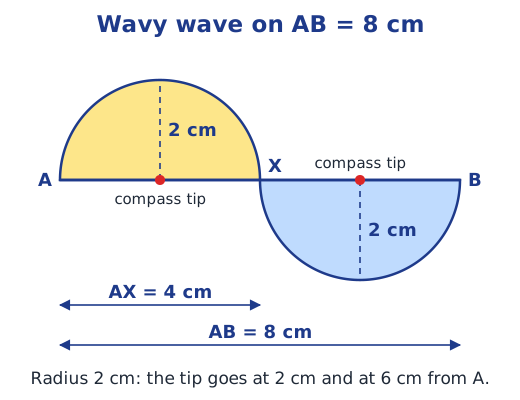
- The two waves share AB = 8 cm equally, so AX = 4 cm. The first wave is a half circle on AX with its centre at the middle of AX, so the compass radius is 2 cm.
- Any length works if the radius is a quarter of AB. For AB = 6 cm: AX = 3 cm and the radius is 1.5 cm, with the tip at 1.5 cm and 4.5 cm from A. For AB = 10 cm: the radius is 2.5 cm, with the tip at 2.5 cm and 7.5 cm from A.
- For waves smaller than half circles, the tip goes off the line, on the middle line of each wave, and both waves use the same radius and the same distance. On AB = 8 cm: mark the middle of AX (2 cm from A), draw a short perpendicular through it, and put the tip on it 1.5 cm below AB. A radius of 2.5 cm then passes exactly through A and X; draw the arc above AB. For the second wave, put the tip 1.5 cm above the middle of XB and, with the same 2.5 cm radius, draw the arc from X to B below AB. The two waves are identical, and each rises only 1 cm.
Construct: Eyes (page 192, with Hint A on page 215)
Each curve of an eye is drawn like the top of ‘A Person’: an arc through the two corners of the eye.
- Draw a light supporting line for the eye, say 6 cm long, and mark its middle. Through the middle, draw a light line at 90° to it.
- On this middle line, mark B 4 cm below the supporting line and A 4 cm above it.
- Put the needle on B, open the compass to reach an end of the supporting line (5 cm) and draw the upper curve from one end to the other.
- Put the needle on A and, with the same opening, draw the lower curve.
- Draw the pupil as a small filled circle in the middle. Draw a second supporting line beside the first and repeat for the other eye.
A and B must be on the middle line, at equal distances from the supporting line, so that the two curves match and the eye is symmetrical. The farther A and B are from the line, the flatter the eye.
Make other artwork of your choice. One idea (Extra): draw a circle of radius 3 cm. Keeping the same opening, put the needle anywhere on the circle and draw an arc inside it from one side of the circle to the other. Move the needle to where the arc meets the circle and repeat. Six arcs make a flower with six petals.
Which is not a name for this square? (page 193)
1. PQSR. Going round the square, the corners come in the order S, P, Q, R. SPQR, RSPQ and QRSP all follow this order of travel, but in PQSR the step from Q to S cuts across the square instead of going along a side.
Figure it Out: squares and rectangles on dot paper (page 194)
-
Count dots so that the picture is the same on the left and the right, and at the top and the bottom. For example, draw the rectangle 4 spaces long and 2 spaces tall and each square 1 space by 1 space, and keep every square 1 space to the left or right of the rectangle and 1 space above or below it. Each square then sits in the same position near its own corner, so the four are placed symmetrically.
-
Only A is a square.
- A: every side goes 4 spaces across and 4 spaces up or down, so all four sides are equal. A side that goes 4 across for 4 down makes half a right angle (45°) with a row of dots, so two sides meeting at a corner make 45° + 45° = 90°. A is a turned square.
- B: every side goes 3 across and 4 down, so the sides are equal, but each side is steeper than half a right angle and the angle at the top is less than 90°. Not a square.
- C: every side goes 5 across and 4 down, so the sides are equal again, but the angle at the top is more than 90°. Not a square.
- D: the short sides go 2 across and 1 down, and the long sides go 2 across and 4 down. Its angles are 90°, but its sides are not all equal, so it is a turned rectangle, not a square.
Think: yes, you can decide without instruments by counting the steps of each side on the grid. If every side has the same steps, only turned, the sides are equal. If one side goes 2 across and 1 down and the next goes 1 back and 2 down, the second is the first turned through a quarter turn, so the angle between them is 90°.
-
Some figures with their corners on dots (counting spaces):
- A turned square: from a corner go 2 right and 1 down, then 1 left and 2 down, then 2 left and 1 up, then 1 right and 2 up, back to the start.
- A bigger turned square: 3 right and 1 down, then 1 left and 3 down, then 3 left and 1 up, then 1 right and 3 up.
- A turned rectangle: 2 right and 1 down, then 2 left and 4 down, then 2 left and 1 up, then 2 right and 4 up.
In the squares every side has the same steps, so all sides are equal; in the rectangle the opposite sides have the same steps. Every turn is a quarter turn, so all the angles are 90°. Check with a ruler and a protractor.
Constructing a square of side 6 cm (pages 195–196)
Why should PS be 6 cm long? All the sides of a square are equal (property S1). PQ = 6 cm, so PS must be 6 cm too.
How long is RS, and what are ∠R and ∠S? RS = 6 cm, and ∠R = ∠S = 90°. PQRS has all its sides equal and all its angles 90°, so it is a square. With the compass still open to 6 cm, R is marked in one go: put the needle on Q and cut the perpendicular through Q.
Construct: rectangles (page 197)
- 4 cm by 6 cm. Draw AB = 6 cm. Draw perpendiculars to AB at A and at B. With the compass at 4 cm, mark D on the perpendicular at A and C on the one at B, and join DC. Check R1: AB = DC = 6 cm and AD = BC = 4 cm. Check R2: each of the four angles measures 90°.
- 2 cm by 10 cm. Draw AB = 10 cm, draw perpendiculars at A and B, mark AD = BC = 2 cm and join DC. Again the opposite sides are equal (10 cm and 2 cm) and every angle is 90°.
- No. Draw AB with right angles at A and B: the sides from A and B go straight up. If AD is made shorter than BC, the line DC slants, and the angles at D and C are no longer 90°. So when all four angles are 90°, the opposite sides are always equal, and the figure is a rectangle.
An exploration in rectangles (pages 197–199)
Construct rectangle ABCD with AB = 7 cm and BC = 4 cm. X moves along AD and Y along BC.
When are X and Y closest? When they are at the same distance from A and B, level with each other. Then XY = 7 cm, the same as AB. They can never be closer, because the sides AD and BC are 7 cm apart all the way along.
When are they farthest? When X is at A and Y is at C, or X is at D and Y is at B. Then XY is a diagonal, AC or BD, about 8.1 cm long. So the farthest distance is equal to the diagonal.
Keeping track. A table with three columns does the job. Your measurements should come out close to these:
| Distance of X from A | Distance of Y from B | Length of XY |
|---|---|---|
| 5 mm | 3 cm | about 7 cm 4 mm |
| 1 cm | 1 cm | 7 cm |
| 2 cm | 4 cm | about 7 cm 3 mm |
When X and Y are the same distance from A and B (5 mm and 5 mm, 1 cm and 1 cm, 1 cm 5 mm and 1 cm 5 mm, and so on):
- XY is always 7 cm, equal to AB.
- ABYX is a rectangle: AB and XY are both 7 cm, AX and BY are equal, and all its angles are 90°.
Breaking rectangles (pages 199–201)
Two identical squares. In the rough diagram ACDF, ABEF and BCDE are squares, so AF = AB = BE = FE and BE = BC = CD = ED: all the shorter lines are equal. If AF = 4 cm, then AC = 4 + 4 = 8 cm. To construct it without measuring twice:
- Draw AF of any length.
- Draw a line through A, perpendicular to AF.
- Open the compass to the length AF. With the needle on A, mark B on the perpendicular; with the needle on B, mark C.
- Draw a perpendicular to AF at F and a perpendicular to AC at C; they meet at D. With the same opening, mark E on FD from F, and join BE.
Three identical squares. Do the same, but copy the length AF three times along the perpendicular from A. With AF = 3 cm the rectangle is 3 cm by 9 cm, and lines 3 cm and 6 cm from the short side cut it into three squares.
Rectangles that cannot be divided:
- into two identical squares: any rectangle whose long side is not 2 times its short side, such as 3 cm by 5 cm or 4 cm by 6 cm;
- into three identical squares: any rectangle whose long side is not 3 times its short side, such as 3 cm by 8 cm, or 4 cm by 8 cm, which splits into two squares but not three.
Construct: squares, rectangles and curves (pages 201–203)
- A Square within a Rectangle. In a rough diagram the square touches both long sides, so its side is 4 cm, the short side of the rectangle. That leaves 8 − 4 = 4 cm of the long side, shared equally: 2 cm at each end. Construct the 8 cm by 4 cm rectangle, mark points 2 cm from each end on both long sides, and join each top point to the point below it. The corners of the square are 2 cm from the corners of the rectangle, and its centre is 4 cm from each short side and 2 cm from each long side, exactly where the rectangle’s centre is.
- Falling Squares. Construct the first square of side 4 cm. Extend its top side 4 cm to the right and its right side 4 cm upwards: these are two sides of the second square, which starts at the top right corner of the first. Complete it with a perpendicular and the compass, and repeat for the third square. For the 3 cm, 5 cm and 7 cm version, start with the 7 cm square at the bottom, build the 5 cm square on its top right corner in the same way, and the 3 cm square on the top right corner of the 5 cm one.
- Shadings. Choose a big square of side 8 cm, so that the small squares are 2 cm. Mark every 2 cm along the sides and draw the grid lines, but keep the bottom left 4 cm by 4 cm block as one square with no lines inside. In each small square of the top two rows, draw the diagonal from its top left corner to its bottom right corner and shade the triangle above it. In the bottom right 4 cm by 4 cm block, do the same in three of the small squares and leave its bottom left small square plain.
- Square with a Hole. The circle’s centre must be the centre of the square. Draw the two diagonals lightly, or join the middles of opposite sides; they cross at the centre. Put the needle there and draw a circle with a radius less than half the side, for example a 6 cm square with a 2 cm radius.
- Square with more Holes. Draw a big square, say 8 cm, and join the middles of opposite sides to cut it into four 4 cm squares. Find the centre of each small square in the same way and draw four circles with the same radius, for example 1.2 cm.
- Square with Curves. Construct the 8 cm square. Each curve passes through the two corners of one side and bulges into the square, so its centre is outside the square, on the middle line of that side. Put the needle 4 cm outside the square, opposite the middle of the side (this is the centre of an imaginary 8 cm square drawn next to it), open the compass to a corner of that side (about 5.7 cm) and draw the arc from one corner to the other. Use the same distance and the same radius on all four sides, so the four curves bulge equally, each by about 1.7 cm.
Exploring diagonals (pages 203–204)
Compare the lengths of the diagonals. They are equal: PR = QS. Check this in every rectangle you construct.
Are g and h equal? Are c and d equal? Not in an ordinary rectangle. The equal ones are a = d = e = h, the four parts next to the long sides, and b = c = f = g, the four parts next to the short sides. The parts next to the long sides are the smaller ones, and at every corner the two parts add up to 90°.
How should the rectangle be constructed so that the diagonal divides the opposite angles into equal parts? Make all four sides equal: in a square every part is 45°.
Recording. A table with the two side lengths, the eight angle parts a to h and the lengths of the two diagonals shows the pattern quickly.
General laws you can frame:
- The two diagonals of a rectangle are equal.
- The eight angle parts come in two groups of four equal angles: the ones next to the long sides and the ones next to the short sides.
- The two parts at each corner add up to 90°, and the smaller part is next to the longer side.
- In a square all eight parts are 45°.
How can we be sure the laws are always true? Measuring a few rectangles only shows that they work for those rectangles; a reason works for all of them. Fold a rectangle along the line through the middles of PQ and SR: P lands on Q and S lands on R, so diagonal PR lands exactly on QS. They match, so PR = QS, and d = e, c = f, h = a and g = b. Now turn the rectangle half a turn about its centre: P goes to R and Q goes to S, which shows that d = h and c = g. Together these give the two groups of four equal parts.
In the solved examples (pages 205–210)
- The other part of ∠A (example 1). ∠A is 90° and one part is 60°, so the other part, ∠DAC, is 30°.
- Two ways to find D. Draw a perpendicular to BC at C, because all the angles of a rectangle are 90°; or mark AD = BC with the compass, because opposite sides are equal.
- Where the circle meets the line l (example 2). That point is on the circle of radius 7 cm around D, so it is 7 cm from D, and it is on l. So it is B.
Construct: rectangles from angles and diagonals (page 211)
- Diagonal dividing the corners into 50° and 40°. Draw AB of any length, say 5 cm, and a perpendicular to AB at B. At A, use a protractor to draw a line making 50° with AB; it meets the perpendicular at C. Draw a perpendicular to AB at A and mark D on it with AD = BC using the compass (or draw a perpendicular to BC at C). Join CD. Now ∠CAB = 50° and ∠DAC = 40°. With AB = 5 cm, BC comes out close to 6 cm.
- 45° and 45°. Follow the same steps with a 45° line from A. This time BC comes out equal to AB, so all four sides are equal: the rectangle is a square.
- Side 4 cm, diagonal 8 cm. Draw DC = 4 cm and a line l perpendicular to DC at C. With centre D and radius 8 cm, draw an arc cutting l at B. Draw perpendiculars at D and at B; they meet at A. ABCD is the rectangle, and BC measures about 6.9 cm.
- Side 3 cm, diagonal 7 cm. Same steps: DC = 3 cm, a perpendicular l at C, an arc of radius 7 cm from D cutting l at B, then complete the rectangle. BC measures about 6.3 cm.
The diagonal must always be longer than the side: an arc shorter than DC, drawn from D, could never reach the line l.
Points equidistant from two points: the House (pages 211–214)
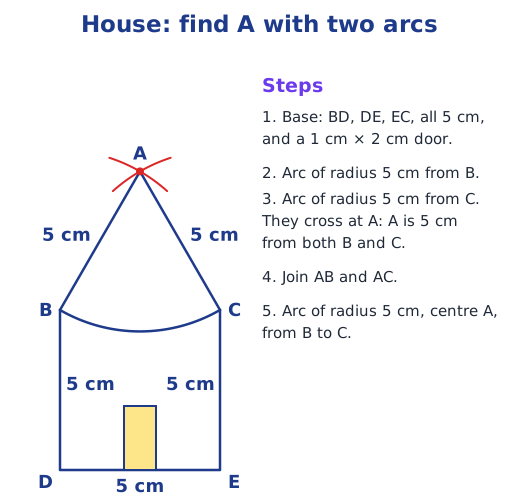
Can you complete the figure? After the base (BD, DE and EC, each 5 cm, with the 1 cm by 2 cm door), you need the point A, which is 5 cm from both B and C.
Does the circle around B help? Every point 5 cm from B lies on the circle of radius 5 cm with centre B, so A is somewhere on this circle: it is the point on it that is also 5 cm from C.
Where the two circles cross. Draw the circle of radius 5 cm with centre C as well. The point where the two circles cross above BC is 5 cm from B and 5 cm from C, so it is A. The circles also cross at a second point below BC, inside the house, which is also 5 cm from both, but the roof needs the one above.
Were two full circles necessary? No. Only the parts near A matter, so two short arcs of radius 5 cm, one from B and one from C, are enough.
The last curve. A is 5 cm from both B and C, so an arc of radius 5 cm with centre A passes through both of them. Draw it from B to C, and the house is ready.
Construct: a bigger house and more (page 215)
- A house with all sides 7 cm. Draw DE = 7 cm and perpendiculars at D and E. Mark B and C on them at 7 cm with the compass. Draw arcs of radius 7 cm from B and from C; they cross at A. Join AB and AC, and draw an arc of radius 7 cm with centre A from B to C. The door can stay 1 cm by 2 cm in the middle of DE, or be made a little bigger.
- Artwork with the House idea. The House shows how to find a point that is the same distance from two points: draw arcs of the same radius from both points, and they cross at the point you need. Use it to find the compass tip for each curve:
- A Person: from the two top corners of the body (say 4 cm apart), draw arcs of radius 2.5 cm that cross above the body. With the needle on the crossing point and the same radius, draw the curve from one corner to the other.
- Wavy Wave: from A and X, draw arcs of the same radius, say 2.5 cm, that cross below AB, and draw the first wave from there. From X and B, draw arcs that cross above AB, and draw the second wave from there. With a radius of 2 cm, half of AX, the arcs meet on the line itself and the waves become half circles.
- Eyes: from the two corners of an eye, 6 cm apart, draw arcs of radius 5 cm. They cross at two points, 4 cm above and 4 cm below the middle of the eye. Use the point below for the upper curve and the point above for the lower curve.
- Yes, a 4-sided figure can have all its sides equal without being a square (Hint B). Draw AC = 5 cm, and AB = 5 cm at an angle to AC that is not 90°, for example 60°. The fourth corner D must be 5 cm from both B and C, so draw arcs of radius 5 cm from B and from C: they cross at A and at one more point, D. Join BD and CD. All four sides of ABDC are 5 cm, but its angles are 60° and 120°, not 90°, so it is not a square. (Extra: such a figure is called a rhombus.)
Practice
-
A Wavy Wave is drawn on AB = 12 cm with two equal half circles. What radius do you set on the compass?
Show answer
Answer: (c) 3 cm Each half circle stands on half of AB, 6 cm, so its radius is 3 cm.
-
A rectangle can be divided into 3 identical squares, and its short side is 2.5 cm. Its long side is:
Show answer
Answer: (b) 7.5 cm The long side is made of 3 sides of the squares: 3 × 2.5 cm = 7.5 cm.
-
Which rectangle can be divided into 2 identical squares?
Show answer
Answer: (b) 4 cm by 8 cm Its long side, 8 cm, is exactly 2 times its short side, 4 cm.
-
In rectangle ABCD, AB = 7 cm and BC = 4 cm. X is on AD, 2 cm from A, and Y is on BC, 2 cm from B. How long is XY, and what shape is ABYX?
Show answer
Answer: XY = 7 cm, the same as AB, because X and Y are level. ABYX is a rectangle 7 cm long and 2 cm wide.
-
PQ = 6 cm. How do you find a point that is 6 cm from both P and Q?
Show answer
Answer: Draw an arc of radius 6 cm with centre P and another with centre Q. They cross at two points, one on each side of PQ, and each of them is 6 cm from both P and Q.
Stuck on a question?
Take a photo and Lagnever AI explains it step by step. Try it for 7 days for ₹2.
Get it on Google Play Open in browser
For parents: after the trial, the plan renews monthly by UPI or card autopay. You can cancel anytime in the app.