
Class 6 Maths Chapter 8: Playing with Constructions Notes
This chapter in five lines
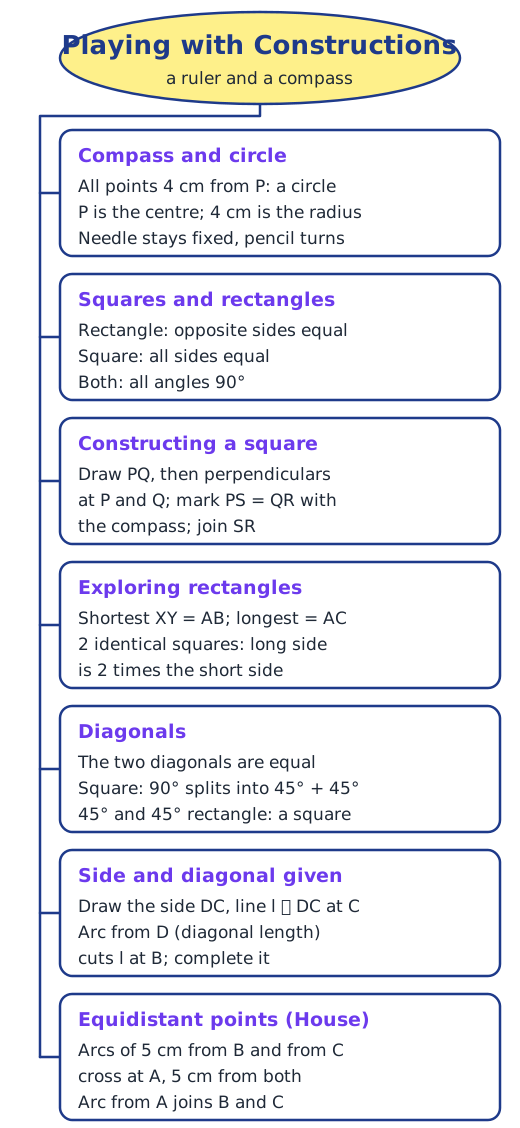
Playing with Constructions is about drawing exact figures with a ruler and a compass. All the points at the same distance from a centre make a circle, and that distance is the radius. A rectangle has equal opposite sides and four 90° angles; a square also has all four sides equal. A rough diagram helps to plan a construction, and two arcs of the same radius find a point that is the same distance from two given points.
What is this chapter about?
A construction is an exact drawing made with a few instruments: here, a ruler and a compass. The chapter starts with artwork made of circles and curves, then moves to squares and rectangles: what makes a figure a square or a rectangle, how to construct one, and what its diagonals do. Again and again it asks you to plan first with a rough diagram, and to use the compass to mark points without trial and error.
Circles and the compass
Mark a point P and many points that are 4 cm from it, in every direction. Together they make a circle. P is its centre, and 4 cm, the distance from the centre to any point on the circle, is its radius. To draw it, open the compass to 4 cm against a ruler, keep the needle fixed on P and turn the pencil all the way round. With circles and half circles you can draw artwork such as the Wavy Wave: on AB = 8 cm, two half circles of radius 2 cm stand on the two halves of AB. Learn the steps in how to draw a circle with a compass.
Squares and rectangles
In rectangle ABCD, the points A, B, C and D are the corners, AB, BC, CD and DA are the sides, and AB and CD are opposite sides. A rectangle has two properties:
- R1: its opposite sides are equal, and
- R2: all its angles are 90°.
A square has S1: all sides equal, and S2: all angles 90°. A name lists the corners in an order of travel round the figure, so ABCD, BCDA and ADCB are names of the same rectangle, but ABDC is not. A square or a rectangle that is turned is still a square or a rectangle, because turning changes neither the lengths nor the angles.
Constructing squares and rectangles
To construct square PQRS of side 6 cm, draw PQ = 6 cm, draw perpendiculars to PQ at P and at Q, use the compass to mark S and R at 6 cm on them, and join SR. A rectangle is made the same way with two different lengths. You cannot make a 4-sided figure with four 90° angles and unequal opposite sides: the opposite sides always come out equal. See how to construct a rectangle and a square.
An exploration in rectangles
In rectangle ABCD with AB = 7 cm and BC = 4 cm, let X move along AD and Y along BC. XY is shortest, exactly 7 cm, when X and Y are at the same distance from A and B; then ABYX is a rectangle. XY is longest when it joins opposite corners, that is, when it is a diagonal, AC or BD.
A rectangle can be broken into 2 identical squares only when its long side is 2 times its short side, and into 3 identical squares only when it is 3 times. A rough diagram shows which sides are equal, and the compass copies one length onto another without a ruler.
Diagonals of rectangles and squares
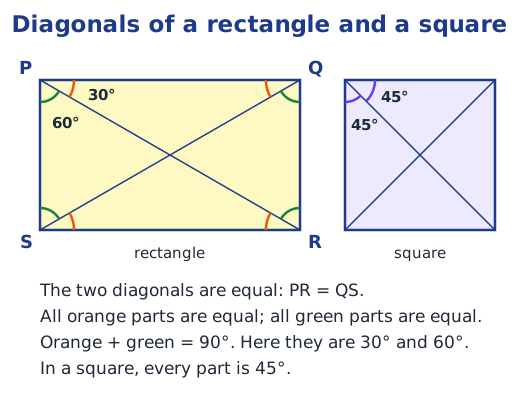
The lines PR and QS joining opposite corners are the diagonals of rectangle PQRS, and they are equal. A diagonal splits each corner it meets into two parts. The four parts next to the long sides are equal, the four next to the short sides are equal, and each pair adds up to 90°. Only in a square are the two parts equal: 45° and 45°.
Two kinds of rectangle constructions use this. If a diagonal must split the corners into 60° and 30°, draw AB, a perpendicular at B and a line from A at 60° to AB; they meet at C. If a side and a diagonal are given, draw the side, a perpendicular at one end, and an arc of the diagonal’s length from the other end to find the third corner.
Points the same distance from two points: the House
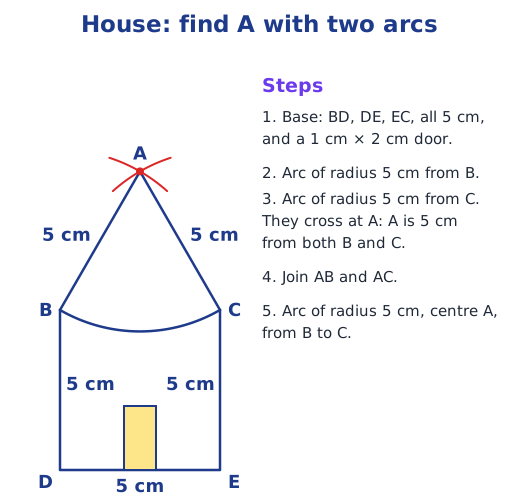
In the House, every border line is 5 cm. After the base, you need a point A that is 5 cm from both B and C. All points 5 cm from B lie on a circle around B, and all points 5 cm from C lie on a circle around C, so A is where the two circles cross. Only small arcs are needed. The same idea gives a 4-sided figure with all sides equal that is not a square. Answers to every question of the chapter are in the NCERT solutions for Chapter 8.
Key terms
| Term | Meaning |
|---|---|
| Compass | An instrument with a needle on one leg and a pencil on the other, used to draw circles and arcs and to copy lengths. |
| Circle | All the points that are the same distance from one fixed point, the centre. |
| Centre | The fixed point of a circle. When you draw, the compass needle stays on it. |
| Radius | The distance from the centre to any point on the circle. It is the opening of the compass. |
| Arc | A part of a circle. In constructions a small arc is often enough to mark a point. |
| Rectangle | A 4-sided figure whose opposite sides are equal (R1) and whose angles are all 90° (R2). |
| Square | A 4-sided figure whose sides are all equal (S1) and whose angles are all 90° (S2). |
| Perpendicular | A line that makes a 90° angle with another line. |
| Diagonal | A line joining two opposite corners of a rectangle or square, like PR and QS in PQRS. |
| Opposite sides | Sides that face each other, like AB and CD in rectangle ABCD. |
| Rough diagram | A quick freehand sketch of the finished figure, drawn to plan the order of the construction. |
| Supporting lines | Lightly drawn lines that are not part of the final figure but help to construct it. |
Topics in this chapter
Practice
-
Every point of a circle is 3 cm from its centre. The radius of the circle is:
Show answer
Answer: (b) 3 cm
-
A square has the corners P, Q, R and S in this order. Which is not a name for it?
Show answer
Answer: (c) PQSR P to Q is a side, but Q to S jumps across the square, so the corners are not in order of travel.
-
In rectangle ABCD, AB = 7 cm and BC = 4 cm. X moves on AD and Y moves on BC. The shortest possible length of XY is:
Show answer
Answer: (b) 7 cm XY is shortest when X and Y are level. Then ABYX is a rectangle, so XY = AB = 7 cm.
-
A diagonal of a rectangle divides its corner angles into 45° and 45°. The rectangle is:
Show answer
Answer: (a) a square
-
To construct a rectangle with side DC = 5 cm and diagonal 7 cm, you draw DC and a perpendicular l at C. How do you find B?
Show answer
Answer: (b) Draw an arc of radius 7 cm with centre D B must be 7 cm from D. All such points lie on a circle of radius 7 cm around D, and B is where it cuts l.
Questions students ask
What are the main topics of Class 6 Maths Chapter 8?
Artwork with a compass; circles, their centre and radius; the properties of squares and rectangles; constructing squares and rectangles; an exploration in rectangles; the diagonals of rectangles and squares; and finding points that are the same distance from two given points.
Is Playing with Constructions in the new Ganita Prakash book?
Yes. Playing with Constructions is Chapter 8 of Ganita Prakash, the Class 6 Maths textbook used in the 2026-27 session.
Which instruments do I need for this chapter?
A ruler with centimetre and millimetre marks, a compass with a sharp pencil, and a protractor or a set square to draw and check 90° angles. A sharp pencil keeps the arcs and points exact.
Stuck on a question?
Take a photo and Lagnever AI explains it step by step. Try it for 7 days for ₹2.
Get it on Google Play Open in browser
For parents: after the trial, the plan renews monthly by UPI or card autopay. You can cancel anytime in the app.