
How to construct a rectangle and a square
Answer in short
To construct a square of side 6 cm, draw PQ = 6 cm and draw perpendiculars to PQ at P and at Q. With the compass open to 6 cm, mark S and R on them, and join SR. For a rectangle, use its two side lengths instead. Then check: opposite sides equal and all angles 90°.
Stuck on a question? Take a photo and Lagnever AI explains it step by step. Try it for 7 days for ₹2. Get it on Google Play
What makes a figure a rectangle or a square?
In rectangle ABCD, the points A, B, C and D are its corners, the lines AB, BC, CD and DA are its sides, and ∠A, ∠B, ∠C and ∠D are its angles. AB and CD face each other, so they are opposite sides; AD and BC are the other pair.
A rectangle has two properties:
- R1: its opposite sides are equal in length, and
- R2: all its angles are 90°.
A square has two properties:
- S1: all its sides are equal, and
- S2: all its angles are 90°.
A square has both R1 and R2 as well, so every square is also a rectangle.
How to name a rectangle
A name lists the corners in an order of travel round the figure, starting from any corner and going either way. Rectangle ABCD can also be called BCDA, CDAB, DABC, ADCB, DCBA, CBAD or BADC. ABDC is not a name, because B to D cuts across the rectangle instead of going along a side.
Turned squares and rectangles
Turn a square piece of paper so that it stands on a corner. Its sides are still equal and its angles are still 90°, so it is still a square. In the same way, a turned rectangle is still a rectangle. On dot paper you can check a turned figure without instruments: if each side goes the same number of dots across and down, just turned, the sides are equal.
Steps to construct a square of side 6 cm
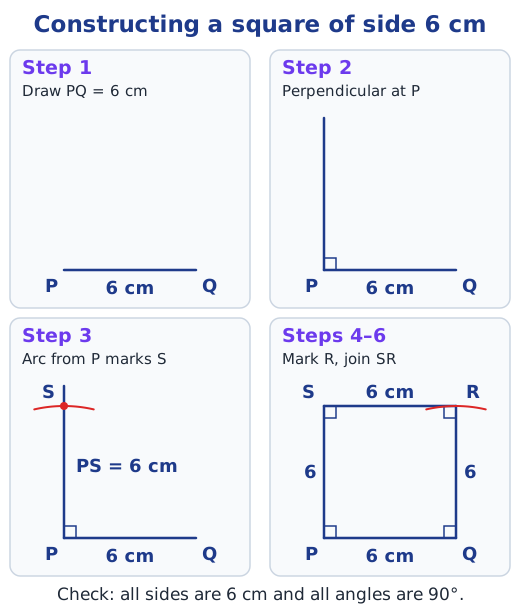
- Draw PQ = 6 cm with a ruler.
- Draw a line through P, perpendicular to PQ.
- Open the compass to 6 cm. With the needle on P, cut the perpendicular at S, so PS = 6 cm. PS must be 6 cm because all the sides of a square are equal.
- Draw a line through Q, perpendicular to PQ.
- Keeping the same opening, put the needle on Q and cut this line at R.
- Join SR.
Now measure: RS is 6 cm, and ∠R and ∠S are 90°. Both square properties hold, so PQRS is a square.
Constructing a rectangle with given sides
For a rectangle with sides 4 cm and 6 cm, draw AB = 6 cm, draw perpendiculars at A and at B, mark D and C at 4 cm on them, and join DC. Check R1: AB = DC = 6 cm and AD = BC = 4 cm. Check R2: all four angles are 90°. A long thin rectangle, like 2 cm by 10 cm, is made in exactly the same way.
Can you make a 4-sided figure whose angles are all 90° but whose opposite sides are not equal? Try it. When the angles at A and B are 90°, the sides from A and B go straight up. If one is shorter than the other, the top side slants and the angles at the top are no longer 90°. So it cannot be done: four right angles force the opposite sides to be equal.
Constructing a rectangle from a side and a diagonal
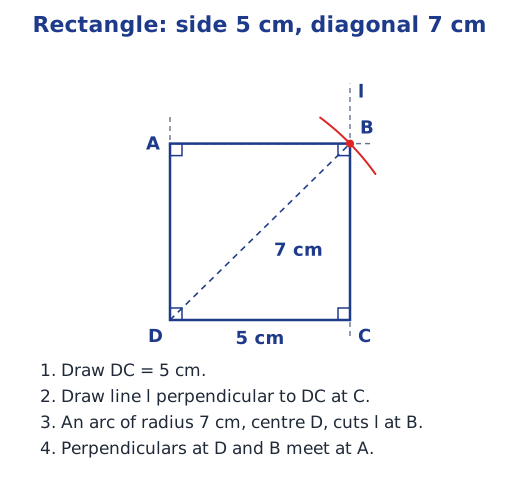
A diagonal joins two opposite corners. To construct a rectangle with one side 5 cm and a diagonal 7 cm, start with a rough diagram, then:
- Draw DC = 5 cm.
- Draw a line l through C, perpendicular to DC. The corner B is somewhere on l.
- B is also 7 cm from D. All the points 7 cm from D lie on a circle of radius 7 cm around D, so draw an arc of radius 7 cm with centre D. Where it cuts l is B. No trial and error is needed.
- Draw perpendiculars to DC at D and to BC at B. They meet at A.
Check that ABCD has both rectangle properties. Its other side, BC, comes out close to 4.9 cm.
Rectangles made of squares
A rectangle that can be cut into 2 identical squares must have its long side exactly 2 times its short side, for example 4 cm by 8 cm. To build it without measuring twice, draw the short side, draw a perpendicular at one end, and use the compass to copy the short side along the perpendicular two times. For 3 identical squares, copy it three times.
The answers to every construction in the chapter are in the Chapter 8 NCERT solutions.
Practice
-
Which is true for every rectangle?
Show answer
Answer: (b) Its opposite sides are equal and all its angles are 90°
-
A square has the corners K, L, M and N in this order. Which is not a name for it?
Show answer
Answer: (c) KMLN K to M jumps across the square, so the corners are not in order of travel.
-
A rectangle has a side DC = 3 cm and a diagonal of 5 cm. After drawing DC and a perpendicular at C, the corner B is marked with an arc of radius:
Show answer
Answer: (b) 5 cm, centre D B is the far end of the diagonal from D, so it is 5 cm from D.
-
Write the steps to construct a rectangle with sides 5 cm and 3 cm.
Show answer
Answer: Draw AB = 5 cm. Draw perpendiculars to AB at A and at B. Open the compass to 3 cm and mark D on the first and C on the second. Join DC, then check that DC = 5 cm and that all the angles are 90°.
-
Can a 4-sided figure have all its angles 90° but unequal opposite sides?
Show answer
Answer: No. If the angles at A and B are 90°, AD and BC both go straight up from AB. If AD were shorter than BC, DC would slant, and the angles at C and D would not be 90°. So the opposite sides must be equal.
Questions students ask
What is the difference between a square and a rectangle?
Both have all their angles equal to 90°. In a rectangle only the opposite sides have to be equal; in a square all four sides are equal. So every square is also a rectangle.
Is a square still a square when it is turned?
Yes. Turning a square does not change its side lengths or its angles, so it still has four equal sides and four 90° angles. A turned rectangle is still a rectangle for the same reason.
Why use a compass to mark a side?
The compass holds a length exactly, so you can copy PQ onto the perpendicular without measuring again. That is how PS is made equal to PQ when you construct a square.
How do you construct a rectangle if a side and a diagonal are given?
Draw the side DC and a perpendicular at C. The corner B is the diagonal's length from D, so an arc of that radius with centre D cuts the perpendicular at B. Then complete the rectangle with perpendiculars at D and B.
Stuck on a question?
Take a photo and Lagnever AI explains it step by step. Try it for 7 days for ₹2.
Get it on Google Play Open in browser
For parents: after the trial, the plan renews monthly by UPI or card autopay. You can cancel anytime in the app.