
How to draw a circle with a compass
Answer in short
Open the compass against a ruler until the needle and the pencil tip are the required distance apart, say 4 cm. Put the needle on the centre and hold it still, then turn the pencil all the way round. Every point of the curve is 4 cm from the centre: that distance is the radius.
Stuck on a question? Take a photo and Lagnever AI explains it step by step. Try it for 7 days for ₹2. Get it on Google Play
What does a compass do?
A compass has two legs joined at the top. One leg ends in a sharp needle, the other holds a pencil. With the needle kept in one place, the pencil can only move along points that are the same distance from the needle. That is why a compass draws circles and parts of circles, called arcs. It can also copy a length: open it to the length of one line and you can mark the same length on another line.
Points at the same distance from P
Mark a point P in your notebook. Now mark as many points as you can, in different directions, that are each 4 cm from P. You can measure each one with a ruler, or open the compass to 4 cm and mark points with its pencil.
Imagine marking all such points. They join up into a round curve: a circle. P is the centre of the circle, and the distance from the centre to any point on the circle is the radius. Here the radius is 4 cm. A point on the circle is exactly 4 cm from P, a point inside it is less than 4 cm away, and a point outside is more than 4 cm away.
Steps to draw a circle of radius 4 cm
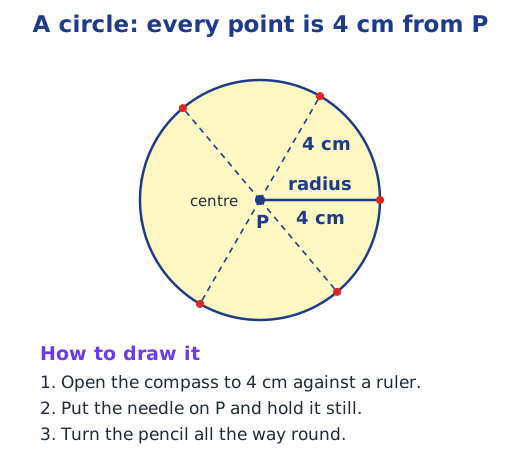
- Mark the centre P with a sharp pencil.
- Lay the ruler flat. Put the compass needle on the 0 mark and open the legs until the pencil tip is on the 4 cm mark.
- Put the needle on P and press it gently so it does not slide.
- Holding the compass by its top, turn the pencil all the way round until the curve closes.
To check your circle, mark a few points on it and measure their distance from P with a ruler. Each one should be 4 cm.
Artwork with a compass
Once you can draw circles, many pictures become easy, and they look neater than freehand drawings:
- Two circles that touch: use the same radius, say 2 cm, and put the centres 4 cm apart (two radii).
- A circle inside a circle: use the same centre with two different radii, such as 2 cm and 1 cm.
- Overlapping circles in a row: the same radius, with the centres a little less than two radii apart, for example 2 cm circles with centres 3 cm apart.
The Wavy Wave
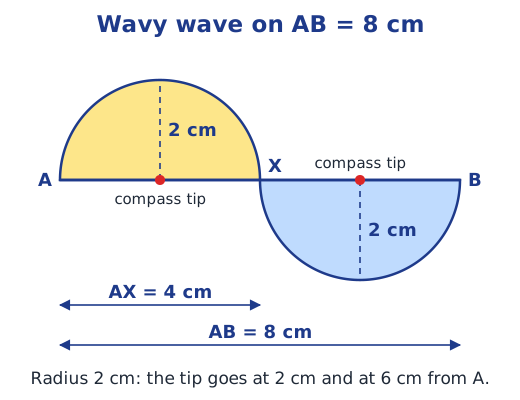
The Wavy Wave is two equal half circles, one above a line and one below it. Take the central line AB = 8 cm. The first wave is a half circle on AX and the second on XB, so X is the middle of AB and AX = 4 cm. A half circle on 4 cm has its centre at the middle of that length, so the radius is 2 cm. Put the needle 2 cm from A and draw the upper half circle from A to X; then put it 6 cm from A and draw the lower half circle from X to B.
For any other length, the radius is a quarter of AB: on AB = 6 cm it is 1.5 cm, and on AB = 10 cm it is 2.5 cm.
A Person and the Eyes
Some curves must pass through two given points without being half circles, like the curved top of the body in ‘A Person’ or the two curves of an eye. The compass tip must then be the same distance from both points, so it sits on the line through the middle of the two points, at right angles to the line joining them. Fix a radius bigger than half the gap and move the tip along that middle line until the curve passes through both points.
For example, for two points 4 cm apart, put the tip 1.5 cm from their midpoint and open the compass to 2.5 cm: the arc passes through both points and rises only 1 cm. For an eye, draw one curve with the tip below the line and the other with the tip above it, at equal distances, so the eye comes out symmetrical.
Next, use the compass to build exact squares and rectangles in how to construct a rectangle and a square.
Practice
-
Every point of a circle is 5 cm from its centre. The radius is:
Show answer
Answer: (b) 5 cm
-
P is the centre of a circle of radius 4 cm, and the point Q is 3 cm from P. Where is Q?
Show answer
Answer: (b) Inside the circle Points on the circle are exactly 4 cm from P. Q is nearer than that, so it is inside.
-
A Wavy Wave is drawn on AB = 10 cm with two equal half circles. The radius of each half circle is:
Show answer
Answer: (c) 2.5 cm Each half circle stands on half of AB, 5 cm, and its radius is half of that: 2.5 cm.
-
How do you draw a circle of radius 3 cm 5 mm?
Show answer
Answer: Put the needle on the 0 mark of the ruler and open the compass until the pencil tip is at 3.5 cm. Fix the needle on the centre and turn the pencil once all the way round.
-
Two circles of radius 3 cm have their centres 6 cm apart. How do they meet?
Show answer
Answer: They just touch at one point: the middle of the line joining the centres, because that point is 3 cm from each centre.
Questions students ask
What is the radius of a circle?
The radius is the distance from the centre to any point on the circle, and it is the same for every point. When you draw with a compass, the radius is the distance between the needle and the pencil tip.
Why must the compass needle not move?
A circle is made of points at one fixed distance from one fixed point. If the needle moves, the centre changes, and the curve you draw is no longer a circle.
What is the difference between a circle and an arc?
A circle goes all the way round. An arc is only a part of a circle, drawn by turning the pencil a little way. In constructions, small arcs are enough to mark points.
How do you draw a half circle on a line?
Put the needle at the middle of that part of the line, open the compass to half of its length, and turn the pencil from one end to the other on one side of the line.
Stuck on a question?
Take a photo and Lagnever AI explains it step by step. Try it for 7 days for ₹2.
Get it on Google Play Open in browser
For parents: after the trial, the plan renews monthly by UPI or card autopay. You can cancel anytime in the app.