
NCERT Solutions Class 6 Maths Chapter 9: Symmetry
Answers to every “Figure it Out” question in Chapter 9, Symmetry, of Ganita Prakash (Reprint 2026-27), with the in-text questions, the tiles activity and the game. The page numbers match the book. Where a question asks you to draw, the answer says what to draw and what the finished figure looks like. Short notes: Chapter 9 notes.
Symmetry around us (pages 217–218)
- The butterfly: its left and right wings are mirror images of each other.
- The rangoli: the red petals come back onto themselves after a quarter turn (90°) about the centre, and so do its other parts.
- The pinwheel: start with the hexagon in the middle. Stuck along each side of it is the same shape, a rhombus made of two equilateral triangles, and every rhombus is tilted the same way. Moving round the hexagon, each rhombus is the previous one turned through 60°.
- The clouds: no part repeats in a definite pattern, so the picture is not symmetrical.
- The Taj Mahal and the gopuram: each has a vertical line of symmetry down its middle; the left half matches the right half.
Figure it Out: lines of symmetry (page 219)
- Yes. The flower has 6 lines of symmetry, the rangoli 4 and the butterfly 1. The pinwheel has no line of symmetry (it has rotational symmetry instead), and the cloud has none.
-
- First figure (the arrow-like shape): 1 line, the slanting line from its sharp left corner through the notch on the right.
- The kite: 1 line, through its top and bottom corners.
- The five-sided figure with a slanting top: no line of symmetry.
- The L-shape: 1 line, the slanting line through its outer corner and its inner corner (the two arms are the same size).
- The triangle: no line of symmetry; all its sides are different.
Folding a square and a rectangle (page 221)
Is there any other way to fold the square so that the halves overlap? No. The vertical fold, the horizontal fold and the two diagonal folds are the only ones, so a square has 4 lines of symmetry.
The three figures with many lines of symmetry: the snowflake-like star has 6, the six-petalled flower has 6, and the looped square knot has 4 (vertical, horizontal and both diagonals).
Is the diagonal of a rectangle that is not a square a line of symmetry? No. Fold the rectangle along a diagonal and the two parts do not overlap: the corners stick out.
Reflection (page 222)
In square ABCD (A top left, B top right, C bottom right, D bottom left):
- Reflecting in the diagonal AC: A and C stay where they are, because they lie on the line; B goes to D’s place and D goes to B’s place.
- Reflecting in the horizontal line of symmetry: A and D swap places, and B and C swap places.
Ink blot devils: the pattern is symmetric, and its line of symmetry is the fold. Usually there is no other line along which it folds into two identical parts.
Paper folding and cutting (page 223)
The unfolded paper: the cut-out, a trapezium against the fold, opens into a six-sided hole made of two trapeziums joined along the fold. Its line of symmetry is the fold line.
The decorative strip: each star and each diamond has a vertical line of symmetry through its middle, there are vertical lines halfway between neighbouring stars, and the horizontal line along the middle of the strip is a line of symmetry too.
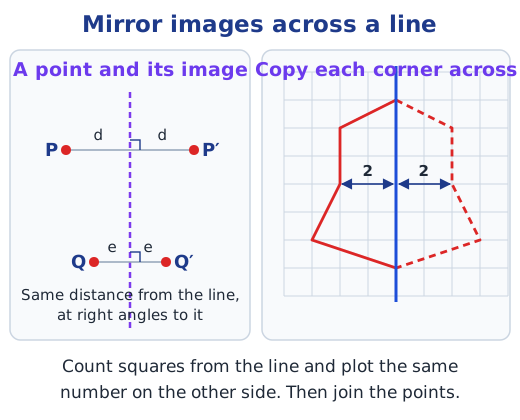
Figure it Out: the punching game and paper cutting (pages 223–230)
-
Where was the paper folded? a. Along the vertical middle line. b. Along a diagonal, from the bottom left corner to the top right corner. c. Along the horizontal middle line. d. The paper was folded twice, vertically and then horizontally (or the other way round), so one punch made four holes.
-
The other holes: each missing hole is the mirror image of the given one: on the other side of the line, the same distance from it, on a line at right angles to it.
- a. The hole just below the top left corner goes to just right of that corner, along the top edge.
- b. The hole in the lower right goes to the upper right, the same distance above the line.
- c. The hole just left of the line near the top goes just right of the line, at the same height.
- d. The hole near the edge, just above the slanting line, goes just below the line at the matching place on the edge.
- e. The hole near the top, on one side of the slanting line, goes to the matching place on the other side.
-
This item only shows how a vertical fold and a horizontal fold are drawn.
-
Predicting the holes:
- a. A hole shaped like a bow: narrow at the fold, with wavy ends on both sides.
- b. A hole shaped like a ribbon banner, with a V-notch at each end.
- c. Two rectangular holes on the vertical middle line, one in the top half and one in the bottom half, and four notches: two in the top edge and two in the bottom edge.
- d. A square hole in the middle, on the fold, and a notch in each side edge at the same height.
-
One straight cut:
- a. Fold the square in half, then in half again, so that its centre becomes the closed corner; then fold once more along the diagonal through that corner. One straight cut across the folded paper, parallel to an edge, opens into a square hole with sides parallel to the edges.
- b. Fold the square in half and in half again, then cut straight across the closed corner, at the same slant to both folds. It opens into a square hole standing on a corner.
In both cases the hole is a square: its four sides are copies of the same cut, so they are equal, and its angles are 90°.
-
a. The tilted square has 4 lines of symmetry and the eight-pointed star has 8. b. The equilateral triangle has 3. c. The regular hexagon has 6.
-
The rhombus figures: the first (one rhombus on two) has 1 line, vertical; the row of three, the diamond of four and the group of six each have 2, vertical and horizontal. The figures on squared paper: the square inside a square has 4; the eight-sided figure has 2, vertical and horizontal; the five-sided figure has 1, the horizontal line through its point; the four-pointed star has 4.
-
The kolam has 6 lines of symmetry: the horizontal line and the two slanting lines through opposite star patterns, and the vertical line and the two slanting lines between them.
-
a. An isosceles triangle with only two equal sides, for example sides 5 cm, 5 cm and 3 cm: 1 line. b. An equilateral triangle: 3 lines. c. A scalene triangle, with all sides different, such as 3 cm, 4 cm and 6 cm: no line. Two lines are not possible. Each line of symmetry of a triangle makes two of its sides equal. Two lines would make all three sides equal, and then the triangle has three lines.
-
With a curved boundary: a. a semicircle, or a heart shape: exactly 1 line. b. An eye shape made of two equal arcs, or a running-track shape: exactly 2 lines. c. A square with a semicircle on each side, like a four-petalled flower: exactly 4 lines.
-
Copy each corner across the blue line, counting squares as in the diagram above. For (c) and (f), turn the book until the blue line looks upright.
- b. The finished figure is the same above and below the line: a tower at the top and bottom, a step on the left and a point on the right.
- c. The staircase above the diagonal is copied below it, and the figure closes into a staircase shape that folds onto itself along the diagonal.
- d. A little house: a triangle roof on a small rectangle.
- e. The five-sided shape and its upside-down copy, joined along the line.
- f. The shape and its mirror image on the other side of the diagonal, overlapping near the line.
-
Reflect the drawing in one blue line, then reflect everything in the other.
- a. A square.
- b. A square with a small triangular point sticking out from the middle of each side.
- c. A tall stepped figure with the same notches on the left and right, and at the top and bottom.
- d. An eight-sided figure: a rectangle with all four corners cut off.
- e. A cross-like figure with a pointed notch at the top and bottom.
- f. Four identical pieces meeting at the centre, like a bow tie in both directions.
-
Number the dots in each grid by column (1 to 6 from the left) and row (1 to 6 from the top), so (3, 1) is column 3, row 1. One answer for each figure:
- First: given (1, 2)–(5, 1) and (1, 2)–(5, 6). With a horizontal line of symmetry halfway between rows 3 and 4, draw (5, 1)–(1, 5) and (1, 5)–(5, 6).
- Second: given (3, 1)–(1, 4), (1, 4)–(2, 6) and (2, 6)–(4, 6). With the vertical line through column 3, draw (3, 1)–(5, 4) and (5, 4)–(4, 6), making a pentagon.
- Third: given (1, 1)–(3, 2), (3, 2)–(5, 1), (5, 1)–(5, 3) and (5, 3)–(3, 6). With the vertical line through column 3, draw (1, 1)–(1, 3) and (1, 3)–(3, 6).
- Fourth: given (1, 1)–(5, 1), (5, 1)–(5, 2) and (5, 2)–(2, 5). With the slanting line through (1, 1) and (5, 5), draw (1, 1)–(1, 5) and (1, 5)–(2, 5).
- Fifth: given (1, 2)–(3, 4) and (1, 2)–(3, 6). With the vertical line through column 3, draw (3, 4)–(5, 2) and (5, 2)–(3, 6).
- Sixth: given (1, 1)–(3, 1), (3, 1)–(6, 3) and (6, 3)–(3, 5). With the horizontal line through row 3, draw (1, 1)–(1, 5) and (1, 5)–(3, 5).
Rotational symmetry: in-text questions (pages 230–235)
- Does the windmill look the same after a turn of less than 90°? No. Its angles of symmetry are 90°, 180°, 270° and 360°.
- Another shape with exactly four angles of symmetry: a square, a plus sign, or a fan with four blades.
- The square: it has 4 angles of symmetry, 90°, 180°, 270° and 360°, and needs a turn of 90° to fit onto itself. The centre of rotation is the point where the diagonals cross.
- The strip (example): after a half turn its long side is on top, so it does not overlap the original; it fits only after 360°. It has no rotational symmetry.
- The figure with 4 radial arms: 4 angles of symmetry, 90°, 180°, 270° and 360°. If the angles between the arms are changed, it no longer has 4 angles of symmetry, because a quarter turn must move each arm onto the next, so all four angles must be 90°.
- Only two angles of symmetry: bend the end of every arm the same way round, as in the book’s figure, or make two opposite arms longer than the other two. Then only 180° and 360° work.
- Three radial arms: with unequal angles, only 360° works. With all three angles equal to 360° ÷ 3 = 120°, the angles of symmetry are 120°, 240° and 360°.
- Five and six radial arms: 5 arms with 72° between neighbours give 72°, 144°, 216°, 288° and 360°; 6 arms with 60° between them give 60°, 120°, 180°, 240°, 300° and 360°.
- Seven radial arms: the smallest angle of symmetry is 360° ÷ 7 = 51 3/7°, which is not a whole number.
Figure it Out: angles of symmetry (pages 235–236)
- a. The plus-shaped figure: 90°, 180°, 270°, 360°. b. The line with small squares at both ends, on the same side: only 360° (after a half turn the squares would be on the other side). c. The figure with two long lines joined in the middle: 180°, 360°.
- More than one angle of symmetry: the circle with two diameters at right angles, the circle with three radii 120° apart, the four curved blades, the cross made of two lines at right angles, and the five-pointed star. The triangle with a dot (its sides are not all equal) and the figure with two half circles have only 360°.
- Orders of rotational symmetry: the line with two flags 2, the cross of two lines 4 (the arc only marks the angle), the six-pointed star 6, the figure with three legs 3, the plus sign 4, the regular pentagon 5.
Are the angles always multiples of the smallest angle? Yes. Turning twice by the smallest angle also fits, so its multiples are angles of symmetry; and any other angle of symmetry, turned back by a multiple, would give a fitting turn smaller than the smallest one.
True or False: Every figure has 360° as an angle of symmetry: True. If the smallest angle of symmetry is a natural number of degrees, it is a factor of 360: True.
Symmetries of a circle (page 237)
Other things with rotational symmetry: a ceiling fan, a bicycle wheel, many flowers, a bangle, the Ashoka Chakra and many rangolis.
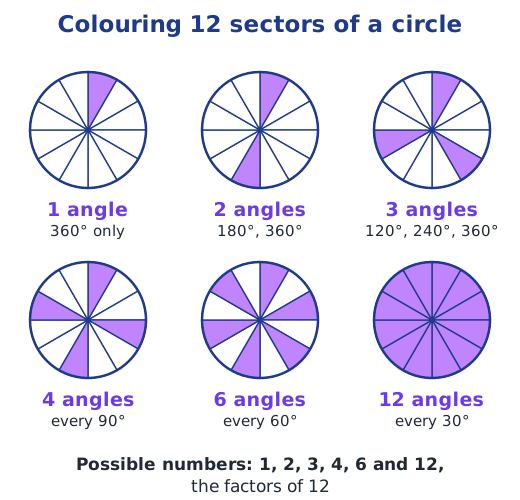
Figure it Out: more symmetry (pages 238–239)
- The circle has 12 equal sectors of 30°. i) For 3 angles of symmetry, colour every fourth sector (one sector, skip three, and so on), or any pattern that repeats every 120°. ii) For 4, colour every third sector, so the pattern repeats every 90°. iii) The possible numbers of angles of symmetry are 1, 2, 3, 4, 6 and 12, the factors of 12: one coloured sector gives 1, two opposite sectors 2, every fourth sector 3, every third sector 4, every other sector 6, and all sectors alike 12.
- For example, a rectangle (2 lines of symmetry; angles 180° and 360°) and an equilateral triangle (3 lines; angles 120°, 240° and 360°). A plus sign and a regular hexagon also work.
- a. An equilateral triangle: 3 lines and 3 angles of symmetry. b. An isosceles triangle with only two equal sides: 1 line, no rotational symmetry. c. A parallelogram that is not a rectangle or a rhombus: no line of symmetry, angles of symmetry 180° and 360°. d. A kite, or a trapezium with equal slanting sides: 1 line, no rotational symmetry.
- The other angles of symmetry are the multiples of 60°: 120°, 180°, 240°, 300° and 360°.
- The angles of symmetry are multiples of the smallest one, and 60° is the third of them, so the smallest is 60° ÷ 3 = 20°. The angles below 60° are 20° and 40°.
- a. Yes: 45 is a factor of 360 (45 × 8 = 360), for example a figure with 8 equal radial arms. b. No: 17 is not a factor of 360 (17 × 21 = 357 and 17 × 22 = 374).
- a. Yes, the outer boundary has 3 lines of symmetry, one through the middle of each long side and the opposite short side. b. Yes, its angles of rotational symmetry are 120°, 240° and 360°.
- Regular polygons: the triangle has 3 lines, the square 4, the pentagon 5, the hexagon 6, the heptagon 7, the octagon 8, the nonagon 9 and the decagon 10. The sequence is 3, 4, 5, 6, …, the counting numbers from 3.
- They have the same numbers of angles of symmetry: 3, 4, 5, 6, …, because a regular polygon with n sides fits onto itself after turns of 360° ÷ n.
- The first shape of the Koch snowflake sequence, the triangle, has 3 lines and 3 angles of symmetry; every later shape has 6 lines and 6 angles of symmetry.
- The Ashoka Chakra has 24 equal spokes, so it has 24 lines of symmetry and 24 angles of symmetry (multiples of 15°).
Playing with tiles (pages 239–240)
- a. Reflect the finished top left quarter into the top right quarter across the vertical red line: each tile’s diagonal turns the other way and its two colours swap sides. Then reflect the whole top half into the bottom half across the horizontal red line. The finished design has exactly the two red lines as lines of symmetry.
- b. Using 16 tiles in a 4 × 4 square: for 1 line, make the right half the mirror image of the left half but use different top and bottom rows; for 2 lines, design one 2 × 2 corner and reflect it into all four quarters.
- c. Your own designs: try ones with rotational symmetry too, by turning the corner design instead of reflecting it.
Game (page 241)
The second player can always win. Whenever the first player draws a line, the second player draws the line that is its copy after a half turn about the centre of the grid. On a 6 by 6 grid no line can be its own copy, and a square and its copy are never next to each other, so the copied line is always still open. The second player always has a move, so the first player is the one who gets stuck.
Practice
-
How many lines of symmetry does a regular octagon (8 equal sides and angles) have?
Show answer
Answer: (c) 8
-
A figure's angles of symmetry are 40°, 80°, 120° and so on up to 360°. How many angles of symmetry does it have?
Show answer
Answer: (c) 9 360° ÷ 40° = 9, so the angles are 40°, 80°, … , 360°: nine of them.
-
Which letter has both a line of symmetry and rotational symmetry?
Show answer
Answer: (b) H H has a vertical and a horizontal line of symmetry, and it looks the same after a half turn.
-
A square sheet is folded in half twice and one hole is punched. How many holes are there when it is opened?
Show answer
Answer: Four. Each fold doubles the holes: the first unfolding gives two, the second gives four, placed symmetrically about both folds.
-
Can a figure have rotational symmetry with a smallest angle of symmetry of 36°?
Show answer
Answer: Yes, because 36 is a factor of 360 (36 × 10 = 360). A figure with 10 equal radial arms, 36° apart, has this smallest angle.
Stuck on a question?
Take a photo and Lagnever AI explains it step by step. Try it for 7 days for ₹2.
Get it on Google Play Open in browser
For parents: after the trial, the plan renews monthly by UPI or card autopay. You can cancel anytime in the app.