
Class 6 Maths Chapter 9: Symmetry Notes
This chapter in five lines
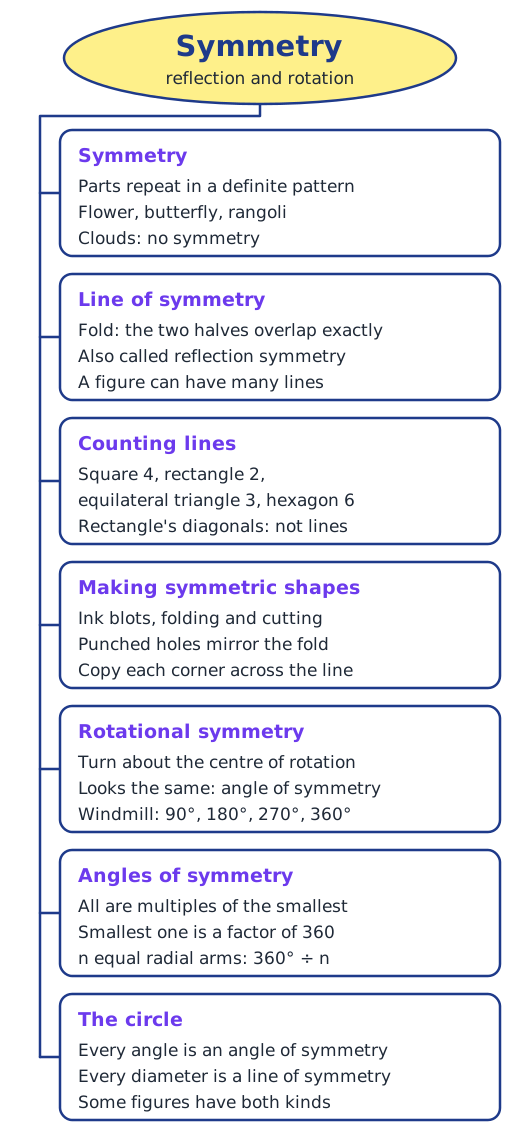
A figure has symmetry when some of its parts repeat in a definite pattern. A line of symmetry cuts a figure into two parts that overlap exactly when it is folded along that line, and a figure can have several such lines. A figure has rotational symmetry when it looks exactly the same after a turn of less than 360° about a fixed centre. Such an angle is an angle of symmetry, and all the angles of symmetry of a figure are multiples of the smallest one.
What is symmetry?
A flower looks the same from many directions, the two wings of a butterfly match, and the petals of a rangoli come back onto themselves when it is turned a quarter of the way round. In each of these, parts of the figure repeat in a definite pattern. That is symmetry, and such figures are called symmetrical. A cloud has no such pattern, so it is not symmetrical. Buildings like the Taj Mahal and a temple gopuram are symmetrical too: their left and right halves match.
Lines of symmetry
Fold an isosceles triangle along the line through its top corner and the middle of its base, and one half covers the other completely: the two parts are mirror halves. A line that cuts a figure into two parts that exactly overlap when folded along it is a line of symmetry.
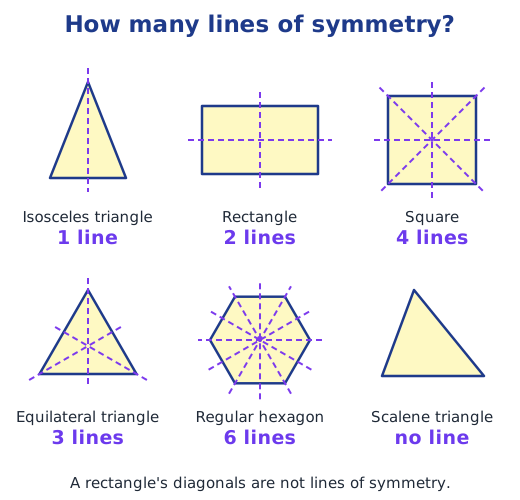
A figure can have more than one. Folding a square piece of paper in half vertically, horizontally and along both diagonals shows that a square has 4 lines of symmetry. A rectangle that is not a square has only 2: folding it along a diagonal does not make the halves overlap. More in line of symmetry.
Reflection
We can also say that a line of symmetry reflects the part of a figure on one side onto the other side. Label the corners of a square A, B, C and D. Reflecting in the vertical line of symmetry sends A to B’s place and D to C’s place, and the other way round. A figure that has a line of symmetry is also said to have reflection symmetry.
Making symmetric shapes
- Ink blot devils: drop ink on one half of a folded paper, press the halves together and open it. The pattern is symmetric about the fold.
- Folding and cutting: cut a shape from a folded paper and unfold it. The fold is a line of symmetry of the cut-out. Folding a strip several times gives a repeating design with many lines of symmetry.
- Punching holes: a hole punched in a folded square becomes two holes, one on each side of the fold, at equal distances from it.
Rotational symmetry
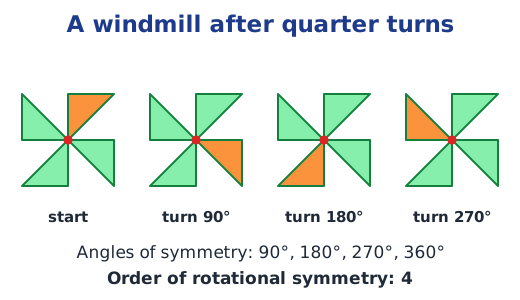
A paper windmill has no line of symmetry, yet it looks exactly the same after a turn of 90° about the point at its centre. It has rotational symmetry. The fixed point is the centre of rotation, and an angle through which a figure can be turned to look exactly the same is an angle of symmetry. The windmill’s angles of symmetry are 90°, 180°, 270° and 360°. Every figure comes back to its starting position after 360°, so 360° is always an angle of symmetry. A figure has rotational symmetry only if it also has an angle of symmetry strictly between 0° and 360°. More in rotational symmetry.
Angles of symmetry
A figure made of radial arms has rotational symmetry when the angles between neighbouring arms are equal. With 3 arms the angle must be 360° ÷ 3 = 120°, giving the angles 120°, 240° and 360°; with 4 arms it is 90°, and with 5 arms 72°. With 7 arms the smallest angle is 360° ÷ 7 = 51 3/7°, not a whole number. In every case the angles of symmetry are multiples of the smallest one, and if the smallest angle is a whole number of degrees, it is a factor of 360. The number of angles of symmetry is called the order of rotational symmetry.
Symmetries of a circle
A circle is the most symmetric shape of all. Turn it about its centre through any angle and it fits onto itself, so every angle is an angle of symmetry. And every diameter is a line of symmetry. Wheels, fans and many flowers have rotational symmetry too. Answers to every question of the chapter are in the NCERT solutions for Chapter 9.
Key terms
| Term | Meaning |
|---|---|
| Symmetry | A part or parts of a figure repeated in a definite pattern. A figure with symmetry is called symmetrical. |
| Line of symmetry (axis of symmetry) | A line that cuts a figure into two parts that overlap exactly when the figure is folded along it. |
| Mirror halves | The two parts of a figure on either side of a line of symmetry; each is the mirror image of the other. |
| Reflection symmetry | The symmetry of a figure that has one or more lines of symmetry: each side is reflected by the line onto the other. |
| Rotational symmetry | A figure has it when it looks exactly the same after being turned through an angle strictly between 0° and 360°. |
| Centre of rotation | The fixed point about which a figure is turned. |
| Angle of (rotational) symmetry | An angle through which a figure can be turned so that it looks exactly the same. 360° is always one. |
| Order of rotational symmetry | The number of angles of symmetry a figure has between 0° and 360°, counting 360°. A windmill has order 4. |
| Radial arms | Arms that spread out from a centre, like the spokes of a wheel or the blades of a fan. |
| Diameter | A line through the centre of a circle, from one side to the other. Every diameter is a line of symmetry of the circle. |
| Asymmetrical | Having no symmetry, like the shape of a cloud or a scalene triangle. |
Topics in this chapter
Practice
-
How many lines of symmetry does a square have?
Show answer
Answer: (c) 4
-
Which of these is not a line of symmetry of a rectangle that is not a square?
Show answer
Answer: (c) A diagonal Folding a rectangle along a diagonal does not make the two halves overlap exactly.
-
A paper windmill looks the same after a turn of 90°. Its angles of symmetry are:
Show answer
Answer: (c) 90°, 180°, 270° and 360°
-
A figure has 5 equal radial arms with equal angles between them. Its smallest angle of symmetry is:
Show answer
Answer: (c) 72° 360° ÷ 5 = 72°.
-
Which statement is true?
Show answer
Answer: (b) Every figure has 360° as an angle of symmetry
Questions students ask
What are the main topics of Class 6 Maths Chapter 9?
What symmetry is, lines of symmetry, figures with more than one line of symmetry, reflection, making symmetric shapes by ink blots, folding, cutting and punching, rotational symmetry, the centre and angles of rotational symmetry, figures with radial arms, and the symmetries of a circle.
Is Symmetry in the new Ganita Prakash book?
Yes. Symmetry is Chapter 9 of Ganita Prakash, the Class 6 Maths textbook used in the 2026-27 session.
What is the difference between line symmetry and rotational symmetry?
A figure has line symmetry if folding it along a line makes the two halves overlap exactly. It has rotational symmetry if turning it about a fixed point through less than a full turn makes it look exactly the same. A square has both; a pinwheel has only rotational symmetry.
Stuck on a question?
Take a photo and Lagnever AI explains it step by step. Try it for 7 days for ₹2.
Get it on Google Play Open in browser
For parents: after the trial, the plan renews monthly by UPI or card autopay. You can cancel anytime in the app.