
What is a line of symmetry?
Answer in short
A line of symmetry, or axis of symmetry, cuts a figure into two parts that overlap exactly when the figure is folded along it. The two parts are mirror halves. A figure can have no line of symmetry, one line, or several: a rectangle has 2, an equilateral triangle 3 and a square 4.
Stuck on a question? Take a photo and Lagnever AI explains it step by step. Try it for 7 days for ₹2. Get it on Google Play
Mirror halves
Draw a triangle with two equal sides and fold it along the line through its top corner and the middle of its base. One half covers the other completely. The two parts are called mirror halves, and the fold line is a line of symmetry. Now take four jigsaw pieces fitted together and fold along a line through the middle: the left half does not fit over the right half, so that line is not a line of symmetry.
A line that cuts a figure into two parts that exactly overlap when folded along that line is a line of symmetry, or axis of symmetry, of the figure.
How many lines of symmetry?
Take a square piece of paper and fold it in half vertically, then horizontally, then along one diagonal and then along the other, opening it out each time. Each fold makes the halves overlap, and there is no other way to do it. So a square has 4 lines of symmetry.
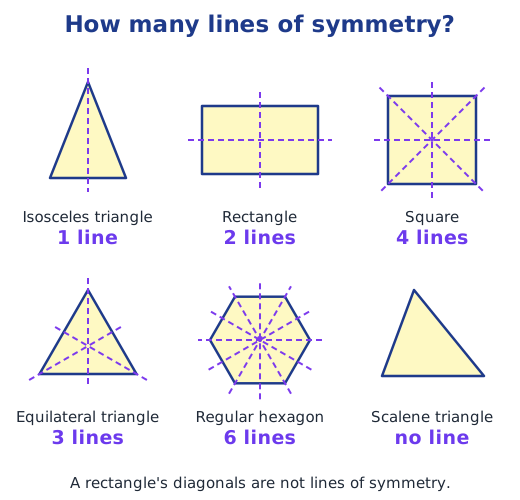
| Figure | Lines of symmetry | Where they are |
|---|---|---|
| Isosceles triangle (two equal sides) | 1 | From the top corner to the middle of the base |
| Rectangle (not a square) | 2 | Through the middles of opposite sides |
| Equilateral triangle | 3 | From each corner to the middle of the opposite side |
| Square | 4 | Through the middles of opposite sides, and both diagonals |
| Regular hexagon | 6 | Through opposite corners, and through middles of opposite sides |
| Scalene triangle | 0 | None |
Notice the rectangle. Fold it along a diagonal and the corners do not meet, so a rectangle’s diagonals are not lines of symmetry, although a square’s diagonals are.
Reflection
A line of symmetry acts like a mirror: it reflects the part of the figure on one side onto the other side. Label the corners of a square A, B, C and D, going round from the top left. Reflect it in the vertical line of symmetry: B and C move to the places of A and D, and A and D move to the places of B and C. Reflect it in the diagonal AC: A and C stay put, while B and D swap. A figure that has a line of symmetry is said to have reflection symmetry.
Finding a mirror image
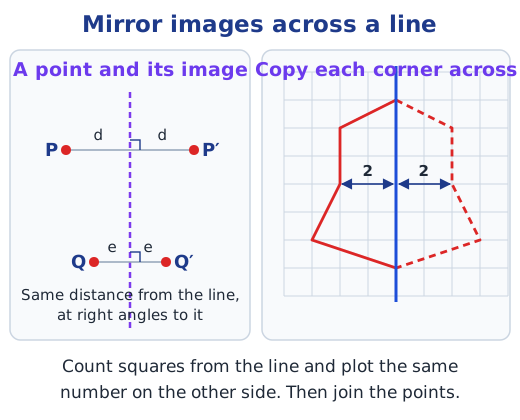
The mirror image of a point is on the other side of the line of symmetry, at the same distance from it, on a line at right angles to it. To complete a figure on squared paper, copy each corner across the line by counting squares, then join the new corners in the same order. For a slanting line, turn the paper so the line looks upright, or count squares along the slant.
Making symmetric shapes
- Ink blots: drop some ink on one half of a folded paper, press the halves together and open it. The blot is symmetric about the fold.
- Folding and cutting: cut a shape from a folded sheet and unfold it. The fold becomes a line of symmetry of the hole.
- Punching game: punch a hole in a folded square. Unfolded, the two holes are mirror images across the fold. Fold twice before punching and one punch gives four holes.
Lines of symmetry around us
Look for lines of symmetry in leaves, butterflies, kolams, rangolis, letters such as A, H and M, and the front views of buildings like the Taj Mahal. A cloud or a scalene triangle has none. Some figures, like a pinwheel, have no line of symmetry but still look the same when turned; learn about them in rotational symmetry.
Practice
-
How many lines of symmetry does an equilateral triangle have?
Show answer
Answer: (c) 3
-
Which shape has exactly one line of symmetry?
Show answer
Answer: (b) An isosceles triangle with only two equal sides
-
A paper is folded once and a single hole is punched through both layers. When it is unfolded, the holes are:
Show answer
Answer: (b) on either side of the fold, the same distance from it
-
Is it possible to draw a triangle with exactly two lines of symmetry?
Show answer
Answer: No. Each line of symmetry of a triangle makes two of its sides equal. Two lines would make all three sides equal, and then the triangle is equilateral, which has three lines of symmetry.
-
Square ABCD is reflected in its diagonal AC. Where do the corners go?
Show answer
Answer: A and C stay where they are, because they lie on the line. B goes to D's place and D goes to B's place.
Questions students ask
What is a line of symmetry?
A line that divides a figure into two parts that overlap exactly when the figure is folded along that line. It is also called an axis of symmetry.
How many lines of symmetry does a rectangle have?
Two: the line joining the middles of the long sides and the line joining the middles of the short sides. Its diagonals are not lines of symmetry unless the rectangle is a square.
What is reflection symmetry?
It is another name for the symmetry of a figure with a line of symmetry. The line acts like a mirror: each part on one side is reflected onto the matching part on the other side.
How do you complete a figure so that a given line is a line of symmetry?
Take each corner of the figure, count how far it is from the line, measured at right angles to the line, and mark a point the same distance away on the other side. Join the new points in the same order.
Stuck on a question?
Take a photo and Lagnever AI explains it step by step. Try it for 7 days for ₹2.
Get it on Google Play Open in browser
For parents: after the trial, the plan renews monthly by UPI or card autopay. You can cancel anytime in the app.