
What is rotational symmetry?
Answer in short
A figure has rotational symmetry when it looks the same after a turn of less than 360° about a fixed point, the centre of rotation. Each such angle is an angle of symmetry. A paper windmill has the angles 90°, 180°, 270° and 360°. Every figure has 360°, and all its angles of symmetry are multiples of the smallest one.
Stuck on a question? Take a photo and Lagnever AI explains it step by step. Try it for 7 days for ₹2. Get it on Google Play
The paper windmill
A paper windmill looks symmetrical, but fold it any way you like and the two halves never overlap: it has no line of symmetry. Yet turn it through 90° about the pin at its centre and it looks exactly the same. We say the windmill has rotational symmetry.
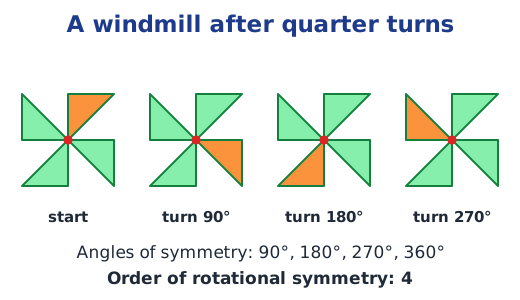
- The fixed point about which a figure is turned is the centre of rotation.
- An angle through which the figure can be turned to look exactly the same is an angle of rotational symmetry, or just an angle of symmetry.
A turn of less than 90° does not work for the windmill. Its angles of symmetry are 90° (a quarter turn), 180° (a half turn), 270° (three-quarters of a turn) and 360° (a full turn). Any figure comes back to its starting position after 360°, so 360° is always an angle of symmetry. A figure has rotational symmetry only when it has an angle of symmetry strictly between 0° and 360°. The number of angles of symmetry, counting 360°, is the order of rotational symmetry: the windmill’s order is 4.
The square
A square also fits onto itself after a turn of 90° about the point where its diagonals cross. The turn takes corner A to B’s place, B to C’s, C to D’s and D to A’s. Its angles of symmetry are 90°, 180°, 270° and 360°. A strip shaped like a trapezium, on the other hand, is upside down after a half turn, with its long side on top; it fits only after 360°, so it has no rotational symmetry.
Figures with radial arms
A figure with 4 equal radial arms at right angles has the angles of symmetry 90°, 180°, 270° and 360°. If the angles between the arms are changed, a quarter turn no longer fits. To keep only two angles of symmetry, 180° and 360°, you could bend the arms or make two opposite arms longer than the other two.
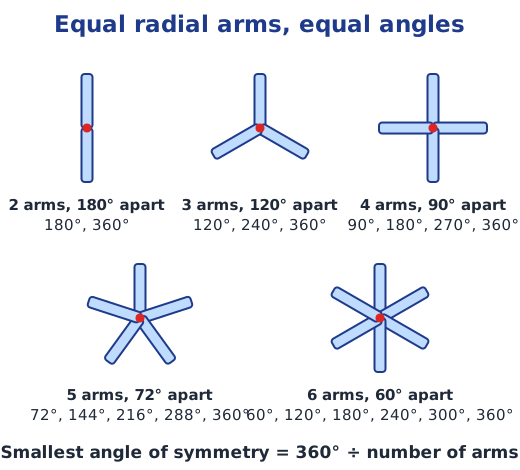
With 3 radial arms, the figure fits onto itself after a turn only if each arm moves into the next arm’s place. So the three angles between the arms must be equal, and since together they make 360°, each must be 360° ÷ 3 = 120°. Then the angles of symmetry are 120°, 240° and 360°. In the same way, 5 equal arms need 72° gaps, and 6 arms need 60° gaps. With 7 arms the smallest angle would be 360° ÷ 7 = 51 3/7°, which is not a whole number.
Patterns in the angles
| Number of angles of symmetry | The angles |
|---|---|
| 2 | 180°, 360° |
| 3 | 120°, 240°, 360° |
| 4 | 90°, 180°, 270°, 360° |
| 6 | 60°, 120°, 180°, 240°, 300°, 360° |
In each row the angles are the multiples of the smallest one, and this is always true. Turning twice by the smallest angle also fits, so every multiple of it is an angle of symmetry. And there can be no others: an angle of symmetry between two multiples, turned back by the smaller multiple, would give a fitting turn smaller than the smallest one. So if the smallest angle of symmetry is a whole number of degrees, it must divide 360 exactly: it is a factor of 360. That is why 45° can be a smallest angle (45 × 8 = 360), but 17° cannot.
The circle and the world around us
Turn a circle about its centre through any angle and it fits onto itself, so every angle is an angle of symmetry. Every diameter is also a line of symmetry. Ceiling fans, wheels, many flowers and the Ashoka Chakra all have rotational symmetry. Some figures have only lines of symmetry, some only rotational symmetry, and some, like a square, have both; see line of symmetry to compare.
Practice
-
What are the angles of symmetry of a square, about its centre?
Show answer
Answer: (b) 90°, 180°, 270° and 360°
-
A figure's smallest angle of symmetry is 60°. Which of these is also an angle of symmetry?
Show answer
Answer: (c) 240° The angles of symmetry are multiples of 60°: 60°, 120°, 180°, 240°, 300° and 360°.
-
Can a figure have rotational symmetry with a smallest angle of symmetry of 17°?
Show answer
Answer: (b) No, because 17 is not a factor of 360
-
A figure has 3 equal radial arms. What must the angle between neighbouring arms be for it to have rotational symmetry?
Show answer
Answer: The three angles must be equal and together make a full turn, so each is 360° ÷ 3 = 120°. Then the angles of symmetry are 120°, 240° and 360°.
-
What is the order of rotational symmetry of a regular pentagon?
Show answer
Answer: 5. It looks the same after turns of 72°, 144°, 216°, 288° and 360° about its centre.
Questions students ask
What is rotational symmetry?
A figure has rotational symmetry if it looks exactly the same after being turned about a fixed point through an angle greater than 0° and less than 360°.
What is an angle of symmetry?
An angle through which a figure can be turned about its centre of rotation so that it looks exactly the same. Every figure has 360° as an angle of symmetry.
What is the order of rotational symmetry?
The number of angles of symmetry of a figure, counting 360°. A windmill with four blades has order 4; a figure that only matches itself after a full turn has order 1 and no rotational symmetry.
How many angles of symmetry does a circle have?
Endlessly many. A circle fits onto itself after a turn through any angle about its centre, and every diameter is also a line of symmetry.
Stuck on a question?
Take a photo and Lagnever AI explains it step by step. Try it for 7 days for ₹2.
Get it on Google Play Open in browser
For parents: after the trial, the plan renews monthly by UPI or card autopay. You can cancel anytime in the app.