
NCERT Solutions Class 6 Science Chapter 10: Living Creatures — Exploring their Characteristics
Answers to Activities 10.1 to 10.6, the in-text questions and all 9 questions of “Let us enhance our learning” in Chapter 10, Living Creatures: Exploring their Characteristics, of Curiosity (Reprint 2026-27). The page numbers match the book. For activities you do yourself, the answers show what you should observe; your own numbers may differ a little. Short notes: Chapter 10 notes.
Activity 10.1 and the characteristics of living beings (pages 184–188)
Table 10.1, completed:
| Name | Living or non-living? | Reason |
|---|---|---|
| Pencil, book | Non-living | Do not grow, eat, respire, excrete, respond or reproduce |
| Pigeon | Living | Moves, eats, grows, breathes, responds and lays eggs |
| Car | Non-living | Moves only when driven; does not grow, eat or reproduce |
| Plant | Living | Grows, respires, excretes, responds to stimuli, makes seeds |
Why is a pencil non-living but a pigeon living? The pigeon moves on its own, eats, grows, breathes, responds to danger and lays eggs; the pencil does none of these. Living beings are alike in sharing these features.
Tasks you can do but a car cannot: grow, eat food, breathe, feel pain and pull away, sweat, think, and have children. A car does not grow, so growth is one of the features that separates living from non-living.
Five things that move on their own, and are they all living? For example, a dog, an ant, a fish, a bird and a ceiling fan. The fan moves when switched on but is non-living, and a river or the clouds move too. So movement alone does not decide whether something is living.
Breaths per minute: you breathe faster after a run or dancing than after a normal walk, because the body needs more air when it works harder. Resting dogs, cats and cows also breathe; you can see their bellies rise and fall.
Three stimuli and responses: stepping on a thorn, and pulling the foot back; touching a hot cup, and jerking the hand away; a bright light, and closing the eyes.
Why do the leaves of chhui-mui and amla respond this way? Chhui-mui folds its leaves in response to touch; the amla’s leaves come together in response to the darkness after sunset.
Young ones of animals: a cat has kittens, a dog has puppies, a cow has a calf, a hen has chicks and a frog has tadpoles. Non-living things like a pencil, a chair or a bulb never have young ones.
Is a seed living or non-living? Living. It looks lifeless, but given water and air it germinates and grows into a plant (Activity 10.2), which a non-living thing cannot do.
Activity 10.2: conditions for germination (pages 188–190)
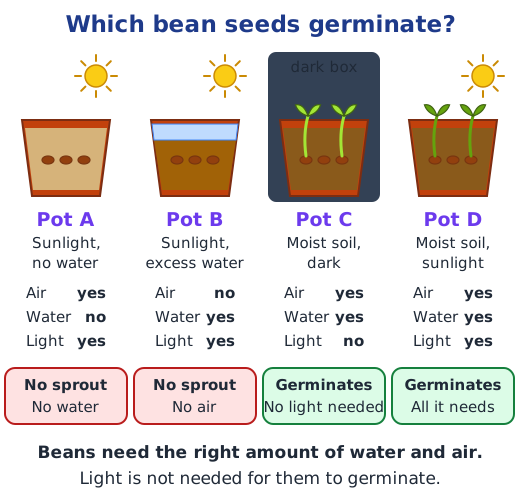
Table 10.2, completed:
| Pot | Air, sunlight, water | Germination and reason |
|---|---|---|
| A: sunlight, no water | Air yes, sunlight yes, water no | No: there is no water |
| B: sunlight, excess water | Air no, sunlight yes, water yes | No: water fills the soil spaces, so there is no air |
| C: dark, moist soil | Air yes, sunlight no, water yes | Yes: light is not needed to germinate |
| D: sunlight, moist soil | Air yes, sunlight yes, water yes | Yes: it has water and air |
- Is sunlight necessary for germination? No. The seeds in the dark pot C germinated too.
- Is there a pot without air? Yes, pot B. The water standing above the soil fills the spaces between the soil particles, so no air reaches the seeds, and they do not germinate (they may even rot).
- Which seeds receive both air and water? Those in pots C and D, and only these germinate.
- Conditions that favour germination: the right amount of water and air. Water softens the seed coat so the embryo can grow; air comes from the spaces between soil particles.
- What other conditions could affect germination? Temperature (seeds may not sprout in great cold or heat), the depth at which seeds are sown, and whether the seeds are healthy. Some seeds also need light or darkness.
Activity 10.3: direction of growth (pages 191–194)
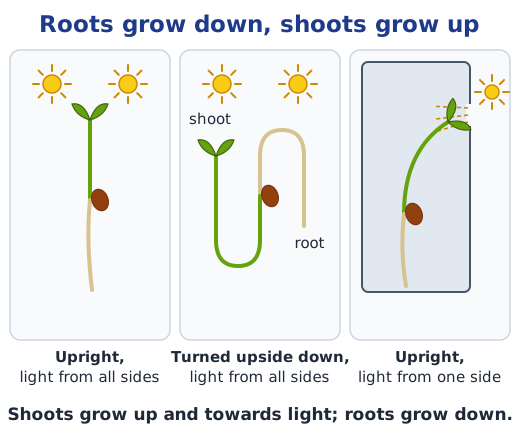
Table 10.3, observations:
- Beaker A (light from all directions, upright): the shoot grows upwards and the root grows downwards.
- Beaker B (light from all directions, inverted): the shoot bends and grows upwards; the root bends and grows downwards.
- Beaker C (light from one direction, upright): the shoot bends and grows towards the light; the root keeps growing downwards.
Conclusion: shoots grow upwards and move towards sunlight, while roots grow downwards.
Activity 10.4: the bean plant’s life (pages 194–195)
Your dates will depend on the bean variety and the weather, but the order of changes is the same:
- First change: within about a week, the seed germinates: a root goes down and a shoot comes up.
- Leaves: a few days later, the first leaves open, and more leaves follow as the plant grows taller.
- First flower: after some weeks (for many beans, about six to eight weeks), the first flowers appear.
- After the flowers dry: the remaining part of each flower grows into a fruit, here a pod with seeds inside.
- After the pods form: the plant slowly turns yellow and dries, even if you keep watering it. Its life cycle is complete. Sow its seeds, and a new generation of bean plants begins.
Life cycle of a mosquito (pages 196–199)
Why must water not be allowed to stagnate? Mosquitoes lay their eggs on or near stagnant water, and their larvae and pupae grow in it. No standing water means no place to breed.
Larvae and pupae: the larva is long, thin and worm-like, with a distinct head, and it wriggles; the pupa is comma-shaped, with a big rounded front part and a curled tail. Both keep coming to the surface because they live in water but need air to breathe.
How can the life cycle be disrupted? Empty and clean coolers, pots, tyres and other containers every week; cover water tanks; drain puddles; spray kerosene oil on water that cannot be drained, so the larvae and pupae cannot breathe; and report breeding places to your teacher. (Extra: some fish that eat mosquito larvae are also put into ponds.)
Activity 10.5: which stage comes after the egg? The larva comes first, then the pupa. Without separating them, you can keep the puddle water in a transparent container covered with a fine net, so no adult mosquito escapes, and count the larvae and pupae every day. If the number of larvae goes down while the number of pupae goes up, larvae are turning into pupae; later, as adults appear on the net, the pupae decrease. So the order is egg, larva, pupa, adult. Throw away the water safely when you finish.
Is it easy to imagine that a mosquito comes out of a pupa? No, because the pupa looks completely different from the winged adult. This is why the changes in a mosquito’s life cycle are called significant.
Activity 10.6: life cycle of a frog (pages 199–201)
Table 10.5, completed, and the sequence:
- A: a cluster of tiny round eggs with dark dots, in a jelly (spawn).
- F: eggs in which small comma-shaped embryos are developing.
- C: a tadpole with a rounded body and a long tail, but no legs.
- D: similar to C, but it has two legs.
- B: looks like a small frog with four legs, but still has a short tail (froglet).
- E: an adult frog with no tail and strong legs, sitting on a leaf.
So the sequence is A, F, C, D, B, E.
Discussion points:
- How are frog’s eggs different from other eggs? They are tiny, soft and without a hard shell, and many are laid together in water inside a jelly. A hen’s egg is large, single and has a hard shell.
- Which stage is the shortest? The egg stage: the spawn develops embryos by day 3–4, and tadpoles hatch by day 7–10. The tadpole stage is the longest.
- Does the habitat change? Yes. Eggs and tadpoles live only in water; froglets live in water but begin to spend time on land; adults live both in water and on land.
- How do special features help each stage? The jelly holds the eggs together; the tail helps the tadpole swim; legs grow as the frog prepares for land; strong legs help the adult jump and land.
Birds, plants and animals (page 202)
Do birds show significant changes in their life cycle? No. A chick looks like a small bird from the time it hatches; it only grows bigger and grows its adult feathers. There is no stage like a tadpole or a pupa.
How does the life cycle of animals differ from that of plants? A plant goes from seed to seedling to a plant with flowers and fruits, and the seeds start the next generation; an animal goes from an egg or a newborn to an adult that produces young. Plants grow in one place and keep adding new parts like leaves and flowers, while many animals move about, and some, like mosquitoes and frogs, change their whole body shape.
Let us enhance our learning (pages 203–204)
1. List the similarities and differences in the life cycles of plants and animals.
Similarities: both begin small (a seed, or an egg or newborn); both grow and develop through stages; both reproduce to make new ones of their own kind, which keeps life continuing; and both finally die.
Differences:
| Plants | Animals |
|---|---|
| Begin as a seed that germinates | Begin as an egg or a newborn |
| Stay in one place and keep adding leaves, flowers and fruits | Many move about; some change their whole body shape |
| Reproduce through flowers that make fruits and seeds | Lay eggs or give birth to young ones |
2. Does it grow? Does it respire? Find examples.
| Grows? / Respires? | Example | Remarks |
|---|---|---|
| No / No | A stone, a pencil, a chair | Non-living things neither grow nor respire. |
| No / Yes | A grown-up adult; a dry seed in storage | Living things respire all their lives, even after they stop growing taller; a dry seed starts to grow only when it gets water. |
| Yes / No | Not possible for a living being | Every living being respires. Some non-living things get bigger, like a sugar crystal in a sugar solution, but only by adding material from outside, not by growing. |
| Yes / Yes | A child, a puppy, a young plant | Growing living beings both grow and respire. |
3. How can we use what we know about germination to store grains and pulses?
Seeds need water and air to germinate. So grains and pulses should be dried well in the sun before storing and kept in dry, airtight containers in a dry place. Without moisture they will not sprout. (Extra: dry storage also keeps away moulds, which spoil damp grain.)
4. What is the advantage of a tail in the tadpole stage?
A tadpole lives only in water, and its tail helps it swim: to move about, find food and get away from danger. When the frog develops strong legs for jumping and starts to live on land too, it no longer needs the tail, and the tail disappears.
5. Charan and Charu on the wooden log.
Both are partly wrong. Charan is right that the log is non-living, but not because it cannot move: plants do not move from place to place, yet they are living. The log is non-living because it does not grow, take in food, respire, excrete, respond to stimuli or reproduce. Charu is wrong: the wood came from a living tree, but once it was cut it stopped showing any of these features. It was part of a living thing and is now dead, so it is non-living.
6. Similarities and distinguishing features in the life cycles of a mosquito and a frog.
Similarities: both lay eggs in or near water; their young stages live in water; both pass through four stages; and their body shape and structure change greatly before they become adults.
| Feature | Mosquito | Frog |
|---|---|---|
| Stages | Egg, larva, pupa, adult | Egg, tadpole, froglet, adult |
| Young stages | Larva and pupa come up to the surface for air | Tadpole swims with its tail, then grows legs |
| Adult | Flies; lives for about 10 to 15 days | Hops; lives in water and on land |
7. A pot kept along the ground (Fig. 10.9).
After a week, the shoot bends and grows upwards, and the root bends and grows downwards, so the seedling looks like a sideways letter S. Reason: as in Activity 10.3, shoots always grow upwards and towards light, and roots always grow downwards, whatever position the plant is in.
8. What do Tara and Vijay want to find out (Fig. 10.10)?
They planted seedlings lying sideways, upside down and upright. They want to find out whether the position in which a seed is sown changes the direction in which its root and shoot grow. After some days, they can gently dig the seedlings out, or use transparent containers. If in all three pots the root has turned to grow downwards and the shoot has turned to grow upwards, they are correct that roots always grow down and shoots always grow up, whatever the position of the seed.
9. Design an experiment to check whether temperature affects seed germination.
- Take three identical containers with moist cotton or soil, and put 10 bean seeds in each.
- Keep everything the same (the same seeds, the same amount of water and air), and change only the temperature: keep one in a refrigerator (cold), one in the room (moderate), and one in a warm place, such as near a sunny window, with an adult’s help.
- Keep the cotton or soil moist, and check every day for 7 to 10 days.
- Record in a table the day on which each seed sprouts and how many seeds germinate in each container.
- Compare the results. If the numbers differ, temperature affects germination. Seeds usually germinate well at a moderate temperature and slowly, or not at all, in the cold.
Learning further and Let us create (page 205)
-
Plants without germinating seeds (Extra): many plants grow from other parts, for example potatoes from the ‘eyes’ of a potato, sugarcane and roses from stem cuttings, ginger from its underground stem, and Bryophyllum from buds on the edges of its leaves.
-
Butterfly or moth: both pass through egg, larva (caterpillar), pupa and adult, so their stages are like a mosquito’s.
-
Does the environment affect insect life cycles? Yes: temperature, rain and standing water, food, and pollution all affect how fast insects grow and how many survive.
-
The frog poem: add your own lines. For example:
They laid their eggs in jelly clear,
A floating spawn, the bank was near.
In days the dots grew tails and swam,
Small tadpoles in the pond so calm.
Then two back legs, then two in front,
The froglets climbed a fallen stump;
Their tails were gone, they leapt on land,
Grown frogs, the jolliest of the band!
Practice
-
Which leaves come together after sunset, as if sleeping?
Show answer
Answer: (a) Leaves of the amla tree
-
Mosquito larvae and pupae keep coming to the water surface to:
Show answer
Answer: (b) breathe air
-
The Khadi and Village Industries Commission has set up centres in India for producing:
Show answer
Answer: (b) silk
-
Why does a thin layer of kerosene on stagnant water kill mosquito larvae?
Show answer
Answer: The layer separates the water from the air, so the larvae and pupae cannot come up and breathe in air, and they die.
-
Name two seeds that need darkness to germinate and two that need light.
Show answer
Answer: Calendula and Zinnia seeds need darkness, so they are covered with soil. Coleus and Petunia seeds need light, so they are not covered.
Stuck on a question?
Take a photo and Lagnever AI explains it step by step. Try it for 7 days for ₹2.
Get it on Google Play Open in browser
For parents: after the trial, the plan renews monthly by UPI or card autopay. You can cancel anytime in the app.