
Class 6 Science Chapter 10: Living Creatures — Exploring their Characteristics Notes
This chapter in five lines
Living beings share some characteristics: they move, need food, grow, respire, excrete, respond to stimuli, reproduce and die, while non-living things do not show these features. A seed germinates when it gets the right amount of water and air; most seeds do not need light to germinate. Roots grow downwards, and shoots grow upwards and towards light. Every living being has a life cycle: a bean plant goes from seed to plant to new seeds, a mosquito from egg to larva, pupa and adult, and a frog from egg to tadpole, froglet and adult.
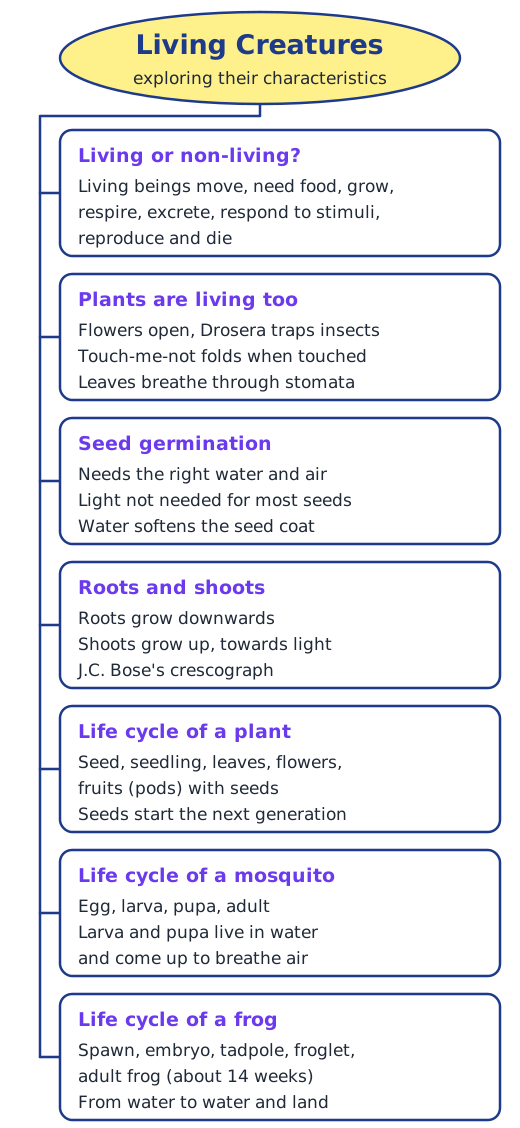
Living or non-living?
On a morning walk, Avadhi wants to pick up some shells, but her mother stops her: a shell may be the home of a living snail, and part of its body. How can something that is not even moving be part of a living being? To find out, list the things around you, such as a pencil, a book, a pigeon, a car and a plant, and sort them into living and non-living. Then ask what the living ones have in common.
Characteristics of living beings
Compare things with yourself. You move, eat, grow, breathe and respond when something hurts you; a car can move, but it cannot grow, eat or produce young ones, so it is non-living. All living beings:
- move: animals move from place to place; plants do not, but flowers open, the hairs of the insectivorous plant Drosera close over insects, and climbers wind around supports;
- need food (nutrition) to grow and develop, and grow;
- respire: breathing is part of respiration, and plants take air in and out through tiny pores on leaves called stomata;
- excrete waste, such as sweat and urine; plants give out extra water as droplets on leaves;
- respond to stimuli: we pull back from a thorn, and touch-me-not (chhui-mui) folds its leaves when touched;
- reproduce, producing young ones of their own kind, which keeps life continuing;
- and, in the end, die.
A thing that does not show these features is non-living. More in characteristics of living things.
Seed germination
A seed looks lifeless, but is it? When a seed turns into a sprout, it has germinated. In an activity with four pots of bean seeds, only the seeds in moist soil sprouted, whether the pot was in sunlight or in the dark. Seeds in dry soil had no water, and seeds under standing water had no air. So bean seeds need the right amount of water and air. Water softens the seed coat so that the tiny embryo inside can develop, and air comes from the spaces between soil particles. Most seeds do not need light to germinate, but the seedling needs sunlight to grow further. A seed that germinates and grows is clearly living. Read more in germination of seeds.
Roots grow down, shoots grow up
Seedlings fixed upright, upside down, or in a box lit through one hole show the same pattern: the root grows downwards, and the shoot grows upwards and towards light. An upside-down seedling simply bends its root down and its shoot up. The Indian scientist Jagadish Chandra Bose (1858–1937) built a machine called the crescograph to record how plants respond to light, heat, electricity and gravity, and to measure how fast they grow.
Life cycle of a plant
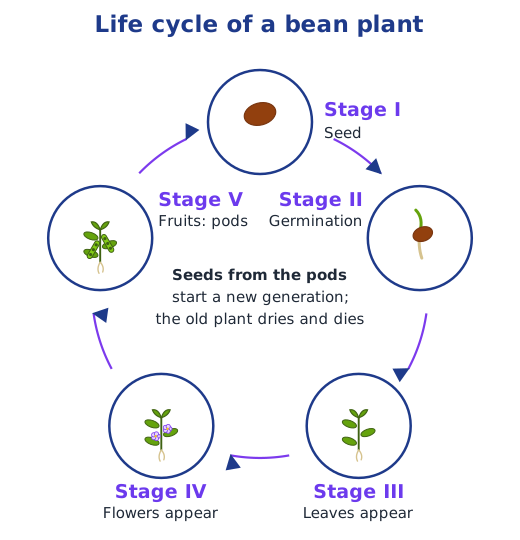
Sow a bean seed and watch it for three months. It germinates, grows leaves, produces flowers, and the flowers develop into fruits, here pods, with seeds inside. After the pods form, the plant turns yellow and dries even if you keep watering it. The seeds give rise to a new generation of bean plants. The whole journey from seed to plant to the next generation of seeds is the life cycle of a plant.
Life cycle of a mosquito
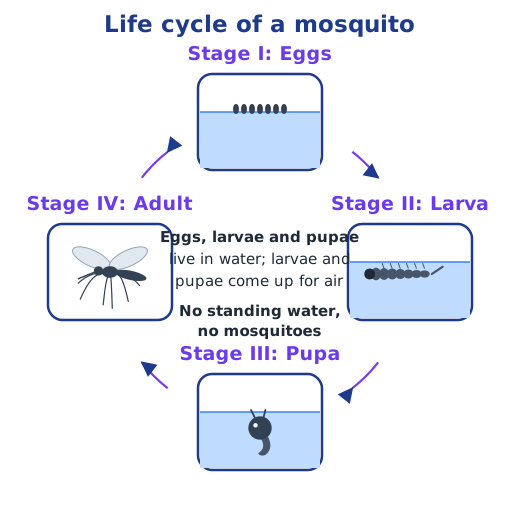
Female mosquitoes suck blood and spread diseases such as malaria, dengue and chikungunya, and they lay eggs on or near water. That is why we are told not to let water stand in coolers, pots or open containers. A mosquito passes through four stages: egg, larva, pupa and adult. The worm-like larvae and the comma-shaped pupae live in water and keep coming up to the surface to breathe air, which is why a thin layer of kerosene on stagnant water kills them. The adult rests on the water briefly, flies away and lives for about 10 to 15 days. The silk moth also has four stages, and its larvae spin the threads used to make silk.
Life cycle of a frog
In the rainy season, a pond may hold a white, jelly-like cluster of frog’s eggs called spawn. Embryos develop in the eggs, and tadpoles hatch with a tail and no legs. Later they grow hind legs, then become froglets that look like little frogs and begin to spend time on land, and finally adult frogs that lose their tails and live in water and on land. The frog changes its body shape, structure and even its home as it grows. See life cycle of a frog.
Plants, animals and the living world
Plants and animals both start small, grow, reproduce and die, and their young continue the cycle. Their journeys differ: a bean plant adds leaves, flowers and fruits, while some animals, like mosquitoes and frogs, change completely from stage to stage. By caring for living beings and their homes, we help the living world flourish. Answers to all the activities and exercises are in the NCERT solutions for Chapter 10.
Key terms
| Term | Meaning |
|---|---|
| Living beings | Things that move, need food, grow, respire, excrete, respond to stimuli, reproduce and die, like animals and plants. |
| Non-living things | Things that do not show these features, like a pencil, a book or a car. |
| Stimulus (plural: stimuli) | Any thing or event that makes a living being respond, like stepping on a thorn or touching a hot cup. |
| Respiration | A life process of all living beings. Breathing, taking air in and out, is part of it. |
| Excretion | Removal of waste products from the body, like sweat and urine in humans, or extra water given out by plants. |
| Reproduction | Producing new ones of one's own kind. It keeps life continuing. |
| Stomata | Tiny pores on the surface of leaves that help plants take air in and out. |
| Germination | The process by which a seed turns into a sprout. |
| Seed coat and embryo | The seed coat is the outer covering of a seed; the embryo is the tiny plant inside it that develops into a plant. |
| Life cycle | All the stages a living being passes through, from its start to producing the next generation, like seed to plant to seeds. |
| Larva and pupa | Two stages in the life of a mosquito: the worm-like larva, and the pupa that changes into the adult. Both live in water. |
| Spawn, tadpole and froglet | Stages of a frog: a jelly-like cluster of eggs, the young that swims with a tail, and the little frog that begins to visit land. |
| Insectivorous plant | A plant that depends on insects for its nutrition, like Drosera, whose sticky hairs trap insects. |
Topics in this chapter
Practice
-
Which of these is a characteristic of all living beings?
Show answer
Answer: (b) They respond to stimuli
-
The tiny pores on leaves that help plants take air in and out are called:
Show answer
Answer: (b) stomata
-
Bean seeds in a pot full of water do not germinate because:
Show answer
Answer: (b) they get no air Excess water fills the spaces between the soil particles, so no air reaches the seeds.
-
What is the correct order of stages in the life cycle of a mosquito?
Show answer
Answer: (b) Egg, larva, pupa, adult
-
A seedling is turned upside down. After a few days its shoot:
Show answer
Answer: (c) bends and grows upwards
Questions students ask
What are the main topics of Class 6 Science Chapter 10?
The characteristics of living beings, the conditions needed for seeds to germinate, the direction in which roots and shoots grow, the life cycle of a plant, and the life cycles of a mosquito and a frog.
Is Living Creatures: Exploring their Characteristics in the new Curiosity book?
Yes. It is Chapter 10 of Curiosity, the Class 6 Science textbook used in the 2026-27 session.
How many questions are in the chapter exercise?
“Let us enhance our learning” has 9 questions. Our NCERT solutions page answers all of them, along with Activities 10.1 to 10.6 and the in-text questions.
Stuck on a question?
Take a photo and Lagnever AI explains it step by step. Try it for 7 days for ₹2.
Get it on Google Play Open in browser
For parents: after the trial, the plan renews monthly by UPI or card autopay. You can cancel anytime in the app.