
What are the characteristics of living things?
Answer in short
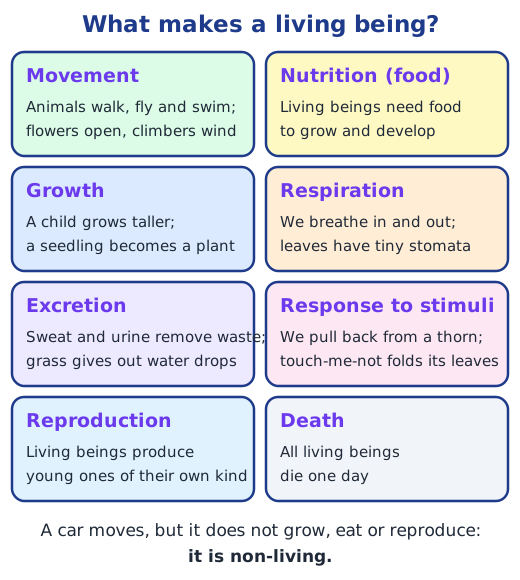
All living beings share some characteristics. They move, need food, grow, respire, excrete waste, respond to stimuli, reproduce and, in the end, die. A thing that does not show these features is non-living. Plants are living too: they grow, respire, excrete and respond to stimuli, although they do not move from place to place.
Stuck on a question? Take a photo and Lagnever AI explains it step by step. Try it for 7 days for ₹2. Get it on Google Play
Living or non-living?
A snail shell lying still on the path may still be part of a living snail. So how do we decide whether something is living? Look around your classroom: a pencil, a book, a pigeon at the window, a plant in a pot. One good way is to compare each thing with yourself, because you are a wonderful example of a living being. What can you do that a pencil or a car cannot?
Movement
Animals walk, run, fly, crawl and swim. Plants do not move from one place to another, but they do show movement. Flowers open. The leaves of Drosera, an insectivorous plant that depends on insects for its nutrition, are shaped like saucers with sticky hairs; when an insect enters, the hairs move inwards and trap it. Climbers wind themselves around any support near them.
Movement alone, though, does not prove that something is alive. A car, a fan and a river all move.
Food and growth
Living beings need food, or nutrition, to grow and develop. You cannot wear the clothes you wore four years ago, because your body has grown. Plants and animals grow too. A car never grows.
Respiration
Count your breaths in one minute after a normal walk, after a run and after a few dance steps: you breathe faster after exercise. When we breathe in, air moves into the body; when we breathe out, it moves out. Breathing is part of a process called respiration. Watch a resting dog or cow and you will see its belly move as it breathes. Plants respire too: tiny pores called stomata on the surface of leaves let air in and out. All living beings respire.
Excretion
The white patches that form on shirts in summer come from sweat, which is water and salts removed by the body as waste. Urine is another waste. Removing waste products from the body is called excretion. Plants excrete too: grass and roses give out extra water and minerals as small droplets on their leaves.
Response to stimuli
If you step on a thorn or touch a hot cup of tea, you pull away at once. Any thing or event that makes a living being respond is a stimulus (plural: stimuli). Plants respond as well. Touch-me-not (mimosa, chhui-mui or lajjalu) folds its leaves when touched, and the leaves of the amla tree come together after sunset, as if they were sleeping.
Reproduction and death
Cats have kittens and dogs have puppies, but a pencil never has young ones. Reproduction is producing new ones of one’s own kind, and it is necessary for life to continue. Finally, all living beings die. When a living being cannot show these characteristics even though food, air and water are available, it is dead.
Sorting things around you
| Thing | Living or non-living? | Reason |
|---|---|---|
| Pencil, book | Non-living | They do not grow, eat, respire or reproduce. |
| Pigeon | Living | It moves, eats, grows, breathes and lays eggs. |
| Car | Non-living | It moves only when driven; it does not grow or reproduce. |
| Plant | Living | It grows, respires, makes seeds and responds to stimuli. |
A seed may look lifeless, but give it water and air and it germinates and grows, so a seed is living. Find out what a seed needs in germination of seeds.
Practice
-
Stepping on a thorn and pulling your foot back is an example of:
Show answer
Answer: (b) response to a stimulus
-
Through which tiny pores do plants take air in and out?
Show answer
Answer: (a) Stomata
-
Sweat is a way of:
Show answer
Answer: (b) removing waste from the body Sweat is made of water and salts that the body removes as waste. Removing waste is called excretion.
-
Why is a car non-living even though it moves?
Show answer
Answer: It does not grow, does not need food to grow, does not respire, excrete or respond to stimuli by itself, and cannot produce young cars. It moves only when someone drives it.
-
What makes the leaves of a touch-me-not plant fold?
Show answer
Answer: Touch. When we touch the leaves, they fold. The touch is the stimulus and the folding is the plant's response.
Questions students ask
What are the characteristics of living things?
Living things move, need food (nutrition), grow, respire, excrete waste, respond to stimuli, reproduce and die.
Do plants show movement?
Yes, though they do not move from place to place. Flowers open, the hairs of the insectivorous plant Drosera move inwards to trap insects, and climbers wind themselves around objects placed near them.
Do plants excrete?
Yes. Plants give out extra water and minerals as small droplets on their leaves, as you can see on grass and roses.
When is a living being said to be dead?
When it cannot show the characteristics of life even though everything it needs to stay alive, such as food, air and water, is available.
Stuck on a question?
Take a photo and Lagnever AI explains it step by step. Try it for 7 days for ₹2.
Get it on Google Play Open in browser
For parents: after the trial, the plan renews monthly by UPI or card autopay. You can cancel anytime in the app.