
What does a seed need to germinate?
Answer in short
A seed germinates when it turns into a sprout. Bean seeds need the right amount of water and air to germinate: water softens the seed coat so the tiny embryo inside can grow, and air comes from the spaces between soil particles. Most seeds do not need light to germinate, but the seedling needs sunlight to grow further.
Stuck on a question? Take a photo and Lagnever AI explains it step by step. Try it for 7 days for ₹2. Get it on Google Play
What is germination?
When a seed turns into a sprout, it is said to have germinated. The outer covering of a seed is the seed coat. Inside it is a tiny embryo, which can develop into a whole plant if it gets the right conditions. But which conditions? An experiment with four pots finds out.
The four-pot experiment
Fill four identical pots with garden soil and sow four bean seeds in each. Keep them like this for about two weeks and look at them every day:
- Pot A: in direct sunlight, with no water at all.
- Pot B: in direct sunlight, with so much water that it always stands above the soil.
- Pot C: soil kept slightly moist, in a dark place.
- Pot D: soil kept slightly moist, in direct sunlight.
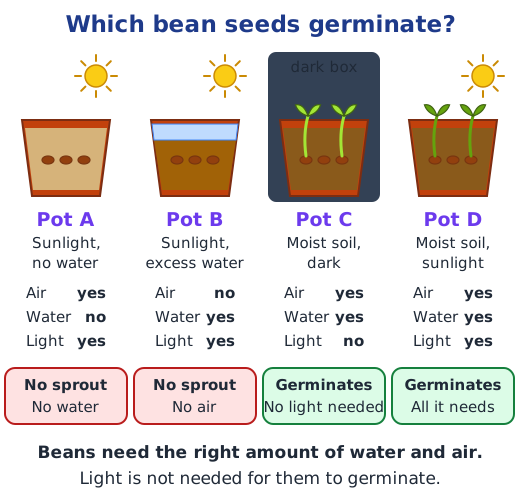
| Pot | Air, water, light | Germinates? |
|---|---|---|
| A: sunlight, no water | Air and light, but no water | No |
| B: sunlight, excess water | Water and light, but no air | No |
| C: moist soil, dark | Air and water, but no light | Yes |
| D: moist soil, sunlight | Air, water and light | Yes |
The seeds germinate only in pots C and D, which both have the right amount of water and air. Pot C shows that light is not needed for germination.
Why water and air?
- Water: seeds need water to carry out the processes needed for growth. Water softens the seed coat and helps the embryo inside develop into a plant.
- Air and soil: seeds use the air in the spaces between soil particles. These spaces also let roots grow easily. In pot B, standing water fills the spaces, so the seeds get no air.
- Light or dark: most seeds, like beans, do not need light to germinate. After germination, though, the seedling needs sunlight to grow further.
Some seeds are different. Seeds of Coleus and Petunia need light to germinate, so covering them with soil stops them from sprouting. Seeds of Calendula and Zinnia need darkness, so they should be covered well with soil.
Roots go down, shoots go up
Germinate some bean or gram seeds on a moist cloth until each has a small root and shoot. Tie them gently to glass plates covered with wet blotting paper: one upright in sunlight, one upside down in sunlight, and one upright inside a box that lets light in through one small hole.
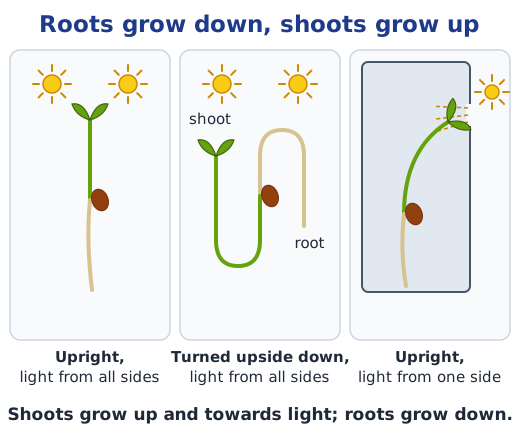
After some days, the upright root grows downwards and its shoot upwards. In the upside-down seedling, the root bends and grows downwards and the shoot bends and grows upwards. In the box, the shoot grows towards the hole, while the root keeps growing downwards. So shoots grow upwards and towards sunlight, and roots grow downwards.
The Indian scientist Jagadish Chandra Bose (1858–1937) built a machine called the crescograph to record how plants respond to light, heat, electricity and gravity, and to measure how fast they grow.
Using what we know
Because seeds need water and air to germinate, grains and pulses are dried well and kept in dry, closed containers, so they do not sprout in storage. A seed that is given water and air, on the other hand, germinates and grows, which shows that it is living. Learn how characteristics like these are shared by all living beings in characteristics of living things.
Practice
-
Which pot of bean seeds will germinate?
Show answer
Answer: (c) Moist soil in the dark
-
Water helps germination mainly by:
Show answer
Answer: (b) softening the seed coat so the embryo can grow
-
Seeds of which of these plants need light to germinate?
Show answer
Answer: (c) Petunia Coleus and Petunia seeds need light, so they should not be covered with soil. Calendula and Zinnia seeds need darkness.
-
Why do bean seeds in a pot full of water fail to germinate?
Show answer
Answer: The water fills the spaces between the soil particles, so no air reaches the seeds. Seeds need air as well as water to germinate.
-
A seedling is placed upside down. What happens to its root and shoot after a few days?
Show answer
Answer: The root bends and grows downwards, and the shoot bends and grows upwards, because roots grow downwards and shoots grow upwards whatever the position.
Questions students ask
What is germination of a seed?
It is the process in which a seed turns into a sprout: the tiny embryo inside the seed starts to grow into a young plant.
What conditions are needed for seed germination?
The right amount of water and air. Many seeds germinate in light or in darkness; a few need light and a few need darkness. (Extra: a suitable temperature also matters.)
Is sunlight needed for seed germination?
Not for most seeds, including beans: they germinate even in the dark. But once the seed has germinated, the seedling needs sunlight to keep growing.
Is a seed living or non-living?
Living. A seed may look lifeless, but when it gets water and air it germinates and grows into a plant, which only a living thing can do.
Stuck on a question?
Take a photo and Lagnever AI explains it step by step. Try it for 7 days for ₹2.
Get it on Google Play Open in browser
For parents: after the trial, the plan renews monthly by UPI or card autopay. You can cancel anytime in the app.