
NCERT Solutions Class 6 Science Chapter 11: Nature's Treasures
Answers to Activities 11.1 to 11.6, the in-text questions, all 16 questions of “Let us enhance our learning” and the Learning further tasks in Chapter 11, Nature’s Treasures, of Curiosity (Reprint 2026-27). The page numbers match the book. For activities and surveys you do yourself, the answers show what you can expect to find; your own lists may differ. Short notes: Chapter 11 notes.
Treasures of nature (pages 207–208)
More treasures of nature: fresh air, water in streams and rivers, sunlight, fertile soil, forests with their plants and animals, rocks and minerals, and fossil fuels such as coal and petroleum.
Activity 11.1: holding your breath (pages 208–209)
Most people can hold their breath for only a short time, often well under a minute, and it soon feels uncomfortable: you feel an urge to breathe and may feel restless. This happens because the body is not getting the oxygen it needs to work. We can survive without food or water for a few days, but not without oxygen for even a few minutes. (Do not hold your breath until you feel unwell.)
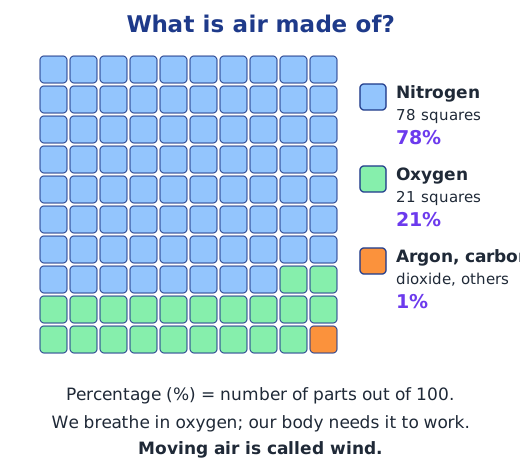
Gases in air: nitrogen (78%), oxygen (21%), and argon, carbon dioxide and other gases (1%).
Activity 11.2: making a firki (page 210)
When you run holding the firki, or blow on it, it rotates. It is the wind, moving air, that makes it turn. A windmill works the same way; wind turns its wings, and windmills are used to run flour mills, pull up water from wells and generate electricity. Other windmill farms (Extra): besides Tamil Nadu, Rajasthan and Maharashtra, Gujarat, Karnataka and Andhra Pradesh also have large windmill farms.
Water (pages 211–214)
Uses of water for the blank bubble: cooking, bathing, washing clothes and utensils, cleaning the house, watering plants, giving water to animals, growing crops, and use in industries.
Sources of water: rain, rivers, streams, lakes, ponds, wells, hand pumps and tube wells (underground water), springs, and snow and glaciers. Seas and oceans hold most of the Earth’s water, but it is salty.
Activity 11.3, Table 11.1, completed:
| Activity | How water is wasted | Ways to reduce wastage |
|---|---|---|
| Hand washing | Tap left running while soaping | Close the tap while soaping |
| Washing clothes | Rinsing under a running tap; washing a few clothes at a time | Use buckets; wash a full load at once; reuse the last rinse water for mopping |
| Washing utensils | Tap kept running | Wash in a tub of water; rinse quickly |
| Taking a shower | Long showers | Take a bucket bath or a shorter shower |
| Cooking | Washing vegetables and rice under a running tap | Wash them in a bowl; water the plants with that water |
| Gardening | Watering too much or in the midday heat; using a hose | Water in the morning or evening with a can; water only the roots |
| Brushing teeth | Tap left running | Use a mug of water |
Conclusion: a lot of water is wasted through small daily habits, mostly by leaving taps running. Families can save water by closing taps, fixing leaks, reusing water (for example, on plants) and harvesting rainwater.
Other human activities that pollute water: letting sewage and dirty water from homes flow into rivers and ponds; dumping factory waste; washing clothes, vehicles and animals in rivers and ponds; and throwing garbage and plastic into water. (Extra: chemical fertilisers and pesticides from fields can also wash into water.) What we can do: use dustbins, never throw waste into water bodies, join clean-up drives and tell others why clean water matters.
Ways to conserve water: turn off taps, fix leaks, reuse water, take bucket baths, water plants in the morning or evening, and harvest rainwater.
Traditional water harvesting (Extra): besides the bawadi and vav, examples include the johad and tanka of Rajasthan, the eri tanks of Tamil Nadu, the kuhl channels of Himachal Pradesh and the bamboo drip system of Meghalaya. Ask your elders about the ones in your area.
World Water Day (22 March): it reminds everyone that freshwater is precious and limited, and encourages people to save water, keep it clean and make sure everyone has safe drinking water.
Energy from the Sun (pages 214–216)
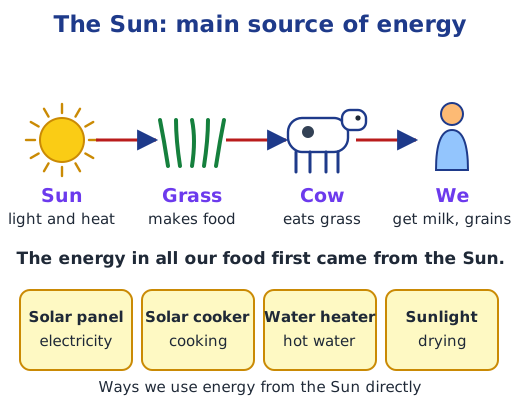
Uses of the Sun’s heat and light: plants make food; drying clothes, chillies, raw mangoes, grains and papads; getting light during the day; warming ourselves in winter; making salt from sea water by evaporation; heating water in a solar water heater; cooking in a solar cooker; and making electricity with solar panels.
The cow conversation: whose statement is correct? Surya’s final explanation. Bhoomi is right that the cow gets its energy by eating grass, and that standing in the Sun does not feed it. But grass needs sunlight to make its food, so the energy in the grass came from the Sun. The cow gets energy from the grass, and the main source of that energy is the Sun.
What will happen if the Sun is not visible for a few days?
- We may have to depend on artificial lighting during the daytime too.
- Plants will not be able to make food, so they will start to suffer.
- It will become colder, and clothes, grains and crops will not dry; solar panels and solar cookers will not work.
Forests (pages 216–218)
Five products from forests: wood (timber and firewood), fruits such as nellikai, honey, medicinal plants, and bamboo. Others are gum, spices, fodder for animals and paper made from wood.
Consequences of cutting a large forest area: animals and birds lose their food and homes, and some may disappear; the soil, no longer held by roots, is washed away; fallen leaves no longer enrich the soil; we lose fruits, wood and medicines; and the air becomes less fresh. A short poem you could start with:
The old trees fell, one, two and three,
No shade was left for you or me.
The birds flew off, the rains washed land,
Let’s plant again, and lend a hand!
Activity 11.4: looking at soil (pages 218–220)
Table 11.2, what you may find: soil from different places looks different. Garden or farm soil is usually dark brown and soft, with roots, dead leaves, small pebbles and earthworms; soil near a road may be dry, light brown or grey, and mixed with sand, stones and bits of trash; soil from a riverbank may be sandy and gritty or sticky and smooth. Soil from a freshly ploughed farm is loose, soft and moist.
- Guess and observation: your guess may miss small things that you see only when you look closely, such as tiny insects, hair-like roots and bits of leaves.
- Different places: yes, the colour and texture differ, because the soils contain different materials.
- Naked eye and magnifying lens: the lens shows grains of different sizes, tiny insects and pieces of roots and leaves that the naked eye misses. Some organisms are too small to see even then.
Always wash your hands after touching soil.
Rocks, minerals and fossil fuels (pages 220–223)
How are rocks and minerals transported? Mostly by trucks, trains and ships, which run on fossil fuels such as diesel.
Activity 11.5, Table 11.3, a sample survey:
| Type of vehicle | Type of fuel used |
|---|---|
| Scooter, motorcycle | Petrol |
| Car | Petrol, diesel, CNG, or electricity |
| Bus, truck | Diesel or CNG |
| Auto-rickshaw | CNG, petrol, LPG, or electricity |
| Tractor | Diesel |
| E-rickshaw | Electricity (battery) |
The most common fuels are petrol and diesel.
Major coal-producing States (Extra): Odisha, Chhattisgarh, Jharkhand, Madhya Pradesh, Telangana, Maharashtra and West Bengal. Mark them on a map of India.
More ways to save fossil fuels: share rides (car pooling), switch off the engine at red lights, keep vehicles well serviced, switch off lights and fans when not needed (much electricity comes from coal), and use solar energy.
Resources we use (pages 224–225)
Alternatives for reducing air pollution: electric vehicles and CNG vehicles, public transport, walking and cycling, planting trees, using solar and wind energy, not burning garbage or leaves, and cooking with LPG or natural gas instead of wood and dung cakes.
Activity 11.6, Table 11.4, completed:
| Activity | Natural resources used |
|---|---|
| Washing clothes | Water |
| Making clay toys | Soil (clay) and water; sunlight to dry them |
| Collecting firewood | Forests (wood) |
| Making kites | Wood or bamboo for the sticks and paper (from forests); air to fly them |
| Having breakfast | Food from plants and animals (grains, fruits, milk), water, and fuel such as LPG for cooking |
Let us enhance our learning (pages 227–229)
1. Match the items with their jumbled names, and classify them.
| Item | Name | Type |
|---|---|---|
| Tap with water | atwre = Water | Renewable |
| Windmill | ndiw = Wind | Renewable |
| Forest | refost = Forest | Renewable |
| Rock | ocrk = Rock | Non-renewable |
2. True or False
- (i) Nature has all the resources to meet human needs. True. (It meets our needs, though not our greed.)
- (ii) Machines are a resource found in nature. False. Machines are human-made resources, made from natural resources.
- (iii) Natural gas is a non-renewable resource. True.
- (iv) Air is a renewable resource. True.
3. Fill in the blanks
- (i) A fuel commonly used in two-wheelers like scooters or bikes is (b) Petrol.
- (ii) An example of a renewable resource is (b) Water.
4. Classify coal, natural gas, forests and minerals.
Renewable: forests. Non-renewable: coal, natural gas and minerals.
5. Why is petroleum a non-renewable resource?
Petroleum formed from the remains of microorganisms and plants buried deep inside the Earth, over millions of years. It is found in limited quantities, and once used it is gone; it is not replenished within a reasonable time. So it is non-renewable.
6. It is difficult to regrow forests. Justify.
Trees grow slowly: it takes years before even a fruit tree bears fruit, and many more years for a forest to grow. A forest is not just trees; it is also the animals, birds, insects and fertile soil that depend on one another. When a large forest is cut, the soil is washed away without roots to hold it, and fallen leaves no longer enrich it, so new plants find it hard to grow. That is why forests must be used responsibly, giving them time to regenerate.
7. Five daily activities that use natural resources, and how to use less
| Activity | Resource | How to use less |
|---|---|---|
| Brushing teeth | Water | Turn off the tap; use a mug |
| Bathing | Water | Use a bucket instead of a long shower |
| Going to school | Fossil fuels | Walk, cycle or take the school bus |
| Using lights and fans | Electricity (often made from coal) | Switch them off when leaving the room |
| Writing in notebooks | Paper (from trees) | Use both sides; reuse old notebooks for rough work |
8. Four activities possible because of air
Breathing (we need oxygen); windmills generating electricity, running flour mills and pumping water; flying kites and turning firkis; and drying clothes faster in a breeze.
9. Enhancing the green cover of your locality
- Plant saplings of local trees during Van Mahotsav in July, or on special days.
- Water and protect young plants, for example with tree guards.
- Start a kitchen garden or keep potted plants at home and school.
- Protect old trees, and do not pluck leaves, flowers or fruits needlessly.
- Make an eco-club plan for the year and tell neighbours why trees matter.
10. The solar cooker
- (i) Solar energy, energy from the Sun, is used for cooking.
- (ii) Benefit: it needs no fuel, so it causes no smoke and saves fossil fuels. Drawback: it works only when the Sun is shining, so it cannot be used at night or on cloudy days, and cooking takes longer.
11. Why does large-scale tree cutting harm the soil?
The roots of trees hold the soil and stop it from being washed away, and fallen leaves decay and enrich it with nutrients. When many trees are cut, rain and wind carry away the top soil, and no leaves fall to enrich it, so the soil loses its fertility.
12. Two ways people pollute the air, and one remedy
Burning fossil fuels in vehicles releases smoke and carbon dioxide; burning coal to produce electricity, and wood or dung cakes for cooking, also release smoke. One action: walk, cycle or use public transport instead of private vehicles (or switch to cleaner CNG or electric vehicles).
13. A family with solar panels, a gas stove and a windmill: a week without sunlight
The solar panels would not produce electricity, so the family would need another source of electricity for lights and fans (or would have to manage without it). The gas stove would still work, because cooking gas does not need sunlight. The windmill would still pump water as long as the wind blows. Plants around them would not be able to make food, and it would become colder.
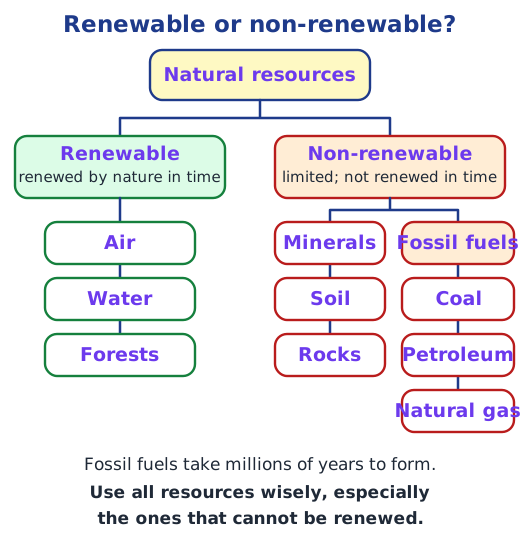
14. Fill up the concept map
- Natural resources → Renewable resources: air, water, forest.
- Natural resources → Non-renewable resource → Fossil fuels: coal, natural gas, petroleum.
15. Felling trees for industries and housing: is it justified? A brief report
Should we cut trees for industries and housing?
Our town needs wood, paper and land for new homes and factories, which also give people jobs. But trees give us fresh air, shade, fruits and medicines, are home to birds and animals, and hold the soil together. A forest takes many years to grow back, and the Chipko movement showed how much people value their trees.
Conclusion: cutting trees on a large scale is not justified. Only trees that truly must go should be cut, and for every tree cut, several new ones should be planted and cared for. Industries should recycle paper and use other materials where possible, and houses should be planned so that old trees are saved.
16. A plan to use less water in school
- Survey: a team of students checks every tap, tank and toilet for leaks and notes how water is used.
- Fix and remind: get leaking taps repaired, and put up “Turn off the tap” signs near every tap.
- Reuse: collect water left in bottles and the waste water from water purifiers to water plants and clean floors.
- Harvest rain: ask the school to collect rainwater from the roof in a tank or a recharge pit.
- Water monitors: each class chooses monitors who check taps after breaks; share the results in the morning assembly, especially on World Water Day (22 March).
How it helps the environment: freshwater is limited, so saving it leaves more for people, plants and animals; rainwater harvesting refills groundwater; and less pumping saves electricity.
Learning further (pages 229–230)
- Traditional rainwater harvesting (Extra): stepwells (bawadi, vav), johads and tankas in Rajasthan, eri tanks in Tamil Nadu, kuhls in Himachal Pradesh, zings in Ladakh and bamboo drip irrigation in Meghalaya.
- Air pollution and health: elders may mention coughing, breathing trouble, itchy eyes and headaches. Main local sources are often vehicle smoke, factory smoke, burning garbage and leaves, and construction dust. Two practical steps: a walk-or-cycle-to-school day each week, and a ban on burning waste in the school and neighbourhood, with trees planted along roads.
- Minerals and rocks in your area (a sample list): marble and granite (floors and kitchen tops), sandstone and laterite (buildings), slate (roofs), clay (pots and bricks), iron (tools, gates), copper (wires), aluminium (utensils), gold and silver (jewellery).
- Tree plantation drive: plan with your teacher; choose the spot and local trees; get saplings from a nursery; dig pits; plant, water and protect the saplings; give each class some trees to care for; and keep a record. In your one-page report, list each tree, for example neem (shade, medicinal uses), amla (fruits), jamun (fruits for birds and people) and peepal (shade), with why it matters.
Practice
-
Which windmill farm mentioned in the chapter is in Tamil Nadu?
Show answer
Answer: (b) Muppandal Wind Farm
-
World Water Day is observed every year on:
Show answer
Answer: (b) 22 March
-
Which rock can be used as a building material like bricks?
Show answer
Answer: (a) Laterite
-
Name two fuels that have replaced coal, wood and dung cakes for cooking in many homes.
Show answer
Answer: Natural gas and LPG (Liquefied Petroleum Gas), which cause less pollution.
-
How do earthworms help the soil?
Show answer
Answer: They are natural agents that turn and loosen the soil, which lets air in and makes room for roots to grow.
Stuck on a question?
Take a photo and Lagnever AI explains it step by step. Try it for 7 days for ₹2.
Get it on Google Play Open in browser
For parents: after the trial, the plan renews monthly by UPI or card autopay. You can cancel anytime in the app.