
NCERT Solutions Class 6 Science Chapter 7: Temperature and its Measurement
These are answers to all 14 questions of “Let us enhance our learning” at the end of Chapter 7, Temperature and its Measurement, in Curiosity (Reprint 2026-27). Each answer gives the reason, so you can explain it in your own words in the exam. Short notes: Chapter 7 notes.
Question 1
The normal temperature of a healthy human being is close to ____. (i) 98.6 °C (ii) 37.0 °C (iii) 32.0 °C (iv) 27.0 °C
Answer: (ii) 37.0 °C. Normal body temperature is taken as 37.0 °C. The number 98.6 is the same temperature on the Fahrenheit scale (98.6 °F), so 98.6 °C is wrong.
Question 2
37 °C is the same temperature as ____. (i) 97.4 °F (ii) 97.6 °F (iii) 98.4 °F (iv) 98.6 °F
Answer: (iv) 98.6 °F.
Question 3
Fill in the blanks.
- The hotness or coldness of a system is determined by its temperature.
- The temperature of ice-cold water cannot be measured by a clinical thermometer, because ice-cold water is far below the body temperatures a clinical thermometer is made for.
- The unit of temperature is degree Celsius. (Degree Fahrenheit is also a unit of temperature, but Celsius is the scale our thermometers use.)
Question 4
The range of a laboratory thermometer is usually ____. (i) 10 °C to 100 °C (ii) −10 °C to 110 °C (iii) 32 °C to 45 °C (iv) 35 °C to 42 °C
Answer: (ii) −10 °C to 110 °C.
Question 5
Four students used a laboratory thermometer to measure the temperature of water (Fig. 7.6). Who followed the correct way?
Answer: (ii) Student 2. In the figure, Student 2 holds the thermometer upright with the bulb in the water, not touching the bottom or the sides of the beaker. The others made a mistake:
- Student 1 tilts the thermometer.
- Student 3 lets the bulb touch the bottom of the beaker.
- Student 4 lets the thermometer touch the side of the beaker.
Question 6
Colour the red column on the thermometers in Fig. 7.7 to show 14 °C, 17 °C and 7.5 °C.
Answer: First find what one small division reads on each thermometer, then colour the column from the bulb up to the right mark.
- 14 °C: this thermometer has 5 divisions between numbered marks that are 10 °C apart, so one division reads 2 °C. Colour up to 2 divisions above the 10 °C mark.
- 17 °C: 10 divisions between the numbered marks, so one division reads 1 °C. Colour up to 7 divisions above the 10 °C mark.
- 7.5 °C: 20 divisions between the numbered marks, so one division reads 0.5 °C. Colour up to 15 divisions above the 0 °C mark, halfway between 7 °C and 8 °C.
Question 7
Observe the part of the thermometer in Fig. 7.8.
- What type of thermometer is it? A laboratory thermometer. Its scale starts below 0 °C (at −10 °C) and goes far above body temperatures, which a clinical thermometer does not do.
- What is the reading? 26 °C. The red column ends 6 small divisions after the 20 °C mark.
- What is the smallest value it can measure? 1 °C. There are 10 small divisions between numbered marks that are 10 °C apart, so 10 ÷ 10 = 1 °C.
Question 8
A laboratory thermometer is not used to measure our body temperature. Give a reason.
Answer: The liquid column of a laboratory thermometer starts falling as soon as it is taken out of the mouth, and it cannot be read while it is inside the mouth, so we would not get a correct reading. It is also a glass tube with liquid that can break and is not meant to go into the mouth. A clinical thermometer is made for body temperature.
Question 9
Vaishnavi’s body temperature record (Table 7.4).
- Highest recorded temperature: 40.0 °C.
- When was it recorded? On Day One at 7 pm.
- On which day did her temperature return to normal? On Day Three. It fell to 37.0 °C by 4 pm on Day Three and stayed at or below it after that.
Question 10
To measure 22.5 °C, which of the three thermometers in Fig. 7.9 will you use? Explain.
Answer: Thermometer (b). 22.5 °C is halfway between 22 °C and 23 °C, so we need a thermometer whose smallest division reads 0.5 °C.
- (a) has 10 divisions between marks 10 °C apart, so it reads 1 °C per division.
- (b) has 20 divisions between marks 10 °C apart, so it reads 0.5 °C per division.
- (c) has 5 divisions between marks 10 °C apart, so it reads 2 °C per division.
Only (b) can show 22.5 °C.
Question 11
The temperature shown by the thermometer in Fig. 7.10 is: (i) 28.0 °C (ii) 27.5 °C (iii) 26.5 °C (iv) 25.3 °C
Answer: (ii) 27.5 °C. On this scale the numbered marks are 5 °C apart, every whole degree has a mark, and a shorter mark shows each half degree. The red column ends at the half-degree mark between 27 °C and 28 °C.
Question 12
A laboratory thermometer has 50 divisions between 0 °C and 100 °C. What does each division measure?
Answer: One division = 100 °C ÷ 50 = 2 °C.
Question 13
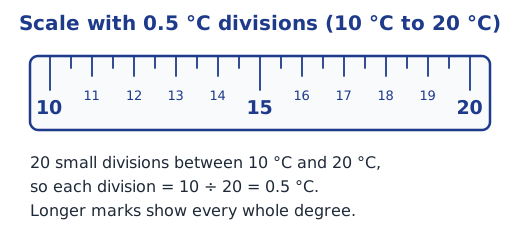
Draw the scale of a thermometer whose smallest division reads 0.5 °C, between 10 °C and 20 °C.
Answer: Between 10 °C and 20 °C there is a difference of 10 °C. For each division to read 0.5 °C, we need 10 ÷ 0.5 = 20 equal divisions.
- Draw a straight line and mark 10 at one end and 20 at the other.
- Divide the line into 20 equal spaces.
- Draw a longer mark at every second line, so each whole degree has a longer mark.
- Label 10, 15 and 20, and write °C.
Question 14
Komal tells you that she has a fever of 101 degrees. Does she mean the Celsius scale or the Fahrenheit scale?
Answer: The Fahrenheit scale. A human body temperature of 101 °C is impossible: our temperature normally stays between 35 °C and 42 °C. Normal body temperature is 98.6 °F, so 101 °F is a little above normal, which means a fever. (Extra: 101 °F is about 38.3 °C.)
Practice
-
A thermometer has 10 small divisions between the 30 °C and 40 °C marks. One division reads:
Show answer
Answer: (b) 1 °C
-
Rani's temperature is 39.0 °C. What does this show?
Show answer
Answer: (a) She has a fever Normal body temperature is taken as 37.0 °C, so 39.0 °C is higher than normal.
-
Which unit is written without a degree sign?
Show answer
Answer: (c) kelvin
-
Convert 37.0 °C into kelvin.
Show answer
Answer: 37.0 + 273.15 = 310.15 K
-
Give two things you must do to read a laboratory thermometer correctly.
Show answer
Answer: Keep it upright with the bulb in the liquid but not touching the sides or bottom, and read it while it is still in the liquid with your eye level with the top of the column.
Stuck on a question?
Take a photo and Lagnever AI explains it step by step. Try it for 7 days for ₹2.
Get it on Google Play Open in browser
For parents: after the trial, the plan renews monthly by UPI or card autopay. You can cancel anytime in the app.