
Class 6 Science Chapter 7: Temperature and its Measurement Notes
This chapter in five lines
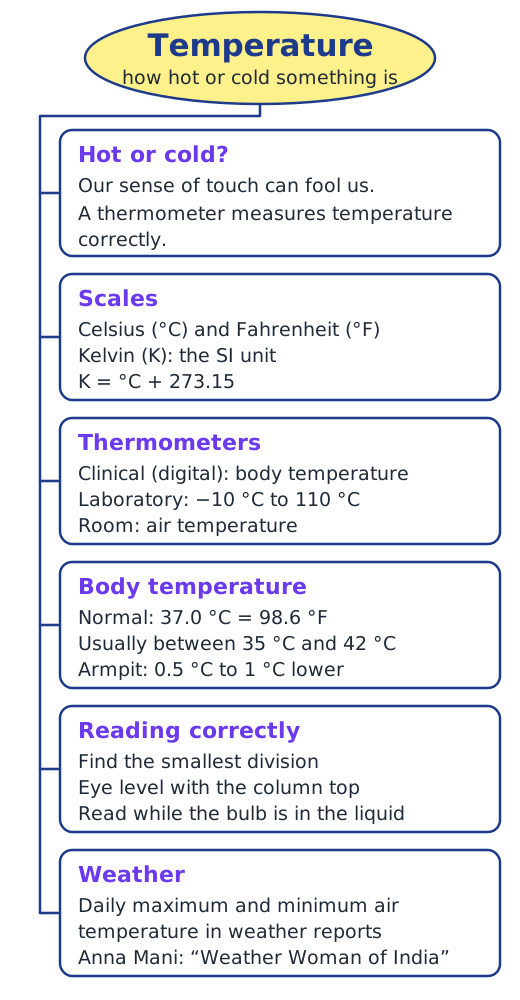
Temperature tells us how hot or cold something is, and our sense of touch cannot judge it reliably. We measure it with a thermometer: a digital clinical thermometer for body temperature and a laboratory thermometer (usually −10 °C to 110 °C) for other things. The common scales are Celsius (°C), Fahrenheit (°F) and Kelvin (K), and the SI unit is the kelvin. Normal body temperature is taken as 37.0 °C, which is 98.6 °F.
Can touch tell us the temperature?
Not reliably. If one hand has been in cold water and the other in warm water, the same tap water feels warm to the first hand and cool to the second. Our hands compare; they do not measure. That is why we need a thermometer.
What is temperature?
Temperature is a reliable measure of how hot or cold a body is. A hotter body has a higher temperature, and the difference between two temperatures tells us how much hotter one body is than the other.
Which thermometers do we use?
- Clinical thermometer: measures human body temperature. Today it is usually a digital thermometer that runs on a battery and shows the number on a screen. Older mercury thermometers are being replaced because mercury is extremely toxic.
- Laboratory thermometer: a long, narrow, sealed glass tube with a bulb of liquid (red-coloured alcohol or mercury) and a Celsius scale. Its range is usually −10 °C to 110 °C.
- Room thermometer: hangs on a wall and gives an approximate idea of the air temperature in a room.
What are the scales of temperature?
Celsius (°C) is the scale our thermometers usually use. Fahrenheit (°F) is used by some thermometers: 37.0 °C is 98.6 °F. Kelvin (K) is the SI unit, used in science. To convert, add 273.15 to the Celsius value.
How do we read a thermometer correctly?
Find the value of one small division first, hold the thermometer upright, keep the bulb away from the sides and bottom of the container, and read it while the bulb is still in the liquid, with your eye in line with the top of the liquid column.
Air temperature and weather
Weather reports give the maximum and minimum air temperature of each day. These change from day to day, rising towards summer and falling in winter. Weather stations all over the world record air temperature to make weather forecasts.
Key terms
| Term | Meaning |
|---|---|
| Temperature | A reliable measure of how hot or cold a body is. A hotter body has a higher temperature. |
| Thermometer | A device that measures temperature. |
| Clinical thermometer | Measures human body temperature. Today it is usually digital and runs on a battery. |
| Laboratory thermometer | A sealed glass tube with a bulb of liquid and a Celsius scale, used for temperatures other than the body's. |
| Range | The lowest to the highest temperature a thermometer can measure. |
| Smallest division | The temperature shown by one small division: the gap between two numbered marks divided by the number of divisions between them. |
| Degree Celsius (°C) | The unit on the Celsius scale, used by our clinical and laboratory thermometers. |
| Degree Fahrenheit (°F) | The unit on the Fahrenheit scale. 37.0 °C is 98.6 °F. |
| kelvin (K) | The SI unit of temperature. Temperature in K = temperature in °C + 273.15. |
| Normal body temperature | The average body temperature of many healthy people, taken as 37.0 °C. |
| Infrared thermometer | A non-contact thermometer that measures temperature without touching the body. |
| Air temperature | The temperature of the air. Weather reports give its maximum and minimum for each day. |
Topics in this chapter
Practice
-
Which device measures temperature?
Show answer
Answer: (b) Thermometer
-
The SI unit of temperature is:
Show answer
Answer: (c) kelvin
-
The normal body temperature of a healthy person is taken as:
Show answer
Answer: (b) 37.0 °C 98.6 is the same temperature on the Fahrenheit scale, so it is 98.6 °F, not °C.
-
Which thermometer would you use to measure the temperature of warm water in the school laboratory?
Show answer
Answer: (b) Laboratory thermometer
-
25 °C on the Kelvin scale is:
Show answer
Answer: (c) 298.15 K 25 + 273.15 = 298.15
Questions students ask
What are the main topics of Class 6 Science Chapter 7?
Hot and cold, temperature, clinical and laboratory thermometers, the Celsius, Fahrenheit and Kelvin scales, reading a thermometer correctly, and air temperature in weather reports.
Is “Temperature and its Measurement” in the new Curiosity book?
Yes. It is Chapter 7 of Curiosity, the Class 6 Science textbook used in the 2026-27 session.
How many questions are in the Chapter 7 exercise?
The “Let us enhance our learning” section has 14 questions. All of them are answered on our NCERT solutions page for this chapter.
Stuck on a question?
Take a photo and Lagnever AI explains it step by step. Try it for 7 days for ₹2.
Get it on Google Play Open in browser
For parents: after the trial, the plan renews monthly by UPI or card autopay. You can cancel anytime in the app.