
How to read a thermometer correctly
Answer in short
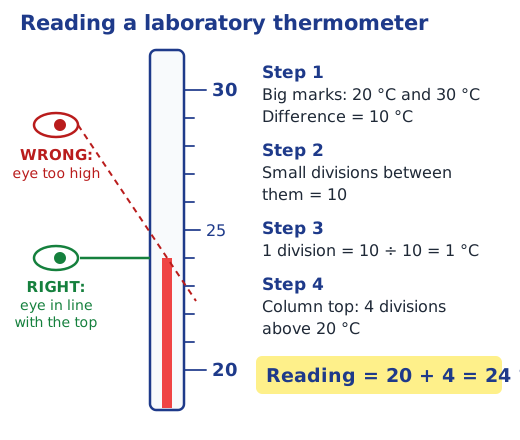
To read a laboratory thermometer, first find the value of one small division: divide the difference between two numbered marks by the number of divisions between them. Then count the divisions from the nearest numbered mark to the top of the liquid column, with your eye level with it, while the bulb is still in the liquid.
Stuck on a question? Take a photo and Lagnever AI explains it step by step. Try it for 7 days for ₹2. Get it on Google Play
What is the range of a thermometer?
The range is the lowest to the highest temperature a thermometer can measure. Look at the numbers at the two ends of the scale. A laboratory thermometer usually has a range of −10 °C to 110 °C, but some have a different range, so always look at the one in your hand.
How do you find the smallest value a thermometer can read?
Pick two numbered marks next to each other and count the small divisions (the spaces) between them. Then divide:
One division = (difference between the two numbered marks) ÷ (number of divisions between them)
| Numbered marks | Divisions between them | One division reads |
|---|---|---|
| 10 °C and 20 °C | 10 | 10 ÷ 10 = 1 °C |
| 0 °C and 10 °C | 20 | 10 ÷ 20 = 0.5 °C |
| 0 °C and 100 °C | 50 | 100 ÷ 50 = 2 °C |
This value tells you how exactly the thermometer can measure. A thermometer that reads 0.5 °C per division can show 22.5 °C; one that reads 2 °C per division cannot.
How do you read a temperature below 0 °C?
A laboratory thermometer can also show temperatures below zero, down to about −10 °C. Below the 0 °C mark, count the divisions downwards. If each division reads 1 °C and the column ends 4 divisions below the 0 °C mark, the reading is −4 °C. Always write the minus sign: −4 °C and 4 °C are very different temperatures.
How do you read the temperature of warm water?
Your teacher will help you set this up. Use only warm water, never boiling water, on your own.
- Take some warm water in a beaker.
- Hold the thermometer upright. Do not tilt it.
- Dip it so that the bulb is fully in the water, without touching the bottom or the sides of the beaker.
- Watch the liquid column rise. Wait until it stops rising, but do not wait too long, or the water itself will start to cool.
- Read it while the bulb is still in the water, with your eye in line with the top of the liquid column.
- Write the reading with its unit, for example 41 °C.
As soon as you take the thermometer out of the water, the column starts to fall. A reading taken after that is wrong.
Why do classmates get different readings of the same water?
If five students read the same beaker of water, their answers may differ slightly. Usually the reason is one of these:
- The eye was above or below the top of the column.
- The thermometer was tilted.
- The bulb touched the bottom or a side of the beaker.
- The reading was taken after the thermometer came out of the water.
- The reading was taken too late, after the water had cooled.
Reading the thermometer the correct way makes everyone’s answer match more closely.
What about a digital thermometer?
A digital clinical thermometer is easier: press reset, wait for the beep or light, and read the number on the display. There are no divisions to count. Wash the tip with soap and water before and after use, keeping the display out of the water.
Practice
-
Between the 10 °C and 20 °C marks there are 10 small divisions. One division reads:
Show answer
Answer: (b) 1 °C
-
Between the 0 °C and 10 °C marks there are 20 small divisions. One division reads:
Show answer
Answer: (a) 0.5 °C
-
When should you read a laboratory thermometer that is measuring warm water?
Show answer
Answer: (b) While the bulb is still in the water
-
A thermometer has 5 small divisions between the 30 °C and 40 °C marks. What does one division read?
Show answer
Answer: (40 − 30) ÷ 5 = 2 °C
-
The liquid column is 3 small divisions above the 20 °C mark, and each division reads 0.5 °C. What is the reading?
Show answer
Answer: 20 + 3 × 0.5 = 21.5 °C
Questions students ask
What is the smallest division of a laboratory thermometer?
It depends on the thermometer. Many school thermometers read 1 °C per small division and some read 0.5 °C. Work it out from the marks every time you use a new thermometer.
Why should the bulb not touch the beaker?
The bottom and sides of the beaker can be hotter or colder than the water, so the thermometer would not show the temperature of the water itself.
Why does the reading fall when the thermometer is taken out of warm water?
The air around it is usually cooler than the warm water, so the liquid in the bulb cools and the column falls. That is why the reading is taken while the bulb is still in the water.
Stuck on a question?
Take a photo and Lagnever AI explains it step by step. Try it for 7 days for ₹2.
Get it on Google Play Open in browser
For parents: after the trial, the plan renews monthly by UPI or card autopay. You can cancel anytime in the app.