
Clinical and laboratory thermometers: what is the difference?
Answer in short
A clinical thermometer measures human body temperature; today it is usually digital and runs on a battery. A laboratory thermometer is a sealed glass tube with a liquid, usually red-coloured alcohol or mercury, and measures other temperatures, typically from −10 °C to 110 °C. Each one is made for its own job.
Stuck on a question? Take a photo and Lagnever AI explains it step by step. Try it for 7 days for ₹2. Get it on Google Play
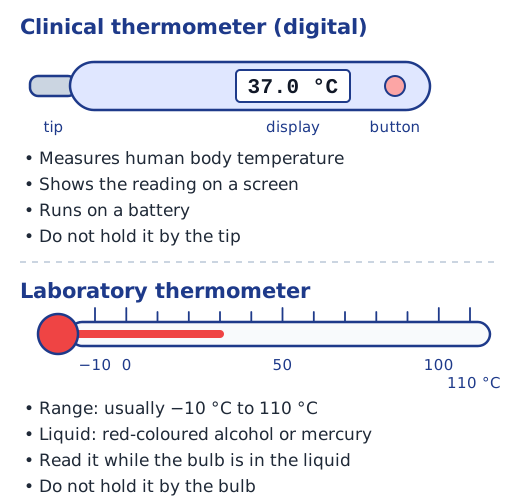
Clinical vs laboratory thermometer at a glance
| Clinical thermometer | Laboratory thermometer | |
|---|---|---|
| Used for | Human body temperature | Water and other things, for example in experiments |
| What it looks like | A small digital device with a screen | A long, narrow, sealed glass tube with a bulb at one end |
| How it works | Heat sensors and a battery | A liquid (red-coloured alcohol or mercury) rises or falls in the tube |
| Range | Made for body temperatures. The human body normally stays between 35 °C and 42 °C | Usually −10 °C to 110 °C |
| How to read it | Read the number on the screen | Read the mark where the top of the liquid column is |
| Never hold it by | The tip | The bulb |
How do you use a digital clinical thermometer?
- Read the instruction manual that comes with it.
- Wash your hands and the tip of the thermometer with soap and water. Keep the display out of the water.
- Press the reset button.
- Place the tip under your tongue and close your mouth.
- Wait until it beeps or a light flashes.
- Take it out and read the temperature on the display.
- Wash the tip again, dry it and put the thermometer away.
For small children or old people, the thermometer can be kept in the armpit instead. This reading is about 0.5 °C to 1 °C lower than the actual body temperature, so keep that in mind.
Why are mercury thermometers being replaced?
Earlier, clinical thermometers had mercury inside. Mercury is an extremely toxic substance, and if such a thermometer breaks, the mercury is difficult to dispose of safely. Digital thermometers have no such risk, and their numbers are easier to read. That is why digital thermometers are taking their place.
What is inside a laboratory thermometer?
A laboratory thermometer is a long, narrow, sealed glass tube of the same width all along. At one end is a bulb filled with a liquid, usually alcohol coloured red so that it is easy to see, or mercury. A Celsius scale is marked along the tube. The liquid column rises when the temperature goes up and falls when it goes down, and the mark at the top of the column is the reading.
Handle it with care: it is made of glass and can break if it hits something hard.
Can one thermometer do the other’s job?
- Clinical thermometer for boiling water or ice? No. Their temperatures are far outside the range it is made for.
- Laboratory thermometer for body temperature? No. The column starts falling as soon as the thermometer is taken out of the mouth, so you cannot get a correct reading, and a glass tube with a liquid is not meant to go into the mouth.
What is an infrared thermometer?
During the COVID-19 pandemic, you may have seen people’s temperature being checked from a short distance. Those were non-contact (infrared) thermometers. They measure temperature without touching the body, which lowers the risk of spreading disease.
What is a room thermometer?
The thermometer hung on the wall of a laboratory, clinic or hospital is a room thermometer. It gives an approximate idea of the air temperature in the room. Weather reports use air temperature too: they give the maximum and minimum temperature of each day.
Practice
-
Which thermometer would you use to check whether your friend has a fever?
Show answer
Answer: (b) Digital clinical thermometer
-
The liquid in a laboratory thermometer is usually:
Show answer
Answer: (c) red-coloured alcohol or mercury
-
Why are mercury thermometers being replaced by digital ones?
Show answer
Answer: (b) Mercury is extremely toxic
-
Write two precautions for using a digital clinical thermometer.
Show answer
Answer: Wash the tip with soap and water before and after use, keeping the display out of the water, and do not hold the thermometer by its tip.
-
Why can a clinical thermometer not measure the temperature of boiling water?
Show answer
Answer: Boiling water is far outside the range of temperatures a clinical thermometer is made for.
Questions students ask
What is the difference between a clinical and a laboratory thermometer?
A clinical thermometer measures body temperature and is usually digital. A laboratory thermometer is a glass tube with a liquid that measures other temperatures, usually from −10 °C to 110 °C.
What is the range of a laboratory thermometer?
Usually −10 °C to 110 °C. Some laboratory thermometers have a different range, so always check the one you are using.
Do digital thermometers contain mercury?
No. A digital thermometer uses heat sensors and a battery, so there is no mercury to break or spill.
What is an infrared thermometer?
It is a non-contact thermometer. It measures temperature without touching the body, which lowers the risk of spreading disease. Such thermometers were widely used during the COVID-19 pandemic.
Stuck on a question?
Take a photo and Lagnever AI explains it step by step. Try it for 7 days for ₹2.
Get it on Google Play Open in browser
For parents: after the trial, the plan renews monthly by UPI or card autopay. You can cancel anytime in the app.