
NCERT Solutions Class 6 Science Chapter 8: A Journey through States of Water
These are answers to all 10 questions of “Let us enhance our learning” at the end of Chapter 8, A Journey through States of Water, in Curiosity (Reprint 2026-27), followed by the answers to Activity 8.6 and Activity 8.11 from the chapter. Several questions ask what you think, so those answers are model answers: explain them in your own words and with your own examples. Short notes: Chapter 8 notes.
Question 1
Which of the following best describes condensation? (i) The conversion of water into its vapour state. (ii) The process of water changing from a liquid into gaseous state. (iii) The formation of clouds from tiny water droplets. (iv) The conversion of water vapour into its liquid state.
Answer: (iv) The conversion of water vapour into its liquid state. Options (i) and (ii) both describe evaporation. Option (iii) is a result of condensation, not its meaning: clouds form because water vapour condenses into tiny droplets.
Question 2
Identify in which of the given processes, evaporation is very important— (i) Colouring with (a) crayons (b) water colours (c) acrylic colours (d) pencil colours (ii) Writing on paper with (a) pencil (b) ink pen (c) ball point pen
Answer:
- (i) (b) Water colours, and also (c) acrylic colours. Both are mixed with water, and the painting dries only when that water evaporates. Crayons and pencil colours put dry colour on the paper, so nothing has to evaporate.
- (ii) (b) Ink pen. The ink of an ink pen is mostly water, and the writing dries as that water evaporates; this is why fresh ink smudges easily. A pencil leaves dry marks, and ball point pen ink is a thick paste that sets almost at once.
Question 3
We see green coloured plastic grass at many places these days. Space around natural grass feels cooler than space around the plastic grass. Can you find out why?
Answer: Natural grass is alive. Its roots take up water from the soil, and its leaves keep giving out water vapour into the air. The moist soil under the grass also loses water by evaporation. Evaporation takes heat from the leaves, the soil and the air close to them, so the space around natural grass feels cooler. Plastic grass has no water to evaporate. In sunlight it only gets hot and warms the air around it.
Extra: plants giving out water vapour through their leaves is called transpiration. You will study it in later classes.
Question 4
Give examples of liquids other than water that evaporate.
Answer: Hand sanitiser (it disappears as you rub it on your hands), perfume (its smell spreads as it evaporates), nail polish remover, petrol (you can smell it near a petrol pump) and the spirit a nurse rubs on your skin before an injection. All of these evaporate faster than water.
Question 5
Fans move air around, creating a cooling sensation. It might seem strange to use a fan to dry wet clothes since fans usually make things cooler, not warmer. Normally, when water evaporates, it requires heat, not cold air. What do you think about this?
Answer: A fan does not make the air colder; it only moves it. As water evaporates from wet clothes, the air right next to them becomes moist, full of water vapour. In still air this moist layer stays there and evaporation slows down. A fan keeps blowing the moist air away and bringing in drier air, so water keeps evaporating quickly. The heat that evaporation needs comes from the clothes and the room around them.
The cool feeling from a fan has the same cause. The fan speeds up the evaporation of sweat, and evaporation takes heat from our skin. So the fan cools us and dries clothes for one reason: it makes evaporation faster.
Question 6
Usually, when sludge is removed from drains, it is left in heaps next to the drain for 3–4 days. Afterward, it is transported to a garden or a field where it can be used as manure. This approach reduces transportation cost of the sludge and enhances the safety of individuals handling it. Reflect upon it and explain how.
Answer: Fresh sludge from a drain is full of water. In 3–4 days in the open air, much of that water evaporates, helped by sunlight and wind.
- Lower transport cost: dried sludge weighs much less and takes less space, so fewer trips are needed to carry it to the garden or field.
- Safer handling: dry sludge does not drip, splash or slide off the spade, so the workers touch less of the dirty mud and can load it more easily. It also smells less once it is dry.
Question 7
Observe the activities in your house for a day. Identify the activities that involve evaporation. How does understanding the process of evaporation help us in our daily activities?
Answer (model): Activities that involve evaporation:
- drying washed clothes, and washed utensils on the rack;
- a mopped floor drying;
- drying hair after a bath, and sweat drying;
- cooking, when water boils away as dal, tea or kheer thickens;
- drying papad, chillies or grains in the sun;
- keeping drinking water cool in a matka.
Knowing how evaporation works helps us every day. We spread clothes out in the sun and wind so they dry fast, switch on a fan to dry a wet floor, keep water cool in a matka, sprinkle water to cool a hot floor or roof, dry food in the sun to store it longer, and cover food and water so that they do not dry out.
Question 8
How is water present in the solid state in nature?
Answer: As ice and snow. For example: snow on high mountains such as the Himalayas, glaciers (huge rivers of ice that move very slowly), the thick ice near the North and South Poles and the icebergs floating in cold seas, lakes that freeze in very cold places in winter, and hailstones that fall during some storms. When this ice and snow melts, the water flows into rivers, which is a part of the water cycle.
Question 9
Reflect on the statement “Water is our responsibility before it is our right.” Share your thoughts.
Answer (model): Everyone needs water, so it is everyone’s right. But only a small part of the water on Earth is fit for plants, animals and people, because most of it is in the oceans. The number of people using water keeps growing, and many places already face water shortages. If we waste water or pollute rivers and lakes, there will not be enough for everyone, now or in the future. So before we demand water, we must take care of it: turn off the tap while brushing, get leaks fixed, reuse the water from washing vegetables for plants, collect rainwater, and never throw waste into water bodies.
Question 10
The seat of a two-wheeler parked on a sunny day has become very hot. How can you cool it down?
Answer: Sprinkle a little water on the seat, or wipe it with a wet cloth, and wait a short while. As the water evaporates, it takes heat from the seat, so the seat cools down. This is the cooling effect of evaporation. Fanning the seat makes the water evaporate faster. Next time, park in the shade or cover the seat with a light-coloured cloth.
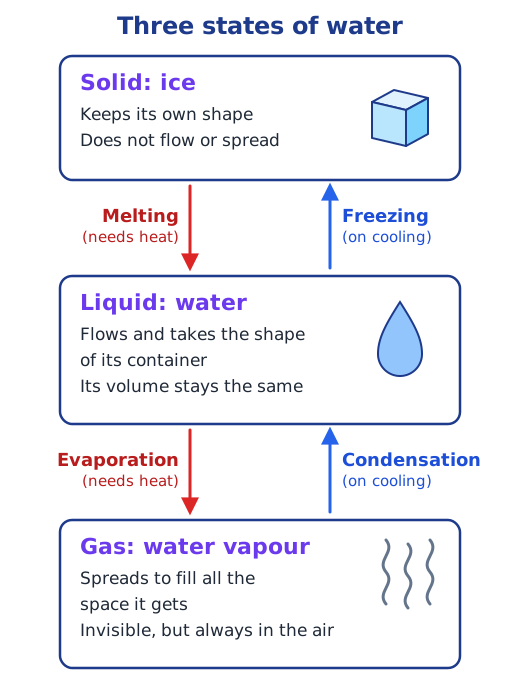
Activity 8.6: complete the diagram
The book shows the three states of water in boxes A, B and C, joined by arrows 1 to 4 for the changes between them. Box A (Solid) and arrow 1 (Melts, from solid to liquid) are filled in. The answers:
- B: Liquid
- C: Gas
- 2 (liquid → gas): Evaporates
- 3 (liquid → solid): Freezes
- 4 (gas → liquid): Condenses
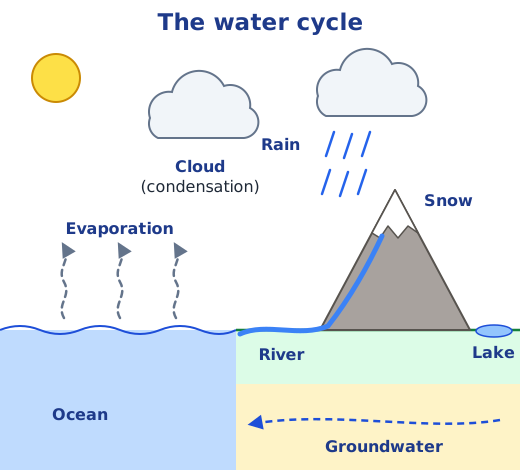
Activity 8.11: label the water cycle
Use the words Cloud, Lake, Ocean, River, Groundwater, Evaporation, Condensation, Rain and Snow like this:
- Ocean, Lake, River: where water is stored on the surface of the Earth.
- Evaporation: the arrows going up from the ocean (and from lakes, rivers and land) into the air.
- Condensation and Cloud: high up, where cool air turns water vapour into droplets that form clouds.
- Rain: drops falling from the clouds. Snow: on the top of the high mountain.
- River: carries rainwater and melted snow from the mountains back to the ocean.
- Groundwater: water that soaks into the ground and moves under it.
Practice
-
Which process changes ice into water?
Show answer
Answer: (b) Melting
-
Which of these liquids evaporates quickly when you rub it on your hands?
Show answer
Answer: (b) Hand sanitiser
-
Snow on high mountains is water in which state?
Show answer
Answer: (a) Solid
-
Why does a wet floor dry faster when the fan is on?
Show answer
Answer: The moving air carries away the moist air just above the floor and brings in drier air, so the water keeps evaporating quickly.
-
Which process in the water cycle forms clouds?
Show answer
Answer: Condensation: high above the ground the air is cool, so water vapour condenses into tiny droplets around dust particles, and the droplets form clouds.
Stuck on a question?
Take a photo and Lagnever AI explains it step by step. Try it for 7 days for ₹2.
Get it on Google Play Open in browser
For parents: after the trial, the plan renews monthly by UPI or card autopay. You can cancel anytime in the app.