
Class 6 Science Chapter 8: A Journey through States of Water Notes
This chapter in five lines
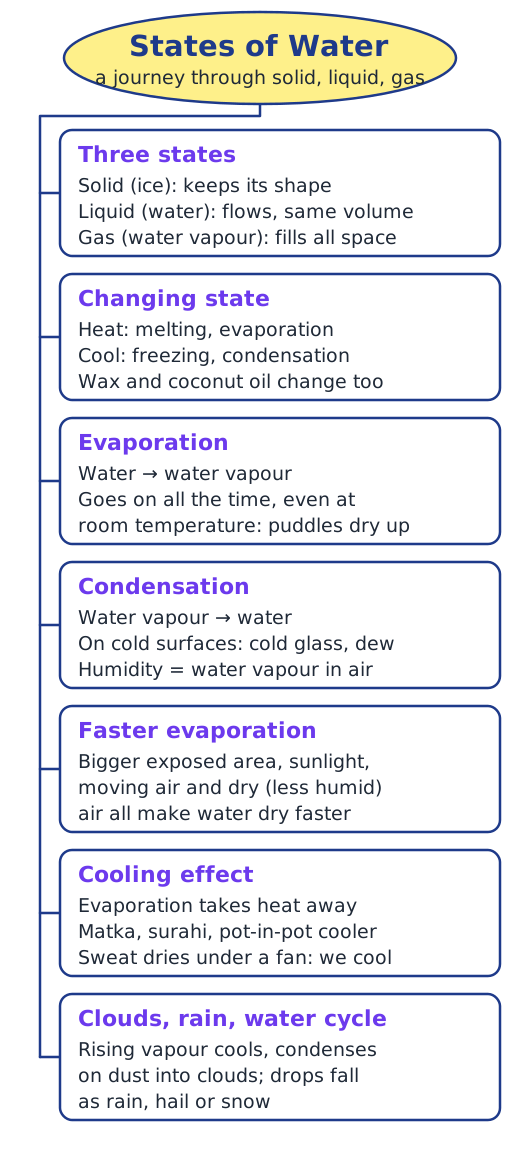
Water exists in three states: solid ice, liquid water and gaseous water vapour. Heating turns ice into water (melting) and water into vapour (evaporation); cooling does the reverse (condensation and freezing). Evaporation goes on all the time and is faster with a larger exposed area, sunlight, wind and dry air, and it cools things. Rising vapour condenses into clouds and falls back as rain, hail or snow: the water cycle.
Are ice and water the same substance?
Yes. Leave an ice cube in a cup and it becomes water; put water in a freezer and it becomes ice again. Nothing is added or taken away, so ice and water are two forms of the same substance. These forms are called states. They still behave differently: water flows and splashes, and ice does neither.
Where does water disappear to?
Puddles shrink and washed utensils dry. A spoonful of water on a steel plate disappears without the underside of the plate ever getting wet, so the water has not seeped through. It has changed into water vapour, the gaseous state of water. This change is called evaporation, and it goes on all the time, even at room temperature. Read more in evaporation and condensation.
Where do the drops on a cold glass come from?
Put ice cubes in a glass of cold water and drops soon appear on the outside. They do not seep out: the water level inside does not fall, and the glass even gets heavier on a digital balance. The drops come from water vapour in the air, which turns back into liquid when it touches the cold glass. This is condensation. Dew on plants forms the same way. The amount of water vapour in the air is called humidity.
What are the three states of water?
Ice (solid) keeps its own shape. Water (liquid) flows and takes the shape of its container, but its volume stays the same. Water vapour (gas) spreads to fill all the space it gets. Wax, oil and ghee can also be solid or liquid. See three states of water.
How can we change the state of water?
Heating turns ice into water (melting) and water into water vapour. Cooling turns water into ice (freezing) in a freezer, and water vapour into water. Candle wax melts near a flame and turns solid again as it cools, and coconut oil often turns solid in winter. Atmospheric Water Generator (AWG) machines use condensation to collect drinking water from humid air.
What makes water evaporate faster?
A larger exposed area (water on a plate dries before water in a bottle cap), sunlight, moving air and dry air all make water evaporate faster. On rainy, humid days clothes dry slowly. See factors affecting evaporation.
Why does evaporation cool things?
Evaporation takes heat from the surface where it happens. Water seeps through a matka and evaporates from its outside, so the water inside stays cool. We feel cool under a fan because it helps our sweat evaporate. A pot-in-pot cooler keeps fruits and vegetables fresh with wet sand and no electricity.
How do clouds give us rain?
Water vapour is lighter than air, so it rises. High above the ground the air is cooler, and the vapour condenses into tiny droplets around dust particles. Floating droplets form clouds. When many droplets join into drops that are too heavy to float, they fall as rain, and sometimes as hail or snow. Water then flows back through rivers and the ground to the oceans. This never-ending journey is the water cycle. Only a small part of Earth’s water is fit to use, so save it and keep rivers and lakes clean.
Key terms
| Term | Meaning |
|---|---|
| States of water | The three forms of water: solid (ice), liquid (water) and gas (water vapour). All three are the same substance. |
| Water vapour | Water in the gaseous state. It is invisible and is always present in the air around us. |
| Evaporation | The change of liquid water into water vapour. It happens all the time, even at room temperature. |
| Condensation | The change of water vapour into liquid water, for example when vapour touches a cold surface. |
| Melting | The change of a solid into a liquid on heating, like ice into water or candle wax into liquid wax. |
| Freezing | The change of a liquid into a solid on cooling, like water into ice in a freezer. |
| Humidity | The amount of water vapour in the air. Rainy days are more humid. |
| Exposed area | The surface of a liquid that is open to the air. A larger exposed area means faster evaporation. |
| Cooling effect | Evaporation takes heat from the surface it happens on, so that surface cools. Example: water in a matka. |
| Steam | Water vapour from hot water. The vapour itself is invisible; tiny water droplets in the steam make it visible. |
| Dew | Water drops on grass and leaves, formed when water vapour in the air condenses on cool surfaces. It is seen mostly in the morning. |
| Water cycle | The circulation of water between the Earth's surface and the atmosphere through evaporation, condensation and rain, hail or snow. |
Topics in this chapter
Practice
-
The change of water vapour into liquid water is called:
Show answer
Answer: (b) condensation
-
Which state of water spreads to fill all the space it gets?
Show answer
Answer: (c) Water vapour
-
Wet clothes dry quickest when they are:
Show answer
Answer: (b) spread out in the sun on a windy day Spreading out gives a larger exposed area, and sunlight and wind both make water evaporate faster.
-
Why does water stay cool in a matka (earthen pot)?
Show answer
Answer: (b) Water seeps out through the clay and evaporates, which cools the pot
-
Drops on the outside of a glass of ice-cold water come from:
Show answer
Answer: (b) water vapour in the air that condenses The water level inside does not drop, while the glass gets heavier: the water comes from the air.
Questions students ask
What are the main topics of Class 6 Science Chapter 8?
The three states of water and how water changes from one state to another, evaporation, condensation, humidity, the conditions that make evaporation faster or slower, the cooling effect of evaporation, and how clouds give us rain in the water cycle.
Is “A Journey through States of Water” in the new Curiosity book?
Yes. It is Chapter 8 of Curiosity, the Class 6 Science textbook used in the 2026-27 session.
How many questions are in the Chapter 8 exercise?
The “Let us enhance our learning” section has 10 questions. All of them are answered on our NCERT solutions page for this chapter, together with the diagram in Activity 8.6.
Stuck on a question?
Take a photo and Lagnever AI explains it step by step. Try it for 7 days for ₹2.
Get it on Google Play Open in browser
For parents: after the trial, the plan renews monthly by UPI or card autopay. You can cancel anytime in the app.