
What are evaporation and condensation?
Answer in short
Evaporation is the change of liquid water into water vapour. It happens all the time, even at room temperature, which is why puddles and wet clothes dry. Condensation is the opposite: water vapour changes into liquid water when it touches something cold, like a glass of ice-cold water. Together they drive the water cycle.
Stuck on a question? Take a photo and Lagnever AI explains it step by step. Try it for 7 days for ₹2. Get it on Google Play
Where does the water go?
After rain, the playground is full of puddles. By evening many of them are smaller. Washed plates and glasses dry on the rack. Where did the water go?
One idea is that the water soaks into the ground. That is partly true for a puddle, but it cannot explain a plate. Test it: put a spoonful of water on a steel plate and look under the plate every few minutes. The underside stays dry, yet the water slowly disappears. It did not seep through. It changed into an invisible gas, water vapour, and went into the air.
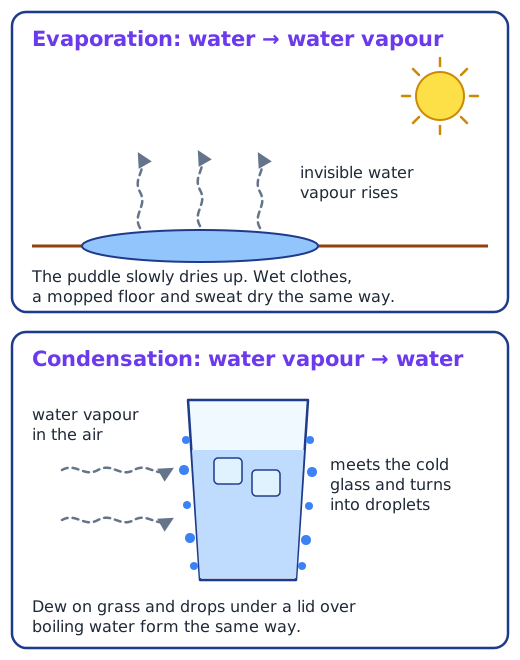
The change of water into water vapour is called evaporation. It goes on all the time, even at room temperature. That is how wet clothes, a mopped floor and the sweat on our skin dry up. Hand sanitiser vanishes as you rub it on your hands for the same reason: it evaporates.
Is steam the same as water vapour?
Sprinkle a few drops of water on a hot pan while making dosa and they disappear in a hiss of steam. Steam is water vapour from hot water. Water vapour itself is invisible. Steam looks white because some of the vapour quickly cools into tiny droplets of water, and those droplets are what you see.
Where do the drops on a cold glass come from?
Fill a glass with cold water and a few ice cubes, and wait five minutes. Drops appear on the outside, and they slowly join into bigger drops. Did water seep out through the glass?
You can check like a scientist:
- Mark the water level on the glass with a marker or tape. The level does not go down, so no water is leaving the glass.
- Weigh it. Put the glass, covered with a small plate, on a digital balance and note the reading every five minutes for half an hour. The reading goes up. Extra water is arriving from outside.
The extra water comes from the air. Air always holds some water vapour. When that vapour touches the cold glass, it cools and turns back into liquid water. This change of water vapour into liquid water is called condensation.
You see condensation in other places too:
- Dew drops on grass and leaves in the morning.
- Drops under a lid placed over a pot of boiling water.
- A misty mirror after a hot bath.
What is humidity?
The amount of water vapour in the air is called humidity. Rainy days are more humid. Your newspaper reports the humidity of your area every day. Atmospheric Water Generator (AWG) machines cool humid air so that its water vapour condenses, and collect the water for drinking, just like the drops on a cold glass.
How do evaporation and condensation make rain?
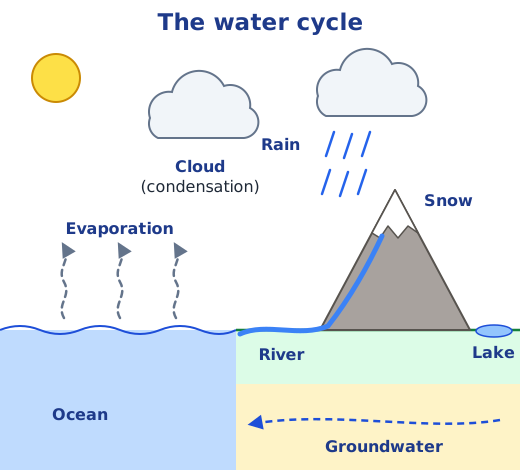
The sun warms the oceans, rivers, lakes and land, and their water evaporates. Water vapour is lighter than air, so it rises. The higher it goes, the cooler the air becomes. At a certain height the vapour condenses into tiny droplets, usually around specks of dust. Huge numbers of floating droplets make a cloud. When droplets join into drops that are too heavy to float, they fall as rain, and in special conditions as hail or snow.
You can make a small cloud in a bottle, with an adult helping. Put a little water in an empty plastic bottle, add a small piece of burnt paper for dust, close the lid, and squeeze and release the bottle again and again. A haze, a tiny cloud, appears above the water.
What is the water cycle?
Rain and melted snow run into rivers and lakes or soak into the ground as groundwater, and much of it flows back to the oceans. Then it evaporates again. This circulation of water between the Earth’s surface and the air is the water cycle.
Only a small part of all the water on Earth is fit for plants, animals and people; most of it is in the oceans. So use water wisely and keep rivers and lakes clean. To see what makes water dry faster, read factors affecting evaporation, or revise the three states of water.
Practice
-
Which of these is an example of evaporation?
Show answer
Answer: (c) Wet clothes drying
-
Which of these is an example of condensation?
Show answer
Answer: (c) Drops forming under a lid over boiling water
-
A glass of ice-cold water on a digital balance gets heavier in 30 minutes because:
Show answer
Answer: (b) water vapour from the air condenses on the glass
-
Why do we see dew drops mostly in the morning?
Show answer
Answer: During the night, grass and leaves cool down. Water vapour in the air condenses on these cool surfaces as tiny drops of dew. Once the sun warms things up, the dew evaporates.
-
How does a cloud form?
Show answer
Answer: Water vapour rises with the air. High above the ground the air is much cooler, so the vapour condenses into tiny droplets around dust particles. Many droplets floating together make a cloud.
Questions students ask
What is the difference between evaporation and condensation?
Evaporation turns liquid water into water vapour; condensation turns water vapour back into liquid water. Evaporation needs heat, and condensation happens when the vapour is cooled.
Why does a glass of cold water “sweat”?
The cold glass cools the air touching it, and the water vapour in that air condenses into drops on the outside of the glass. It is not water leaking from inside.
Where does the water in a puddle go?
Some of it soaks into the ground, and the rest evaporates into the air as water vapour.
What is humidity?
Humidity is the amount of water vapour in the air. The air is more humid on rainy days. Newspapers report the humidity of your area every day.
Stuck on a question?
Take a photo and Lagnever AI explains it step by step. Try it for 7 days for ₹2.
Get it on Google Play Open in browser
For parents: after the trial, the plan renews monthly by UPI or card autopay. You can cancel anytime in the app.