
What are the three states of water?
Answer in short
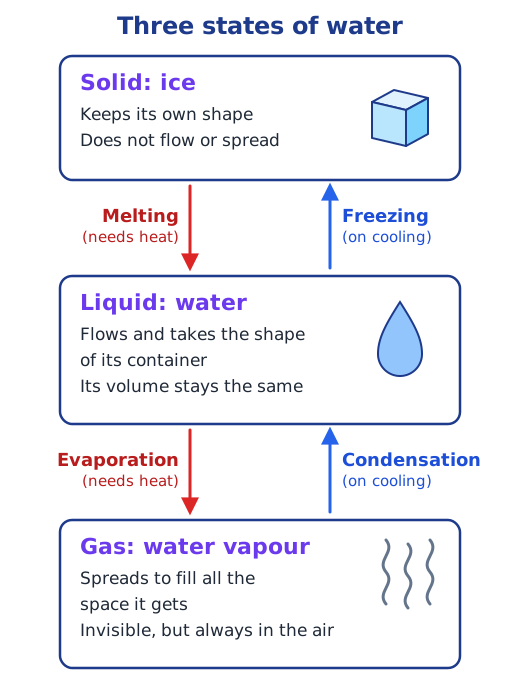
Water is found in three states: solid (ice), liquid (water) and gas (water vapour). Ice keeps its own shape. Water flows and takes the shape of its container, but its volume stays the same. Water vapour spreads to fill all the space it gets and is invisible. Heating or cooling changes one state into another.
Stuck on a question? Take a photo and Lagnever AI explains it step by step. Try it for 7 days for ₹2. Get it on Google Play
Are ice and water really the same thing?
Ice feels hard and you can hold it in your hand. Water runs through your fingers. So are they different substances? Try this: leave an ice cube in a cup on the table. In a while there is only water in the cup. Now put that water in the freezer and it turns back into ice.
Nothing was added and nothing was taken away. So ice and water are the same substance, water, in two different forms. Scientists call these forms states.
What are the three states of water?
In daily life we meet water in three states:
| State | What we call it | Where you see it |
|---|---|---|
| Solid | Ice | Ice cubes, hailstones, snow |
| Liquid | Water | A glass of water, rain, a river |
| Gas | Water vapour | All around us in the air, though we cannot see it |
How do the three states behave?
You can test this at home with a bowl, a box and a plate.
- Shape. Move an ice cube from a round bowl into a square box. It keeps its own shape. Pour water from a tall glass into a flat plate. The water takes the shape of whatever holds it, so it has no fixed shape.
- Flow. Water flows from one container to another. Ice does not flow.
- Spread. Spill a little water on a clean floor and it spreads out, but the amount of water stays the same: its volume does not change. Ice does not spread.
Water vapour has no fixed shape either, and it spreads out to fill all the space it gets. When a mopped floor dries, the water vapour mixes into the air of the whole room. In the same way, the smell of food being cooked reaches you in another room, because smells travel through the air.
Water vapour: the invisible state
Water vapour is present even at room temperature, but it is invisible. Water from drying clothes, mopped floors and our sweat keeps adding vapour to the air around us.
What about the white “smoke” above a pot of boiling water or a hot dosa pan? That is steam. Steam is water vapour, but the white part you see is made of tiny droplets of water that form as some of the vapour cools. Pure water vapour cannot be seen.
How do we change the state of water?
To go from ice to water, and from water to water vapour, we must supply heat. To go the other way, we must cool it.
| Change | Name of the process |
|---|---|
| Solid → liquid (ice → water) | Melting |
| Liquid → solid (water → ice) | Freezing |
| Liquid → gas (water → water vapour) | Evaporation |
| Gas → liquid (water vapour → water) | Condensation |
You can see all four at home. An ice cube melts on a plate. Water freezes in the freezer. Wet clothes dry as their water evaporates. Drops of water collect under a lid over a pot of boiling water as the vapour condenses. Evaporation even happens without heating, only more slowly: a puddle dries on a cool day too. Learn more in evaporation and condensation.
Do other substances have these states too?
Yes. A candle is made of wax: near the flame the wax melts into a liquid, and away from the flame it cools and turns solid again. Ghee and coconut oil are liquid on a hot day but often turn solid in winter.
Look around you for more examples:
- Solids: stone, wood, glass.
- Liquids: milk, oil, juice.
- Gases: air, which contains oxygen and carbon dioxide.
So the idea of solid, liquid and gas is not only about water. Many substances can exist in different states, depending on how hot or cold they are.
Practice
-
Which state of water keeps its own shape?
Show answer
Answer: (a) Ice
-
You pour water from a glass into a bowl. What stays the same?
Show answer
Answer: (b) Its volume Water takes the shape of the new container, but the amount of water, its volume, does not change.
-
Coconut oil turning solid on a cold winter day is an example of:
Show answer
Answer: (b) freezing
-
How can you change ice into water vapour?
Show answer
Answer: Heat it. The ice first melts into water, and on further heating the water changes into water vapour.
-
Name one solid, one liquid and one gas that you meet every day.
Show answer
Answer: Solid: a stone (or wood, or glass). Liquid: milk (or oil). Gas: air, which contains oxygen and carbon dioxide.
Questions students ask
What are the three states of water?
Solid (ice), liquid (water) and gas (water vapour). All three are the same substance in different forms.
Is steam the same as water vapour?
Steam is water vapour coming from hot water. The vapour itself is invisible; the white cloud you see is made of tiny water droplets that form as some of the vapour cools.
Is there water vapour in the air even when it is not hot?
Yes. Water evaporates all the time, even at room temperature, so the air around us always holds some water vapour. The amount is called humidity.
Which other substances can change state like water?
Wax, ghee, butter and coconut oil melt when heated and turn solid again when cooled.
Stuck on a question?
Take a photo and Lagnever AI explains it step by step. Try it for 7 days for ₹2.
Get it on Google Play Open in browser
For parents: after the trial, the plan renews monthly by UPI or card autopay. You can cancel anytime in the app.