
NCERT Solutions Class 7 Maths Chapter 1: Large Numbers Around Us
Answers to every question in Chapter 1, Large Numbers Around Us, of Ganita Prakash Grade 7 Part 1 (Reprint 2026-27): the questions in the text, every Figure it Out, Math Talk and Try This, and the Puzzle Time on toothpick digits. Page numbers follow the book (pages 1–23). Long calculations were checked twice, and the puzzles by a computer search as well. Short notes: Chapter 1 notes.
A Lakh Varieties! (pages 1–3)
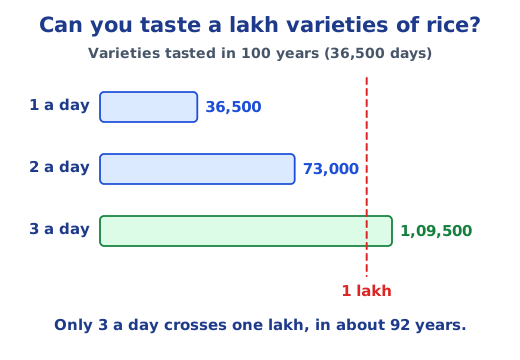
One new variety a day for 100 years: is that close to a lakh? No. 100 years have about 365 × 100 = 36,500 days, so you would taste only 36,500 varieties, about a third of a lakh.
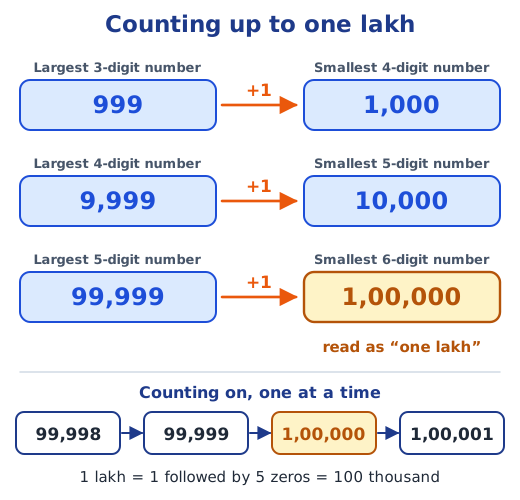
Fill in the boxes. 999 + 1 = 1,000; the largest 4-digit number is 9,999 and 9,999 + 1 = 10,000; the largest 5-digit number is 99,999 and 99,999 + 1 = 1,00,000. Counting on: 99,995, 99,996, 99,997, 99,998, 99,999, 1,00,000, 1,00,001, 1,00,002, 1,00,003, 1,00,004.
Two varieties a day for 100 years? 2 × 36,500 = 73,000. Still not a lakh.
Three varieties a day? 3 × 36,500 = 1,09,500, which is more than a lakh, so yes. They would finish during the 92nd year, since 1,00,000 ÷ 3 is about 33,334 days, and 33,334 ÷ 365 is about 91.3 years.
Choose a number for y. For y = 100, 365 × 100 = 36,500 days, 63,500 short of a lakh. For y = 200 it is 73,000. For y = 274 it is 1,00,010, just 10 more than a lakh. So a lakh days is about 274 years.
Figure it Out (page 3)
- 1,00,000 − 75,000 = 25,000. So 75,000 is 25,000 less than a lakh.
- 1,06,000 − 1,00,000 = 6,000. So 1,06,000 exceeds a lakh by 6,000.
- 1,06,000 − 75,000 = 31,000, using the rounded 2011 figure. (With the exact census figure, 76,068, the increase is 29,932, about 30,000.)
Getting a Feel of Large Numbers (page 3)
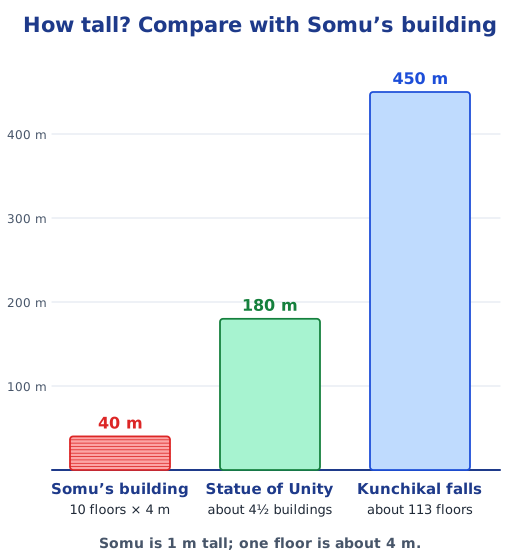
Height of Somu’s building. The picture shows 10 floors, each about 4 times Somu’s 1 m, so the building is about 10 × 4 = 40 m high.
Statue of Unity or the building? The statue, by 180 − 40 = 140 m. It is about 180 ÷ 40 = 4.5 times as tall.
Kunchikal waterfall compared with the building? 450 − 40 = 410 m taller.
Floors needed to reach 450 m? 450 ÷ 4 = 112.5, so about 113 floors.
Is One Lakh a Very Large Number? (page 4)
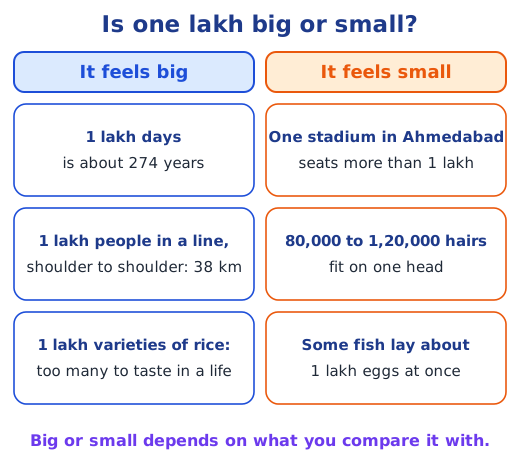
Big or small? Both views are right; it depends on what you compare it with. Roxie’s facts check out: 1,00,000 ÷ 365 is about 274 years, and 38 km ÷ 1,00,000 = 38 cm, about the width of one person’s shoulders. Estu’s facts show a lakh fitting in small spaces: a stadium, a head of hair, a batch of fish eggs. Connecting the facts: a stadium with more than a lakh seats could hold almost all of Chintamani’s 2024 population of about 1,06,000.
Reading and Writing Numbers (pages 4–5)
In words.
- (a) 3,00,600: three lakh six hundred
- (b) 5,04,085: five lakh four thousand eighty-five
- (c) 27,30,000: twenty-seven lakh thirty thousand
- (d) 70,53,138: seventy lakh fifty-three thousand one hundred thirty-eight
In figures (Indian system).
- (a) 1,23,456
- (b) 4,07,704
- (c) 50,05,050
- (d) 10,00,235
Land of Tens (pages 5–7)
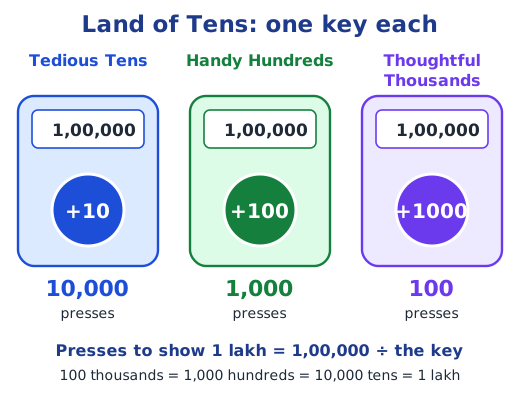
1. Thoughtful Thousands (+1000 only). Presses needed: 3,000 → 3; 10,000 → 10; 53,000 → 53; 90,000 → 90; 1,00,000 → 100. (f) 153 presses show 1,53,000. (g) 100 thousands make a lakh.
2. Tedious Tens (+10 only). Presses needed: 500 → 50; 780 → 78; 1,000 → 100; 3,700 → 370; 10,000 → 1,000; 1,00,000 → 10,000. (g) 435 presses show 4,350.
3. Handy Hundreds (+100 only). Presses needed: 400 → 4; 3,700 → 37; 10,000 → 100; 53,000 → 530; 90,000 → 900; 97,600 → 976; 1,00,000 → 1,000. (h) 582 presses show 58,200. (i) 100 hundreds make ten thousand. (j) 1,000 hundreds make a lakh.
(k) Is Handy Hundreds right? No. Handy Hundreds can show only multiples of 100, and every multiple of 100 is also a multiple of 10, so Tedious Tens can show it too, with ten times as many presses. For example, Thoughtful Thousands cannot show 3,700, but Tedious Tens can.
4. Creative Chitti and 321. Yes: 32 presses of +10 give 320, and one press of +1 makes 321. The other way also works: 200 + 120 + 1 = 321.
5. Another way to get 5072. For example (5 × 1,000) + (7 × 10) + (2 × 1) = 5072, or (4 × 1,000) + (10 × 100) + (6 × 10) + (12 × 1) = 5072, or (507 × 10) + (2 × 1) = 5072.
Figure it Out (pages 6–7): two ways each
- (a) 8300 = (8 × 1,000) + (3 × 100), or (83 × 100)
- (b) 40629 = (4 × 10,000) + (6 × 100) + (2 × 10) + (9 × 1), or (406 × 100) + (29 × 1)
- (c) 56354 = (5 × 10,000) + (6 × 1,000) + (3 × 100) + (5 × 10) + (4 × 1), or (56 × 1,000) + (35 × 10) + (4 × 1)
- (d) 66666 = (6 × 10,000) + (6 × 1,000) + (6 × 100) + (6 × 10) + (6 × 1), or (666 × 100) + (66 × 1)
- (e) 367813 = (3 × 1,00,000) + (6 × 10,000) + (7 × 1,000) + (8 × 100) + (1 × 10) + (3 × 1); another way is (36 × 10,000) + (78 × 100) + (13 × 1)
Chitti’s question (a): exactly 30 presses. The largest 3-digit number is 993 = (9 × 100) + (8 × 10) + (13 × 1), with 9 + 8 + 13 = 30 presses. The smallest is 102 = (8 × 10) + (22 × 1), with 8 + 22 = 30 presses. Why these? Every key (1, 10, 100, …) leaves a remainder of 1 when divided by 9, so a number and its number of presses always leave the same remainder when divided by 9. Thirty leaves 3, and 993 and 102 are the largest and smallest 3-digit numbers that leave 3.
Chitti’s question (b): 997 with a different number of clicks. 997 = (9 × 100) + (9 × 10) + (7 × 1) uses 25 clicks. Swapping one +100 click for ten +10 clicks gives (8 × 100) + (19 × 10) + (7 × 1) = 997 with 34 clicks. Each such swap adds 9 clicks, so 43, 52 and so on also work, up to 997 clicks of +1.
Systematic Sippy: fewest clicks. (a) The table’s way for 5072 uses 5 + 0 + 6 + 12 = 23 clicks. Fewer: (5 × 1,000) + (7 × 10) + (2 × 1), only 14 clicks. (b) 8300 = (8 × 1,000) + (3 × 100), 11 clicks.
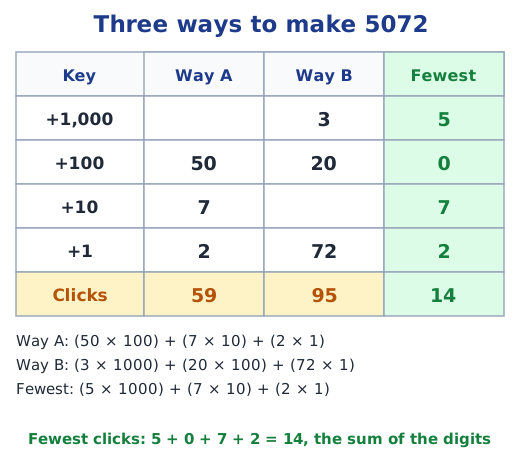
Figure it Out (page 7)
- Fewest clicks: 8300 = (8 × 1,000) + (3 × 100), 11 clicks; 40629 = (4 × 10,000) + (6 × 100) + (2 × 10) + (9 × 1), 21 clicks; 56354 = (5 × 10,000) + (6 × 1,000) + (3 × 100) + (5 × 10) + (4 × 1), 23 clicks; 66666 = (6 × 10,000) + (6 × 1,000) + (6 × 100) + (6 × 10) + (6 × 1), 30 clicks; 367813 = (3 × 1,00,000) + (6 × 10,000) + (7 × 1,000) + (8 × 100) + (1 × 10) + (3 × 1), 28 clicks.
- The fewest clicks always equal the sum of the digits of the number.
- If any key were pressed 10 or more times, ten of those presses could be replaced by one press of the next bigger key, saving 9 clicks. So in the fewest-clicks way, each key is pressed 0 to 9 times, and the presses on each key are exactly the digit in that place. That is the place value form of the number.
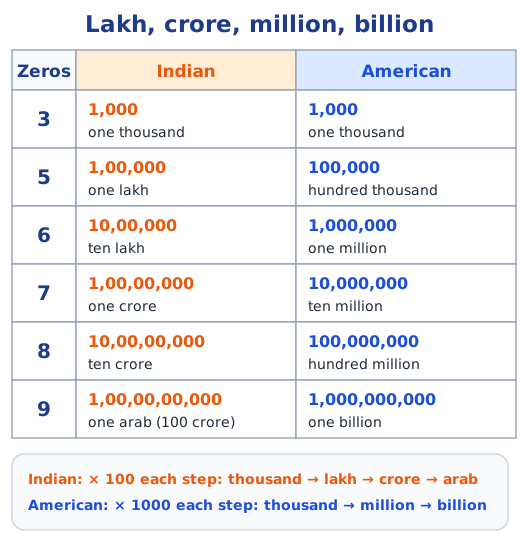
Ten presses of +10,00,000. The display shows 1,00,00,000, which has 7 zeros. It is 100 lakh, called one crore.
Of Crores and Crores! (pages 8–9)
Zeros in a thousand lakh. 1000 × 1,00,000 = 10,00,00,000, which is ten crore and has 8 zeros.
Zeros in a hundred thousand. 100 × 1000 = 1,00,000, one lakh, with 5 zeros.
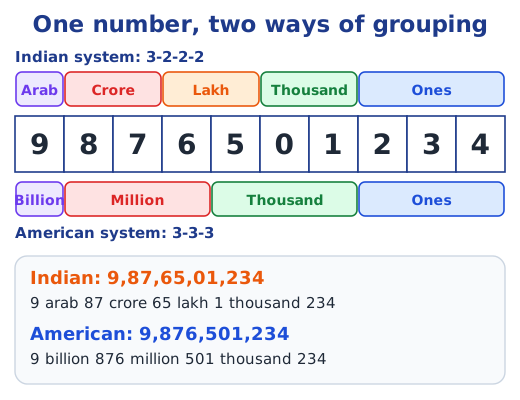
Figure it Out (page 9)
1. Number names in both systems.
- (a) 40,50,678: forty lakh fifty thousand six hundred seventy-eight. American: 4,050,678, four million fifty thousand six hundred seventy-eight.
- (b) 4,81,21,620: four crore eighty-one lakh twenty-one thousand six hundred twenty. American: 48,121,620, forty-eight million one hundred twenty-one thousand six hundred twenty.
- (c) 2,00,22,002: two crore twenty-two thousand two. American: 20,022,002, twenty million twenty-two thousand two.
- (d) 24,68,13,579: twenty-four crore sixty-eight lakh thirteen thousand five hundred seventy-nine. American: 246,813,579, two hundred forty-six million eight hundred thirteen thousand five hundred seventy-nine.
- (e) 34,50,00,543: thirty-four crore fifty lakh five hundred forty-three. American: 345,000,543, three hundred forty-five million five hundred forty-three.
- (f) 1,02,03,04,050: one arab two crore three lakh four thousand fifty (or one hundred two crore three lakh four thousand fifty). American: 1,020,304,050, one billion twenty million three hundred four thousand fifty.
2. In Indian place value notation. (a) 1,01,01,010; (b) 1,000,000,000 + 1,000,000 + 1,000 + 1 = 1,00,10,01,001; (c) 10,20,30,040; (d) 9,000,000,000 + 80,000,000 + 700,000 + 600 = 9,08,07,00,600.
3. Compare.
- (a) 30 thousand < 3 lakhs (30,000 is less than 3,00,000)
- (b) 500 lakhs > 5 million (500 lakh is 5 crore, which is 50 million)
- (c) 800 thousand < 8 million (8 lakh against 80 lakh)
- (d) 640 crore < 60 billion (60 billion is 6,000 crore)
Exact and Approximate Values (pages 9–10)
The book fair joke. “1 lakh visitors” is a rounded figure. One visitor more or less would not change it, so the joke is that nobody would have written 99,999. Headlines use round numbers all the time: “a crowd of 50,000”, “1 crore votes”.
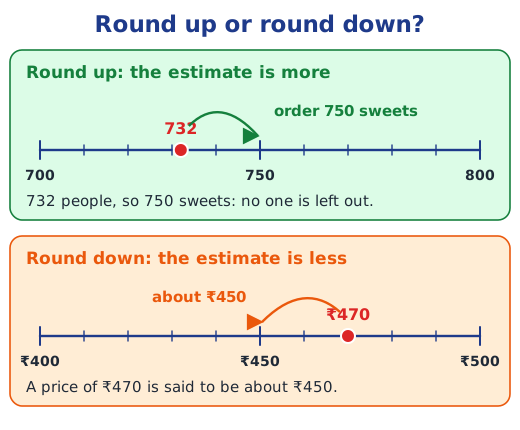
When to round up, round down, either, or be exact.
- (a) Round up: sweets or food for a party, buses or seats for a school trip, tiles or paint for a room, so that nothing runs short.
- (b) Round down: how many full boxes you can pack, how many notebooks your money can buy, a rough price quoted by a shopkeeper (₹470 as about ₹450).
- (c) Either is fine: the distance between two cities, the crowd at a match, a town’s population in a news report.
- (d) Exact: phone numbers, PIN codes, money paid or kept in a bank, medicine doses, exam marks.
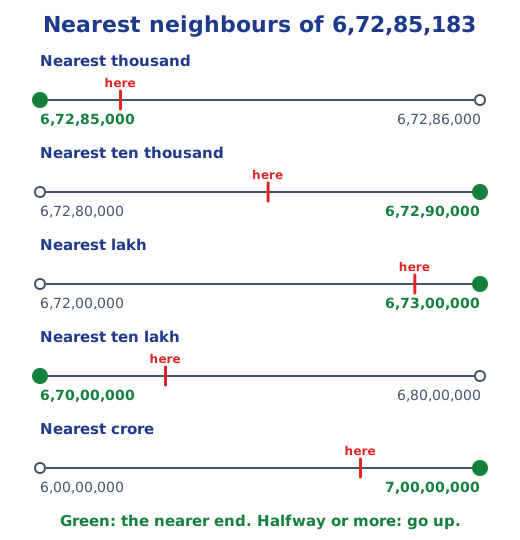
Nearest Neighbours (page 11)
- (a) 3,87,69,957: nearest thousand 3,87,70,000; ten thousand 3,87,70,000; lakh 3,88,00,000; ten lakh 3,90,00,000; crore 4,00,00,000.
- (b) 29,05,32,481: nearest thousand 29,05,32,000; ten thousand 29,05,30,000; lakh 29,05,00,000; ten lakh 29,10,00,000; crore 29,00,00,000.
Math Talk: a number whose five nearest neighbours are all 5,00,00,000. The nearest thousand is the hardest condition: the number must be within 500 of 5,00,00,000, that is, from 4,99,99,500 to 5,00,00,499 (counting exactly halfway as rounding up). Every such number also rounds to 5,00,00,000 at the ten thousand, lakh, ten lakh and crore places. One example is 4,99,99,999. There are 1,000 such numbers: 500 below 5,00,00,000 and 500 from 5,00,00,000 upwards.
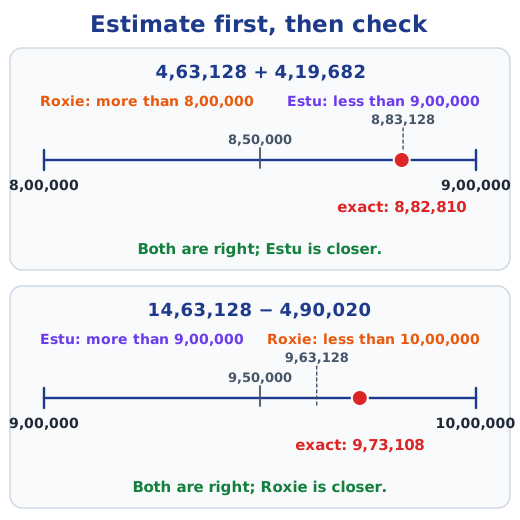
1. 4,63,128 + 4,19,682. (a) Both estimates are correct, but Estu’s is closer. (b) Greater than 8,50,000, because 4,63,128 is more than 4,50,000 and 4,19,682 is more than 4,00,000. (c) Less than 8,83,128, because 8,83,128 = 4,63,128 + 4,20,000 and 4,19,682 is less than 4,20,000. (d) Exact value: 8,82,810.
2. 14,63,128 − 4,90,020. (a) Both estimates are correct, but Roxie’s is closer. (b) Greater than 9,50,000. (c) Greater than 9,63,128, because 9,63,128 = 14,63,128 − 5,00,000 and we take away less than 5,00,000. (d) Exact value: 9,73,108.
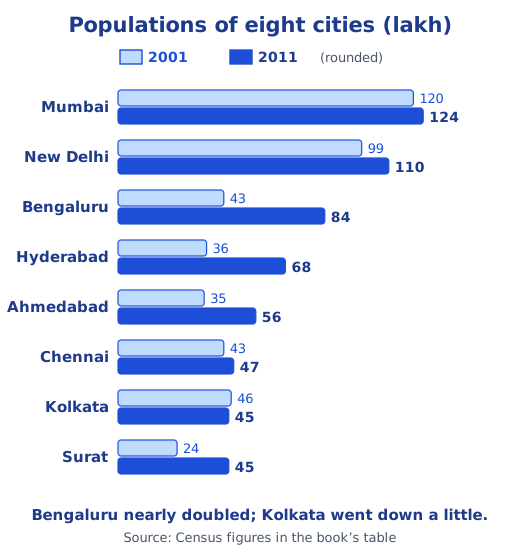
Populations of Cities (pages 12–13)
- Observations. Almost every city grew between 2001 and 2011. Mumbai and New Delhi had more than a crore people each. Bengaluru, Hyderabad and Surat nearly doubled, and Vadodara more than doubled. Kolkata is the only city whose population fell, and in 2001 it was larger than both Chennai and Bengaluru.
- A title. “Populations of 20 large Indian cities in 2011 and 2001”, ranked by the 2011 figures.
- Pune. 31,15,431 in 2011, about 31 lakh. It grew by about 6 lakh (exactly 5,76,958) since 2001.
- Biggest increase. Bengaluru, by about 41 lakh (exactly 41,24,644).
- Almost doubled. Bengaluru (43 to 84 lakh), Hyderabad (36 to 68 lakh) and Surat (24 to 45 lakh); Vadodara went from about 17 to 36 lakh, more than double. (Extra: part of the jump for Bengaluru and Hyderabad came because their city limits were widened in 2007.)
- Patna to Mumbai. Patna had about 17 lakh people and Mumbai about 124 lakh, and 124 ÷ 17 is about 7. Multiply by about 7: 7 × 16,84,222 = 1,17,89,554, which is close (7.4 is closer still).
Patterns in Products (pages 13–15)
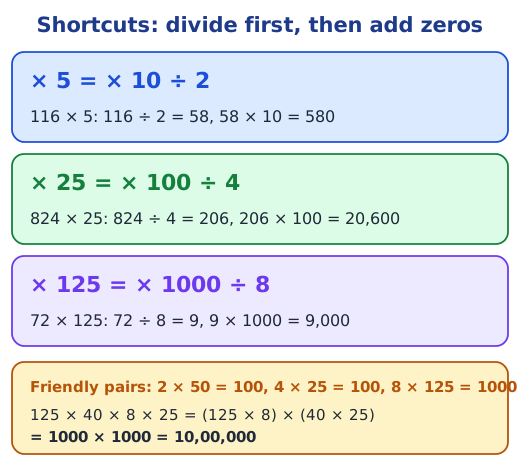
Why is × 5 the same as ÷ 2 and × 10? 5 is half of 10. Five groups of a number make half of ten groups of it, so n × 5 = n × 10 ÷ 2.
Figure it Out (page 14)
- (a) 2 × 1768 × 50 = 1768 × (2 × 50) = 1768 × 100 = 1,76,800. (b) 72 × 125 = 72 × 1000 ÷ 8 = 9 × 1000 = 9,000. (c) 125 × 40 × 8 × 25 = (40 × 25) × (125 × 8) = 1000 × 1000 = 10,00,000.
- (a) 25 × 12 = 100 × 12 ÷ 4 = 300. (b) 25 × 240 = 100 × 60 = 6,000. (c) 250 × 120 = 1000 × 30 = 30,000. (d) 2500 × 12 = 10,000 × 3 = 30,000. (e) 12,00,00,000 = 1200 × 1,00,000; other pairs work too, such as 12,000 × 10,000 or 2500 × 48,000.
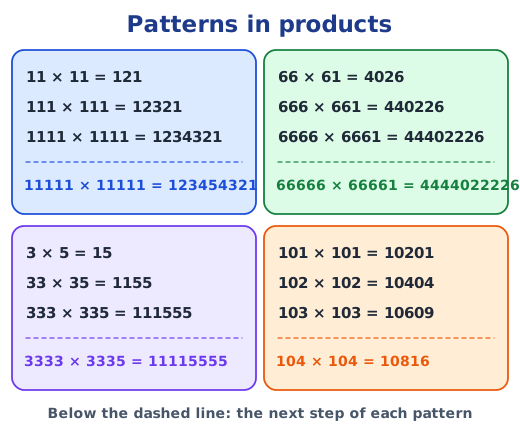
How long is the product?
- 11 × 11 = 121, 111 × 111 = 12321, 1111 × 1111 = 1234321; next, 11111 × 11111 = 123454321.
- 66 × 61 = 4026, 666 × 661 = 440226, 6666 × 6661 = 44402226; next, 66666 × 66661 = 4444022226.
- 3 × 5 = 15, 33 × 35 = 1155, 333 × 335 = 111555; next, 3333 × 3335 = 11115555.
- 101 × 101 = 10201, 102 × 102 = 10404, 103 × 103 = 10609; next, 104 × 104 = 10816.
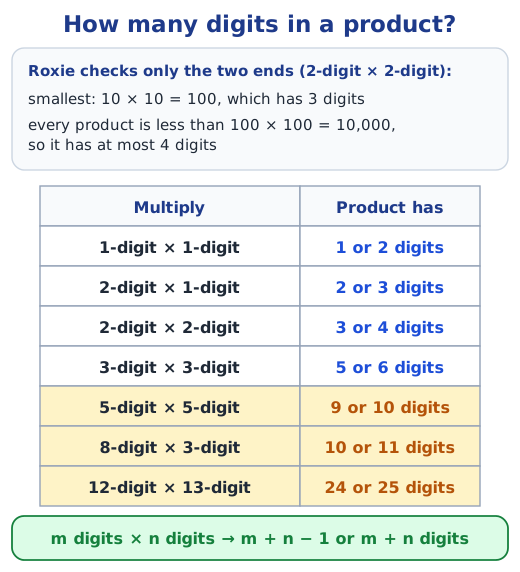
Digits and products. In every line, a product of an m-digit and an n-digit number has m + n − 1 or m + n digits: 2-digit × 2-digit gave 3 or 4 digits, 3-digit × 3-digit gave 5 or 6, and 4-digit × 4-digit gave 7 or 8.
Is Roxie correct? Yes. The smallest product of two 2-digit numbers is 10 × 10 = 100 (3 digits), and every product is less than 100 × 100 = 10,000, so it has at most 4 digits.
Must we try every pair? No. Checking the smallest and largest possible products, as Roxie did, settles it.
3-digit × 3-digit giving a 4-digit number? No. The smallest product is 100 × 100 = 10,000, which already has 5 digits.
4-digit × 2-digit giving a 5-digit number? Yes, for example 1000 × 10 = 10,000 or 1200 × 12 = 14,400.
Complete the table. 5-digit × 5-digit = 9 or 10 digits; 8-digit × 3-digit = 10 or 11 digits; 12-digit × 13-digit = 24 or 25 digits.
Fascinating Facts about Large Numbers (pages 16–18)
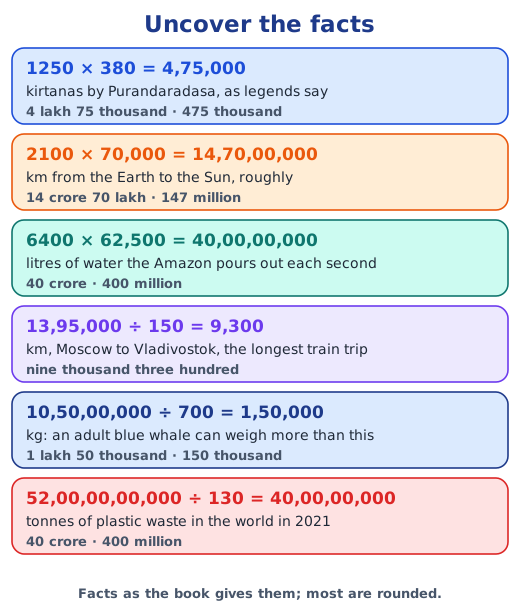
- 1250 × 380 = 4,75,000: four lakh seventy-five thousand, or 475,000, four hundred seventy-five thousand. That is how many kirtanas legends credit to Purandaradasa. (Extra: he is usually dated to about 1484–1564, around 80 years. Composing for about 50 of them would mean 4,75,000 ÷ 50 = 9,500 songs a year, about 26 a day, which is why the number is a legend rather than a count.)
- 2100 × 70,000 = 14,70,00,000 km: fourteen crore seventy lakh, or 147,000,000, one hundred forty-seven million. (Extra: the Earth is about 147 million km from the Sun in early January and about 152 million km in early July. Astronomers first measured it well by timing Venus crossing the Sun’s face from far-apart places, in the 1760s; today radar signals bounced off planets give it very precisely.)
- 6400 × 62,500 = 40,00,00,000 litres a second: forty crore, or 400,000,000, four hundred million, the book’s figure for the Amazon.
- 13,95,000 ÷ 150 = 9,300 km: nine thousand three hundred in both systems, the Moscow to Vladivostok train. It takes about 7 days, or 168 hours, which is about 55 km an hour; the Dibrugarh to Kanyakumari train, 4,219 km in about 76 hours, also averages about 55 km an hour.
- 10,50,00,000 ÷ 700 = 1,50,000 kg: one lakh fifty thousand, or 150,000, one hundred fifty thousand. An adult blue whale can weigh more than this, about 55 times a newborn blue whale of 2,700 kg.
- 52,00,00,00,000 ÷ 130 = 40,00,00,000 tonnes: forty crore, or 400 million, tonnes of plastic waste in 2021. It is the same number as the Amazon’s litres per second.
Did You Ever Wonder…? (pages 18–19)
Mumbai in 5000 Titanics? 5000 × 2500 = 1,25,00,000, which is 1 crore 25 lakh. Mumbai’s 2011 population, 1,24,42,373, is a little less, so yes, just about, with 57,627 places to spare.
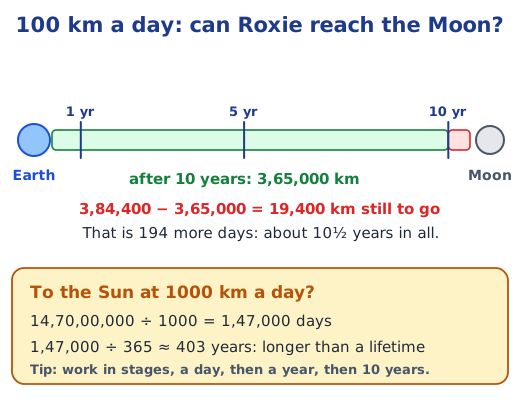
Roxie and the Moon. In a year she travels 365 × 100 = 36,500 km, and in 10 years 3,65,000 km. The Moon is 3,84,400 km away, so she is still 19,400 km short, which takes 194 more days. She would need about 10½ years.
To the Sun at 1000 km a day? 14,70,00,000 ÷ 1000 = 1,47,000 days, and 1,47,000 ÷ 365 is about 403 years. No, not in a lifetime.
- (a) 1,00,000 × 5 g = 5,00,000 g = 500 kg. No one can lift that.
- (b) 250 × 60 × 24 = 3,60,000 babies a day, less than a million (10 lakh). No.
- (c) A day has 60 × 60 × 24 = 86,400 seconds, so even without sleep you could count only 86,400 coins. No: a million coins would take about 11½ days.
Figure it Out (pages 19–21)
- (a) Largest multiple of 5: 9876543210 (the largest arrangement already ends in 0). (b) Smallest even number: 1023456798 (the smallest arrangement, 1023456789, is odd, so swap the last two digits).
- Use the longest name for each part: seventy-three, seventy-seven or seventy-eight (12 letters each) for the two-digit parts, and three, seven or eight for the hundreds digit. For example, 77,77,777, “seventy seven lakh seventy seven thousand seven hundred seventy seven”, has 60 letters, or 61 if you write “lakhs” as the book’s example does. Any number built from 73, 77 or 78 in each two-digit part and 3, 7 or 8 in the hundreds place ties with it.
- 123456789, and it is the only one. If a digit were bigger than a digit to its right, swapping those two would make the number smaller, so the digits must rise from left to right. Two equal digits would swap into the same number, so all nine digits are different, and 0 cannot be used because it would have to come first.
- 5534512345. Choose the digits from the left: the first must come from the first 11 digits, so take the 5 in place 5; the next from places 6 to 12, so take the 5 in place 10; then the 3 in place 13; after that, all of the last seven digits, 4512345, must stay.
- You never find such a pair: every two consecutive numbers share a letter. Check the pairs up to twenty one by one (zero and one share e and o, three and four share r, five and six share i, and so on). After that, neighbours keep the same front part, as twenty-three and twenty-four do, or one of them is a round number and they still share letters: twenty-nine and thirty share t and y, ninety-nine and one hundred share n and e. A computer check up to 20 lakh finds no exception.
- (a) Numbers 1 to 9 use 9 digits and 10 to 99 use 180, 189 in all. 1000 − 189 = 811 = 3 × 270 + 1, so the 270 numbers from 100 to 369 use 810 more digits, and the 1000th digit is the first digit of 370: 3. (b) Up to 99,999 we write 9 + 180 + 2,700 + 36,000 + 4,50,000 = 4,88,889 digits. The remaining 5,11,111 = 6 × 85,185 + 1, so the millionth digit is the first digit of 1,85,185. (c) From 1 to 9,999 the digit 5 is written 4,000 times (1,000 times in each place). From 10,000 to 12,999 it appears 900 more times, and from 13,000 to 13,495 another 100 times (50 in the ones place and 50 in the tens place). So the 5,000th ‘5’ is the last digit of 13,495.
- (a) 20,800: 2 clicks of +10,000 and 8 of +100, 10 clicks in all. (b) 92,100: 9 of +10,000 and 21 of +100, 30 clicks. (c) 1,20,500: 12 of +10,000 and 5 of +100, 17 clicks. (d) 65,30,000: 653 of +10,000 and none of +100, 653 clicks. (e) 70,25,700: 702 of +10,000 and 57 of +100, 759 clicks. These are the fewest; other ways, such as 208 × 100 for 20,800, use more clicks.
- A billion is 100 crore, and a crore is 100 lakh, so a billion is 10,000 lakh.
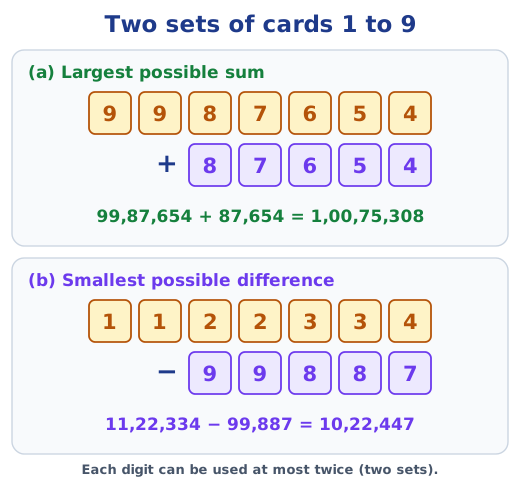
- (a) Put the biggest digits in the biggest places: 99,87,654 + 87,654 = 1,00,75,308. (b) Make the top number as small as possible and the bottom one as large as possible: 11,22,334 − 99,887 = 10,22,447.
- Every target except the last can be made exactly:
- (a) The book’s example reaches 1,13,000, but (13,000 × 20) − 1,50,000 = 1,10,000 exactly.
- (b) (70,000 × 5) − 1,50,000 = 2,00,000.
- (c) (70,000 × 5) + 1,50,000 + (4000 × 20) = 5,80,000.
- (d) (13,000 + 70,000) × 300 ÷ 20 = 83,000 × 15 = 12,45,000.
- (e) (70,000 + 300) × 20 + (1,50,000 − 13,000) × 5 = 14,06,000 + 6,85,000 = 20,91,000, only 200 more. A computer search found one even closer: 70,000 + (1,50,000 − 13,000) ÷ 20 × (300 − 5) = 20,90,750, just 50 less.
- 180 m = 180 × 1000 mm = 1,80,000 mm, so 1,80,000 coins.
- 12,000 ÷ 1000 = 12 days and 12,000 ÷ 900 is about 13⅓ days, so about 12 to 14 days.
- 13,560 ÷ 11 is about 1,233 km a day (roughly 1,200 km), and 1,233 ÷ 24 is about 51 km an hour (roughly 50 km).
- With the 40 m building: bald eagles fly 4,500 ÷ 40 = 112.5 to 6,000 ÷ 40 = 150 times as high; Everest is 8,850 ÷ 40, about 221 times as high; aeroplanes fly 10,000 ÷ 40 = 250 to 12,800 ÷ 40 = 320 times as high.
Puzzle Time: Toothpick Digits (page 23)
The digits need these sticks: 0 needs 6, 1 needs 2, 2, 3 and 5 need 5, 4 needs 4, 6 and 9 need 6, 7 needs 3, and 8 needs 7. So 5108 needs 5 + 2 + 6 + 7 = 20 sticks.
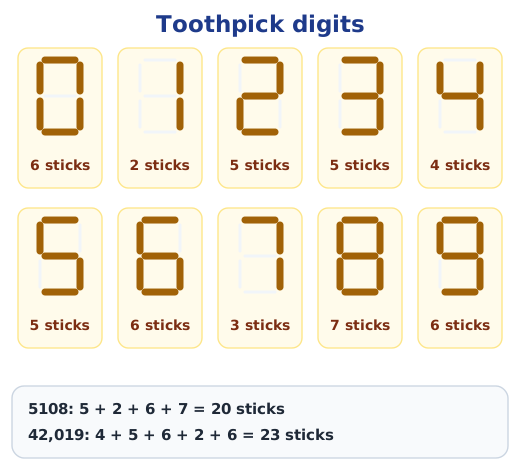
First box. 1. 42,019 needs 4 + 5 + 6 + 2 + 6 = 23 sticks. 2. Adding exactly two sticks to the digits gives, besides 42,078: 42,049 (1 becomes 4), 48,019 (2 becomes 8), 92,019 (4 becomes 9), 42,879 (0 becomes 8 and 1 becomes 7) and 42,818 (0 becomes 8 and 9 becomes 8). 3. Put the new 1 after the 4 and the 2: 4,21,019 is the biggest. 4. The other places give 1,42,019, 4,12,019, 4,20,119 and 4,20,191.
Second box. 1. 63,890 needs 6 + 5 + 7 + 6 + 6 = 30 sticks. 2. Many numbers work; a computer count finds 704 of them bigger than 63,890. For example, 98,894: move one stick inside the 6 to make 9, add two sticks to the 3 to make 8, and turn the 0 into a 4 by taking away three sticks and adding one in the middle. The biggest of all is 99,985.
Third box. 1. For example 2008 (5 + 6 + 6 + 7) or 4,44,444 (six 4s of 4 sticks each). 2. The biggest number uses the most digits, and 1 needs the fewest sticks, so twelve 1s: 1,11,11,11,11,111. 3. The smallest needs the fewest digits: three digits use at most 21 sticks, so it has 4 digits. A first digit 1 would leave 22 sticks for three digits, too many, so it starts with 2, then 0, 0 and 8: 2008.
Practice
-
How many hundreds make one crore?
Show answer
Answer: (c) 1,00,000
-
Which of these is the largest?
Show answer
Answer: (c) 1 crore
-
What is 7,49,999 to the nearest lakh?
Show answer
Answer: (a) 7,00,000
-
Without adding exactly, is 2,48,000 + 3,72,000 more or less than 6 lakh?
Show answer
Answer: More. 2,48,000 is only 2,000 short of 2,50,000, while 3,72,000 is 22,000 more than 3,50,000, so the sum is more than 6,00,000. (It is 6,20,000.)
-
Counting 1 coin every second without a break, about how many days would 1 crore coins take?
Show answer
Answer: A day has 60 × 60 × 24 = 86,400 seconds. 1,00,00,000 ÷ 86,400 is about 116, so it would take about 116 days, nearly 4 months.
Stuck on a question?
Take a photo and Lagnever AI explains it step by step. Try it for 7 days for ₹2.
Get it on Google Play Open in browser
For parents: after the trial, the plan renews monthly by UPI or card autopay. You can cancel anytime in the app.