
Class 7 Maths Chapter 1: Large Numbers Around Us Notes
This chapter in five lines
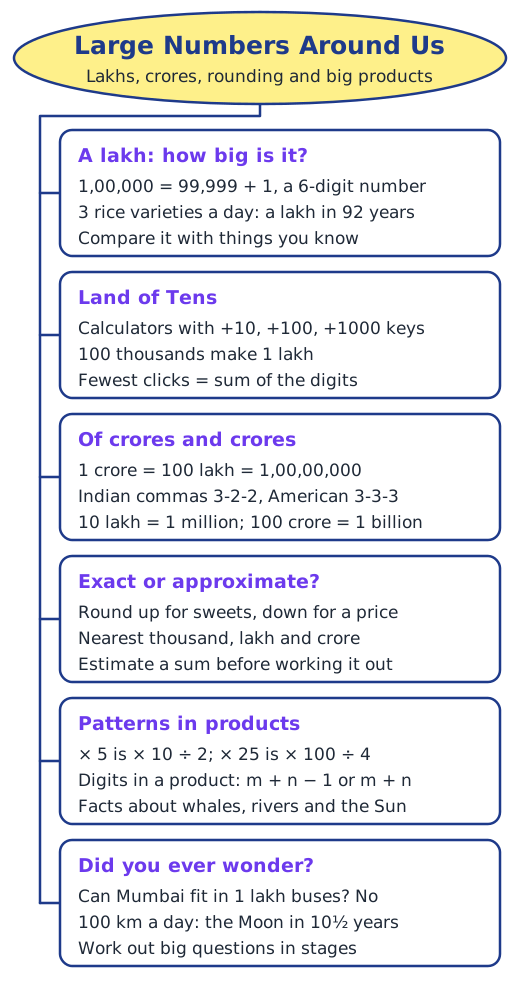
Large Numbers Around Us is about numbers in lakhs and crores: how big they are, how to read and write them, and how to work with them. One lakh is 1,00,000 and one crore is 1,00,00,000. You compare the Indian system (lakh, crore) with the American one (million, billion), round and estimate large numbers, find shortcuts for big products and answer playful questions such as whether all of Mumbai could fit into one lakh buses.
What is this chapter about?
The chapter opens in a market in Chintamani, a town in Karnataka. A farmer hears that India once grew about a lakh varieties of rice, and his son wonders whether anyone could taste them all in a lifetime. Eating one variety a day for 100 years gives only 36,500 days, far short of a lakh. Questions like this run through the whole chapter: how big is a lakh, or a crore, and how do we read, write, round and calculate with such numbers?
How big is one lakh?
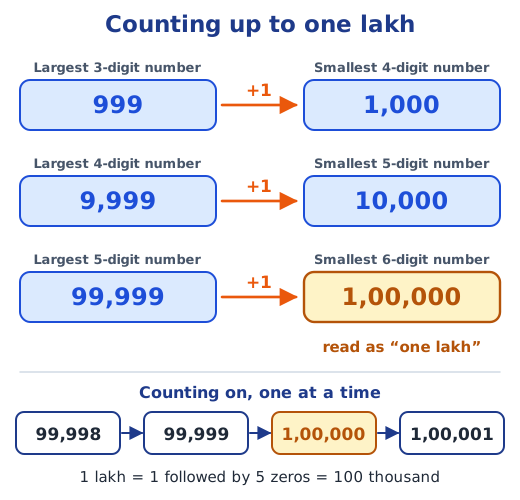
Add 1 to 999 and you get 1,000, the smallest 4-digit number. Add 1 to 99,999 and you get 1,00,000, the smallest 6-digit number, read as one lakh. It has 5 zeros.
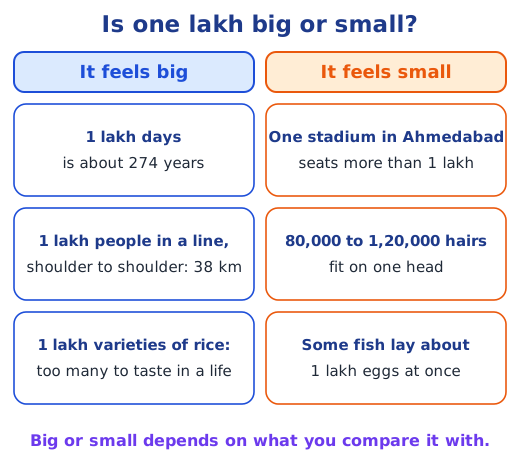
Is a lakh big? It depends on what you compare it with. A lakh days is about 274 years, but one stadium in Ahmedabad seats more than a lakh people. Large measures also make more sense next to something familiar: Somu is 1 m tall, a floor of his building is about 4 m, and the 10-floor building is about 40 m. The Statue of Unity, about 180 m, is roughly four and a half such buildings.
Land of Tens: place value with button clicks
In the Land of Tens, calculators have only some keys. A calculator with only a +1000 key needs 100 presses to show a lakh; one with +100 needs 1,000, and one with +10 needs 10,000. A calculator with all the keys (+1, +10, +100 and so on) can make 5072 in many ways, but the fewest clicks are 5 on +1000, 7 on +10 and 2 on +1: 14 clicks, the sum of the digits. The fewest clicks always follow place value.
Crores, arabs, millions and billions
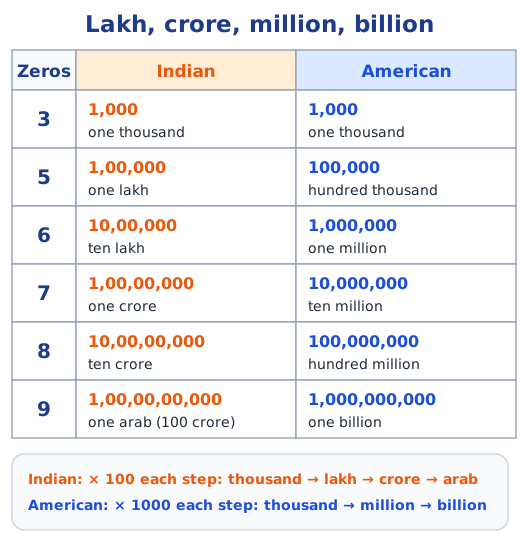
Press +10,00,000 ten times and you get 100 lakh, called a crore: 1,00,00,000, with 7 zeros. A hundred crore make an arab. In the Indian system commas go after three digits from the right and then after every two (3-2-2-2). The American, or International, system uses millions and billions, with a comma after every three digits. So 10 lakh is 1 million, 1 crore is 10 million and 100 crore is 1 billion. The words lakh and crore come from Sanskrit. Read more in lakhs and crores.
Exact and approximate values
Often an exact number is not needed. Chintamani’s 2011 population was 76,068, but “about 75,000” gives the idea. We round up when a bigger figure is safer, as when a school of 732 people orders 750 sweets, and round down when a smaller figure suits, as when a ₹470 item is said to cost about ₹450. Exact numbers are still needed for phone numbers and money in a bank.
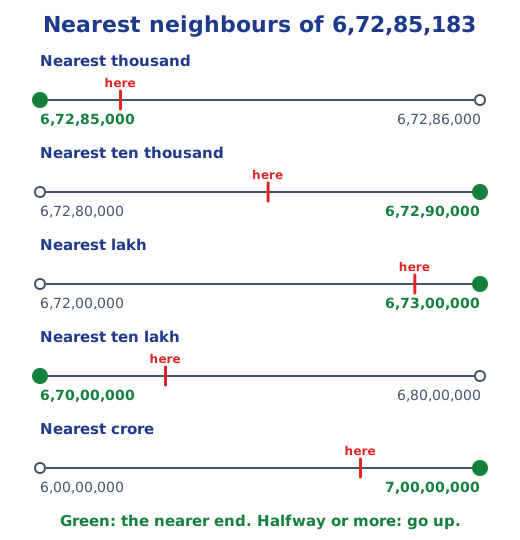
Large numbers also have nearest neighbours: the nearest thousand, ten thousand, lakh, ten lakh and crore. Estimating first helps too: 4,63,128 + 4,19,682 must be between 8,50,000 and 8,83,128. The chapter then asks questions about the populations of 20 cities in 2001 and 2011. See rounding and estimation.
Patterns in products
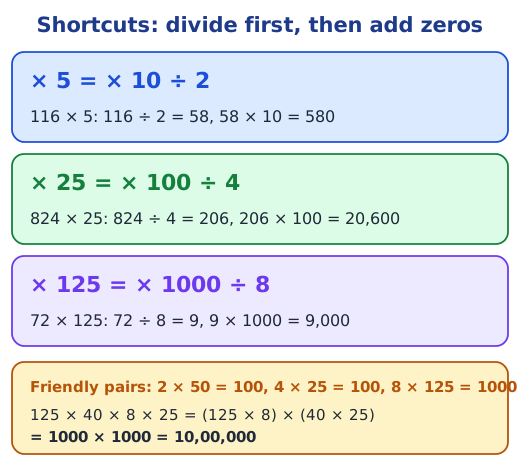
Multiplying by 5 is the same as halving and then multiplying by 10, so 116 × 5 = 58 × 10 = 580. In the same way, × 25 is ÷ 4 and × 100, and × 125 is ÷ 8 and × 1000. Grouping factors into round numbers helps too: 125 × 40 × 8 × 25 = 1000 × 1000. The chapter also asks how many digits a product has; two 2-digit numbers always give 3 or 4 digits. Then a few multiplications and divisions uncover facts, such as the distance to the Sun (about 14,70,00,000 km) and the weight of a blue whale. Read patterns in products.
Did you ever wonder…?
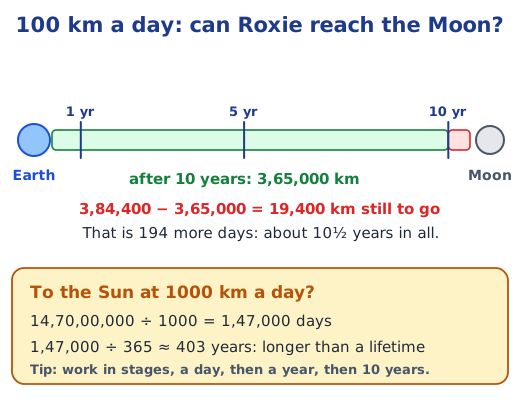
The last section plays with large numbers. Could Mumbai, with more than 1 crore 24 lakh people, fit into 1 lakh buses of 50 seats? No: they hold only 50 lakh. Could you reach the Moon at 100 km a day in 10 years? Work in stages: 36,500 km a year, 3,65,000 km in 10 years, still 19,400 km short.
The chapter closes with a puzzle about digits made of toothpicks. Answers to every question, the Figure it Out exercises and the puzzle are in the NCERT solutions for Chapter 1.
Key terms
| Term | Meaning |
|---|---|
| Lakh | 1,00,000, or one hundred thousand: 1 followed by 5 zeros. It is the smallest 6-digit number, one more than 99,999. |
| Crore | 1,00,00,000: 100 lakh, or 1 followed by 7 zeros. In the American system it is ten million. |
| Arab | 1,00,00,00,000: 100 crore, or 1 followed by 9 zeros. It equals one billion. |
| Million and billion | American (International) names: a million is 1,000,000, which is 10 lakh, and a billion is 1,000,000,000, which is 100 crore. |
| Indian place value system | Commas after the first three digits from the right and then after every two (3-2-2-2), giving thousands, lakhs, crores and arabs: 12,78,830. |
| American (International) system | Commas after every three digits from the right (3-3-3), giving thousands, millions and billions: 1,278,830. |
| Place value | The value a digit gets from its position. In 5072 the 5 stands for 5 thousands and the 7 for 7 tens. |
| Rounding up and rounding down | Replacing a number by a nearby round number that is bigger (rounding up) or smaller (rounding down), as with 750 sweets for 732 people. |
| Nearest neighbour | The closest round number at a chosen place: the nearest lakh of 6,72,85,183 is 6,73,00,000 and its nearest crore is 7,00,00,000. |
| Estimate | A quick approximate answer, used to judge a result before or after working it out exactly. |
| Factorise and regroup | Split numbers into factors and group them to make round numbers: 125 × 40 × 8 × 25 = (40 × 25) × (125 × 8) = 1000 × 1000. |
Topics in this chapter
Practice
-
How many zeros does one crore have when written in figures?
Show answer
Answer: (c) 7
-
How is 24681357 written with Indian commas?
Show answer
Answer: (b) 2,46,81,357
-
10 lakh is the same as:
Show answer
Answer: (a) 1 million
-
What is 6,72,85,183 rounded to the nearest lakh?
Show answer
Answer: (b) 6,73,00,000
-
Which is a quick way to work out 824 × 25?
Show answer
Answer: (b) 824 ÷ 4, then × 100
-
A 3-digit number times a 3-digit number has:
Show answer
Answer: (b) 5 or 6 digits
Questions students ask
What are the main topics of Class 7 Maths Chapter 1?
How big one lakh is and how to get a feel for large numbers; the Land of Tens calculators and place value; crores and arabs, and reading numbers in the Indian and American systems; exact and approximate values, rounding, nearest neighbours and estimation; patterns in products and multiplication shortcuts; and thought experiments with large numbers. It ends with a toothpick-digits puzzle.
Is Large Numbers Around Us in the new Ganita Prakash book?
Yes. It is Chapter 1 of Ganita Prakash, the Class 7 Maths textbook Part 1 (Reprint 2026-27), on pages 1 to 23. It starts from the 5-digit numbers you already know and goes up to crores, arabs and billions.
What is the difference between the Indian and the American system?
Both use the same digits and place values; they group and name the digits differently. The Indian system puts the first comma after three digits from the right and then one after every two digits (thousand, lakh, crore, arab). The American, or International, system puts a comma after every three digits (thousand, million, billion). So ten lakh, 10,00,000, is one million, 1,000,000.
Stuck on a question?
Take a photo and Lagnever AI explains it step by step. Try it for 7 days for ₹2.
Get it on Google Play Open in browser
For parents: after the trial, the plan renews monthly by UPI or card autopay. You can cancel anytime in the app.