
Patterns in products: shortcuts for big multiplications
Answer in short
Multiplying by 5 is the same as halving and then multiplying by 10, since 5 is half of 10. Likewise, × 25 is ÷ 4 then × 100, and × 125 is ÷ 8 then × 1000. An m-digit number times an n-digit number has m + n − 1 or m + n digits.
Stuck on a question? Take a photo and Lagnever AI explains it step by step. Try it for 7 days for ₹2. Get it on Google Play
Halve first, then add a zero
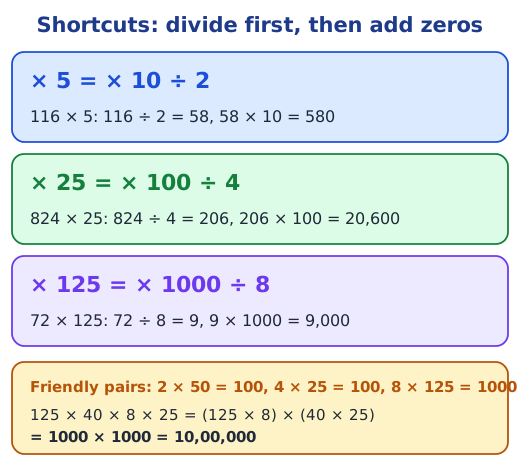
Multiplying by 10 is easy: just write a 0 at the end. Multiplying by 5 is nearly as easy, because 5 is half of 10. Roxie works out 116 × 5 by halving 116 to get 58 and then multiplying by 10: the answer is 580. This works for any number, because five groups of something are exactly half of ten groups of it.
A quarter for 25, an eighth for 125
The same idea works for other numbers. Since 4 × 25 = 100, multiplying by 25 is the same as dividing by 4 and multiplying by 100. Estu works out 824 × 25 as 206 × 100 = 20,600. Since 8 × 125 = 1000, multiplying by 125 is dividing by 8 and multiplying by 1000, so 72 × 125 = 9 × 1000 = 9,000. The shortcut is quickest when the division comes out exact, but it still works when it does not: 30 × 25 = 7.5 × 100 = 750.
Friendly pairs and regrouping
In a long product, look for friendly pairs whose product is 10, 100 or 1000, and multiply them first. The order of factors does not change a product, so 2 × 1768 × 50 = 1768 × (2 × 50) = 1768 × 100 = 1,76,800. And 125 × 40 × 8 × 25 = (40 × 25) × (125 × 8) = 1000 × 1000 = 10,00,000. Splitting a number into factors helps as well: 250 × 120 = (25 × 12) × 100 = 300 × 100 = 30,000.
You can also work backwards. Which two numbers multiply to make 12,00,00,000? One answer is 1200 × 1,00,000; another is 2500 × 48,000, since 25 × 48 = 1200.
How many digits in a product?
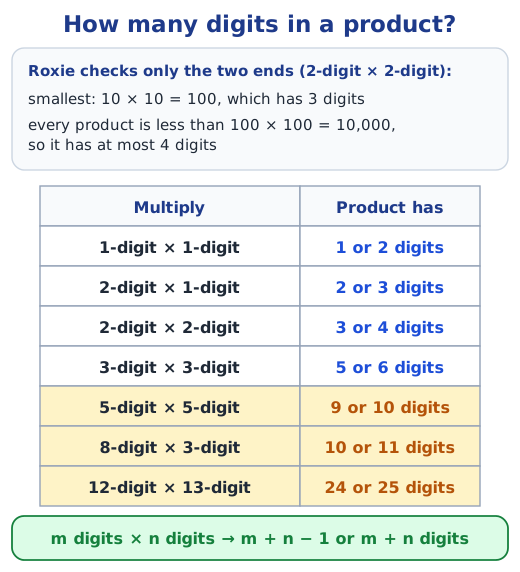
Roxie claims that two 2-digit numbers always multiply to give a 3-digit or 4-digit number. She does not try every pair. The smallest product is 10 × 10 = 100, which has 3 digits. Every 2-digit number is less than 100, so every product is less than 100 × 100 = 10,000, which means at most 4 digits. Checking the two ends settles the question.
The same reasoning gives a rule: an m-digit number times an n-digit number has m + n − 1 or m + n digits. So two 3-digit numbers can never give a 4-digit product (the smallest is 10,000), but a 4-digit number times a 2-digit number can give a 5-digit one, such as 1000 × 10 = 10,000.
Patterns to extend
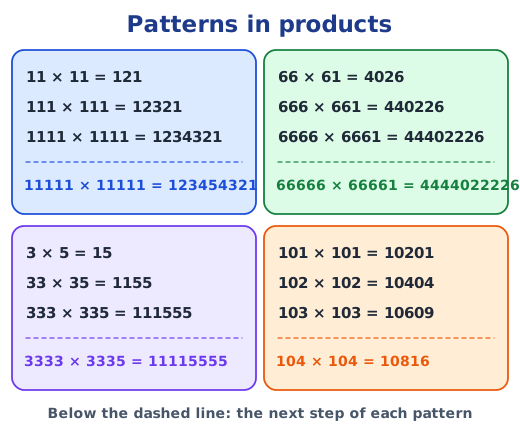
Some products make striking patterns: 11 × 11 = 121, 111 × 111 = 12321 and 1111 × 1111 = 1234321, so 11111 × 11111 = 123454321. Again, 3 × 5 = 15, 33 × 35 = 1155 and 333 × 335 = 111555. Count the digits in each line too: they follow the rule above.
Products that uncover facts
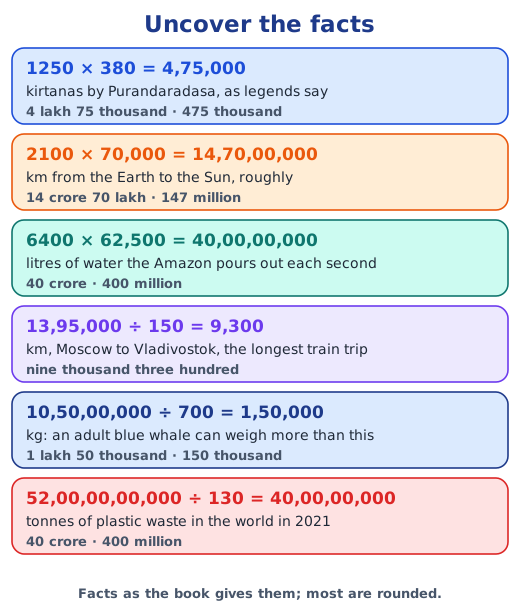
The chapter hides facts behind calculations. 1250 × 380 = 4,75,000, the number of kirtanas that legends credit to Purandaradasa. 2100 × 70,000 = 14,70,00,000, roughly the distance in kilometres from the Earth to the Sun, or 147 million in the American system. And 10,50,00,000 ÷ 700 = 1,50,000: an adult blue whale can weigh more than this many kilograms.
Why it matters
Shortcuts like these let you multiply large numbers in your head and check calculator answers. To read the results, see lakhs and crores; to judge their size quickly, see rounding and estimation. Worked answers to every textbook question are in the NCERT solutions for Chapter 1; see all of the Chapter 1 notes.
Practice
-
What is 48 × 25?
Show answer
Answer: (b) 1,200
-
A 4-digit number times a 2-digit number has:
Show answer
Answer: (b) 5 or 6 digits
-
Which grouping makes 4 × 37 × 25 easy?
Show answer
Answer: (b) (4 × 25) × 37
-
Work out 64 × 125 quickly.
Show answer
Answer: 125 = 1000 ÷ 8, so 64 × 125 = (64 ÷ 8) × 1000 = 8 × 1000 = 8,000.
-
Continue the pattern 9 × 9 = 81, 99 × 99 = 9801, 999 × 999 = 998001 by one more step.
Show answer
Answer: 9999 × 9999 = 99980001. Each step adds one more 9 at the start and one more 0 before the final 1.
Questions students ask
Why does multiplying by 5 give the same answer as halving and then multiplying by 10?
Because 5 is half of 10. Five groups of a number make half as much as ten groups of it, so n × 5 = n × 10 ÷ 2. You may halve first or multiply by 10 first: 116 × 5 = 58 × 10 = 580.
How can you tell how many digits a product will have without multiplying?
Add the numbers of digits of the two factors: the product has that many digits or one fewer. Check the extremes to see why. For two 3-digit numbers, 100 × 100 = 10,000 has 5 digits and 999 × 999 = 9,98,001 has 6, so every such product has 5 or 6 digits.
What are friendly pairs in multiplication?
Pairs whose product is a round number, such as 2 and 50, 4 and 25, or 8 and 125. When a long product contains them, group them first: 125 × 40 × 8 × 25 = (40 × 25) × (125 × 8) = 1000 × 1000 = 10,00,000.
Stuck on a question?
Take a photo and Lagnever AI explains it step by step. Try it for 7 days for ₹2.
Get it on Google Play Open in browser
For parents: after the trial, the plan renews monthly by UPI or card autopay. You can cancel anytime in the app.