
Rounding and estimating large numbers
Answer in short
Rounding replaces a number with a nearby round number when the exact value is not needed. Round up when a bigger figure is safer, like 750 sweets for 732 people; round down when a smaller one suits, like calling ₹470 about ₹450. Estimating with rounded numbers shows roughly how big an answer will be.
Stuck on a question? Take a photo and Lagnever AI explains it step by step. Try it for 7 days for ₹2. Get it on Google Play
Exact or approximate?
The chapter starts this section with a joke: one child claims that without their own visit, the book fair’s headline would have read “99,999 people visited”. Headlines say “1 lakh” because a round number gives the idea; nobody counts the visitors one by one. In the same way, Chintamani’s population in the 2011 census was 76,068, but saying “about 75,000” is enough to show how big the town is.
Some numbers, though, must be exact. In another cartoon, Bappi is asked to phone and check on a train and dials a “rounded off” number, which of course reaches nobody. Phone numbers, bank amounts and PIN codes are labels or exact amounts, not sizes, so they are never rounded.
Rounding up and rounding down
When we round up, the approximate number is bigger than the real one. A school of 732 people might order 750 sweets rather than 700, so that everyone gets one. When we round down, the approximate number is smaller. A shopkeeper may say an item of ₹470 costs about ₹450 rather than about ₹500.
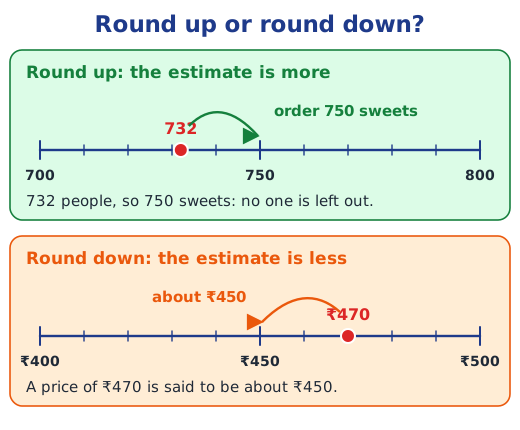
Think about which way is safer. For food, seats or buses, round up. For how many full boxes you can pack, or how much you can spend from a fixed sum, round down. For the distance between two cities or the crowd at a match, either way is fine.
Nearest neighbours
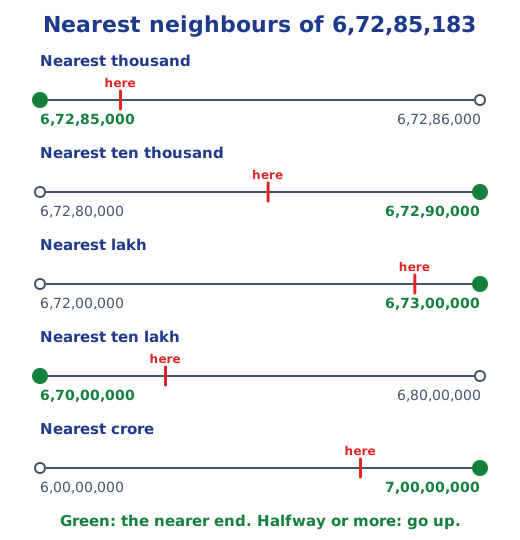
With large numbers we often round to a big place: the nearest thousand, ten thousand, lakh, ten lakh or crore. Each one is a nearest neighbour of the number. To find one, take the two round numbers on either side and see which is closer. A quick test: look at the part after that place. If it is half the place value or more, go up; otherwise stay down.
For 6,72,85,183, the nearest thousand is 6,72,85,000 (because 183 is less than 500), the nearest ten thousand is 6,72,90,000, the nearest lakh is 6,73,00,000, the nearest ten lakh is 6,70,00,000 and the nearest crore is 7,00,00,000.
Estimating sums and differences
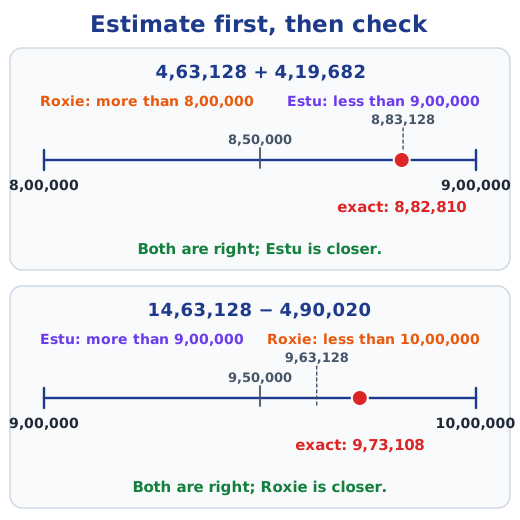
Roxie and Estu estimate 4,63,128 + 4,19,682. Roxie says it is near 8,00,000 and more than it; Estu says it is near 9,00,000 and less than it. Both are right, but which is closer? Since 4,63,128 is more than 4,50,000 and 4,19,682 is more than 4,00,000, the sum is more than 8,50,000. Since 4,19,682 is less than 4,20,000, the sum is less than 4,63,128 + 4,20,000 = 8,83,128. So the sum is in the upper half, and Estu is closer. The exact sum, 8,82,810, agrees.
Reading a table of big numbers
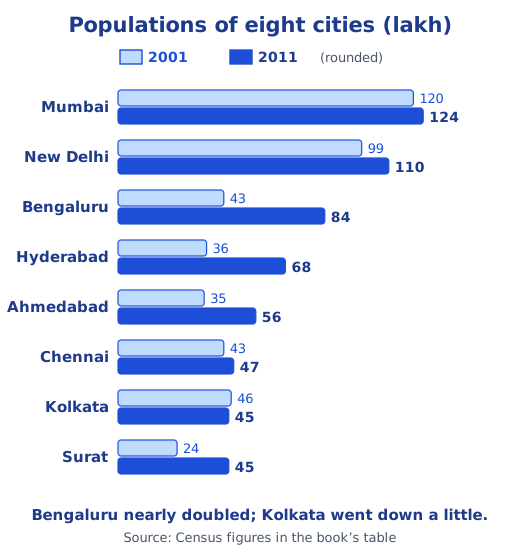
The chapter gives the 2001 and 2011 populations of 20 Indian cities. Rounded to lakhs, the table is easy to read. Pune grew from about 25 lakh to about 31 lakh, an increase of about 6 lakh. Bengaluru grew the most, by about 41 lakh, and nearly doubled, as did Hyderabad and Surat; Vadodara more than doubled. Kolkata is the one city whose population fell a little. Patna had about 17 lakh people and Mumbai about 124 lakh, so Mumbai was roughly 7 Patnas.
A feel for big measures
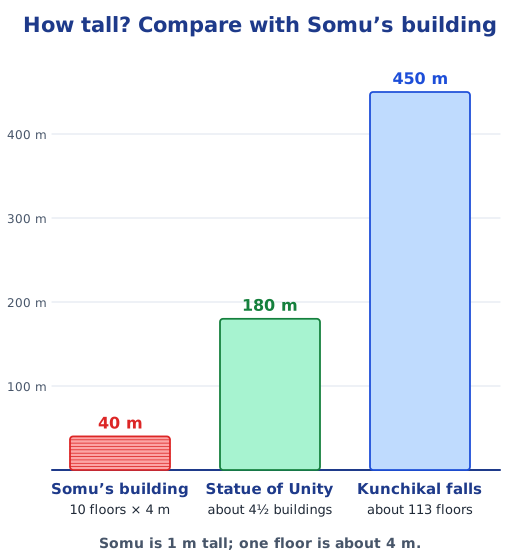
Rounded numbers also help us compare sizes. Somu is 1 m tall and each floor of his building is about 4 m, so his 10-floor building is about 40 m. The Statue of Unity, about 180 m tall, is roughly four and a half such buildings, and the Kunchikal waterfall, about 450 m, would need a building of about 113 floors.
Why it matters
Shopping, travel plans and news reports use rounded numbers all the time, and a good estimate tells you at once when an exact answer has gone wrong. Learn to read and write such numbers in lakhs and crores, and calculate with them in patterns in products. Every textbook question is answered in the NCERT solutions for Chapter 1; see all of the Chapter 1 notes.
Practice
-
What is 4,56,78,912 to the nearest lakh?
Show answer
Answer: (b) 4,57,00,000
-
Which of these needs an exact number?
Show answer
Answer: (c) The amount on a bank deposit slip
-
Without adding exactly, 3,48,500 + 2,61,200 is:
Show answer
Answer: (b) between 6,00,000 and 6,50,000
-
A school has 1,186 students and staff. How many sweets should it order, and is that rounding up or down?
Show answer
Answer: About 1,200 sweets, the nearest hundred above 1,186. That is rounding up, so that no one is left out.
-
Write the five nearest neighbours of 8,04,96,512.
Show answer
Answer: Nearest thousand 8,04,97,000; nearest ten thousand 8,05,00,000; nearest lakh 8,05,00,000; nearest ten lakh 8,00,00,000; nearest crore 8,00,00,000.
Questions students ask
When should you round up and when should you round down?
Round up when falling short would cause trouble, as with food or seats for a group, or buses for a school trip. Round down when a smaller figure is the sensible one, such as the number of full boxes you can pack or a shopkeeper’s rough price. In everyday talk either is fine, as long as the number stays close.
How do you find the nearest lakh of a number?
Find the two lakhs on either side of the number, then look at the part after the lakh place. If it is 50,000 or more, go up to the next lakh; if it is less, stay at the lower one. For 6,72,85,183 that part is 85,183, so the nearest lakh is 6,73,00,000.
Why estimate if you can calculate exactly?
An estimate is quick and catches mistakes. If 4,63,128 + 4,19,682 must lie between 8,50,000 and 8,83,128, an answer such as 7,82,810 is clearly wrong. Estimates are also enough for many questions about crowds, populations and distances.
Stuck on a question?
Take a photo and Lagnever AI explains it step by step. Try it for 7 days for ₹2.
Get it on Google Play Open in browser
For parents: after the trial, the plan renews monthly by UPI or card autopay. You can cancel anytime in the app.