
NCERT Solutions Class 7 Maths Chapter 2: Arithmetic Expressions
Answers to every question in Chapter 2, Arithmetic Expressions, of Ganita Prakash Grade 7 Part 1 (Reprint 2026-27): the questions in the text, every Figure it Out, Math Talk and Try This, and the Expression Engineer puzzles. Page numbers follow the book (pages 24–45). Every value was worked out twice, and the puzzles were also checked by a computer search. Short notes: Chapter 2 notes.
Simple Expressions (pages 24–26)
Choose your favourite number and write expressions with that value. For 36: 30 + 6, 40 − 4, 4 × 9, 72 ÷ 2, 6 × 6 and 18 + 18. Any number works; check each expression by working it out.
Figure it Out (page 25)
- (a) 13 + 4 = 17, so the blank is 11, since 11 + 6 = 17. (b) 6 × 5 = 30, so 22 + 8 = 30. (c) 64 ÷ 2 = 32, so 8 × 4 = 32. (d) 34 − 9 = 25.
- The values are (a) 67 − 19 = 48, (b) 67 − 20 = 47, (c) 35 + 25 = 60, (d) 5 × 11 = 55 and (e) 120 ÷ 3 = 40. In ascending order: 120 ÷ 3 < 67 − 20 < 67 − 19 < 5 × 11 < 35 + 25. (Even without subtracting, 67 − 20 < 67 − 19, because taking away more leaves less.)
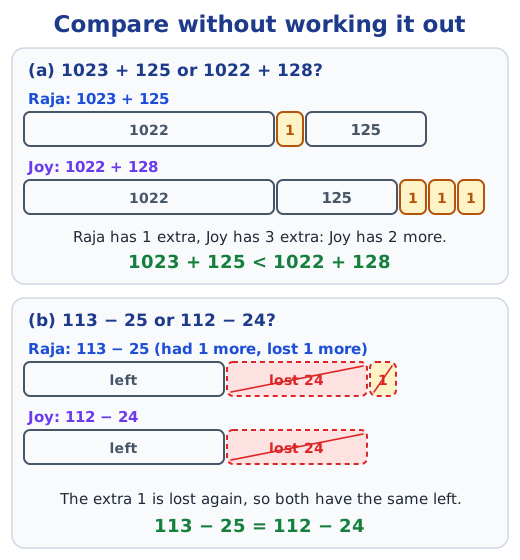
Compare using >, < or = without long calculations (page 26).
- (a) 245 + 289 > 246 + 285. 245 is 1 less than 246, but 289 is 4 more than 285, so the left side is 3 more (534 and 531).
- (b) 273 − 145 = 272 − 144. The left starts 1 higher and also takes away 1 more (both are 128).
- (c) 364 + 587 < 363 + 589. 364 is 1 more, but 587 is 2 less, so the left is 1 less (951 and 952).
- (d) 124 + 245 < 129 + 245. The same 245 is added to a smaller number (369 and 374).
- (e) 213 − 77 < 214 − 76. The left starts 1 lower and takes away 1 more, so it is 2 less (136 and 138).
Reading and Evaluating Complex Expressions (pages 26–29)
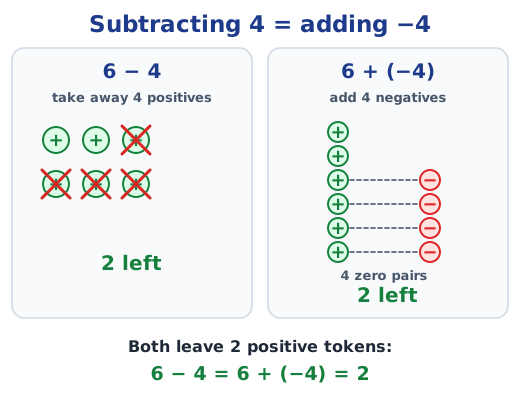
Check that replacing subtraction by adding the inverse keeps the value. 18 − 10 = 8 and 18 + (−10) = 8; 5 − 9 = −4 and 5 + (−9) = −4. It works every time.
Why is subtracting a number the same as adding its inverse? Use the token model. For 6 − 4, take 4 positive tokens away from 6: 2 are left. For 6 + (−4), add 4 negative tokens to the 6 positive ones; each negative token and a positive token form a zero pair, and 2 positive tokens are left. Both give 2.
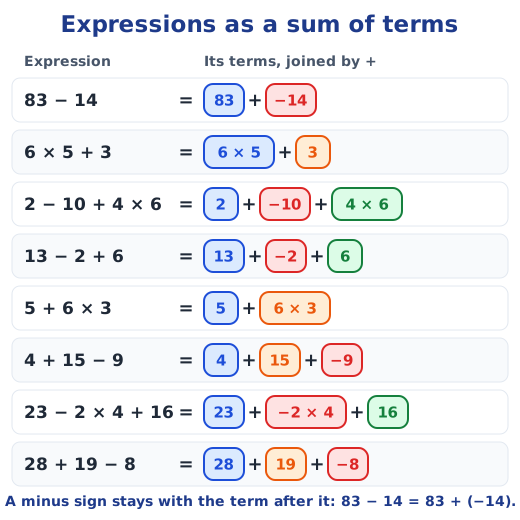
Complete the table (page 29).
- 13 − 2 + 6 = 13 + (−2) + 6. Terms: 13, −2, 6.
- 5 + 6 × 3. Terms: 5, 6 × 3.
- 4 + 15 − 9 = 4 + 15 + (−9). Terms: 4, 15, −9.
- 23 − 2 × 4 + 16 = 23 + (−2 × 4) + 16. Terms: 23, −2 × 4, 16.
- 28 + 19 − 8 = 28 + 19 + (−8). Terms: 28, 19, −8.
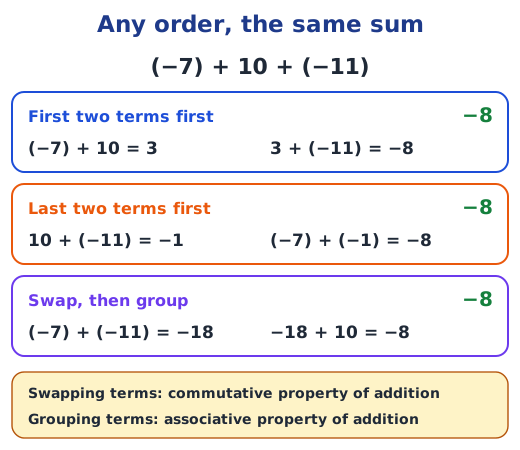
Does changing the order in which the terms are added give different values? No. For example, 9 + (−3) + 5 = 11 and 5 + 9 + (−3) = 11.
Swapping and Grouping (pages 29–32)
Does swapping two terms keep the sum when some terms are negative? Yes: (−3) + (−5) = −8 = (−5) + (−3), and 9 + (−4) = 5 = (−4) + 9.
Explain swapping with the token model. Adding puts all the tokens into one pile. The pile is the same whichever group of tokens goes in first, and the same zero pairs cancel, so the sum does not depend on the order.
Does grouping keep the sum with negative terms? Yes: ((−3) + 8) + (−6) = 5 + (−6) = −1, and (−3) + (8 + (−6)) = (−3) + 2 = −1.
Explain grouping with the token model. Whether piles 1 and 2 or piles 2 and 3 are joined first, in the end all three piles are together, and the same zero pairs cancel.
(−7) + 10 + (−11): add −7 and −11 first. (−7) + (−11) = −18 and −18 + 10 = −8, the same as the other two orders.
Does adding the terms in any order give the same value, also with more than 3 terms? Yes. For 12 + (−5) + 7 + (−9): in order, 7 + 7 = 14 and 14 + (−9) = 5; positive terms first, 19 + (−14) = 5; in pairs, (12 + (−9)) + ((−5) + 7) = 3 + 2 = 5.
Manasa forgot to add 9055. Must she start again? No. Since terms can be added in any order and grouped in any way, she adds the missing number to her total: 11749 + 9055 = 20804. (Check: 1342 + 774 + 8611 + 1022 = 11749.)
More Expressions and Their Terms (pages 32–34)
Example 7: seven friends, the same ₹5 tip. 7 × 23 + 5 = 161 + 5 = ₹166. The terms are 7 × 23 and 5.
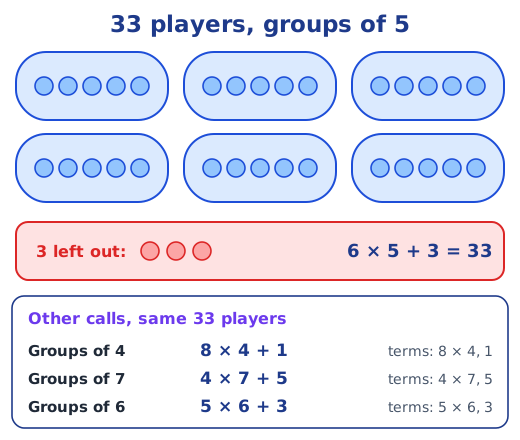
Example 8: why did Ruby write 6 × 5 + 3? The 33 players formed 6 groups of 5, which is 30 players, and 3 were left out: 6 × 5 + 3 = 33.
- If the teacher calls 4: 8 × 4 + 1, with the terms 8 × 4 and 1.
- If the teacher calls 7: 4 × 7 + 5, with the terms 4 × 7 and 5.
- For your class, use your own numbers. With 40 players and a call of 6, for example: 6 × 6 + 4.
Example 10: identify the terms. In 4 × 100 + 1 × 20 + 1 × 10 + 2 × 1 the terms are 4 × 100, 1 × 20, 1 × 10 and 2 × 1. In 8 × 50 + 1 × 10 + 4 × 5 + 2 × 1 they are 8 × 50, 1 × 10, 4 × 5 and 2 × 1.
More ways of giving ₹432. 2 × 100 + 4 × 50 + 1 × 20 + 1 × 10 + 2 × 1; 4 × 100 + 6 × 5 + 2 × 1; 21 × 20 + 2 × 5 + 2 × 1. Each adds up to 432.
Example 11: the expression for the arrangement on the right. Each column has 5 yellow and 3 blue squares, and there are 2 columns: 2 × (5 + 3) = 16. It can also be written 5 + 3 + 5 + 3 or 5 × 2 + 3 × 2.
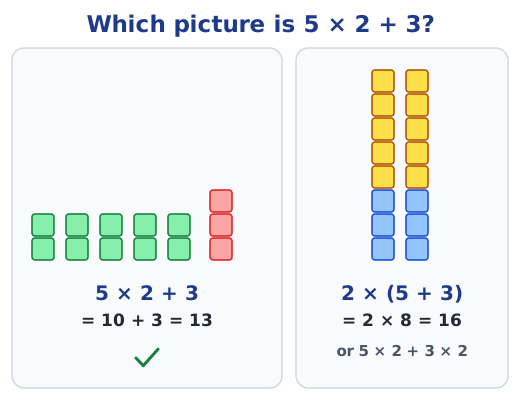
Figure it Out (pages 34–35)
- (a) 28 − 7 + 8 = 28 + (−7) + 8. Terms 28, −7, 8; value 29.
(b) 39 − 2 × 6 + 11. Terms 39, −2 × 6, 11; 39 − 12 + 11 = 38.
(c) 40 − 10 + 10 + 10. Terms 40, −10, 10, 10; value 50.
(d) 48 − 10 × 2 + 16 ÷ 2. Terms 48, −10 × 2, 16 ÷ 2; 48 − 20 + 8 = 36.
(e) 6 × 3 − 4 × 8 × 5. Terms 6 × 3 and −4 × 8 × 5; 18 − 160 = −142. - Sample stories; yours can be different.
(a) 89 + 21 − 10 = 100. A bus has 89 passengers; 21 get on at a stop and 10 get off. 100 passengers are now on the bus.
(b) 5 × 12 − 6 = 54. A shop gets 5 trays of 12 eggs and 6 eggs break. 54 eggs are left.
(c) 4 × 9 + 2 × 6 = 48. A teacher buys 4 packets of 9 pencils and 2 packets of 6 pencils: 36 + 12 = 48 pencils. - (a) Elsa now has 2 × 100 coins and Anna has 100 ÷ 2. Expression 2 × 100 + 100 ÷ 2; terms 2 × 100 and 100 ÷ 2; value 200 + 50 = 250 gold coins.
(b) (i) 4 × 40 + 3 × 20; terms 4 × 40 and 3 × 20; 160 + 60 = ₹220. (ii) 2 × (3 × 40), a single term; 2 × 120 = ₹240. It can also be written 3 × 40 + 3 × 40.
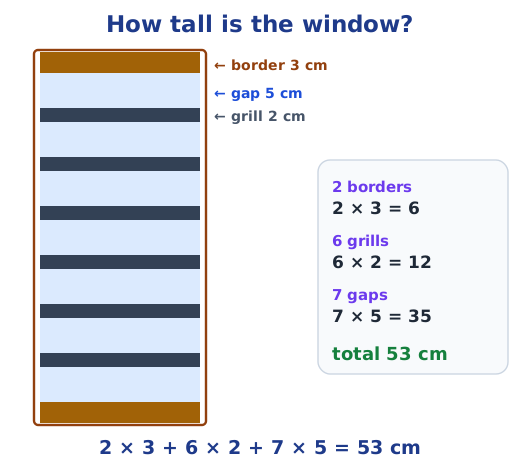
(c) The window has 2 borders of 3 cm, 6 grills of 2 cm and 7 gaps of 5 cm. Expression 2 × 3 + 6 × 2 + 7 × 5; terms 2 × 3, 6 × 2 and 7 × 5; 6 + 12 + 35 = 53 cm.
Removing Brackets I (pages 35–36)
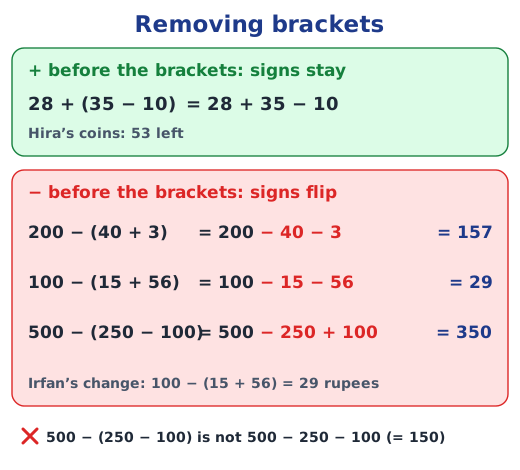
Check that 500 − (250 − 100) is not equal to 500 − 250 − 100. 500 − (250 − 100) = 500 − 150 = 350, but 500 − 250 − 100 = 150. The second is 200 less, because 100 was subtracted instead of being added back.
Tinker the Terms I (pages 36–37)
- First column: 54 + (−16) = 38, because 54 is 1 more than 53. 53 + (−15) = 38, because −15 is 1 more than −16.
- Second column: 52 + (−16) = 36, because 52 is 1 less than 53. 53 + (−17) = 36, because −17 is 1 less than −16.
- Third column: −87 + (−16) = −103. −88 + (−15) = −103: one term is 1 less and the other 1 more. −86 + (−18) = −104: 1 more and 2 less make 1 less. −97 + (−26) = −123: 10 less and 10 less make 20 less.
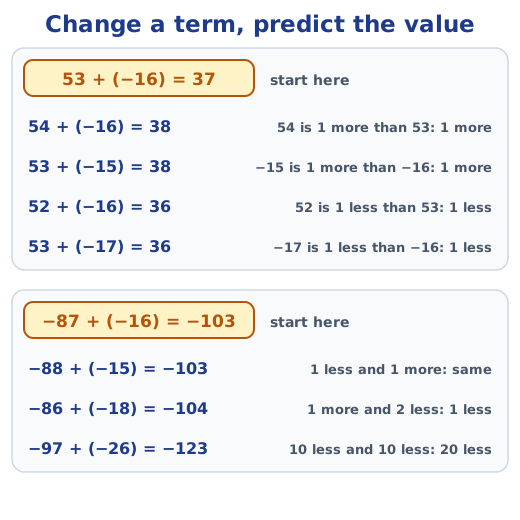
Figure it Out (pages 37–38)
- (a) 24 + (6 − 4) = 24 + 6 − 4.
(b) 38 + (9 − 4) = 38 + 9 − 4.
(c) 24 − (6 + 4) = 24 − 6 − 4.
(d) 24 − 6 − 4 = 24 − 6 − 4.
(e) 27 − (8 + 3) = 27 − 8 − 3.
(f) 27 − (8 − 3) = 27 − 8 + 3. - (a) 14 + (12 + 10) = 14 + 12 + 10 = 36.
(b) 14 − (12 + 10) = 14 − 12 − 10 = −8.
(c) 14 + (12 − 10) = 14 + 12 − 10 = 16.
(d) 14 − (12 − 10) = 14 − 12 + 10 = 12.
(e) −14 + (12 − 10) = −14 + 12 − 10 = −12.
(f) 14 − (−12 − 10) = 14 + 12 + 10 = 36. Notice that (a) and (f) have the same value. - (a) (6 + 10) − 2 = 14 and 6 + (10 − 2) = 14: equal.
(b) 16 − (8 − 3) = 16 − 8 + 3 = 11, but (16 − 8) − 3 = 5: not equal.
(c) 27 − (18 + 4) = 27 − 18 − 4 = 5 and 27 + (−18 − 4) = 27 − 18 − 4 = 5: equal.
Two expressions are equal when, after the brackets are removed correctly, they have the same terms. - (a) 319 − 537 and −537 + 319 are equal, because both are made of the terms 319 and −537. 319 + 537 has the terms 319 and 537, and 537 − 319 has 537 and −319, so neither matches.
(b) As printed, the first three expressions are the same, 87 + 46 − 109, so they are equal. 87 − 46 + 109 and (87 − 46) + 109 are equal, because both are made of the terms 87, −46 and 109. 87 − (46 + 109) = 87 − 46 − 109 has −109 instead of 109, so it is different. - (a) 34 − (9 + 12) = 34 − 21 = 13.
(b) (56 − 14) − 8 = 42 − 8 = 34. This is also what the expression means without brackets; 56 − (14 − 8) would give 50.
(c) −22 − (12 + 10) + 22 = −22 − 22 + 22 = −22. - (a) 419 is 4 less than 423, so the blank on the right must be 4 more than the blank on the left: for example, 423 + 1 = 419 + 5, or 423 + 419 = 419 + 423.
(b) 210 is 3 more than 207, so 3 more must be taken away: 207 − 68 = 210 − 71. - Using 2, 3 and 5 once each, with + and − and brackets, there are six values: 2 + 3 + 5 = 10, 3 + 5 − 2 = 6, 2 + 5 − 3 = 4, 2 + 3 − 5 = 0, 3 − (2 + 5) = −4 and 2 − (3 + 5) = −6. All of them are even, because 2 + 3 + 5 = 10 is even and changing a + to a − lowers the total by twice that number. If a minus sign is also allowed before the first number, −(2 + 3 + 5) = −10 is one more.
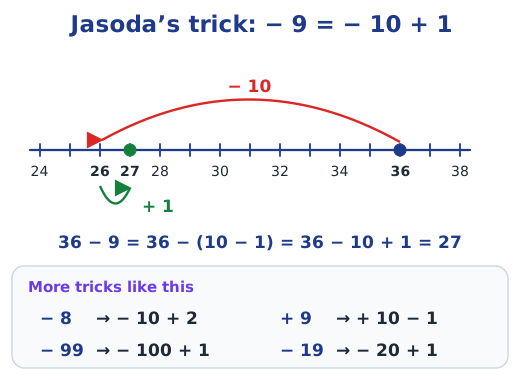
- (a) Yes, she always gets the right answer. Subtracting 9 is subtracting 10 − 1, so 36 − 9 = 36 − (10 − 1) = 36 − 10 + 1 = 27.
(b) Yes. For − 8, take away 10 and put back 2: 55 − 8 = 45 + 2 = 47. For + 9, add 10 and take away 1: 47 + 9 = 57 − 1 = 56. For − 99, take away 100 and put back 1: 350 − 99 = 250 + 1 = 251.
- 73 − 14 + 1 equals (b) 73 − (14 − 1) and (c) 73 + (−14 + 1); all three are 60. 73 − 14 − 1 equals (a) 73 − (14 + 1) and (d) 73 + (−14 − 1); all three are 58.
Removing Brackets II (pages 38–40)
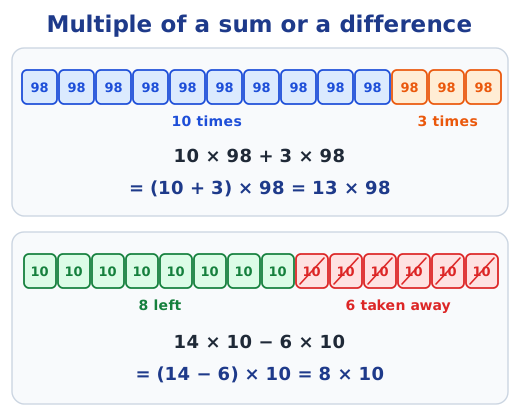
Sangmu joins and orders the same items. What is the expression for the total? 3 × (43 + 24) = 3 × 67 = ₹201, the same as 3 × 43 + 3 × 24 = 129 + 72.
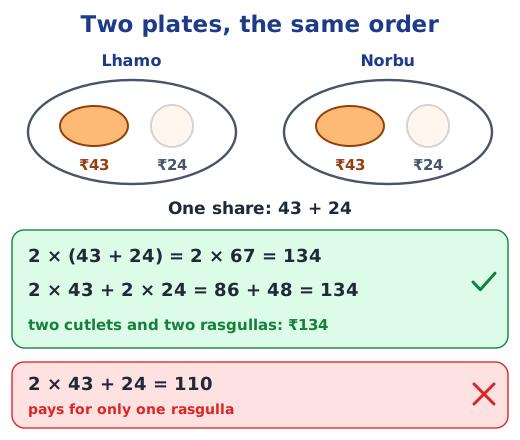
Why is 5 × 4 + 3 ≠ 5 × (4 + 3)? 5 × 4 + 3 = 20 + 3 = 23, but 5 × (4 + 3) = 5 × 7 = 35. In the first only the 4 is multiplied by 5; in the second both 4 and 3 are.
Is 5 × (4 + 3) = 5 × (3 + 4) = (3 + 4) × 5? Yes, all three are 35. Swapping the numbers inside the brackets does not change the sum, and swapping the two numbers of a product does not change the product.
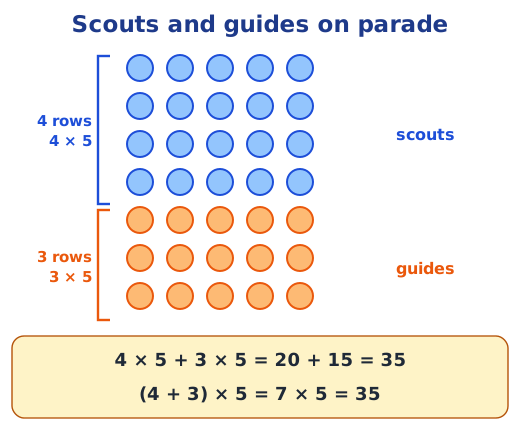
On page 40 the book prints “98 × 10 + 9 × 83 = 98 (10 + 3)”; it should read 98 × 10 + 98 × 3 = 98 × (10 + 3), as the next line shows.
Tinker the Terms II (pages 40–41)
Example 18: find the value. 97 × 25 = 100 × 25 − 3 × 25 = 2500 − 75 = 2425.
Use this method. (a) 95 × 8 = (100 − 5) × 8 = 800 − 40 = 760. (b) 104 × 15 = (100 + 4) × 15 = 1500 + 60 = 1560. (c) 49 × 50 = (50 − 1) × 50 = 2500 − 50 = 2450.
Is this quicker than the usual method? Usually yes, because each step is a round number product and a small one, which can be done mentally.
Which other products might be quick like this? Products where one number is near a multiple of 10, 50, 100 or 1000: 98 × 7 = 700 − 14 = 686; 103 × 9 = 900 + 27 = 927; 51 × 12 = 600 + 12 = 612; 999 × 6 = 6000 − 6 = 5994.
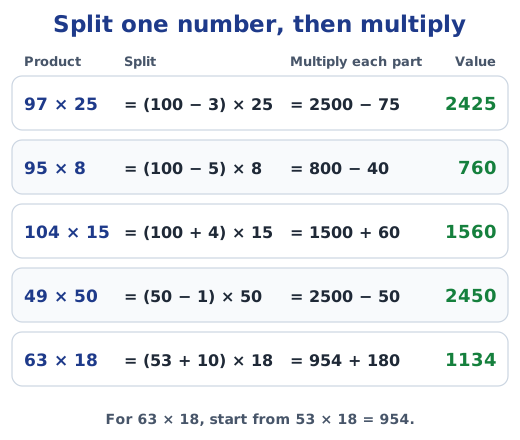
Figure it Out (pages 41–42)
- Parts (a) and (b) are complete examples.
(c) 3 × (5 + 8) = 3 × 5 + 3 × 8.
(d) (9 + 2) × 4 = 9 × 4 + 2 × 4.
(e) 3 × (10 + 4) = 3 × 10 + 3 × 4. Any number can replace 10 if it is used in both places.
(f) (13 + 6) × 4 = 13 × 4 + 6 × 4.
(g) 3 × (5 + 2) = 3 × 5 + 3 × 2.
(h) (2 + 3) × 4 = 2 × 4 + 3 × 4.
(i) 5 × (9 − 2) = 5 × 9 − 5 × 2.
(j) (5 − 2) × 7 = 5 × 7 − 2 × 7.
(k) 5 × (8 − 3) = 5 × 8 − 5 × 3.
(l) (8 − 3) × 7 = 8 × 7 − 3 × 7.
(m) 5 × (12 − 3) = 5 × 12 − 5 × 3. Any number can replace 3 if it is used in both places.
(n) (15 − 6) × 7 = 15 × 7 − 6 × 7.
(o) 5 × (9 − 4) = 5 × 9 − 5 × 4.
(p) (17 − 9) × 7 = 17 × 7 − 9 × 7. - (a) (8 − 3) × 29 > (3 − 8) × 29. 8 − 3 is 5 and 3 − 8 is −5, so the left side is positive and the right side negative.
(b) 15 + 9 × 18 < (15 + 9) × 18. The right side is 15 × 18 + 9 × 18, and 15 × 18 is much more than 15.
(c) 23 × (17 − 9) < 23 × 17 + 23 × 9. The left side is 23 × 17 − 23 × 9: it subtracts what the right side adds.
(d) (34 − 28) × 42 = 34 × 42 − 28 × 42, by the distributive property. - Some other ways: 2 × (3 + 4), 2 × (2 + 5), 7 × (1 + 1) and 1 × (9 + 5). There are many more, such as 1 × (6 + 8).
- Picture I has five 4s and four 8s. Way 1: 5 × 4 + 4 × 8 = 20 + 32 = 52. Way 2: pair each 8 with a 4: 4 × (4 + 8) + 4 = 48 + 4 = 52. Way 3: add the rows: 16 + 20 + 16 = 52.
Picture II has eight 5s and eight 6s. Way 1: 8 × 5 + 8 × 6 = 40 + 48 = 88. Way 2: 8 × (5 + 6) = 8 × 11 = 88. Way 3: every row is 5 + 6 + 6 + 5 = 22, so 4 × 22 = 88.
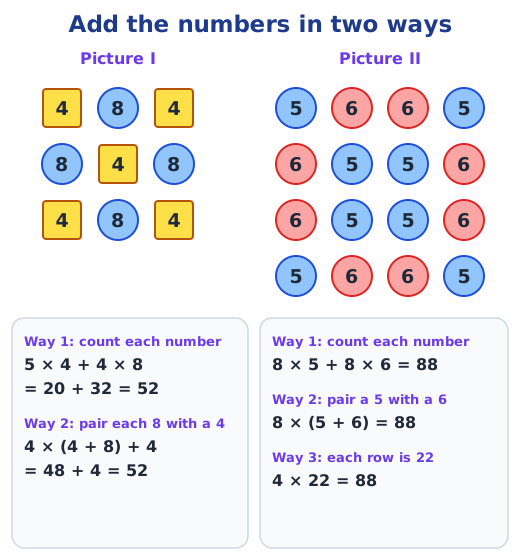
Figure it Out (pages 42–44)
- (a) Together they supply 9 + 11 kg a day, so in a week 7 × (9 + 11) = 7 × 20 = 140 kg. (Also 7 × 9 + 7 × 11 = 63 + 77.)
(b) 12 × 20,000 − 12 × (5,000 + 5,000 + 2,000) = 2,40,000 − 1,44,000 = ₹96,000. She saves ₹8,000 a month.
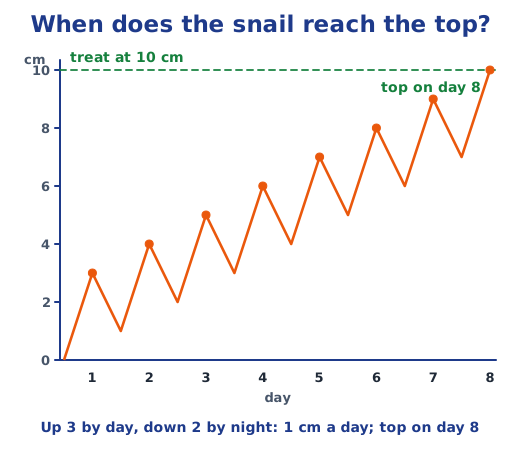
(c) In each day and night the snail gains 3 − 2 = 1 cm, so after 7 days and nights it is 7 cm up. On the 8th day it climbs 3 cm and reaches 10 cm before night: 7 × (3 − 2) + 3 = 10. It gets the treat on day 8, not day 10, because it does not slip back once it is at the top.
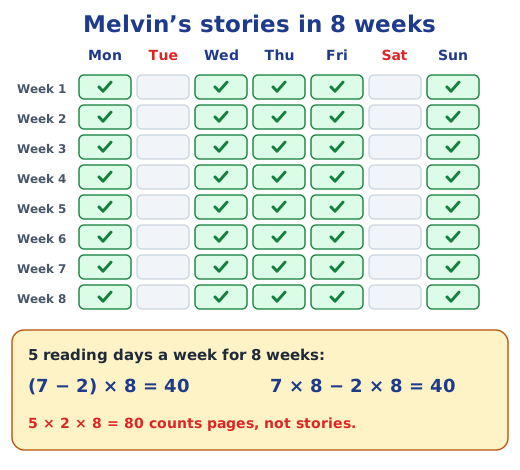
- He reads on 7 − 2 = 5 days a week, so in 8 weeks he reads 40 stories. The expressions that describe this are (b) (7 − 2) × 8 and (g) 7 × 8 − 2 × 8. (a) 5 × 2 × 8 = 80 counts pages, not stories.
- (a) Way 1, pair neighbours: (1 − 2) + (3 − 4) + (5 − 6) + (7 − 8) + (9 − 10) = 5 × (−1) = −5. Way 2, odd and even numbers apart: (1 + 3 + 5 + 7 + 9) + (−2 − 4 − 6 − 8 − 10) = 25 + (−30) = −5. Way 3: 1 + (−2 + 3) + (−4 + 5) + (−6 + 7) + (−8 + 9) − 10 = 1 + 4 − 10 = −5.
(b) Way 1: (1 − 1) + (1 − 1) + (1 − 1) + (1 − 1) + (1 − 1) = 0. Way 2: five 1s and five −1s, 5 + (−5) = 0. Way 3: 1 + (−1 + 1) + (−1 + 1) + (−1 + 1) + (−1 + 1) − 1 = 1 + 0 − 1 = 0. - (a) 49 − 7 + 8 = 49 − 7 + 8: the two sides are the same expression.
(b) 83 × 42 − 18 > 83 × 40 − 18: 83 × 42 is 2 × 83 more than 83 × 40.
(c) 145 − 17 × 8 < 145 − 17 × 6: the left side takes away more.
(d) 23 × 48 − 35 > 23 × (48 − 35): the right side is 23 × 48 − 23 × 35, which takes away 23 times as much.
(e) (16 − 11) × 12 = −11 × 12 + 16 × 12: the right side is 16 × 12 − 11 × 12 with its terms swapped.
(f) (76 − 53) × 88 > 88 × (53 − 76): the left side is positive and the right side negative.
(g) 25 × (42 + 16) = 25 × (43 + 15): both brackets are 58.
(h) 36 × (28 − 16) > 35 × (27 − 15): both brackets are 12, and 36 × 12 is more than 35 × 12. - (a) 83 − 37 − 12 equals (i) 84 − 38 − 12, where one term is 1 more and another 1 less, and (iv) −37 + 83 − 12, which has the same terms. (ii) 84 − (37 + 12) is 1 more, and (iii) 83 − 38 − 13 is 2 less.
(b) 93 + 37 × 44 + 76 has the terms 93, 37 × 44 and 76. Only (iv) 37 × 44 + 93 + 76 has the same terms. (i) and (ii) multiply different numbers, and (iii) multiplies two sums. - For 36: 30 + 6, 40 − 4, 4 × 9, 72 ÷ 2, 6 × 6, 18 + 18, 3 × 10 + 6, 50 − 2 × 7, (2 + 4) × 6 and 100 − 64. Choose any number and check each of your expressions.
Expression Engineer (page 45)
Four 4s for every value from 1 to 20. With +, −, ×, ÷ and brackets: 1 = (4 + 4) ÷ (4 + 4); 2 = 4 ÷ 4 + 4 ÷ 4; 3 = (4 + 4 + 4) ÷ 4; 4 = 4 + (4 − 4) × 4; 5 = (4 × 4 + 4) ÷ 4; 6 = 4 + (4 + 4) ÷ 4; 7 = 4 + 4 − 4 ÷ 4; 8 = 4 + 4 + 4 − 4; 9 = 4 + 4 + 4 ÷ 4; 12 = (4 − 4 ÷ 4) × 4; 15 = 4 × 4 − 4 ÷ 4; 16 = 4 + 4 + 4 + 4; 17 = 4 × 4 + 4 ÷ 4; 20 = (4 + 4 ÷ 4) × 4. A computer search shows that these operations cannot make 10, 11, 13, 14, 18 or 19 from exactly four 4s. If you may write 44, then 10 = (44 − 4) ÷ 4. The rest need tools beyond this chapter, such as decimals or square roots, so ask your teacher which tools are allowed.
1, 2, 3, 4 and 5 once each, values from −10 to +10. A computer search shows that every whole number from −10 to 10 can be made. Some examples: 1 + 2 + 3 + 4 − 5 = 5; 5 + 4 + 3 − 2 − 1 = 9; 4 + 5 + 3 − 2 × 1 = 10; 5 − 4 + 3 − 2 − 1 = 1; 1 − 2 × 5 − 4 + 3 = −10; (5 − 4 − 1) × 2 × 3 = 0. With only + and − the value is always odd, because 1 + 2 + 3 + 4 + 5 = 15 is odd, so even values need × or ÷.
The digits 0 to 9 once each, value 100. 0 + 1 + 2 + 3 + 4 + 5 + 6 + 7 + 8 × 9 = 28 + 72 = 100.
What other similar questions can you ask? For example: make 100 with the digits 1 to 9 in order (1 + 2 + 3 − 4 + 5 + 6 + 78 + 9 = 100), or find which values from 1 to 10 five 5s can make.
Practice
-
What is the value of 6 × 3 − 4 × 8 × 5?
Show answer
Answer: (a) −142
-
Which expression is equal to 27 − (8 + 3)?
Show answer
Answer: (c) 27 − 8 − 3
-
Melvin reads a story daily but skips Tuesdays and Saturdays. How many stories is that in 8 weeks?
Show answer
Answer: (c) 40
-
A snail climbs 3 cm by day and slips 2 cm at night on a 10 cm post. On which day does it reach the top?
Show answer
Answer: Day 8. It gains 1 cm in each day and night, so it is 7 cm up after 7 days; on day 8 it climbs 3 cm and reaches 10 cm before night comes.
-
Compare without calculating: 25 × (42 + 16) and 25 × (43 + 15).
Show answer
Answer: They are equal. In the second bracket the first number is 1 more and the second 1 less, so both brackets are 58 and both products are 25 × 58.
Stuck on a question?
Take a photo and Lagnever AI explains it step by step. Try it for 7 days for ₹2.
Get it on Google Play Open in browser
For parents: after the trial, the plan renews monthly by UPI or card autopay. You can cancel anytime in the app.