
Class 7 Maths Chapter 2: Arithmetic Expressions Notes
This chapter in five lines
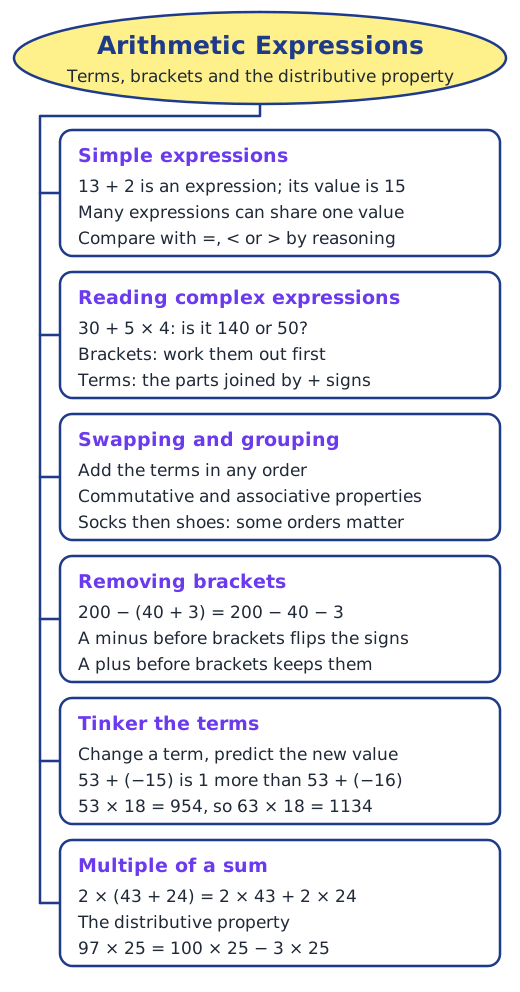
Arithmetic Expressions is about reading and evaluating expressions such as 30 + 5 × 4. You compare expressions by reasoning, split them into terms, use brackets to fix what is done first, add terms in any order, remove brackets correctly and meet the distributive property, which also gives quick ways to multiply.
What is this chapter about?
You have been writing things like 13 + 2 and 12 × 5 for years. This chapter looks closely at such arithmetic expressions: what their values are, how to compare them, and how to read a long expression so that everyone gets the same answer. Along the way it names three properties you have been using without names: the commutative, associative and distributive properties.
Simple expressions and their values
Every expression has a value, the number it works out to, and the equals sign joins the two: 13 + 2 = 15. Mallika pays ₹25 for lunch on each of 5 school days, so her week’s lunch costs 5 × 25. Many expressions share one value: 10 + 2, 15 − 3, 3 × 4 and 24 ÷ 2 are all 12.
Comparing expressions by reasoning
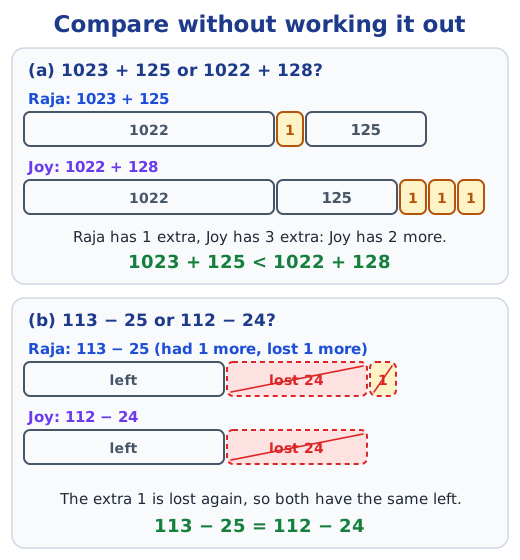
Expressions can be compared with =, < and >, often without working them out. Raja has 1023 marbles and gets 125 more; Joy has 1022 and gets 128 more. Raja starts 1 ahead, but Joy gains 3 more, so 1023 + 125 < 1022 + 128. And 113 − 25 = 112 − 24, because the one who starts 1 ahead also loses 1 more. Read more in reading and evaluating expressions.
Reading complex expressions
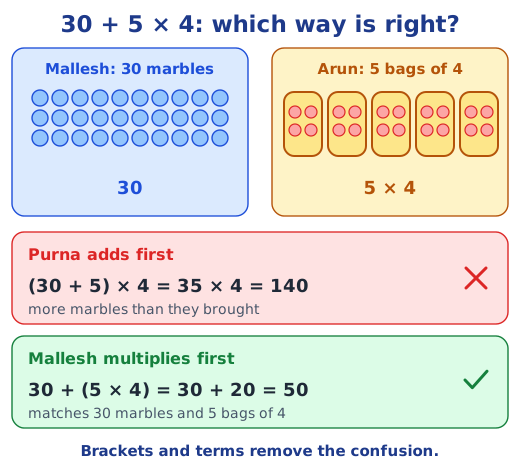
A sentence can mean two things until a comma settles it. Expressions are similar. Mallesh brought 30 marbles, and Arun brought 5 bags of 4, so Mallesh wrote 30 + 5 × 4. Purna added first and got 140; Mallesh multiplied first and got 50, which is right. Mathematics uses two tools to remove such confusion:
- Brackets: work out what is inside them first. Irfan pays ₹100 for biscuits (₹15) and toor dal (₹56), so his change is 100 − (15 + 56) = 29 rupees.
- Terms: the parts of an expression joined by + signs. Each subtraction is written as adding the inverse, so 83 − 14 has the terms 83 and −14, and 6 × 5 + 3 has the terms 6 × 5 and 3.
To find a value, work out the brackets, then each term, and add the terms.
Swapping and grouping terms
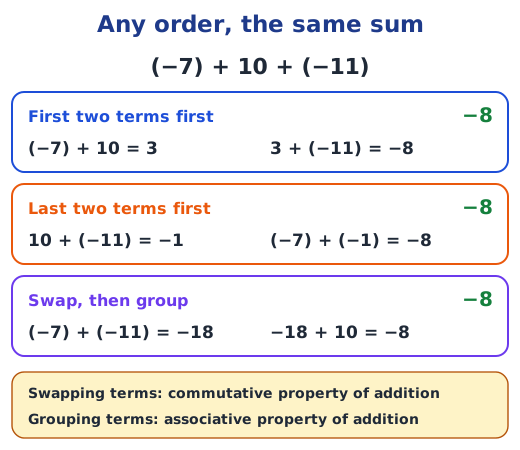
A drone goes 6 m up and 4 m down: 6 − 4 = 6 + (−4) = 2, and swapping the terms, (−4) + 6, also gives 2. With three terms, (−7) + 10 + (−11) is −8 whichever two terms you add first. So terms can be added in any order: swapping is the commutative property of addition and grouping is the associative property. Everyday actions are not always like this: hat and shoes can go on in either order, but socks must go on before shoes. See terms and brackets.
Removing brackets
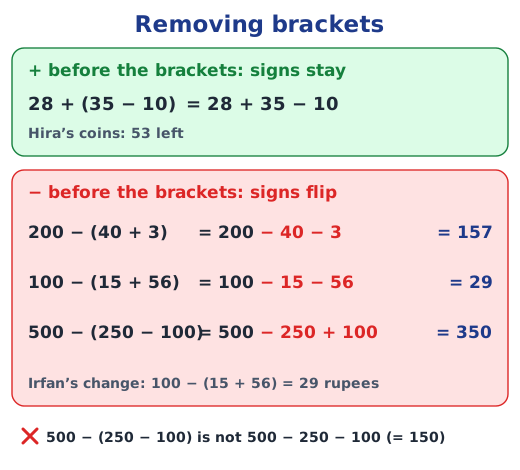
200 − (40 + 3) can be worked out as 200 − 40 − 3: both numbers are taken away. In 500 − (250 − 100), taking away all of 250 removes 100 too many, so 100 is added back: 500 − 250 + 100. So a minus sign before brackets flips the sign of every term inside, while a plus sign leaves them as they are: Hira’s coins, 28 + (35 − 10), are 28 + 35 − 10 = 53.
Tinker the terms
Change one term and the value changes by the same amount. Since 53 + (−16) = 37, the expression 54 + (−16) is 38, and so is 53 + (−15), because −15 is 1 more than −16. Jasoda uses the same idea to subtract 9: she subtracts 10 and adds 1, because 36 − 9 = 36 − (10 − 1) = 36 − 10 + 1.
The distributive property
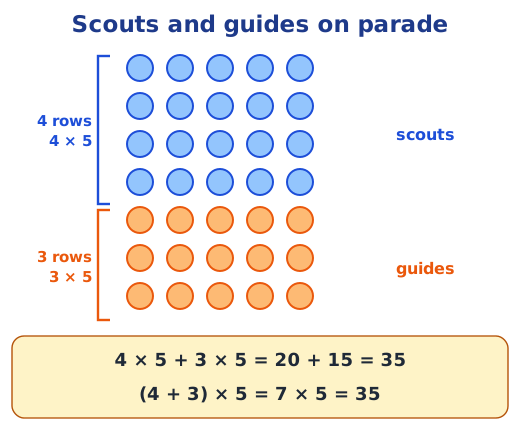
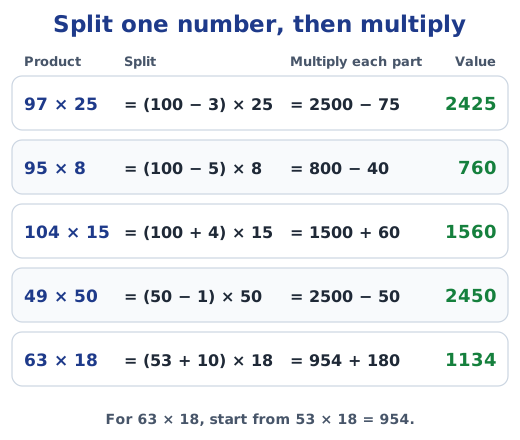
Lhamo and Norbu each order a cutlet (₹43) and a rasgulla (₹24). Together they pay 2 × (43 + 24), which equals 2 × 43 + 2 × 24 = 134 rupees. Writing 2 × 43 + 24 would pay for only one rasgulla. In a parade, 4 rows of 5 scouts and 3 rows of 5 guides make 4 × 5 + 3 × 5 = (4 + 3) × 5 = 35 children. The general rule, the multiple of a sum (or difference) is the sum (or difference) of the multiples, is called the distributive property. It also makes products quick: since 53 × 18 = 954, 63 × 18 = 954 + 10 × 18 = 1134, and 97 × 25 = 100 × 25 − 3 × 25 = 2425. Read the distributive property.
Expression Engineer
The chapter ends with puzzles: make expressions from three 3s, from four 4s, from 1, 2, 3, 4 and 5, and from all the digits 0 to 9. For example, 0 + 1 + 2 + 3 + 4 + 5 + 6 + 7 + 8 × 9 = 100. Answers to every question, the Figure it Out exercises and the puzzles are in the NCERT solutions for Chapter 2.
Key terms
| Term | Meaning |
|---|---|
| Arithmetic expression | A mathematical phrase made of numbers and operation signs, such as 13 + 2, 20 − 4 or 5 × (3 + 2). |
| Value | The number an expression works out to. The value of 13 + 2 is 15, and we write 13 + 2 = 15. |
| Term | A part of an expression joined to the rest by a + sign. The terms of 23 − 2 × 4 + 16 are 23, −2 × 4 and 16. |
| Brackets | They mark a part of an expression to be worked out first: 100 − (15 + 56) = 100 − 71 = 29. |
| Inverse | The number with the opposite sign: the inverse of 14 is −14. Taking away a number gives the same result as adding its inverse. |
| Commutative property of addition | Swapping two terms does not change the sum: 6 + (−4) = (−4) + 6. |
| Associative property of addition | Grouping the terms differently does not change the sum: ((−7) + 10) + (−11) = (−7) + (10 + (−11)) = −8. |
| Removing brackets | With a minus sign before the brackets, every sign inside flips: 200 − (40 + 3) = 200 − 40 − 3. With a plus sign, the signs stay. |
| Distributive property | A multiple of a sum or difference equals the sum or difference of the multiples: 5 × (4 + 3) = 5 × 4 + 5 × 3. |
Topics in this chapter
Practice
-
What is the value of 30 + 5 × 4?
Show answer
Answer: (b) 50
-
What are the terms of 23 − 2 × 4 + 16?
Show answer
Answer: (c) 23, −2 × 4 and 16
-
Which expression is equal to 200 − (40 + 3)?
Show answer
Answer: (d) 200 − 40 − 3
-
Which expression is equal to 500 − (250 − 100)?
Show answer
Answer: (a) 500 − 250 + 100
-
Which expression is equal to 2 × (43 + 24)?
Show answer
Answer: (b) 2 × 43 + 2 × 24
-
Without working them out, compare 213 − 77 and 214 − 76.
Show answer
Answer: (c) 213 − 77 is smaller
Questions students ask
What are the main topics of Class 7 Maths Chapter 2?
Simple expressions and their values; comparing expressions by reasoning; reading and evaluating complex expressions with brackets and terms; swapping and grouping terms; removing brackets; tinkering with terms to predict a new value; and the distributive property, with quick ways to multiply. It ends with the Expression Engineer puzzles.
Is Arithmetic Expressions in the new Ganita Prakash book?
Yes. It is Chapter 2 of Ganita Prakash, the Class 7 Maths textbook Part 1 (Reprint 2026-27), on pages 24 to 45. It follows Large Numbers Around Us and uses the negative numbers, or integers, that you met in Class 6.
Why is 30 + 5 × 4 equal to 50 and not 140?
Because 5 × 4 is a single term, and terms are worked out before they are added: 30 + 20 = 50. Getting 140 means adding 30 and 5 first, which would need brackets: (30 + 5) × 4. In the chapter’s story, 30 marbles and 5 bags of 4 marbles really do make 50 marbles.
Does the chapter teach BODMAS?
No. The book does not use a memorised rule. It uses two ideas instead: work out what is inside brackets first, and split an expression into terms, the parts joined by + signs. Work out each term, which may contain × or ÷, and then add the terms. This gives the same answers and also explains why.
Stuck on a question?
Take a photo and Lagnever AI explains it step by step. Try it for 7 days for ₹2.
Get it on Google Play Open in browser
For parents: after the trial, the plan renews monthly by UPI or card autopay. You can cancel anytime in the app.